
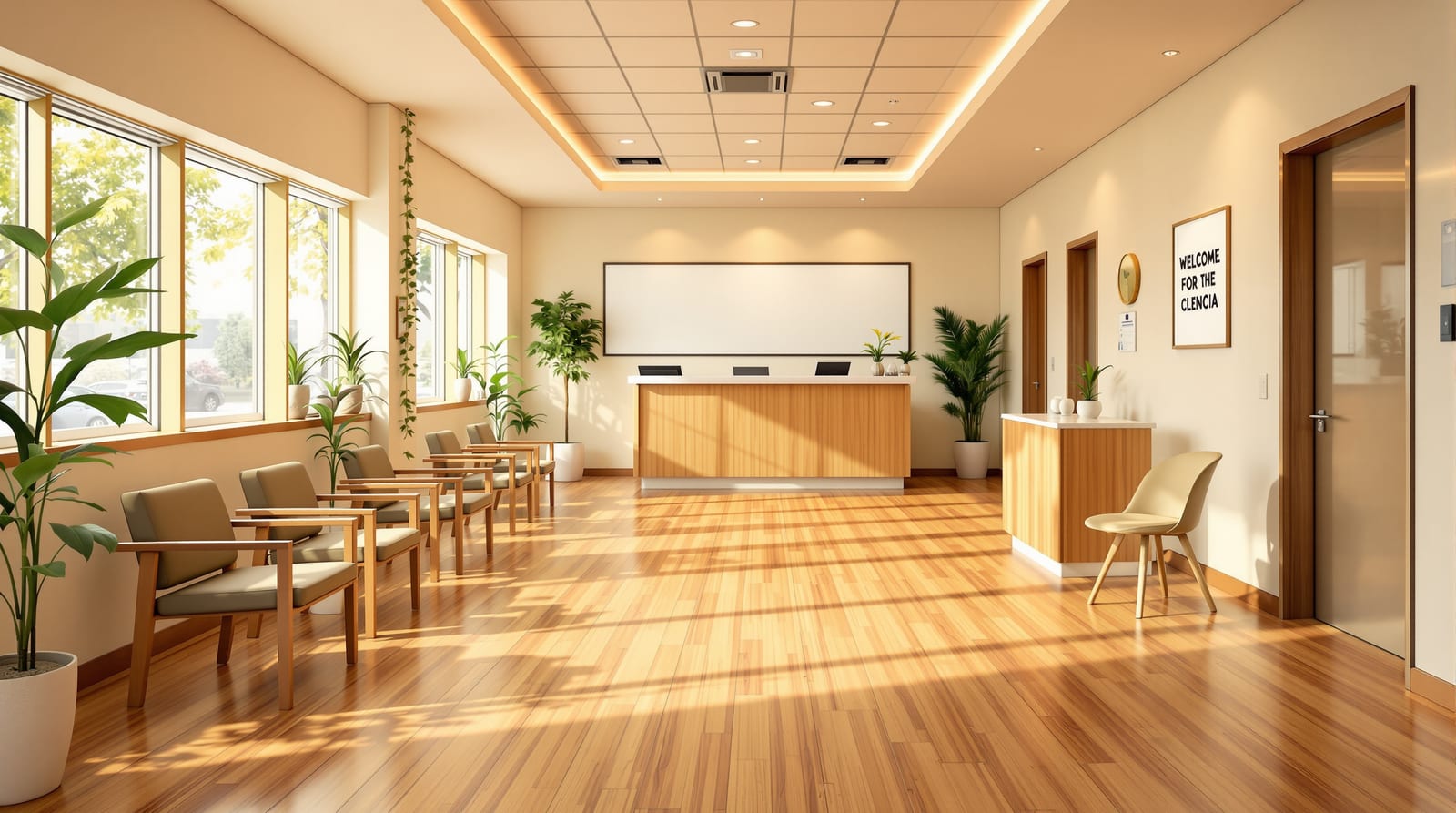
Clinic Flooring in India: Hygienic, Welcoming Floors for Clinics, Dental and Diagnostic Centres
How to specify clinic flooring zone by zone — seamless anti-bacterial vinyl, warmer LVT for the waiting room, anti-slip vitrified for budgets and chemical-resistant epoxy for labs — on a smaller footprint and tighter budget than a hospital.
A clinic, dental practice or diagnostic centre carries the same infection-control logic as a hospital but on a fraction of the floor area and a much tighter budget — and unlike a ward, the first thing a nervous patient sees is your waiting-room floor. So the brief splits in two: the public face must feel warm and reassuring, while the clinical rooms behind it must be seamless, disinfectable and genuinely slip-safe. Get this balance right and your floor cleans up after a full day of spills, shoe traffic and chemical wipes without ever looking institutional.
This guide ranks the floors that work for an Indian clinic — seamless anti-bacterial PVC sheet vinyl as the clinical standard, warmer luxury vinyl for the waiting room, anti-slip vitrified for budget-led practices, and chemical-resistant epoxy or PU for labs and dental bays — then maps each one to the right zone, with realistic 2026 rates and the one detail that separates a clean clinic from a grubby one: coving.
What a clinic floor really demands
A clinic floor is judged on hygiene first and looks second, but it cannot ignore either. Before picking a material, be clear about the loads each zone takes.
- Disinfectable, non-porous surface. Floors are wiped daily with hospital-grade disinfectants — phenolics, quaternary ammonium, sometimes dilute bleach. The surface and any joints must shrug these off without etching, fading or absorbing them. Porous and cement-grouted floors are a hygiene liability.
- Seamless where it matters. In treatment, dressing, dental and lab rooms, every grout line is a place for fluids and bacteria to lodge. The clinical standard is a welded, jointless sheet that turns up the wall as a coved skirting, so there is no sharp corner and no joint to harbour grime.
- A welcoming, non-institutional look. A clinic is not a hospital ward. The waiting room and reception set the patient's first impression, so the floor should read warm and calm — wood-look or soft stone-look — not cold and clinical.
- Anti-slip safety, wet and dry. Reception, toilets and entrances see wet shoes and the odd spill; elderly and unwell patients fall easily. Wet zones need a genuine R10-R11 textured finish under DIN 51130, with R11 at thresholds and toilets.
- Chemical resistance in the lab and dental bay. Pathology labs and dental areas meet acids, reagents, mercury amalgam, X-ray developer and disinfectant concentrates. These rooms need a chemical-resistant seamless floor, not ordinary vinyl.
- Fast, low-disruption install. Clinics rarely have a long shutdown window. Sheet vinyl and LVT go down fast over a sound screed and are walkable quickly — a real advantage over wet trades.
- Budget honesty. Unlike a NABH hospital, most clinics run lean. The trick is to spend on seamless vinyl where hygiene is non-negotiable and use a smart anti-slip vitrified elsewhere, rather than gold-plating every room.
The top picks, ranked for a clinic
1. Homogeneous / heterogeneous PVC sheet vinyl — the clinical standard. For consultation, treatment, dressing and procedure rooms, heat-welded PVC roll flooring is the default across Indian clinics and hospitals alike. It lays as a continuous sheet with welded seams and a coved, jointless skirting up the wall, so there is nothing for fluids or bacteria to lodge in. Most medical-grade sheets carry an anti-bacterial, anti-fungal treatment in the wear layer and resist the disinfectants used daily. Homogeneous sheet (colour all the way through) is the toughest and most renovatable; heterogeneous sheet adds a printed design layer for a softer look. It is the right answer wherever hygiene is the priority, and it installs fast with minimal downtime.
2. Luxury vinyl tile (LVT) — the warm waiting-room face. For reception and waiting, luxury vinyl tile gives a convincing warm wood- or stone-look that reassures patients, while still being water-resistant, comfortable underfoot and easy to wipe clean. Glue-down LVT is quiet and stable for a busy public area. Where the waiting room flows into clinical space, specify a sheet-vinyl or welded LVT option so the public and clinical zones can share one continuous, cleanable surface with no dirt-trapping transition. For the broader material picture, see the vinyl flooring guide.
3. Anti-slip vitrified tile — the budget workhorse. When the budget is tight, a matte anti-skid vitrified tile is a perfectly respectable clinic floor for reception, corridors, toilets and even consultation rooms in smaller practices. It is hard, fully waterproof in the tile body, cheap and instantly familiar to Indian builders. Its weak point is the grout line, so always specify epoxy grout — never cement grout — so disinfectant water cannot wick through and blacken the joints. Use a matte R10-R11 finish, never a polished gloss, anywhere patients walk.
4. Epoxy / PU resin — for the lab and dental bay. Pathology labs, sample rooms and dental areas meet chemicals that ordinary vinyl dislikes. A seamless epoxy floor gives a single jointless, chemical-resistant, fully washable surface; where heavy chemicals, hot spillage or steam sterilisers are involved, step up to a tougher PU resin floor. Both cove up the wall and have no joints, which is exactly what a lab hygiene audit wants. They cost more and need a sound, dry screed, but for the few square metres of a clinic lab they are worth it.
What to avoid: polished gloss vitrified or marble anywhere patients walk (slippery when wet, and cold and hard for the elderly); wood, laminate and carpet in clinical rooms (they absorb fluids and cannot be disinfected); and cement-grouted tile in any treatment area (the joints become a permanent stain and hygiene problem). For a full hospital-scale treatment of these choices, see the hospital flooring guide, and for the wider building see the commercial flooring guide.
Zone-by-zone: which floor where
A clinic is small, so a sensible specification uses just two or three materials — a warm public floor, a seamless clinical floor, and a chemical-resistant floor for the lab.
| Zone | Recommended floor | Why | ₹/sq ft (installed, 2026) |
|---|---|---|---|
| Reception / waiting room | LVT (wood/stone-look) or warm vitrified | Welcoming, warm, water-resistant, easy to wipe; sets first impression | 90-400 (LVT) / 80-220 (vitrified) |
| Consultation / treatment room | Seamless welded PVC sheet vinyl, coved | Jointless, disinfectable, anti-bacterial; the clinical standard | 90-260 |
| Dressing / procedure / minor-OT room | Homogeneous sheet vinyl, coved (ESD if needed) | Toughest, fully renovatable, no joints to harbour bacteria | 120-260 |
| Pathology lab / sample room | Chemical-resistant epoxy or PU resin, coved | Resists acids, reagents, disinfectant concentrates; seamless | 120-350 (epoxy) / 180-500 (PU) |
| Dental operatory / X-ray | Seamless sheet vinyl or epoxy, coved | Disinfectable, chemical- and amalgam-resistant, easy decontamination | 120-350 |
| Corridors / passage | Sheet vinyl (continuity) or anti-skid vitrified | Durable, continuous, easy to clean under trolley and chair traffic | 90-260 |
| Toilets / wet areas | Anti-skid vitrified, R11 matte | Waterproof, genuine wet grip, cheap and robust | 80-220 |
Costs are indicative installed ranges for 2026; confirm against local rates with the flooring cost per square foot guide. To match floors to zones quickly, the hospital flooring selector covers clinic spaces too, and the anti-slip rating selector confirms the R-rating each wet zone needs.
Why coving is the detail that defines a clinic floor
The single thing that separates a hygienic clinic floor from a grubby one is not the material — it is whether the floor turns up the wall. A flat skirting leaves a sharp 90-degree corner at the wall-floor junction where fluids, dust and bacteria collect and mops never reach. A coved skirting curves the floor material up the wall 100-150 mm, so there is no corner and no joint: a damp mop sweeps from wall to wall in one stroke. Sheet vinyl, epoxy and PU all cove naturally; tile can be coved with a special skirting tile, but it never matches a welded sheet for seamlessness. This is why clinical rooms specify sheet vinyl over tile even when tile is cheaper.
If the clinic is part of a larger healthcare facility or you need the OT-grade and NABH detail, the hospital flooring guide covers ESD operating-theatre floors and infection-control standards in depth.
Design and care tips
- Two materials, one clinic. A warm LVT or vitrified at the front and a seamless welded vinyl behind is enough for most practices. Resist specifying a different floor for every room — it raises cost and creates dirt-trapping transitions.
- Cove every clinical room. In any treatment, dressing, lab or dental room, insist on a coved skirting. It is the cheapest, highest-impact hygiene upgrade you can make.
- Epoxy grout, always, on any tile. Where you use vitrified, cement grout will blacken under daily disinfectant mopping. Epoxy grout keeps the joints sealed and stain-free.
- Choose a calm, mid-tone, low-glare colour. Soft greys, warm wood tones and muted stone-looks hide daily scuffs, reduce the institutional feel and cut glare for unwell patients. Avoid pure white (shows everything) and high-gloss (slippery and clinical).
- Specify anti-bacterial, medical-grade sheet. Ask for a sheet with an anti-bacterial, anti-fungal wear layer rated for healthcare and check its disinfectant-compatibility list against the cleaners your clinic actually uses.
- Mind the slip rating at the door and toilet. Wet shoes from outside and the toilet floor are the real fall risks. Use R11 matte there; confirm with the anti-slip rating selector.
- Plan the install around a closure. Sheet vinyl and LVT go down fast, but welding and curing need a clean, traffic-free window — schedule clinical rooms over a weekend or holiday.
Frequently asked questions
What is the best flooring for a clinic in India?
For clinical rooms, heat-welded PVC sheet vinyl with a coved skirting and an anti-bacterial wear layer is the standard — it is seamless, disinfectable and installs fast. For the waiting room, warm wood-look LVT reads welcoming while staying easy to clean. On a tight budget, a matte anti-skid vitrified tile with epoxy grout works for reception, corridors and toilets.
Why is seamless vinyl preferred over tiles in a clinic?
Every grout line in a tiled floor is a place for fluids and bacteria to lodge and stain, and a flat tile skirting leaves a sharp corner that mops miss. Welded sheet vinyl has no joints and coves up the wall, so a clinical room can be wiped wall to wall in one stroke. That is why treatment, dental and lab rooms specify sheet vinyl even when tile is cheaper.
How much does clinic flooring cost in India?
As a rough 2026 guide per sq ft installed: PVC sheet vinyl 90-260, LVT 90-400, anti-skid vitrified 80-220, epoxy 120-350 and PU resin 180-500. A typical clinic mixes a warm front-of-house floor with seamless vinyl behind, so the blended cost stays well below a full hospital fit-out while keeping clinical rooms to standard.
What flooring should a dental clinic or pathology lab use?
The dental operatory and pathology lab meet chemicals, amalgam and reagents that ordinary vinyl dislikes, so use a chemical-resistant seamless floor — heavy-duty sheet vinyl, epoxy, or PU resin for the harshest exposure — all coved up the wall. This makes decontamination easy and resists the acids, developers and disinfectant concentrates these rooms see daily.
Is anti-slip flooring required in a clinic?
Yes, especially at entrances and in toilets where wet shoes and spills meet elderly or unwell patients. Use a genuine R10-R11 textured matte finish (R11 at the door and toilet) under DIN 51130, and never a polished gloss tile or marble where patients walk. The anti-slip rating selector confirms the rating each zone needs.
Export this guide
Related Guides — Deep-dive reading
Hospital Flooring India: Infection-Control Floors by Zone, with Costs and NABH Codes
Why Indian hospitals choose seamless, coved, antibacterial PVC and vinyl sheet over tiles — a zone-by-zone guide to OT and ICU, wards, corridors, labs, lobby and wet areas, with anti-slip and anti-static grades, ₹/sq ft and NABH/IS compliance.
Flooring & SurfacesSchool Flooring in India: Safe, Durable, Low-Maintenance Floors for Classrooms, Corridors, Labs and Play Areas
How to specify school flooring zone by zone — anti-skid vitrified for classrooms and corridors, rubber and vinyl for little ones, chemical-resistant epoxy for labs and impact-soft surfaces for play areas — for child safety, abuse-proof durability and tight budgets.
Flooring & SurfacesEpoxy Grout vs Cement Grout for Tiles in India: Which to Specify (2026)
A plain-English guide to tile grouts for Indian homes: what grout does, how cementitious grout compares with epoxy grout on cost, stain and water resistance, hygiene and durability, and exactly where each one belongs - kitchens, bathrooms, pools, dry rooms and more.
Building MaterialsRelated Tools — Try Free
Acoustic Privacy (STC) Visualizer
Indian healthcare acoustic visualizer — compare wall assemblies and noise sources, see received SPL after STC attenuation, and check FGI 2018 / IS 1950 / NABH speech-privacy compliance with live dual-canvas waveform.
Acoustic ToolFlooring Cost Calculator
Estimate the all-in cost of a floor — material, laying, wastage, skirting and GST — by area and material.
Flooring CalculatorFlooring Material Selector
Get the best flooring material for your room, budget and climate, with anti-slip checks for wet areas.
Flooring Tool