
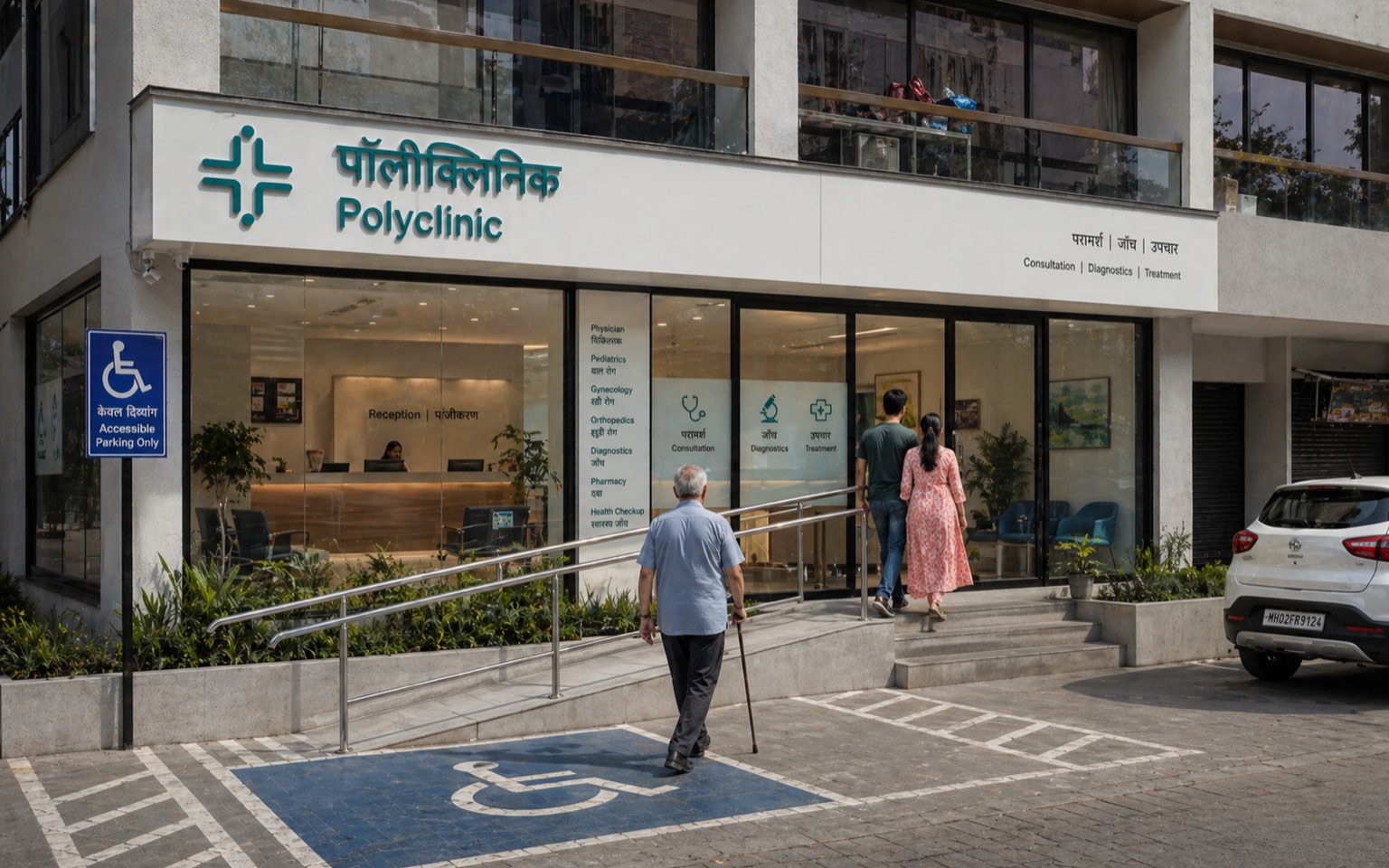
Clinic & Polyclinic Design in India: Regulatory Compliance Requirements
An Architect's Working Reference — Single-Doctor Clinic, Polyclinic, and Day-Care Centre Compliance under State CEA, BMW Rules, AERB, PC-PNDT, Drug License, Accessibility, and Fire Safety — with the Conversion Typologies and Failure-Mode Catalogue
The clinic — a single-doctor, polyclinic, or day-care facility without overnight inpatient stay — is statistically the most common healthcare facility in India and the architectural-regulatory typology with the highest under-recognition of compliance burden. Clinic owners and architects routinely treat clinics as light commercial fit-outs, when in fact a clinic that performs ultrasound, dispenses drugs, generates biomedical waste, conducts day-care procedures, or operates an X-ray machine triggers exactly the same statutes as a hospital — at smaller scale, but with no fewer regulatory categories.
This guide is the fourth in the ten-part series and the third facility-type deep-dive. It assumes the reader has read the pillar reference, the hospital deep-dive, and the nursing-home deep-dive, and turns the regulatory framework into a practical compliance brief for the clinic scale.
The guide covers three facility profiles separately:
1. Single-doctor clinic — OPD only, no surgery, no overnight stay
2. Polyclinic — multi-practitioner OPD, possibly with diagnostic services
3. Day-care centre — short-stay procedures (dialysis, chemotherapy, day surgery, IVF)
Each profile has a distinct regulatory footprint. Conflating them — designing a polyclinic with the assumptions appropriate to a single-doctor clinic, or a day-care centre with polyclinic logic — is the most common architectural-regulatory mistake at this scale.
"The clinic is where most patients first meet healthcare. If the clinic is shabby, ill-lit, badly ventilated, and inaccessible, the system has already failed at the front door — and no quantity of tertiary excellence can compensate for that." — Dr. Abhay Bang (b. 1950), public-health practitioner, founder SEARCH Gadchiroli, paraphrased from a 2014 lecture
"Small does not mean simple. The smallest hospital is just a small hospital — it has every rule the big one has." — Anonymous senior architect on healthcare practice, paraphrased from a private interview
1. The Three Profiles — A Differentiation Matrix
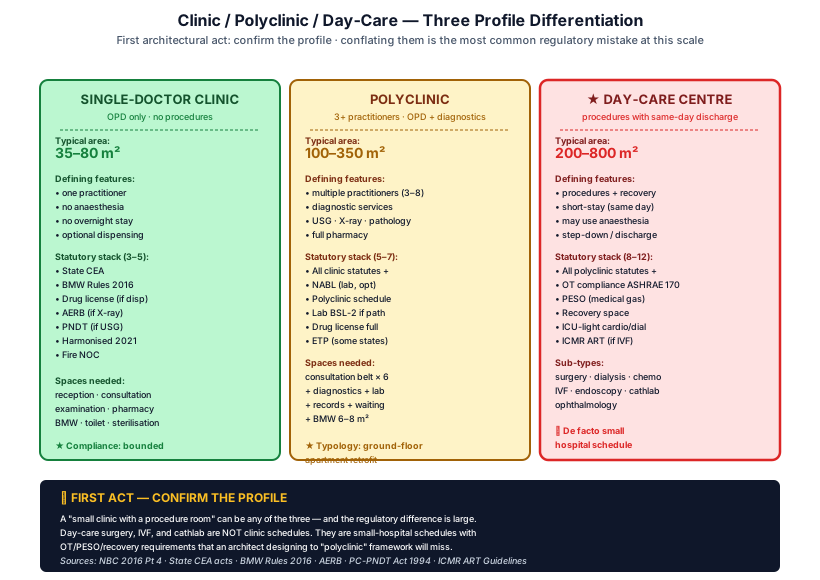
| Profile | Defining Feature | Typical Area | Statutory Footprint |
|---|---|---|---|
| Single-doctor clinic | One practitioner; OPD only; no procedures requiring anaesthesia | 35–80 m² | State CEA + BMW + drug license (if dispensing) + AERB (if X-ray) + PNDT (if USG) + fire NOC + accessibility |
| Polyclinic | Multiple practitioners (≥ 3); OPD with diagnostics | 100–350 m² | All of above + state CEA polyclinic schedule + lab license (if pathology) |
| Day-care centre | Procedures with same-day discharge; chairs / day-beds | 200–800 m² | All of above + OT compliance (if surgery) + recovery space + medical gas (if anaesthesia) + ICU-light if cardiac/dialysis-emergency |
The architect's first act on a clinic brief is to confirm the profile. A "small clinic with a procedure room" can be any of the three — and the regulatory difference is large.
2. Single-Doctor Clinic — Minimum Compliance
The single-doctor clinic is the most common healthcare facility in India. The compliance burden is real but bounded.
Required spaces
| Space | Minimum Area | Compliance Note |
|---|---|---|
| Reception / waiting | 12–18 m² | Comfortable for 4–6 waiting patients |
| Consultation room | 9–12 m² | Privacy + auditory separation |
| Examination room | 9–12 m² | Adjacent to consultation; can be combined |
| Toilet — patient | 2.5–3.5 m² | Accessibility-compliant |
| Toilet — staff | Separate | — |
| Pharmacy / dispensing | 4–6 m² | If drugs dispensed; cold storage if applicable |
| BMW storage | 1.5–3 m² | Sealed, labelled bin set; 48-hour cycle |
| Sterilisation / utility | 4–6 m² | Autoclave, instrument cleaning |
Statutory schedule
| Statute | Trigger | Architectural Note |
|---|---|---|
| State CEA / NH Act | Practice of medicine for fee | Registration mandatory; minimum-area schedule per state |
| BMW Rules 2016 | Generation of biomedical waste | Bin set + CBWTF tie-up; storage room sized for 48-hour cycle |
| Drug License | Dispensing > sample | State drug controller; pharmacy area minimum |
| AERB | Any X-ray (incl. dental) | Lead-shielded room; mobile X-ray same rule |
| PC-PNDT | Any USG (incl. portable) | Room labelled, F-form display |
| Harmonised Accessibility 2021 | Public-access building | Ramp, accessible toilet, signage |
| Fire NOC | Building permit / state fire code | NBC + state code; location-dependent |
| Building permit | ULB | Change of use if residential / commercial conversion |
State CEA minimum areas — single-doctor clinic
| State | Consultation Min | Toilet | Pharmacy | Notes |
|---|---|---|---|---|
| Karnataka KPME | 10 m² | 1 patient + 1 staff | 6 m² if dispensing | Bilingual signage required |
| TN CEA 2018 | 12 m² | 2 separate | 8 m² | Higher minimums |
| WB CEA 2017 | 9 m² | 1 patient + 1 staff | 6 m² | Tariff display + grievance |
| Bombay NH (MH) | 9 m² | 1 patient + 1 staff | 6 m² | Conservative |
| Delhi NH 1953 + rules | 10 m² | 1 patient + 1 staff | 6 m² | Clinic registration in process |
| Telangana | 10 m² | 1 patient + 1 staff | 6 m² | Lower thresholds |
| Kerala CEA 2018 | 10 m² | 1 patient + 1 staff | 6 m² | Recent state act |
A single-doctor clinic at minimum is therefore approximately 35–55 m² — but the architect-designed clinic at this scale is typically 60–80 m² to accommodate dignified waiting, accessibility, and BMW storage.
3. Polyclinic — Multi-Practitioner Framework
A polyclinic combines multiple practitioners — typically 3 to 8 — sometimes with diagnostic services. The architectural pattern is a consultation belt (multiple consultation rooms) plus shared support (waiting, reception, diagnostics, pharmacy, BMW).
Schedule of spaces — typical polyclinic with 6 practitioners + USG + pathology
| Space | Quantity | Area each |
|---|---|---|
| Reception, registration, waiting | 1 | 35–50 m² |
| Consultation rooms | 6 | 12 m² each |
| Examination rooms | 2–4 | 9 m² each |
| Procedure / dressing room | 1 | 12–15 m² |
| Pathology — sample reception, processing | 1 | 18–25 m² |
| Pharmacy — full | 1 | 10–15 m² |
| USG room | 1 | 12 m² |
| ECG / vitals | 1 | 9 m² |
| Public toilets — accessible | 2 | 3 m² each |
| Staff toilet | 1 | 2.5 m² |
| Staff break | 1 | 9 m² |
| BMW storage | 1 | 6–8 m² |
| Records | 1 | 6 m² |
Total: approximately 220–300 m² built-up.
Polyclinic-specific statutory triggers
| Trigger | Approval | Implication |
|---|---|---|
| Pathology lab | NABL (optional) + state CEA + BMW | Sample reception + processing zones; biosafety BSL-2 |
| USG | PC-PNDT registration | Permanent fixed location; F-form display |
| X-ray (incl. dental) | AERB layout + license | Shielded room; barrier calculation |
| Pharmacy | Drug license — full | Cold chain, schedule X cabinet |
| Multi-practitioner | State CEA polyclinic schedule | Higher area minimums than single-doctor |
| Procedure room | If invasive | Sterilisation, infection control |
| ETP (some states) | If lab effluent significant | Pre-treatment + disinfection |
Polyclinic in apartment ground floor — a common typology
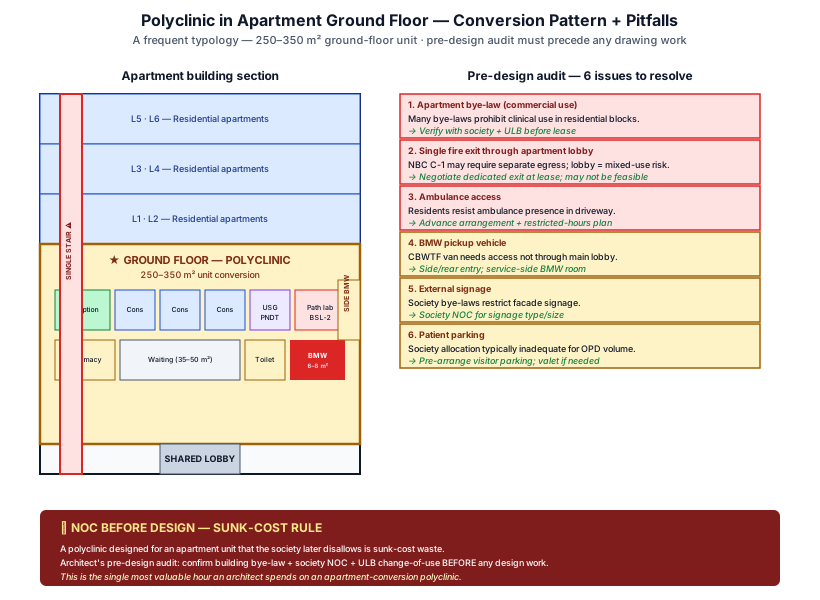
A frequent polyclinic configuration: ground-floor unit of an apartment building, 250–350 m². Issues:
| Issue | Mitigation |
|---|---|
| Apartment building bye-law restricts commercial / clinical use | Verify with society and ULB before lease |
| Single fire exit through apartment lobby | Negotiate dedicated exit; may not be feasible |
| Ambulance access | Society resistance; advance arrangement |
| BMW pickup | Side entry preferred; CBWTF vehicle access |
| Signage external | Society restrictions on facade signage |
| Parking | Society allocation may be inadequate |
The architect's pre-design audit on apartment-ground-floor polyclinics: confirm the building bye-law and society NOC before any design work. A polyclinic designed for a unit that the society later disallows is sunk-cost waste.
4. Day-Care Centre — Hybrid Tier
The day-care centre is the most architecturally and regulatorily complex profile at this scale. It combines clinic-style OPD with hospital-style procedure capability and recovery — without overnight stay.
| Day-Care Type | Signature Architecture | Special Compliance |
|---|---|---|
| Day-care surgery (cataract, hernia, hydrocele, minor plastic, dental implant) | Major OT + recovery + step-down + discharge | OT compliance per ASHRAE 170; medical gas; PESO; recovery |
| Dialysis centre | 8–24 dialysis chairs in open hall; water-treatment plant; patient isolation | Reverse-osmosis water; isolation cubicle; emergency cardiac response |
| Chemotherapy day-care | Infusion chairs; pharmacy with biological safety cabinet; emergency response | Cytotoxic-drug pharmacy; isolation room; spill-response space |
| IVF / fertility centre | Embryology lab + theatre + recovery | Grade A/B/C/D classified rooms; PNDT; Indian Council of Medical Research (ICMR) ART guidelines |
| Endoscopy day-care | Procedure rooms + recovery + reprocessing | Reprocessor (washer-disinfector); separate scope-storage cabinet |
| Cardiac cath day-care | Cath lab + recovery; emergency cardiac arrest response | AERB cathlab license; ICU adjacency or transfer protocol |
| Ophthalmology day-care | Refraction lanes + theatre + recovery | OT clean-air; phaco-machine integration |
The architect must confirm which day-care profile applies, then design to that profile's full schedule. Day-care surgery, IVF, and cathlab are de facto small hospital schedules — not clinic schedules.
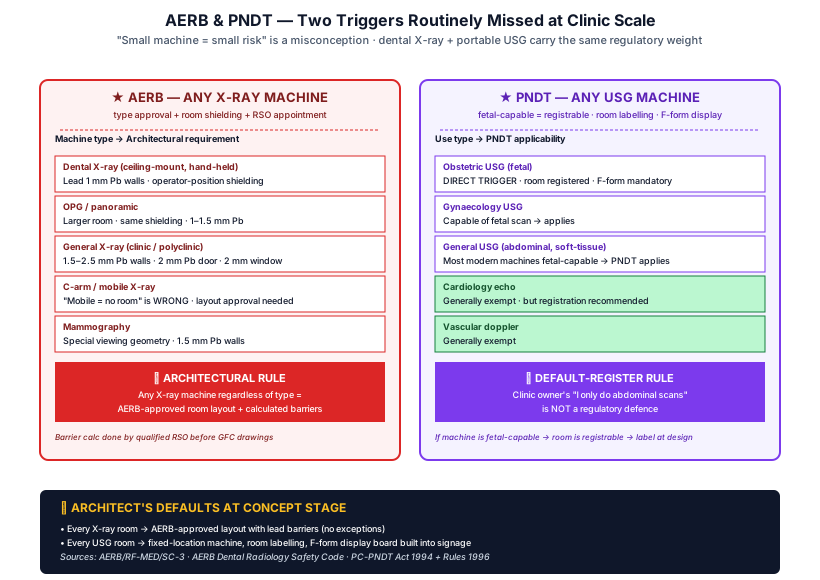
5. AERB & PNDT — Two Triggers Routinely Missed at Clinic Scale
The two specialty approvals most frequently overlooked at clinic scale:
AERB — Any X-ray Machine
| Machine | AERB Requirement | Common Clinic Failure |
|---|---|---|
| Dental X-ray (ceiling-mounted, hand-held) | Type approval + room shielding + RSO | Rooms not shielded; "small machine = small risk" misconception |
| OPG / panoramic | Same as dental | Larger room, same shielding |
| General X-ray (clinic / polyclinic) | Layout approval + post-installation license + RSO | Insufficient lead in walls / door |
| C-arm / mobile X-ray | Layout approval | Considered "mobile, no room" — wrong |
| Mammography | Layout + license | Special viewing geometry |
Architectural rule: any X-ray machine, regardless of type, requires AERB-approved room layout with calculated barriers. Lead-equivalent thickness varies by workload and machine output — typically 1.5–2.5 mm Pb in walls, 2 mm Pb door, 2 mm Pb viewing window for general X-ray. Dental X-ray rooms can use 1 mm Pb walls but still require door and operator-position shielding.
PNDT — Any Ultrasound Machine
| Machine Use | PNDT Trigger | Architectural Implication |
|---|---|---|
| Obstetric USG (fetal) | Yes — direct trigger | Room registered, F-form display, fixed location |
| Gynaecology USG | Yes — capable of fetal | Same |
| General USG (abdominal, soft-tissue) | Yes — if machine is fetal-capable | Most modern machines are fetal-capable; PNDT applies |
| Cardiology echo | Generally exempt | But still recommended to register |
| Vascular doppler | Generally exempt | — |
The clinic owner's "I only do abdominal scans" defence is not a regulatory defence: if the machine is fetal-capable, the room is registrable. The architect should advise PNDT registration as a default for any USG room and design accordingly — fixed-location machine, room labelling at design stage, F-form display board incorporated in signage.
6. BMW for Small Generators — Often Mismanaged
Clinic-scale BMW generation is small (1–5 kg/day for a single-doctor clinic; 5–20 kg/day for a polyclinic) but the rules are the same as for a hospital.
| Element | Small-Generator Compliance |
|---|---|
| 4-bin segregation | Yellow, red, white, blue — labelled bins |
| Storage | Sealed bin set; for clinic, no cooled room mandatory unless storage > 48 hours |
| CBWTF tie-up | Mandatory; pickup typically 2–3 times per week |
| Manifest | Each pickup logged |
| Consent | Some states require BMW authorisation even for clinics |
| Pre-treatment of yellow waste | Generally not required at this scale; CBWTF handles |
Architectural deliverable: a 1.5–3 m² BMW storage area, accessible to staff and CBWTF vehicle, with washable surfaces and floor drain.
7. Accessibility for Clinics — Harmonised Guidelines 2021
Accessibility is statutory for all healthcare buildings. The architectural elements are non-negotiable.
| Element | Specification |
|---|---|
| Approach ramp | Slope ≤ 1:12; landing every 9 m; handrails both sides |
| Entry door | Clear opening ≥ 900 mm; non-glazed door at impact height |
| Reception counter | One section at 750–800 mm height for wheelchair |
| Corridor width | ≥ 1.5 m clear |
| Door width — patient access | ≥ 800 mm clear |
| Accessible toilet | 1.7 × 2.2 m minimum; grab-bars; emergency call |
| Wayfinding signage | Bilingual + tactile + Braille at critical points |
| Floor surface | Non-slip (R10 minimum); no carpet at primary circulation |
| Lift (if multi-floor) | Cabin ≥ 1.1 × 1.4 m; tactile / Braille buttons |
| Tactile guidance path | At entry zones, decision points |
A single-doctor clinic that fails accessibility is a regulatory failure under the Persons with Disabilities Act and the Harmonised Guidelines. Penalties are increasing. Retrofit accessibility is materially more expensive than design-stage accessibility.
8. Fire Safety at Clinic Scale
Clinic fire safety depends on the building rather than the clinic alone.
| Building Context | Fire Safety Implication |
|---|---|
| Standalone building, ground floor | NBC simpler — accessibility, single staircase usually adequate |
| Standalone building, 1st floor or above | NBC C-1 may apply; staircase, lift, fire resistance |
| Apartment ground-floor unit | Apartment building fire scheme — may be inadequate for institutional use |
| Commercial complex / mall floor | Complex's fire scheme — verify rated separation from retail / restaurant |
| Office building floor | Verify Group C-3 vs Group D classification |
The architect must verify the host building's fire NOC and confirm that the clinic's intended use is consistent with that NOC. A "clinic in retail mall" with no separation rating from food courts and electronics stores is a regulatory failure waiting to happen.
9. Conversion Typologies — Retail, Apartment, Residential
Three common clinic conversion typologies with their typical issues:
Retail-shop conversion (high-street ground floor)
| Issue | Resolution |
|---|---|
| Shell condition — exposed slab, no plumbing | Full fit-out with new plumbing |
| Electrical capacity | Sub-meter with adequate load |
| Façade — large glazed shop-front | Acoustic and visual privacy at consultation |
| BMW storage | Internal room; CBWTF rear-side access |
| Signage — landlord restrictions | Negotiate at lease |
| Fire NOC — retail-mall context | Verify with mall management |
Apartment ground-floor conversion
| Issue | Resolution |
|---|---|
| Society NOC | Mandatory; obtain before design |
| Building bye-law — change of use | Verify ULB position |
| Fire exit | Through apartment lobby — verify NOC |
| Patient parking | Society allocation |
| BMW pickup | Side / rear access |
| Signage | Society approval |
Residential ground-floor conversion (independent house)
| Issue | Resolution |
|---|---|
| Zoning — change of use | ULB application; may be conditional |
| Structural | Slab and column adequate for clinic load — likely yes |
| Fire access | Driveway and setback for fire tender |
| Parking | Site capacity check |
| Neighbour relations | Engagement; sometimes determinative |
10. Clinic-Specific Failure Modes
| # | Failure | Prevention |
|---|---|---|
| 1 | AERB shielding overlooked for dental / OPG | All X-ray rooms shielded by default |
| 2 | PNDT not registered for USG | Register at design stage; permanent location |
| 3 | BMW storage room undersized / unlabelled | 1.5–3 m² + clear bin labelling |
| 4 | Accessibility shortfall — ramp slope, toilet | Harmonised 2021 from concept |
| 5 | Apartment ground-floor without society NOC | NOC before design |
| 6 | Pharmacy without cold storage | Cold chain at design |
| 7 | Day-care surgery with inadequate recovery | Recovery sized by OT count × 2 |
| 8 | Day-care without medical gas | LMO, manifold, alarm — design-stage |
| 9 | Tariff display / grievance redress (WB) missing | Designated zone |
| 10 | Single-stair on multi-floor clinic | Two-stair compliance verified at concept |
| 11 | Retail-mall conversion without separation rating | Fire NOC verified before design |
| 12 | Drug license — no schedule X cabinet | At design with locking spec |
| 13 | Polyclinic lab without BSL-2 | Biosafety zoning at design |
| 14 | Dialysis without water treatment provision | RO + storage + circulation loop at design |
| 15 | IVF without ART grade A/B/C/D rooms | ICMR ART + ASHRAE 170 at design |
11. Compliance Calendar — Clinic Scale
A representative timeline for a polyclinic greenfield at 250 m² with USG and pharmacy.
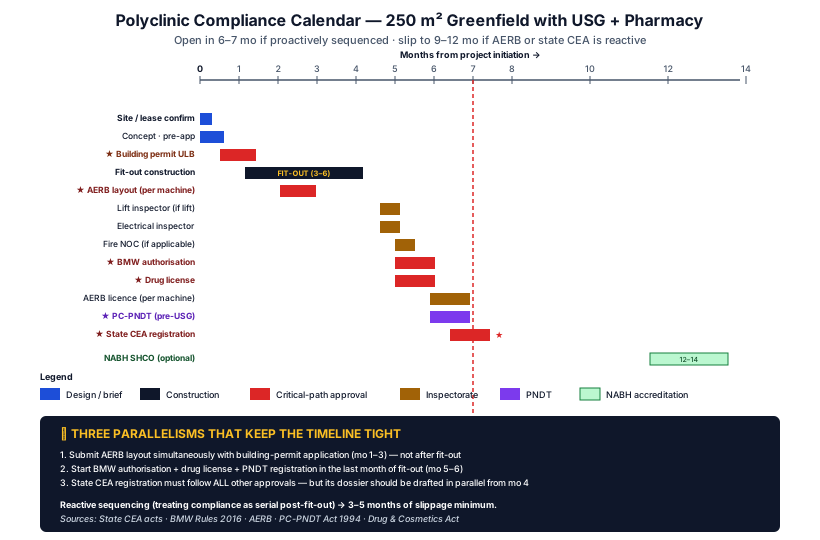
| Stage | Approval | Calendar (months) |
|---|---|---|
| Site / lease confirmation | Society / ULB / fire NOC of host building | 0 |
| Concept design | Pre-application discussion | 0.5–1 |
| Building permit / fit-out approval | ULB | 2–3 |
| Construction / fit-out | — | 3–6 |
| AERB layout (if X-ray) | Per machine | 3–4 |
| Lift inspector (if lift) | Pre-commissioning | 5–6 |
| Electrical inspector | Pre-energisation | 5–6 |
| Fire NOC (if applicable) | Pre-operation | 5–6 |
| BMW authorisation | Pre-operation | 5–7 |
| Drug license | Pre-operation | 5–7 |
| AERB licence (per machine) | Pre-operation | 5–7 |
| PC-PNDT registration | Pre-USG operation | 5–7 |
| State CEA registration | Pre-operation | 6–7 |
| NABH SHCO (optional) | Post-opening 6 mo | 12–14 |
A polyclinic can typically open within 6–7 months of project initiation if compliance is proactively sequenced. Slippage to 9–12 months is common when AERB or state CEA is sequenced reactively.
12. Compliance Checklist — Clinics & Polyclinics
| # | Item | Stage |
|---|---|---|
| 1 | Profile confirmation — clinic / polyclinic / day-care | Brief |
| 2 | Host-building fire NOC and use-NOC verified | Brief |
| 3 | State CEA minimum-area schedule mapped | Concept |
| 4 | Specialty triggers — AERB, PNDT, drug, gas | Concept |
| 5 | BMW storage planned (1.5–3 m² clinic; 6–8 m² polyclinic) | Concept |
| 6 | Accessibility — Harmonised 2021 | Concept |
| 7 | Society / ULB change-of-use confirmed | Concept |
| 8 | Pharmacy cold-chain space | Schematic |
| 9 | AERB shielded room layout | Schematic |
| 10 | PNDT room labelling and F-form board | Schematic |
| 11 | Day-care recovery and medical gas | Schematic |
| 12 | Fire scheme and NBC compliance | Schematic |
| 13 | Tariff display / grievance redress (where required) | Schematic |
| 14 | Detailed drawings | Detailed |
| 15 | Service drawings (HVAC, plumbing, electrical, gas) | Detailed |
| 16 | Construction supervision | Construction |
| 17 | Statutory commissioning (lift, electrical, fire, BMW, drug, AERB, PNDT, CEA) | Commissioning |
| 18 | NABH SHCO readiness (optional) | Post-opening |
References
- AERB (2016) Safety Code for Medical Diagnostic X-Ray Equipment and Installations. AERB/RF-MED/SC-3 (Rev. 2). Mumbai: Atomic Energy Regulatory Board.
- AERB (2018) Safety Code for Dental Radiology. Mumbai: AERB.
- ASHRAE (2021) Standard 170-2021: Ventilation of Health Care Facilities. Atlanta: ASHRAE.
- Bureau of Indian Standards (2016) National Building Code of India 2016, Part 4 — Fire and Life Safety. New Delhi: BIS.
- Central Pollution Control Board (2018) Bio-Medical Waste Management Rules, 2016 (with 2018 amendment). New Delhi: MoEFCC.
- Department of Empowerment of Persons with Disabilities (2021) Harmonised Guidelines and Standards for Universal Accessibility in India 2021. New Delhi: Government of India.
- Government of India (1994) Pre-conception and Pre-natal Diagnostic Techniques (Prohibition of Sex Selection) Act 1994. New Delhi: MoHFW.
- Government of Karnataka (2007) Karnataka Private Medical Establishments Act 2007 (with 2017 amendment). Bengaluru.
- Government of NCT of Delhi (1953) Delhi Nursing Homes Registration Act 1953. New Delhi.
- Government of Tamil Nadu (2018) Tamil Nadu Clinical Establishments (Regulation) Act 2018. Chennai.
- Government of West Bengal (2017) West Bengal Clinical Establishments (Registration, Regulation and Transparency) Act 2017. Kolkata.
- Indian Council of Medical Research (2017) National Guidelines for Accreditation, Supervision and Regulation of ART Clinics in India. New Delhi: ICMR.
- Joshi, D.C. and Joshi, M. (2018) Hospital Administration. 2nd edn. New Delhi: Jaypee Brothers.
- Kobus, R.L., Skaggs, R.L., Bobrow, M., Thomas, J. and Payette, T.M. (2008) Building Type Basics for Healthcare Facilities. 2nd edn. Hoboken: Wiley.
- NABH (2020) Standards for Small Health Care Organisations (SHCO), 3rd Edition. New Delhi: NABH, Quality Council of India.
- Patel, V., Parikh, R., Nandraj, S., Balasubramaniam, P., Narayan, K., Paul, V.K., Kumar, A.K.S., Chatterjee, M. and Reddy, K.S. (2015) 'Assuring health coverage for all in India', The Lancet, 386(10011), pp. 2422–2435.
- Rao, M., Rao, K.D., Kumar, A.K.S., Chatterjee, M. and Sundararaman, T. (2011) 'Human resources for health in India', The Lancet, 377(9765), pp. 587–598.
- Ulrich, R.S., Zimring, C., Zhu, X., DuBose, J., Seo, H.B., Choi, Y.S., Quan, X. and Joseph, A. (2008) 'A review of the research literature on evidence-based healthcare design', HERD, 1(3), pp. 61–125.
- World Health Organization (2008) Essential Environmental Health Standards in Health Care. Geneva: WHO.
Author's Note: The clinic scale is the architectural-regulatory typology most often dismissed as "not requiring an architect." This dismissal is wrong. A 200-sqm polyclinic with USG, X-ray, dispensing, and BMW generation triggers the same regulatory categories as a 100-bed hospital — at smaller scale but with no fewer headings. The architect who internalises this — and who sequences AERB, PNDT, BMW, drug license, accessibility, and state CEA from concept stage — produces a clinic that opens on time. The clinic that opens late is almost always one where a regulatory category was deferred. This guide may be read alongside the pillar reference and the deep-dives on hospitals and nursing homes, and with the forthcoming guides on AERB, PNDT, BMW, fire safety, NABH, and CEA-state variations.
Disclaimer: This article is for informational and educational purposes only and does not constitute legal, regulatory, or professional architectural advice. Clinic and polyclinic compliance depends on the specific state, city, host-building context, scope, equipment, and current statutory amendments. Confirm all requirements with the state health authority, state pollution control board, AERB, PC-PNDT authority, drug controller, fire service, and other applicable regulators before any binding design or construction commitment. Studio Matrx, its authors, and contributors accept no liability for decisions made on the basis of the information in this guide.
Interactive · Clinic compliance wizard
Polyclinic · ≥ 250 sqm · 7 critical rooms · 7 mandatory clearances
Multi-specialty OPD + diagnostics; no inpatient.
Required rooms
Reception + registration + waiting
critical≥ 50 sqm; multiple registration counters
Specialty consult rooms × 6-10
criticalEach 12-14 sqm
Lab (sample collection + basic tests)
critical≥ 25 sqm; NABL recommended
Imaging (X-ray + USG)
criticalX-ray room with Pb-shielding + AERB licence
Day-observation beds
5-15 sqm/bed; recovery monitoring
Pharmacy + drug store
criticalDrug Act licensed; ≥ 18 sqm
Treatment / dressing room
critical≥ 15 sqm
Counselling room (private)
Sensitive consultations; 8-10 sqm
Records + admin office
critical≥ 12 sqm
Statutory clearances
CEA registration
MandatoryMandatory under state CEA notifications
BMW Rules 2016 + CBWTF tie-up
MandatoryBin colour code + collection contract
Fire NOC
MandatoryAlmost certainly > 200 sqm
Drug + Pharmacy Acts
MandatoryIn-house pharmacy + registered pharmacist
AERB licence
MandatoryX-ray / CT
PNDT registration
MandatoryUltrasound — strict anti-sex-determination compliance
NABL accreditation (optional)
ConditionalLab quality + insurance empanelment lever
DPDP Act 2023
MandatoryPatient + investigation data
Snapshot
Beds: 0-5 day-observation · Consult rooms: 6 · Total area: ≥ 250 sqm
References: Clinical Establishments Act 2010 + state notifications, IPHS 2022, NABH Clinics standards. State-specific variations apply.
Export this guide
Related Guides — Deep-dive reading
Nursing Home Design (10–30 beds) in India: A Compliance Guide
An Architect's Working Reference — State Nursing Homes Acts (Bombay, Delhi, WB), Centre & State CEA Application at Small-Hospital Scale, Scaled-Down Infrastructure, Fire Constraints on Residential Plots, Bungalow-to-Nursing-Home Conversions, and the Compliance Calendar
Healthcare ArchitectureHealthcare Architecture in India: The Regulatory Landscape
A Pillar Reference for Architects — Three Regulatory Layers, Approval Matrix by Facility Type, State-by-State Variation, Sequencing, Stakeholder Map, and the Compliance Deliverables Checklist
Healthcare ArchitectureClinical Establishments Act + State Variations: An Architect's Compliance Map for All States
The Centre Act 2010 and the Twelve States with Their Own Statutes — Karnataka, Maharashtra, Delhi, Tamil Nadu, West Bengal, Telangana, Kerala, UP, Rajasthan, Madhya Pradesh, Chhattisgarh, Gujarat — Side-by-Side Schedules of Minimum Areas, Equipment, Penalties, and Architectural Deliverables
Healthcare ArchitectureRelated Tools — Try Free
Acoustic Privacy (STC) Visualizer
Indian healthcare acoustic visualizer — compare wall assemblies and noise sources, see received SPL after STC attenuation, and check FGI 2018 / IS 1950 / NABH speech-privacy compliance with live dual-canvas waveform.
Acoustic ToolHealing View Impact Calculator
Evidence-Based Design dashboard quantifying the recovery impact of nature view + daylight factor on analgesic use, length of stay, and HCAHPS patient-experience uplift. Calibrated against Ulrich 1984 (Science), Park & Mattson 2008, and the CHD EBD evidence base.
EBD CalculatorCircadian Light Meter
Patient-centric circadian lighting visualizer for Indian healthcare design — time-of-day × intensity → CCT, melanopic lux (EML / mEDI), melatonin suppression, and an alertness curve. Calibrated against WELL v2 L03 Circadian Lighting Design, CIE S 026:2018, Brainard 2001, and Lucas et al. 2014.
Circadian Tool