
Gwalior Fort: The Painted Palace on the Rock
How a Hindu king of central India clad a hill-fort palace in bands of blue and green glazed tiles, hid cool chambers deep beneath it, and left, on the cliffs below, a company of colossal carved saints — the pearl among Indian fortresses
The emperor Babur, who conquered much of India and had seen the great fortresses of Central Asia, looked at Gwalior Fort and called it "the pearl among fortresses." He was right, but not for the usual reasons. Gwalior is not the biggest of Indian forts, nor the most impregnable, though it is formidable enough — a sheer-sided sandstone hill rising a hundred metres straight out of the plains of central India, its top a natural citadel. What makes it a pearl is what sits on its edge: the Man Mandir palace, one of the most charming and unusual royal buildings in India, a Hindu palace that did something almost no other did — it wore colour, cladding its stone walls in bands of glazed blue and green picture-tiles. Gwalior is the fort of the painted palace, and it deserves its place near the end of this series as a reminder that Indian architecture could be playful, colourful and delightful as well as grand.
The pearl on the rock
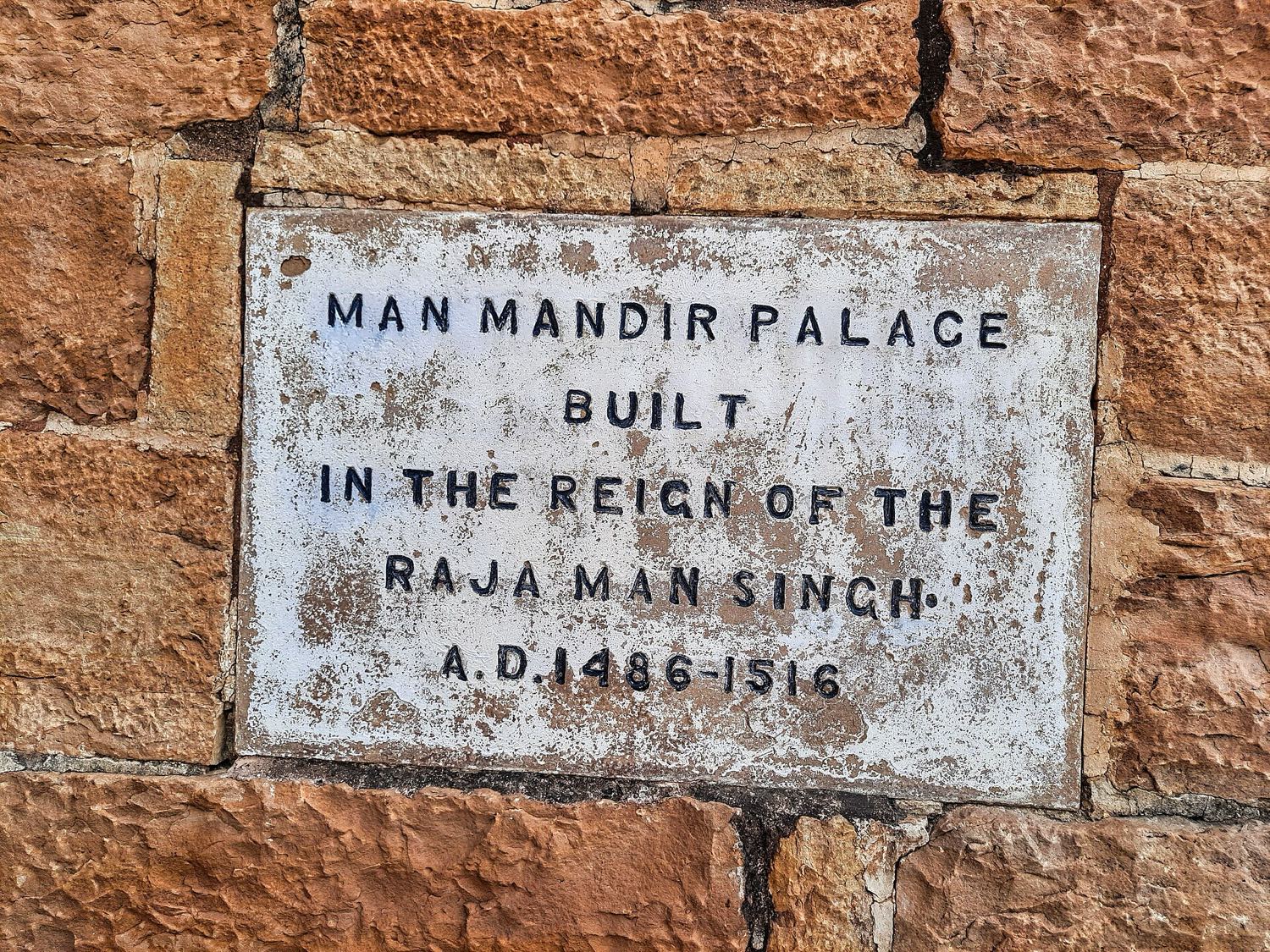
Gwalior Fort is very old — inscriptions on the hill record one of the earliest known uses of the mathematical symbol for zero, carved here well over a thousand years ago — and over the centuries it passed through many hands. But its golden age, and its greatest building, belong to the Tomar dynasty, the Hindu Rajput rulers of Gwalior, and above all to Raja Man Singh Tomar, who ruled around 1486 to 1516 and built the Man Mandir palace on the eastern edge of the fort, looking out over the cliff.
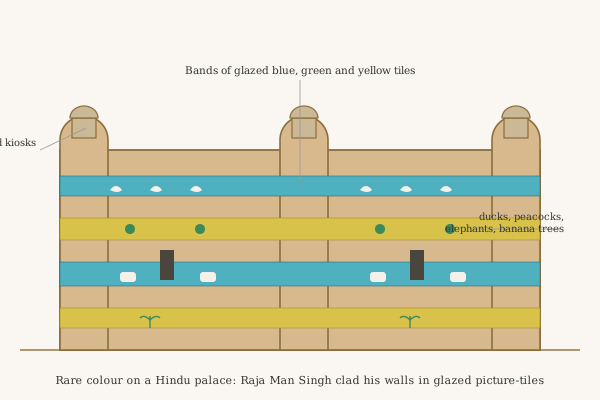
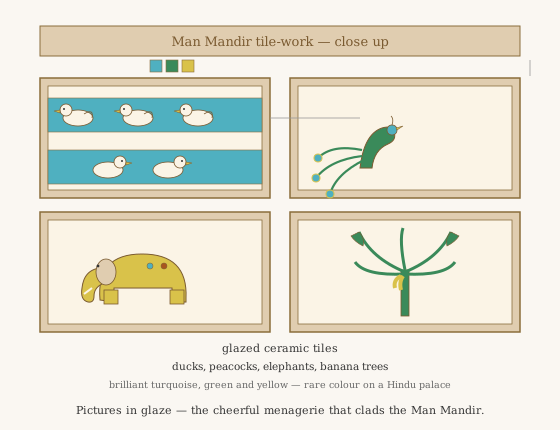
The facade of the Man Mandir is what everyone remembers. It is a long sandstone wall punctuated by great rounded towers, each capped by a domed kiosk (a chhatri), and it is decorated with horizontal bands of glazed tiles in brilliant turquoise-blue, green and yellow. The tiles are not abstract; they are pictures — rows of ducks paddling, peacocks, elephants, tigers, human figures, and stylised banana trees — running like a coloured frieze across the whole width of the palace. This use of vivid glazed tilework on the exterior of a Hindu palace is genuinely rare. Colour on architecture in medieval India was far more often associated with the Persian and Islamic tradition; to find it here, on the palace of a Hindu Rajput king in central India, clad in cheerful pictures of ducks and elephants, is unexpected and enchanting. The Man Mandir shows a side of Indian royal architecture — bright, decorative, almost whimsical — that the sober stone of most forts and temples conceals.
Cool chambers and music
Behind that gay facade, the Man Mandir was a cleverly designed palace. Man Singh Tomar was a great patron of the arts, especially of music — Gwalior is remembered as a cradle of Hindustani classical music, and the tradition links the fort to the legendary musician Tansen — and his palace was built for pleasure and comfort as much as for defence. Around its courtyards were chambers for music and assembly, screened balconies, and fine carved and once-painted interiors.
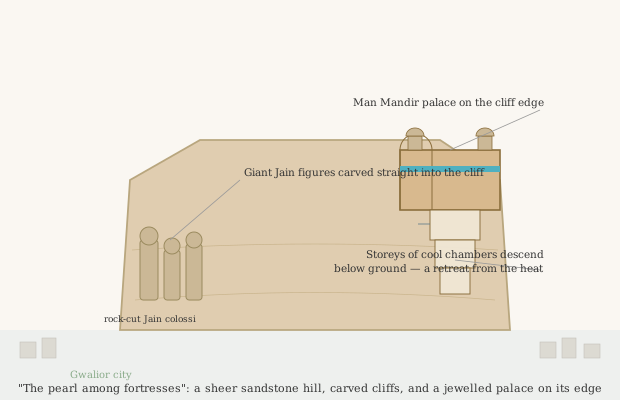
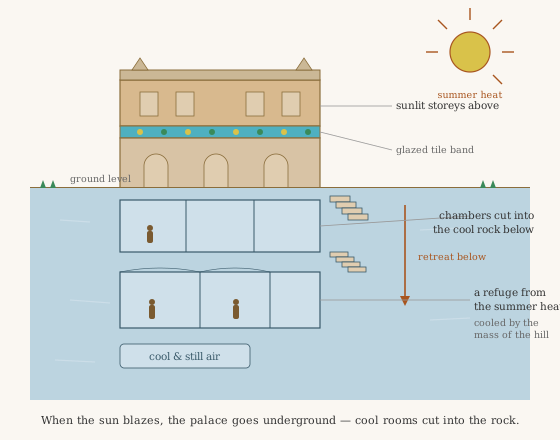
Most ingeniously, the palace descends below ground. Beneath the visible storeys, cut into the rock of the hill, are further levels of chambers — cool, dim rooms to which the royal household could retreat during the ferocious central-Indian summer, insulated from the heat by the mass of stone around them. It is the same instinct for passive cooling we have met across this series — in the water channels of the Red Fort, the wind-drawn Hawa Mahal — here achieved by simply burrowing downward into the cool heart of the rock. These underground chambers later served a grimmer purpose as prison cells under the Mughals, but they were built as a refuge from the sun.
Saints carved from the cliff
Gwalior has one more architectural marvel, and it is on the way up. Carved directly into the sheer sandstone cliff faces of the fort, along the approaches, are colossal figures of the Jain Tirthankaras — dozens of them, some standing many metres tall, cut in the fifteenth century into the living rock of the hill. Like the Gomateshwara colossus at Shravanabelagola and the rock-cut monuments of Ellora and Mamallapuram, these are monumental sculptures made by removing stone from the cliff, so that the fort's approaches are lined with a silent company of giant carved saints gazing out from the rock. They are a reminder that the same hill that carries a colourful Hindu palace on its summit carries a great work of Jain devotion on its flanks — India's habit of layering faith upon faith, age upon age, in a single sacred place.
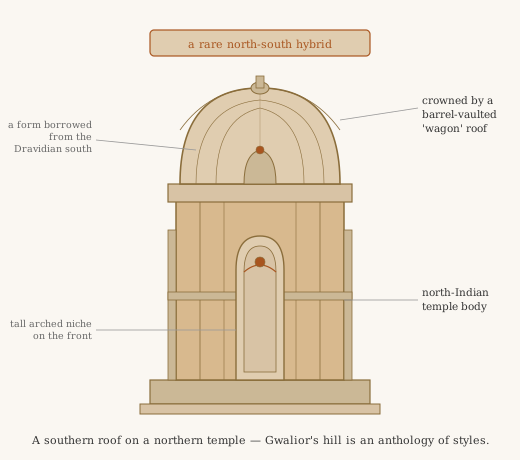
The fort holds still more: the tall, strange Teli ka Mandir, a temple whose north-Indian body is crowned by a barrel-vaulted "wagon" roof of a form borrowed from the Dravidian south — a rare architectural hybrid — and the elegant paired Sas-Bahu temples. Gwalior is a whole anthology of Indian architecture gathered on one rock.
Why Gwalior matters
Gwalior Fort earns its place in this series as the great example of the painted, pleasurable side of Indian royal architecture, and as a treasury of many traditions on a single hill. Where Mehrangarh is all martial power and Chittorgarh all sacrifice and memory, Gwalior's Man Mandir is a king's delight — a palace that put ducks and elephants in blue and green tiles across its walls, hid cool rooms beneath the rock, and rang with music. It shows that a fort need not be only grim, and that a Hindu palace could embrace colour and charm as readily as any Mughal pavilion.
Stand below the eastern cliff and look up at the long tiled facade of the Man Mandir catching the light — the rows of turquoise ducks and green peacocks bright against the honey sandstone, the domed kiosks on their round towers — and you understand why Babur called it a pearl: not for its strength, but for its beauty, a jewel of a palace set on the edge of a great rock, painted for the pleasure of a music-loving king five centuries ago.
Part of the Architectural Wonders series. For the Rajput fort in its martial modes, read Mehrangarh and Chittorgarh; for the rock-cut colossus its cliffs echo, the Gomateshwara at Shravanabelagola.
Hero photograph: “Man Mandir Palace, Gwalior Fort” by Ms Sarah Welch, via Wikimedia Commons, licensed under CC0 / public domain.
Export this guide
Related Guides — Deep-dive reading
Khajuraho: The Temple Built to Be a Mountain
How the Chandela masons of 10th-century central India made the northern temple rise like a Himalayan peak — and why its sculpture, its engineering and its improbable survival still instruct the modern architect.
Architectural WondersMehrangarh Fort, Jodhpur: A Citadel Grown from the Rock
How the Rathore kings of Marwar raised one of the mightiest forts in India on a sheer cliff above the blue city — a fist of stone whose brutal walls and trapped gateways guard a hidden jewel of delicate palaces
Architectural WondersSigiriya: The Sky Palace a Guilty King Built on a Rock
Fifteen hundred years ago in Sri Lanka, a king who had murdered his way to the throne fled his own guilt and fear to the top of a sheer 200-metre rock, and there built one of the most breathtaking places on Earth: symmetrical water gardens whose fountains still run, a cliff painted with celestial maidens, a gateway shaped as a colossal lion, and a pleasure-palace in the clouds. A paradise built out of terror. The seventh article in our chapter on the palaces and pleasures of worldly power.
Architectural WondersRelated Tools — Try Free
Cross-Ventilation Analyzer
Estimate airflow and air changes per hour (ACH) from room size, window areas, layout, and local wind — with NBC 2016 Part 8 compliance check.
Ventilation CalculatorHome Colour Studio
Colour every room — living, bedroom, dining, kitchen, bathroom — surface by surface in any HEX/RGB/CMYK colour, or from 80+ curated Indian shades.
Colour StudioCircadian Light Meter
Patient-centric circadian lighting visualizer for Indian healthcare design — time-of-day × intensity → CCT, melanopic lux (EML / mEDI), melatonin suppression, and an alertness curve. Calibrated against WELL v2 L03 Circadian Lighting Design, CIE S 026:2018, Brainard 2001, and Lucas et al. 2014.
Circadian Tool