
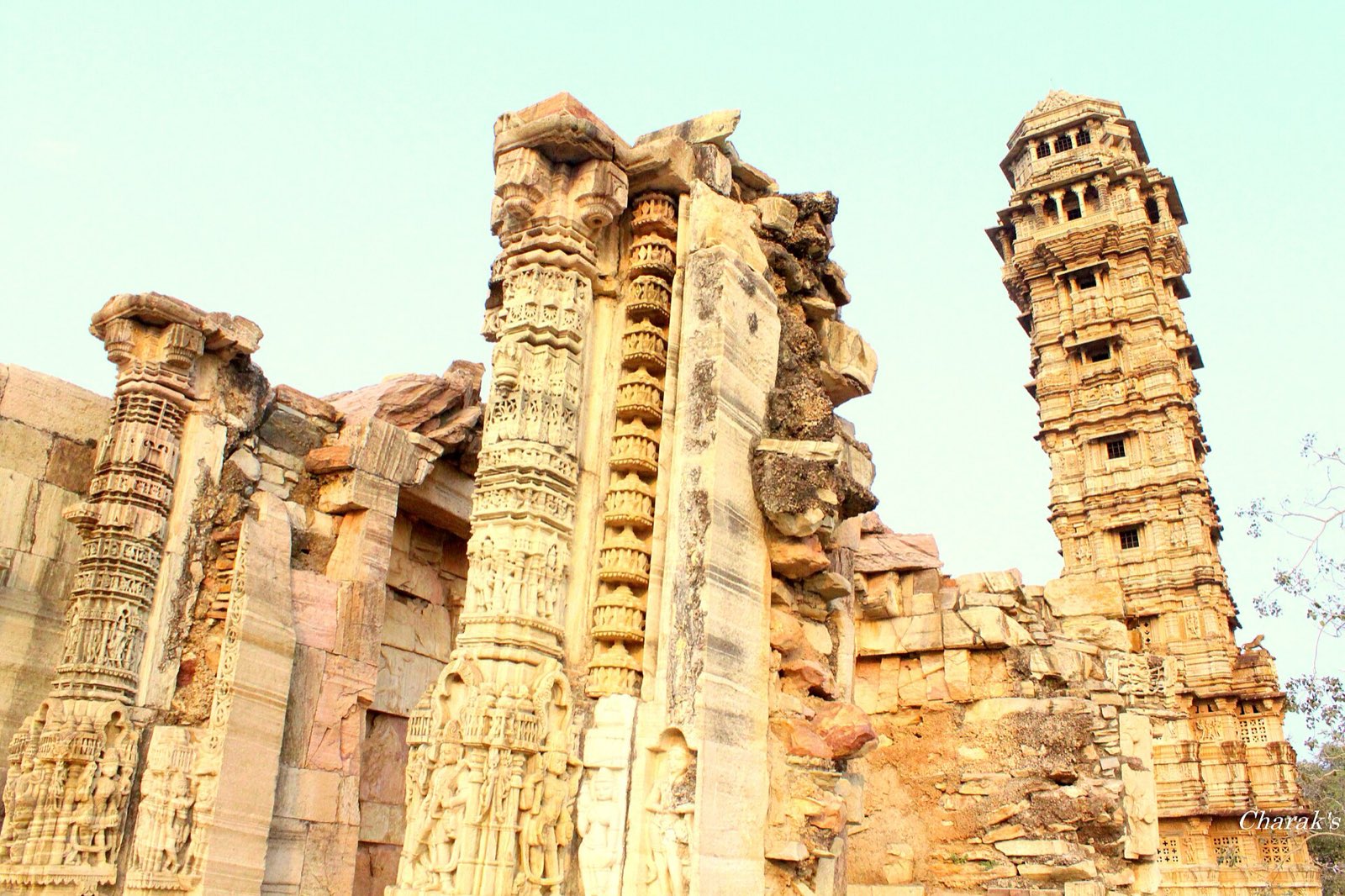
Chittorgarh: The Largest Fort in India, and Its Tower of Victory
How the Rajputs of Mewar held a whole fortified city on a hill for a thousand years — and crowned it with a nine-storey sculpted tower built for no purpose but to proclaim a single victory
We have already visited two great Rajput forts in this series — the refined, Mughal-influenced palace of Amber and the mighty war-citadel of Mehrangarh. Chittorgarh is the third and, in some ways, the greatest of all: the largest fort in India, the ancient capital of the kingdom of Mewar, and the supreme symbol of Rajput valour, honour and defiance. But it earns its place in this collection for a particular and unusual reason. Chittorgarh is not just a fortress; it is a fortified city on a hill, and it holds within it one of the rarest and most distinctive of all Indian building types — a tower built for no practical purpose whatsoever, existing solely to proclaim a victory.
A city on a hill, not a castle on a rock
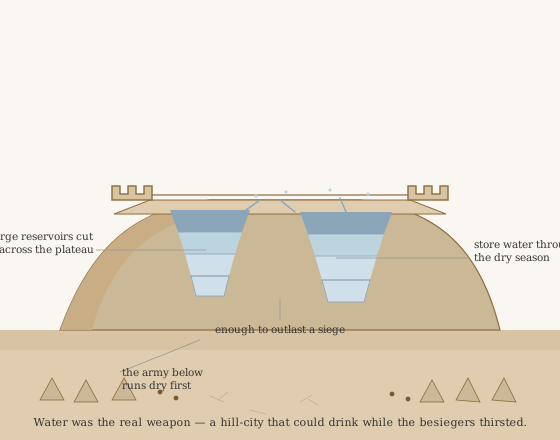
The first thing to grasp about Chittorgarh is its sheer scale, which puts it in a different category from an ordinary fort.
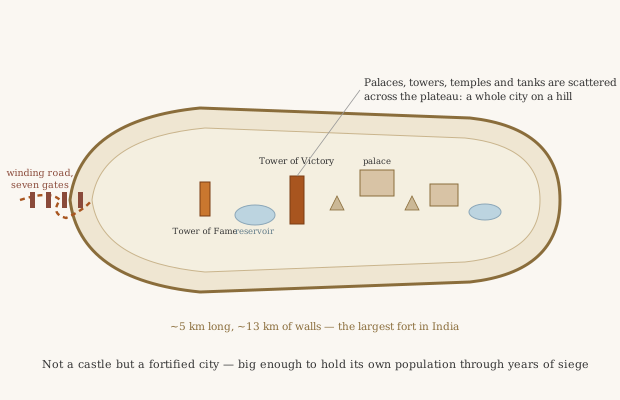
Where Mehrangarh crowns a compact rock, Chittorgarh sprawls across the entire top of a long, narrow plateau rising some 180 metres above the plain and stretching for around five kilometres — an area of nearly 300 hectares, girdled by some thirteen kilometres of wall. This is not a castle; it is a walled hill-city, big enough to contain its own population, its own palaces, dozens of temples, and, crucially, huge water reservoirs carved and dammed to hold enough water to outlast a long siege. The only way up is a steep, winding road that passes through a succession of seven fortified gates, each a defensive strongpoint of the kind we examined at Mehrangarh. Scattered across the plateau are the great monuments of Mewar: the palaces of Rana Kumbha and, by legend, of Rani Padmini; a scatter of Hindu and Jain temples; and, above all, two soaring free-standing towers.
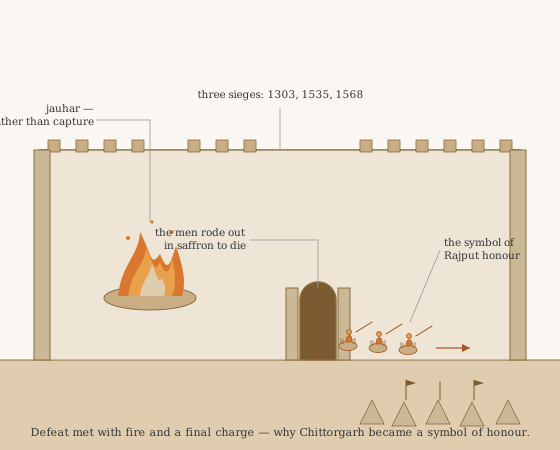
Chittorgarh's history is written in blood and legend. Held by the Sisodia Rajputs of Mewar, it endured three of the most famous sieges in Indian history — by Alauddin Khalji in 1303, by Bahadur Shah of Gujarat in 1535, and by the Mughal emperor Akbar in 1568 — and on each occasion, when defeat became certain, the fort became the scene of jauhar: the Rajput women, rather than face capture, are said to have walked into great fires in mass self-immolation while the men rode out in saffron robes to die in a final hopeless charge. Whatever the exact history behind the legends, Chittorgarh became, and remains, the ultimate symbol of Rajput honour and defiance — a place where a fort's architecture is inseparable from a code of death before dishonour.
The Tower of Victory
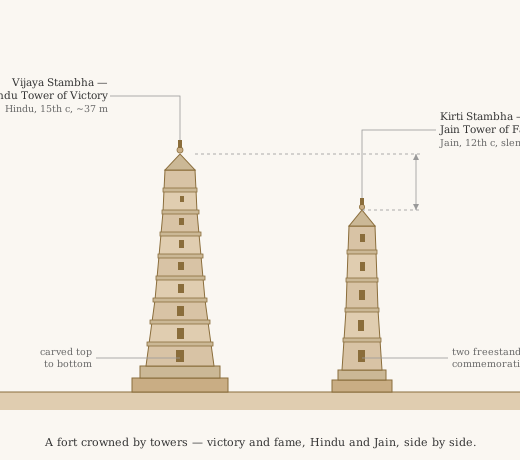
At the heart of the plateau rises the monument that makes Chittorgarh unique in this series: the Vijaya Stambha, the Tower of Victory.
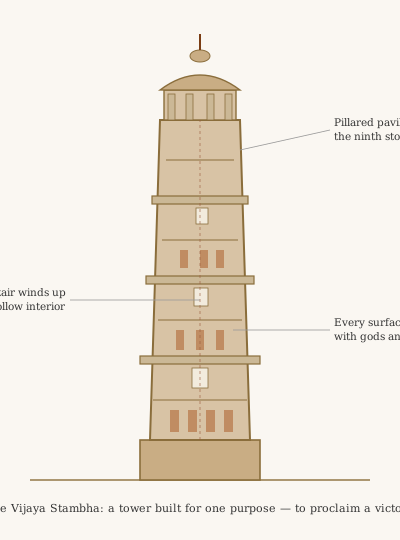
The Vijaya Stambha was built by Rana Kumbha, the great fifteenth-century ruler of Mewar, around 1448, to commemorate his victory over the Sultan of Malwa. And here is what makes it remarkable as architecture: it is a free-standing tower with no practical function at all. It is not a gateway, not a minaret calling to prayer, not a temple tower over a sanctum, not a watchtower. It is a piece of pure commemoration — a nine-storey, thirty-seven-metre column of sandstone raised solely to say, permanently and unmistakably, we won. The victory column is a rare monument type in India, and the Vijaya Stambha is its supreme example.
It is also, unlike a plain triumphal column, covered from base to summit in sculpture: its every storey and surface carved with images of Hindu gods, celestial beings, arms, and scenes, so densely that it doubles as a kind of vertical encyclopedia of the Hindu pantheon — a religious as well as a martial monument. Projecting balconies ring it at several levels, and a staircase winds up through its hollow interior to a pillared open pavilion at the top, from which the whole of Mewar can be surveyed. That you can climb it matters: like the Jantar Mantar's instruments or the gopurams of the south, the Vijaya Stambha is an inhabitable monument, a structure you enter and ascend, not merely a solid marker.
Not far away stands its older, smaller cousin, the Kirti Stambha, the "Tower of Fame" — a twelfth-century Jain tower dedicated to the first tirthankara, Adinatha, and carved with Jain figures. The pair make Chittorgarh a place of towers in a way no other Indian fort is: vertical monuments of commemoration, Hindu and Jain, rising over the walls of the great fortified city.
Why Chittorgarh matters
Chittorgarh completes this series' study of the Rajput fort, and it adds a dimension the others lack. Amber taught us the fort as refined palace; Mehrangarh the fort as impregnable war-machine. Chittorgarh teaches the fort as city and symbol — a fortified urban world large enough to be a kingdom's whole capital, and a repository of collective memory so charged that its very stones stand for an ideal of honour. And in the Vijaya Stambha it gives us something found almost nowhere else in Indian architecture: a monument built purely to commemorate, a sculpted tower whose only job is to remember a victory and to be climbed and admired for it.
There is a poignancy in the fact that this greatest symbol of Rajput independence eventually fell to the Mughals, and that Mewar afterwards shifted its capital to the lake-city of Udaipur — so that Chittorgarh, like Nalanda, is now more monument than living city, its palaces roofless, its temples quiet, its towers standing over a plateau of memory. But the Vijaya Stambha still rises exactly as Rana Kumbha built it, a nine-storey shout of triumph in carved stone, visible for miles across the plains of Rajasthan — proof that a building need do nothing useful at all to be one of the wonders, if what it commemorates is large enough.
Part of the Architectural Wonders series. For the Rajput fort in its other modes, read the palace-fort of Amber and the war-citadel of Mehrangarh; for another monument you climb, the Jantar Mantar.
Hero photograph: “Chittorgarh Fort and the Vijaya Stambha” by Bhartrihari Pandiya, via Wikimedia Commons, licensed under CC BY-SA 4.0.
Export this guide
Related Guides — Deep-dive reading
Mehrangarh Fort, Jodhpur: A Citadel Grown from the Rock
How the Rathore kings of Marwar raised one of the mightiest forts in India on a sheer cliff above the blue city — a fist of stone whose brutal walls and trapped gateways guard a hidden jewel of delicate palaces
Architectural WondersGreat Zimbabwe: The Stone City Europe Refused to Believe Africans Built
In the hills of southern Africa stand the largest ancient stone ruins south of the Sahara — a whole city of massive granite walls built without a drop of mortar, the wealthy capital of a gold-trading kingdom. For a century, colonists refused to accept that Africans had raised it, and invented every other builder they could. This is the story of that architecture, and of the lie it outlived. The article that closes our chapter on the palaces and pleasures of worldly power.
Architectural WondersHampi: The Stone City of Vijayanagara
How a medieval South Indian empire built an entire capital out of the boulder field it stood on — granite that sings, a chariot carved in rock, two architectural worlds fused into one — and how the whole of it fell in a single year.
Architectural WondersRelated Tools — Try Free
Before & After Studio
Generate AI before-and-after renders to preview how your redesign could look.
DesignAICircadian Light Meter
Patient-centric circadian lighting visualizer for Indian healthcare design — time-of-day × intensity → CCT, melanopic lux (EML / mEDI), melatonin suppression, and an alertness curve. Calibrated against WELL v2 L03 Circadian Lighting Design, CIE S 026:2018, Brainard 2001, and Lucas et al. 2014.
Circadian ToolAI BOQ Generator
AI generates detailed Bill of Quantities with city-specific rates and labour breakdown.
ArchitectAI