
Kailasa at Ellora: A Mountain Carved into a Temple
How 8th-century carvers made the largest monolith on earth — a complete multi-storey Dravidian temple, gateway to spire, released top-down from a single basalt hill with no scaffolding and no chance to correct a mistake. The supreme act of subtraction, and the climax of India's rock-cut story.
This series has, all along, been two stories. One is the story of building up — stone stacked on stone, at Konark, Pattadakal, Brihadeeswara, Hampi. The other is the story of carving into rock — the halls of Ajanta, the cave-temples of Badami. At Ellora, in the 8th century, those two stories become one — in the single most astonishing act of building in India, and perhaps anywhere.
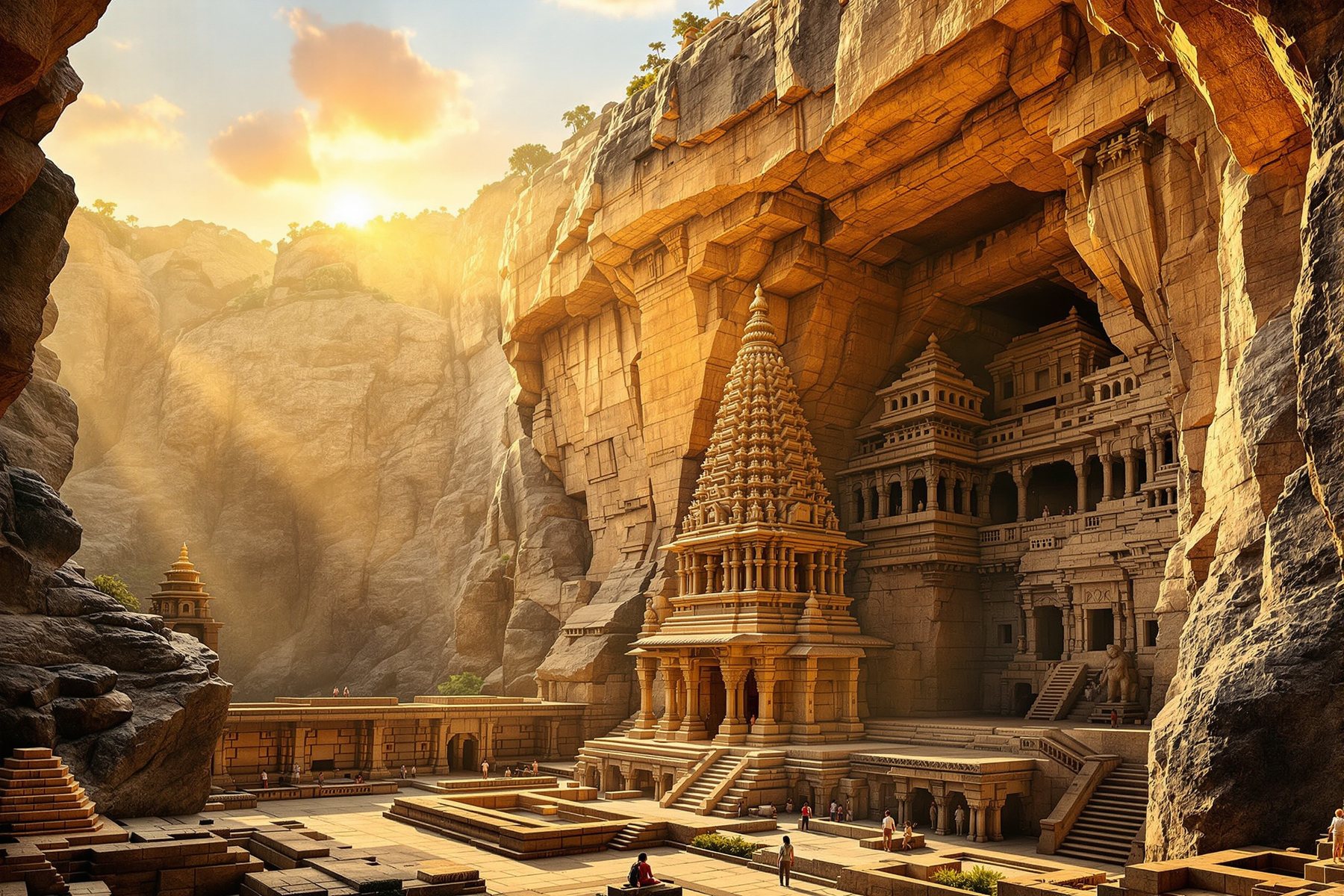
The Kailasa temple is a complete, full-size, multi-storey Hindu temple — gateway, halls, shrine, a tower thirty metres high, courtyards, cloisters, life-size elephants, the lot. But it was never _built_. It was carved — top-down, out of a single hill of solid basalt, by removing everything that was not the temple. It is the largest monolith on earth, and to stand in its courtyard is to stand inside a hole shaped like a cathedral, cut from one rock.
This is the fifteenth article in our Architectural Wonders series, and the climax of its Indian arc.
1. They did not build it. They carved it down.
Every building you have ever seen was made by adding: bringing material and assembling it upward from a foundation. The Kailasa temple was made the opposite way — by subtracting, from the top.
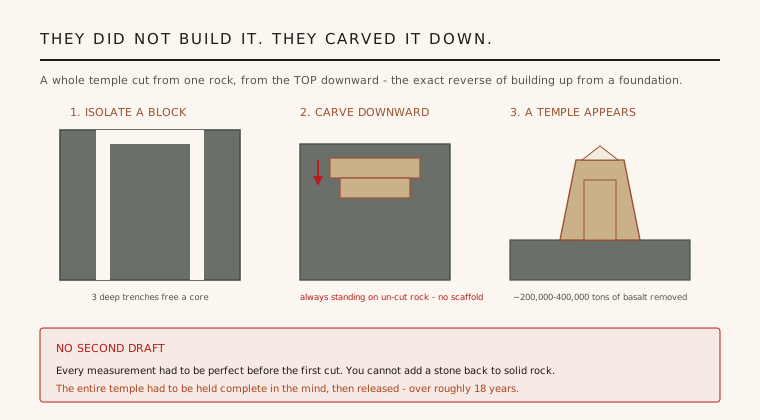
The carvers began by cutting three deep vertical trenches into the sloping hillside, isolating a vast central block of rock. Then they went at it from the top down — cutting away the stone and shaping the temple as they descended, so they were always standing on rock not yet removed. No foundations. No scaffolding. And — this is the part that defies belief — no possibility of a mistake. You cannot glue a wrongly cut piece of mountain back on. Every measurement, every shrine, every god, the whole thirty-metre tower, had to be held complete in the mind and then released, in the correct order, downward, over roughly eighteen years. By the end, some 200,000 to 400,000 tons of basalt had been carried away, and a temple stood in the empty space.
It is the ultimate version of the lesson Ajanta first taught us: in subtractive architecture, _every cut is final_. Here that discipline is carried out at the scale of an entire temple complex.
2. A whole temple, released from one rock
The truly staggering thing is _what_ they carved. This is not a cave or a carved facade. It is a complete free-standing temple complex, of exactly the kind that elsewhere was built stone by stone.
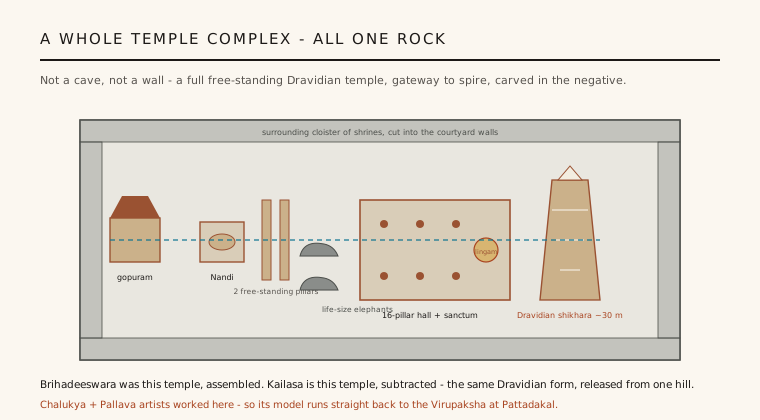
Walk the axis and you pass through an entrance gopuram, into a court with a Nandi pavilion and two tall free-standing pillars; flanking them, life-size elephants carved as if bearing the whole temple on their backs; and beyond, the main shrine, its hall of sixteen pillars holding a great Shiva lingam, crowned by a stepped Dravidian tower (shikhara) about thirty metres tall. Around the whole sunken courtyard runs a cloister of smaller shrines, cut into the rock walls. Every single one of these elements — gateway, bridge, pavilion, tower, elephant, cloister — is one continuous piece of basalt with all the others. Nothing is joined because nothing was ever separate.
And this is exactly where the two threads of our series tie together. Brihadeeswara is this temple _assembled_; Kailasa is the same Dravidian temple _subtracted_. Tellingly, Chalukya and Pallava artists worked here — so the form Kailasa carves runs straight back to the built temples of Pattadakal, whose Virupaksha we saw was the model that travelled north to Ellora. The built temple and the carved mountain are the same idea, made two opposite ways.
3. Where building-up meets carving-down
It is worth pausing on how complete this union is, because it is the quiet summary of everything this series has explored.
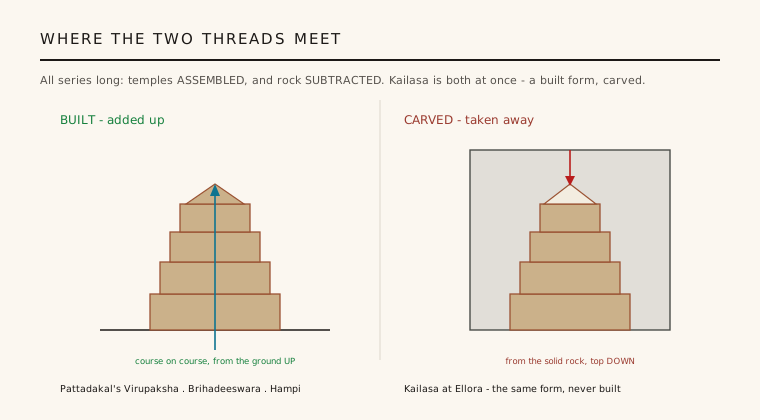
A built temple rises up from the ground, course on course, and its great risk is the one that felled Konark — push the structure too far and the joints give way. A carved temple is freed from the top down, and has no joints to fail at all, but its risk is total and immediate: one wrong cut and there is no remedy. Kailasa chose the harder, more unforgiving path and carried it to a scale no one has matched before or since. The form is the southern temple we have followed from Aihole to Thanjavur; the _method_ is the rock-cutting we followed from Ajanta to Badami. At Ellora, in one hill, the whole of Indian temple architecture — additive and subtractive, built and carved — arrives at a single, impossible object.
4. The temple that is a mountain
And like the very best architecture in this series, all of that effort serves one governing idea, carried without flinching all the way through.
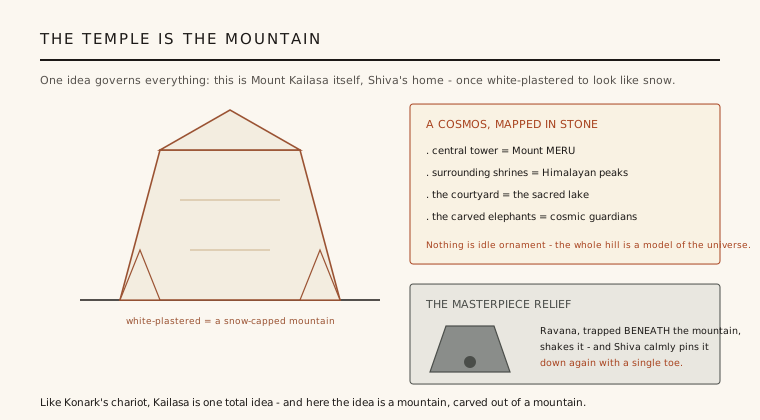
The temple is Mount Kailasa — the Himalayan peak that is Shiva's home. The whole monolith was originally finished in brilliant white plaster, so that this dark basalt hill in the Deccan would read as a shining, snow-capped mountain. And the symbolism is total: the central tower is cosmic Mount Meru, the surrounding shrines are the lesser Himalayan peaks, the courtyard is the sacred lake, the carved elephants are the guardians of the cosmos. Nowhere is the idea more vivid than in the temple's most famous relief: the demon Ravana, trapped _beneath_ the mountain, straining to shake it loose — while Shiva, unbothered, presses it back down with a single toe. Just as Konark is wholly the sun's chariot, Kailasa is wholly a mountain — a mountain carved, astonishingly, out of a mountain.
5. The crown of Ellora
Kailasa does not stand alone. It is Cave 16 of the Ellora Caves — a line of 34 rock-cut caves strung along a basalt escarpment, carved over centuries and, remarkably, shared between three religions.
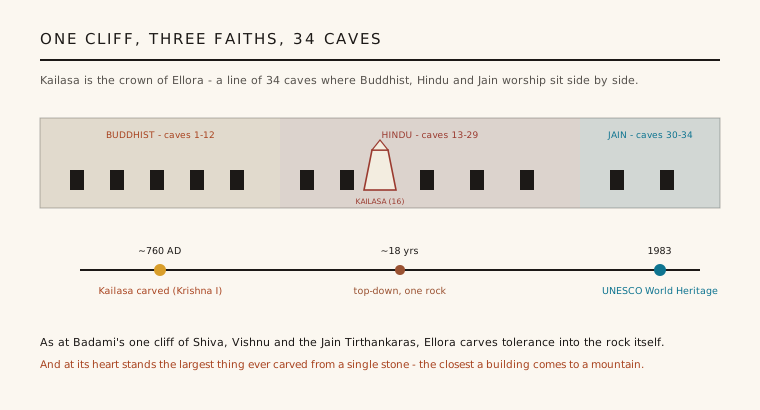
The caves run Buddhist (1–12), Hindu (13–29) and Jain (30–34), worked across roughly the 6th to 10th centuries, with the Kailasa carved under the Rashtrakuta king Krishna I around 760 CE. Just as one cliff at Badami held Shiva, Vishnu and the Jain Tirthankaras together, Ellora carves a long tradition of coexistence straight into the rock. The whole site was inscribed as a UNESCO World Heritage Site in 1983, and at its very heart stands Kailasa — the largest thing humanity has ever cut from a single stone, the closest a building has ever come to being a mountain.
6. What a modern architect can learn from Kailasa
- Visualise the whole before the first cut. Subtractive making is utterly unforgiving — there is no adding back. Kailasa rewards, more than any building on earth, the discipline of holding the entire finished thing in the mind before anything irreversible begins. Plan as if you cannot undo, because sometimes you cannot.
- Method and form are separable — and you can choose. The same Dravidian temple can be built up or carved down. Knowing that _how_ you make something is a free choice, distinct from _what_ you are making, is a deep and liberating idea. Pick the method the situation and material truly call for.
- One idea, carried all the way, makes a masterpiece. "The temple is the mountain" governs the plan, the tower, the symbolism, even the white plaster. The most powerful architecture comes from a single clear concept pursued without compromise. (It is the lesson Konark taught, taken to the summit.)
- Subtraction is design too. We usually think of architecture as adding. Kailasa is a thousand-year reminder that shaping space by _removing_ — sculpting the void, not piling the solid — is an equally profound, and sometimes greater, way to build.
- The hardest path, fully committed, is unforgettable. Easier methods existed; Ellora chose the one with no margin for error and saw it through over decades. Difficulty, embraced with total commitment, is part of why we still travel across the world to stand in this courtyard.
In Amogh's frame
This is not a stock photograph. This is Amogh himself, standing in the courtyard of Kailasa with his mother and his father, a camera in his hand — the rock-cut shrines and the great basalt cliff of Ellora rising behind them. He walked down into this hollowed mountain, stood among the carved elephants and shrines, and looked up at the largest thing human beings have ever cut from a single stone. Of all the wonders in this series, this is one he did not only read about — he was here.
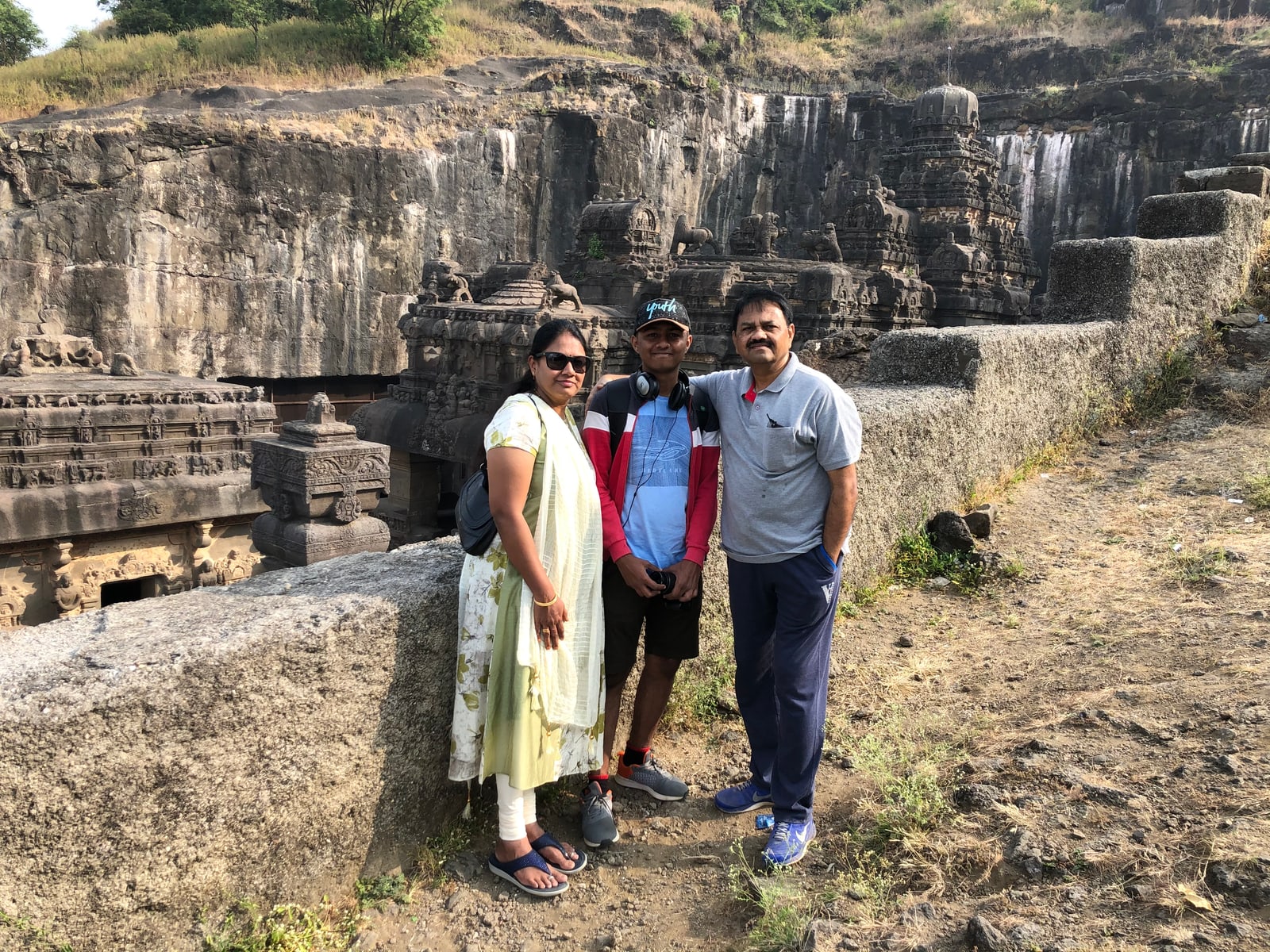
Studio Matrx is built in his memory. Some of these wonders he walked through himself; this is one of them.
References & further reading
1. UNESCO World Heritage Centre — Ellora Caves (inscribed 1983). https://whc.unesco.org/en/list/243/
2. Archaeological Survey of India — Kailasa Temple, Ellora. https://asi.nic.in/
3. Encyclopaedia Britannica — Ellora Caves and the Kailasa temple. https://www.britannica.com/place/Ellora-Caves
4. World History Encyclopedia — Kailasa Temple, Ellora. https://www.worldhistory.org/Ellora/
Last verified 2026-06-30. Dates, the volume of rock removed, dimensions and attributions follow standard archaeological and ASI reference sources and are given as widely accepted approximations; the dedication under the Rashtrakuta king Krishna I around 760 CE, the top-down monolithic method, and the Mount Kailasa symbolism follow the established archaeological and scholarly record.
Export this guide
Related Guides — Deep-dive reading
Badami: The Cradle of the South Indian Temple
How 6th-century Chalukya carvers, still working into a red sandstone cliff like the cave-makers before them, designed the porch, hall and sanctum that every later South Indian temple would copy — and shared one cliff between Shiva, Vishnu and the Jain Tirthankaras. The rock-cut laboratory where Dravidian architecture was born.
Architectural WondersAjanta: The Architecture Carved from Within
How ancient Buddhist monks hollowed thirty halls, monasteries and shrines out of a solid basalt cliff — from the top down, with no scaffolding — and painted, by lamplight, some of the greatest pictures of the ancient world. The rock-cut method, the murals, and the lesson.
Architectural WondersBrihadeeswara: The Chola Tower That Never Fell
How an 11th-century Tamil emperor raised a 216-foot tower of solid granite — with no mortar, no iron and no machine — and why this colossal corbelled mountain has stood for over a thousand years where Konark's fell. The engineering, the 80-tonne capstone, and the lesson.
Architectural WondersRelated Tools — Try Free
AI Measurement Tool
Measure your room using voice, photos, or video sweep — no tape measure needed.
DesignAIConcept Generator
Get 3 AI-generated design concepts for any room with style, materials, and cost estimate.
DesignAIApartment Furniture Size Chart
Standard furniture dimensions for Indian apartments — sofas, beds, tables, dining, storage.
Reference Chart