
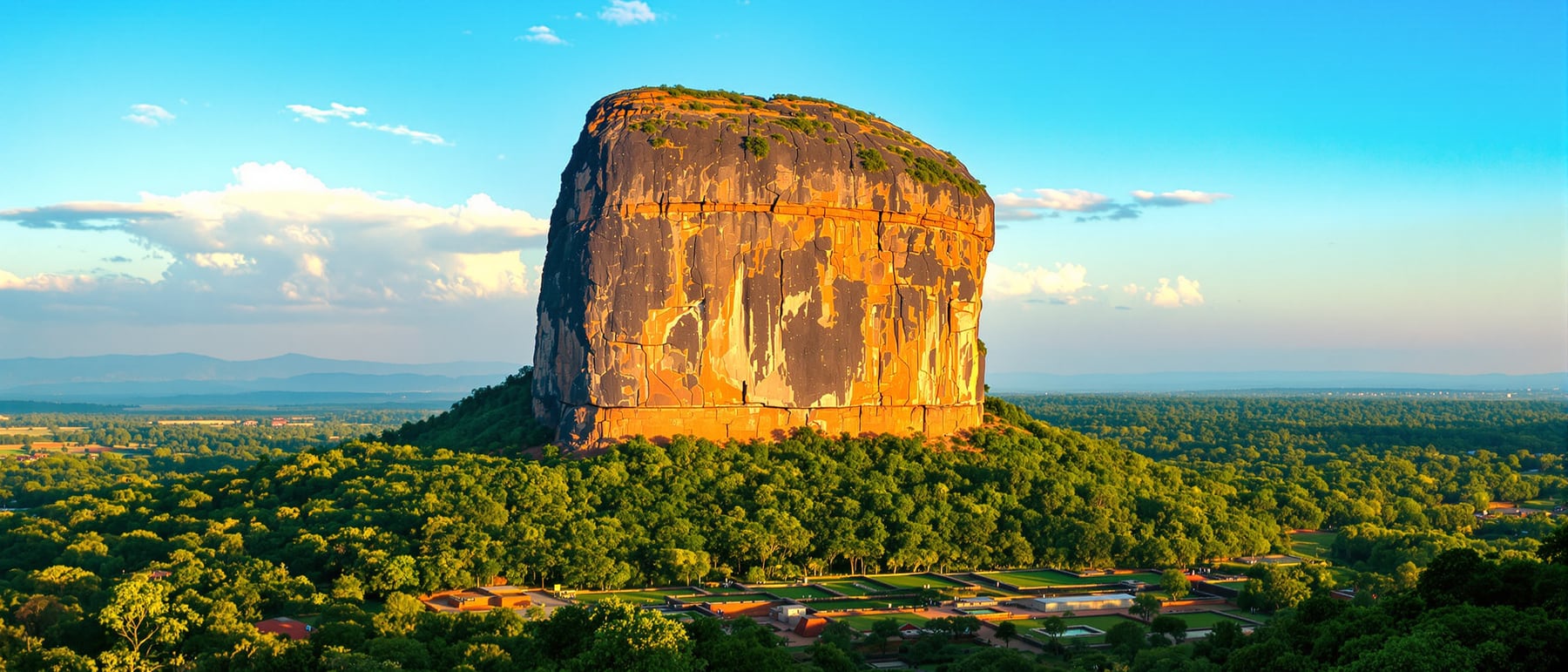
Sigiriya: The Sky Palace a Guilty King Built on a Rock
Fifteen hundred years ago in Sri Lanka, a king who had murdered his way to the throne fled his own guilt and fear to the top of a sheer 200-metre rock, and there built one of the most breathtaking places on Earth: symmetrical water gardens whose fountains still run, a cliff painted with celestial maidens, a gateway shaped as a colossal lion, and a pleasure-palace in the clouds. A paradise built out of terror. The seventh article in our chapter on the palaces and pleasures of worldly power.
We leave Rome now, and travel to one of the most astonishing places in all of Asia — and one of the most poignant in this entire series. For everything we have seen in this chapter, Sigiriya may be the purest fusion of its two themes. It is a pleasure-palace of ravishing beauty: water gardens, frescoes, a court in the sky. And it is a monument to naked power at its most anxious: a fortress built by a king so haunted by what he had done to seize his throne that he fled to the top of a rock. Here, more nakedly than anywhere, paradise and paranoia are the same building.
This is the seventieth article in our Architectural Wonders series, and the seventh in our chapter on the great palaces and pleasures of worldly power.
Sigiriya — the name means "Lion Rock" — rises in the central plains of Sri Lanka, a single colossal column of hardened magma standing nearly two hundred metres sheer above the surrounding jungle. On and around it, in just eighteen years at the end of the fifth century CE, a king built a total designed world: gardens, galleries, a gateway and a palace, integrating architecture, painting, landscape and hydraulic engineering into a single breathtaking whole. It is often called the "eighth wonder of the world" — an affectionate exaggeration, but you understand the impulse the moment you see it.
1. The usurper's rock
To understand Sigiriya, you have to know the crime that built it.
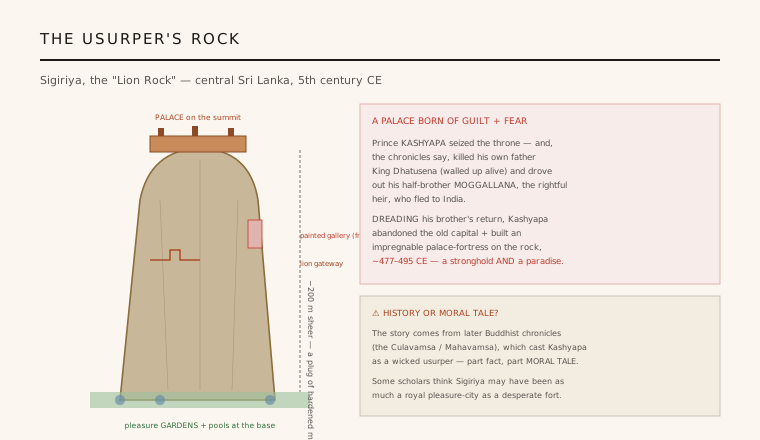
According to Sri Lanka's ancient chronicles, in the 470s CE a prince named Kashyapa (Kassapa) seized power by the darkest possible route: he overthrew his father, King Dhatusena, and had him killed — walled up alive, the chronicles say — and drove into exile his half-brother Moggallana, the legitimate heir, who fled to India vowing revenge. Kashyapa now sat on a throne soaked in his father's blood, waiting for the day his brother would come back with an army. And so, around 477 CE, he did an extraordinary thing: he abandoned the ancient capital of Anuradhapura and moved to the great rock of Sigiriya, where he raised an impregnable fortress-palace — a place both unassailable and unimaginably beautiful, part military stronghold, part royal paradise. He ruled there for about eighteen years. (An honest caution: this dramatic story comes from later Buddhist chronicles, the Culavamsa and Mahavamsa, which paint Kashyapa as a wicked usurper and Sigiriya as his guilty refuge. It is part history and part moral tale, and some modern scholars suspect Sigiriya may have been conceived less as a desperate bunker than as a deliberate royal pleasure-city and ceremonial capital. Either way, fear and delight are braided through every stone of it.)
2. The water gardens
Approach the rock, and the first wonder meets you long before you climb: one of the oldest surviving designed landscapes on Earth.
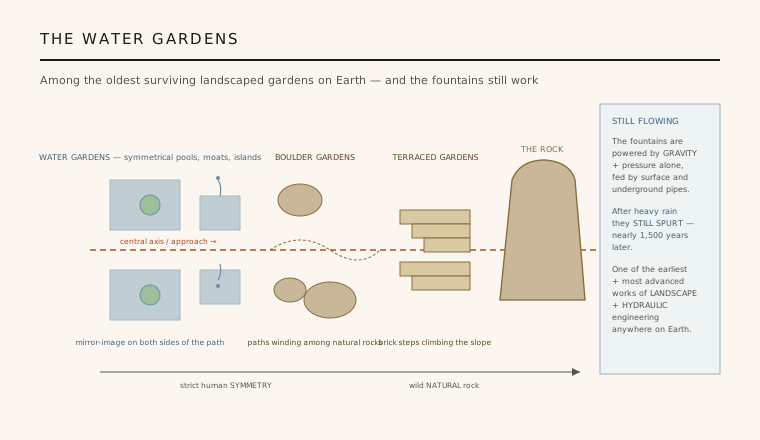
Sigiriya's gardens are among the oldest surviving landscaped gardens in the world, and among the most sophisticated of any age. Along a dead-straight central axis, the visitor passes first through the Water Gardens: a serenely symmetrical composition of rectangular pools, moats, fountains, islands and channels, laid out in perfect mirror-image on either side of the path — an ancient formal garden fed by a hidden network of surface and underground pipes. The most astonishing detail: the fountains still work. Powered by nothing but gravity and water pressure, exactly as they were engineered fifteen centuries ago, they still jet water into the air after heavy rain — surely among the oldest functioning fountains anywhere on Earth. Beyond the formal pools come the Boulder Gardens, where paths wind naturally among enormous scattered rocks, and then the Terraced Gardens, climbing the slope in brick-walled steps to the foot of the cliff. Read as a sequence, the whole landscape is a journey from strict human order to wild nature — geometric symmetry at the entrance, dissolving into raw boulders and living rock as you ascend. It is landscape architecture and hydraulic engineering of a subtlety the world would not routinely see again for a thousand years.
3. The frescoes and the Mirror Wall
Halfway up the western face, in a sheltered pocket of the cliff, waits the most famous sight of all — and beneath it, the strangest.
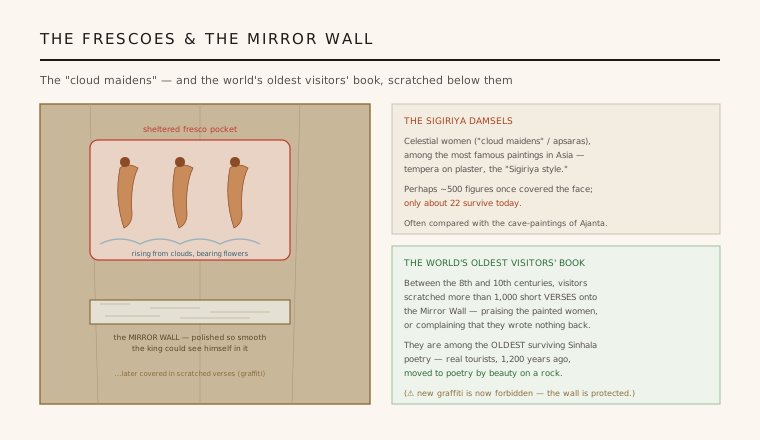
High on the rock survive some of the most beloved paintings in all of Asia: the Sigiriya Damsels, or "cloud maidens" — graceful celestial women, bare to the waist and bearing flowers, who seem to float upward out of banks of cloud. Painted in a distinctive, sensuous style (often compared to the great cave-paintings of Ajanta in India), they may once have numbered around five hundred figures, wrapped across a vast span of the western cliff; only about twenty-two survive today, glowing in their rock shelter. And directly below them runs one of the most charming features in the history of architecture: the Mirror Wall. This long parapet was originally plastered and burnished to such a glassy sheen that — so tradition says — the king could see his own reflection as he walked. But its real fame came later. Over the centuries, visitors to the rock could not resist scratching their thoughts into that perfect surface, and the Mirror Wall became covered in graffiti — more than a thousand short verses, inscribed between roughly the 8th and 10th centuries, most of them addressed to the painted women above: praising their beauty, aching with longing, or teasingly complaining that the ladies stayed silent and would not write back. These verses are among the oldest surviving Sinhala poetry — and, taken together, they are nothing less than the world's oldest visitors' book: the recorded voices of ordinary tourists, twelve hundred years ago, moved to write poems by beauty they found on a rock. (New graffiti is, needless to say, now strictly forbidden; the wall is protected.)
4. Through the lion's mouth
The climb to the summit once passed through the most theatrical gateway ever built — the one that gave the rock its name.
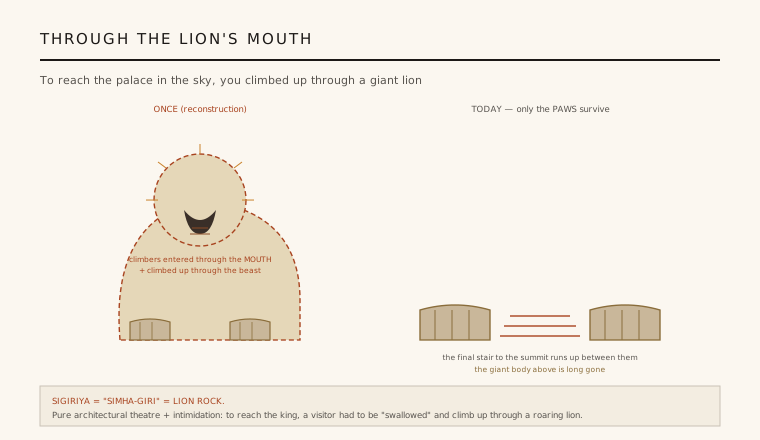
On a broad terrace two-thirds of the way up, the final staircase to the summit once began inside the body of a gigantic lion, modelled in brick and plaster around the living rock. Climbers ascended between its paws and up through the beast itself — entering, it is thought, through the lion's open mouth — so that the last approach to the king's palace led directly up through a colossal, roaring lion. This is where the rock gets its name: Sigiriya, from Siṃha-giri, "Lion Rock." Today only the two enormous paws survive, planted at the foot of the final stair, and you must imagine the vast head and mane that once reared above them. It is a stroke of pure architectural theatre — and pure intimidation. To reach a king who had murdered his own father for power, an ambassador or courtier first had to be symbolically swallowed by a lion and climb, small and awed, up through its throat into the sky. Few buildings have ever stated a ruler's message — you are entering the domain of a predator — with such terrifying clarity.
5. The palace in the sky — and the fall
At the top waited paradise; and, in the end, the very fate the whole rock had been built to prevent.
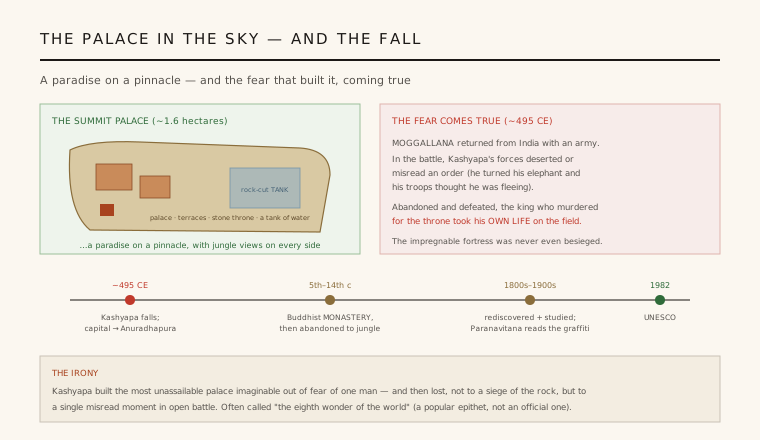
The flat summit — about 1.6 hectares, a sky-island in itself — was levelled and built up into a royal palace in the clouds: brick pavilions, terraced gardens, a stone throne, and, most remarkably, a large tank cut straight into the rock to store water for the court, with dizzying views across the jungle in every direction. Whatever else it was, it was a paradise on a pinnacle. But the fear that raised it came true. Around 495 CE, the exiled Moggallana returned from India with an army. In the decisive battle on the plain below, Kashyapa — by the chronicle's account — turned his war-elephant aside to avoid a marsh, his troops misread the move as flight and deserted him, and the abandoned king, defeated in the open field, took his own life. The great impregnable fortress was never even besieged. Moggallana carried the capital back to Anuradhapura and handed Sigiriya to Buddhist monks, who kept it as a quiet monastery for some seven centuries before it was abandoned and slowly swallowed by the jungle. It was rediscovered and studied only in modern times — the archaeologist Senarat Paranavitana famously deciphering the Mirror Wall's verses — and inscribed by UNESCO in 1982. The lesson of the rock is almost unbearably neat: a king built the most unassailable palace in the world out of fear of one man, and lost everything not to a siege of his fortress, but to a single misread moment in open battle. No wall, however high, could protect him from the consequences of how he had climbed.
6. What a modern architect can learn from Sigiriya
- Design the whole journey, from garden to summit. Sigiriya is not a building but a sequence — water gardens, boulder gardens, painted cliff, lion gate, sky palace — staged as a single ascent from order into wildness into the clouds. The most powerful sites are choreographed landscapes, not isolated objects. Think about the entire arc of arrival.
- Marry architecture to its land. Sigiriya does not fight the rock; it completes it — symmetry in the flat gardens, wildness among the boulders, a palace crowning the natural summit. The greatest works read the genius of the place and answer it, rather than imposing one idea everywhere.
- Water is architecture. Fifteen-hundred-year-old fountains still run on gravity alone. Mastery of water — its movement, storage, sound and stillness — is one of the oldest and most magical tools of design, and one of the most enduring. Engineer it well and it outlives everything else.
- A threshold can carry the whole message. The lion gateway told every visitor exactly whose power they were entering, before a word was spoken. What a building does at the moment of entry — welcome, awe, or fear — can define the entire experience. Design your thresholds with intent.
- Buildings invite people to speak back. The Mirror Wall became the world's oldest visitors' book because it gave people a surface, and a reason, to respond. Great places don't just impress an audience; they provoke a reply — and sometimes the visitors' own voices become part of the wonder.
- No fortress saves you from yourself. The deepest lesson of Sigiriya is not architectural but human: the most impregnable walls ever raised could not protect a king from the guilt and consequence he carried up with him. Architecture can shelter a life, but it cannot redeem one. Build for how people should live — not as a hiding place from how they have.
References & further reading
1. UNESCO World Heritage Centre — Ancient City of Sigiriya (inscribed 1982). https://whc.unesco.org/en/list/202/
2. World History Encyclopedia — Sigiriya. https://www.worldhistory.org/Sigiriya/
3. Encyclopaedia Britannica — Sigiriya. https://www.britannica.com/place/Sigiriya
4. Senarat Paranavitana — Sigiri Graffiti (the classic study and edition of the Mirror Wall verses). https://www.worldcat.org/title/sigiri-graffiti/oclc/2431747
5. Central Cultural Fund of Sri Lanka — Sigiriya (official heritage site). https://www.ccf.gov.lk/
6. Smarthistory / Asian art resources — The frescoes ("cloud maidens") of Sigiriya. https://smarthistory.org/
*Last verified 2026-07-05. Figures follow UNESCO, the World History Encyclopedia, Britannica, the Central Cultural Fund of Sri Lanka and standard scholarship (incl. Paranavitana), and are given as widely cited approximations that vary by source. Sigiriya ("Lion Rock," from Siṃhagiri), in Matale District, central Sri Lanka (near Dambulla), is a fortress-palace complex built on and around a ~180–200 m column of hardened magma. Per the Sri Lankan chronicles (Culavamsa/Mahavamsa), it was built by King Kashyapa (Kassapa) I, r. c. 477–495 CE, who seized the throne by overthrowing/killing his father Dhatusena and exiling his half-brother Moggallana; he moved the capital here from Anuradhapura. NB the chronicle account is later, moralising, and partly legendary; some scholars read Sigiriya as a designed royal/pleasure city rather than only a fear-driven fortress. The complex includes: symmetrical Water Gardens (among the oldest surviving landscaped/water gardens in the world; surface + subterranean hydraulics; gravity/pressure fountains that still function after rain), Boulder Gardens and Terraced Gardens; the western-face frescoes of celestial women ("Sigiriya Damsels"/"cloud maidens"; ~500 estimated originally, ~22 survive; tempera-style painting compared to Ajanta); the Mirror Wall (highly polished plaster parapet) bearing 1,000+ visitor "graffiti" verses (c. 8th–10th c. CE), among the oldest Sinhala poetry (the "world's oldest visitors' book"; studied/deciphered by Senarat Paranavitana); the Lion Gateway (Siṃha), a colossal brick-and-plaster lion whose remaining giant paws frame the final summit stair; and the ~1.6 ha summit palace (brick buildings, terraces, rock-cut cistern/tank, throne, panoramic views). c. 495 CE Moggallana returned from India with an army; Kashyapa's forces deserted after a misread battlefield maneuver and he died by suicide. Sigiriya then became a Buddhist monastery (to c. 13th–14th c.) before abandonment; rediscovered/excavated in the 19th–20th c. (incl. H. C. P. Bell; Paranavitana). Popularly (unofficially) dubbed the "eighth wonder of the world." UNESCO World Heritage Site 1982. This is the seventh article in the "palaces and pleasures of worldly power" chapter of the Architectural Wonders series.
Export this guide
Related Guides — Deep-dive reading
Chan Chan: The Vast City of Mud Where Every King Built His Own Palace
On the desert coast of Peru sprawl the ruins of the largest city ever built of mud — a thousand-year-old capital of adobe walls three storeys high, carved with fish and seabirds, that survived only because it almost never rains. It was a city of ten royal palaces, one for each king, driven by a strange rule of inheritance; and today, an earthen city in a warming world, it is racing the rain to survive. The ninth article in our chapter on the palaces and pleasures of worldly power.
Architectural WondersSomapura Mahavihara: The Buddhist University Hidden Inside a Hill
Twelve hundred years ago in Bengal, a Pala emperor built one of the largest monasteries the Buddhist world had ever seen — a walled quadrangle a fifth of a mile across, ringed by 177 monks' cells, with a great cross-shaped, terraced temple rising from its courtyard. For four centuries scholars came from as far as Tibet to study here; then it was abandoned, and slowly buried, until villagers knew it only as Paharpur — 'the hill-town.'
Architectural WondersThe Colosseum: The Machine That Fed a City Its Pleasures
Rome's greatest emperors built palaces for themselves; the Flavian emperors did something shrewder — they drained a fallen tyrant's private lake and raised, on the spot, a stupendous arena for fifty thousand ordinary citizens. The largest amphitheatre ever built is a masterpiece of crowd engineering, a hidden stage-machine of lifts and trapdoors, and a place of real, organised killing — all at once. The fourth article in our chapter on the palaces and pleasures of worldly power, and the first on pleasure.
Architectural WondersRelated Tools — Try Free
Cross-Ventilation Analyzer
Estimate airflow and air changes per hour (ACH) from room size, window areas, layout, and local wind — with NBC 2016 Part 8 compliance check.
Ventilation CalculatorBefore & After Studio
Generate AI before-and-after renders to preview how your redesign could look.
DesignAILandscape Cost Calculator
Estimate a garden's cost — hardscape, softscape, lawn, irrigation, lighting and annual upkeep — by area, tier and city.
Budget Calculator