
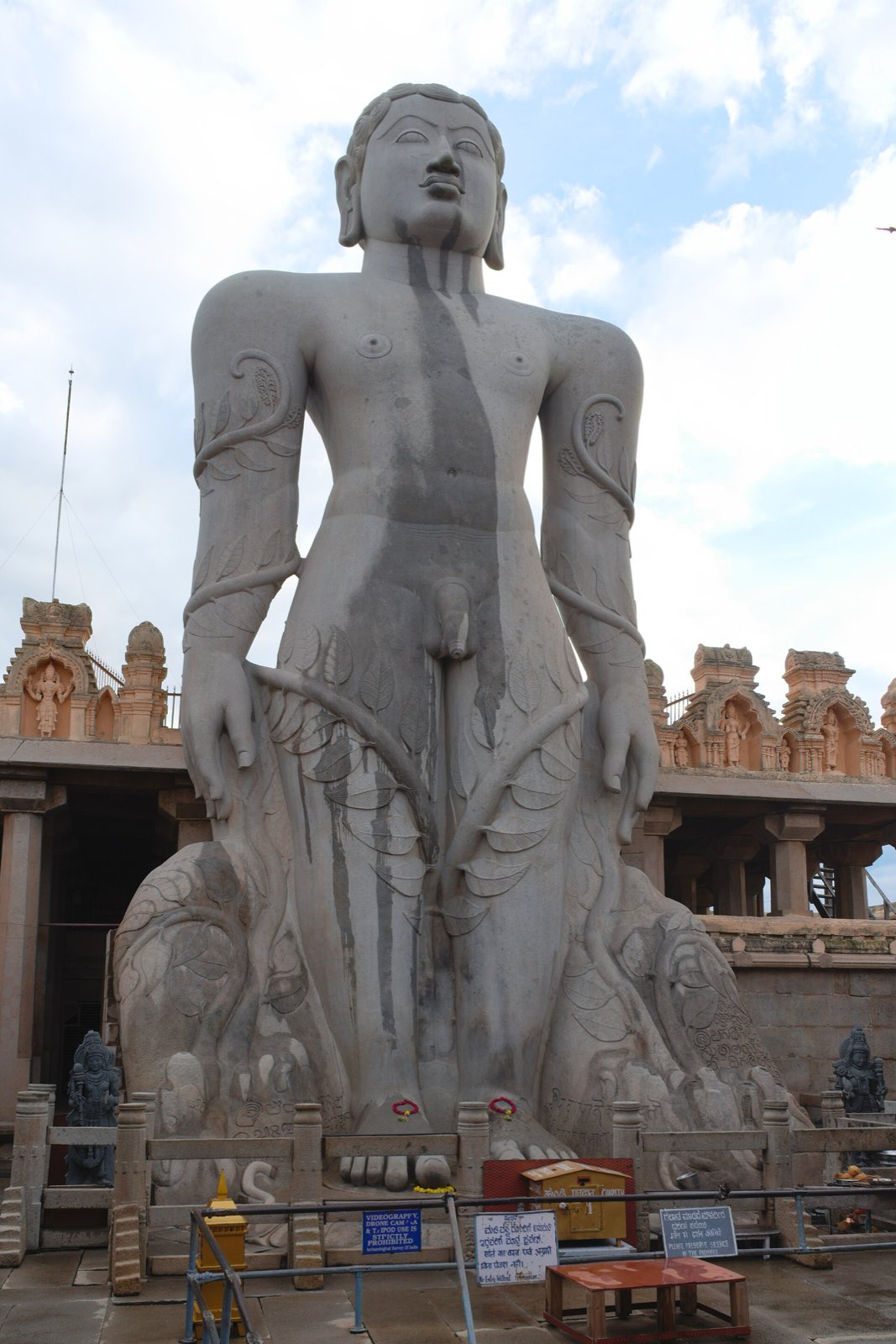
Gomateshwara at Shravanabelagola: A Colossus Carved from a Single Stone
How the Jains of the tenth century cut a seventeen-metre standing figure out of one granite rock on a hilltop — not a building at all, but the boundary where sculpture becomes architecture, and stillness becomes stone
Every other entry in this series is a building — something you enter, walk through, stand inside. This one is a figure: a single, colossal human form, nearly seventeen metres tall, carved around 981 CE out of one piece of granite on the summit of a hill in Karnataka. It is here deliberately, at the edge of the series, because the Gomateshwara colossus stands exactly on the boundary where sculpture becomes architecture — where a statue grows so large, and is so completely one with the living rock and the hilltop it commands, that it functions as a monument in the fullest architectural sense. It is one of the largest free-standing monolithic statues on earth, and one of the most serene.
The figure is Bahubali, called Gommateshwara, a revered figure in Jainism — a prince who, the tradition tells, won a great duel with his brother for their father's kingdom, and then, in the very moment of victory, was so overcome by the emptiness of worldly triumph that he renounced everything and stood in meditation until he attained spiritual liberation. The statue shows him in that final act of renunciation, and everything about its form expresses stillness carried to a superhuman extreme.
A figure of perfect stillness
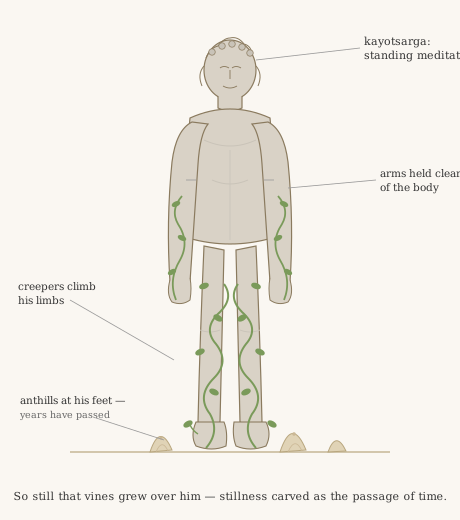
Understanding what you are looking at means reading the posture, because the whole meaning is in the stance.
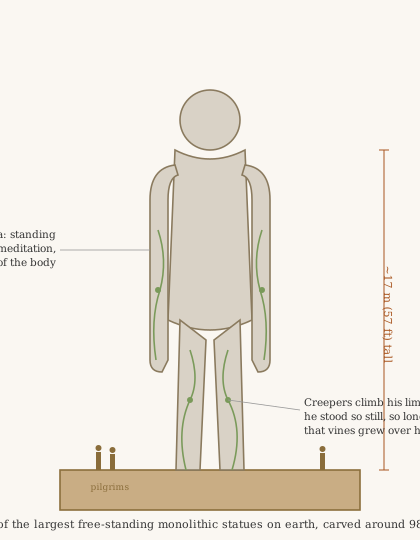
Bahubali stands in the posture called kayotsarga — literally "abandonment of the body" — the Jain stance of standing meditation: bolt upright, utterly motionless, arms hanging straight down but held slightly clear of the body, gaze serene and inward. He is nude, as befits the Digambara ("sky-clad") tradition of Jain ascetics, for whom the total renunciation of clothing expresses the total renunciation of worldly attachment. And climbing up his legs and arms, carved into the granite, are creepers and vines, with anthills at his feet — an extraordinary and beautiful device by which the sculptors conveyed the passage of time: Bahubali stood so still, in meditation, for so long, that plants grew up around his motionless limbs and insects built their mounds at his feet, and still he did not move. The vines are not decoration; they are the depiction of years passing over a body that has become, in its stillness, almost part of the landscape.
The scale is difficult to grasp from a photograph, which is why the tiny pilgrims at the base matter. At nearly seventeen metres — about the height of a five- or six-storey building — the figure dominates its hill and can be seen for kilometres across the surrounding plain. To climb the hundreds of rock-cut steps up the granite hill and arrive, at last, at its feet, is to be reduced to the scale of an ant oneself before the vast, calm, faintly smiling face far overhead.
Carving by taking away
The Gomateshwara connects, in the deepest way, to a tradition we have followed through this whole series — the Indian genius for rock-cut architecture, for making monuments not by building up but by cutting away.
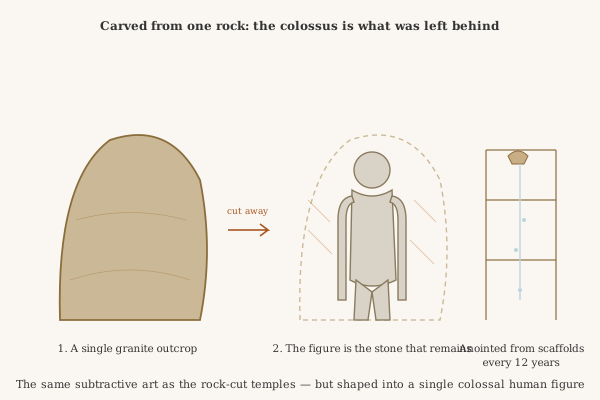
A normal statue is carved from a block that has been quarried and moved. The Gomateshwara is something rarer and more astonishing: it is monolithic, carved in place from a granite outcrop that was already part of the hilltop, so that the figure and the mountain are one continuous piece of stone. The sculptors did not add anything; they removed everything that was not Bahubali, cutting the waste rock away until the colossus stood revealed, still rooted to the living hill beneath its feet. There is no join, no assembly, no possibility of correcting a mistake — a single error in a face seventeen metres up could not be undone. It is the same subtractive art, demanding the same nerve and the same working-from-the-top-down, that produced the Kailasa temple at Ellora, the rathas of Mamallapuram and the caves of Elephanta — but here, instead of a temple or a hall, what was carved out of the mountain was a single human figure of colossal size.
The statue was commissioned around 981 CE by Chavundaraya, a general and minister of the Western Ganga dynasty that ruled this part of Karnataka, and it has been a supreme place of Jain pilgrimage ever since. Once every twelve years it is the focus of one of the most spectacular religious events in India, the Mahamastakabhisheka, the "great head-anointing," when scaffolding is raised around the colossus and it is bathed from above by thousands of devotees in cascades of milk, water, saffron, sandalwood, turmeric and precious substances that pour down the vast serene face and body — the motionless figure momentarily clothed in flowing offerings before standing bare again for another twelve years.
Sculpture as architecture
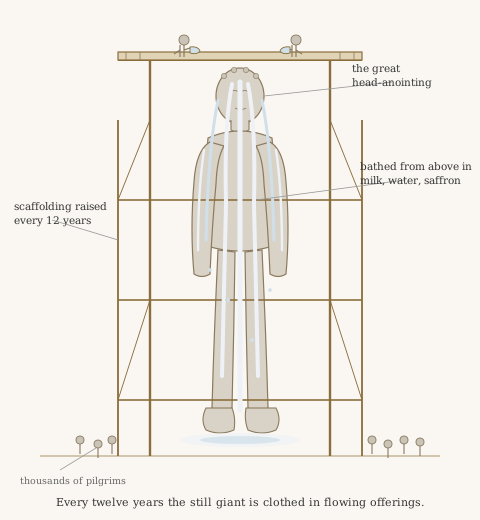
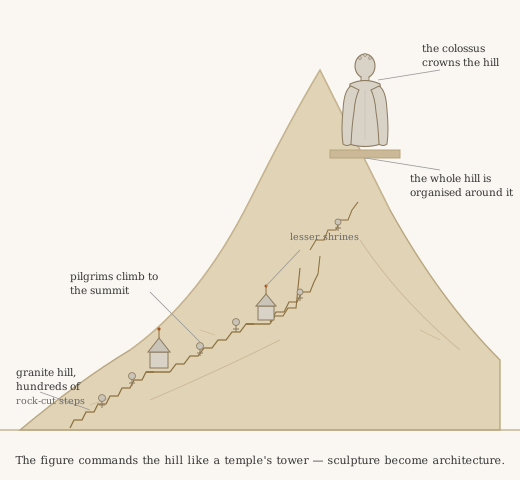
Why does a statue belong in a series of architectural wonders? Because at this scale the distinction dissolves. The Gomateshwara is not an object placed in a setting; it is the monument, the destination of a pilgrimage, the thing a whole sacred hill and its stairways and its lesser shrines are organised around — exactly as a temple's tower or a mosque's dome organises everything around it. It commands space, controls a skyline, and shapes the experience of everyone who approaches it, in precisely the way architecture does. And its method — the colossal monolith cut from living rock — is one of the defining techniques of Indian building, here pushed to a limit reached almost nowhere else in the world.
Set beside the other Jain monuments in this series, it completes the picture of that remarkable tradition. At Dilwara and Ranakpur the Jain genius expressed itself in the infinite carved delicacy of white marble interiors. Here it expresses itself in the opposite mode: not delicacy but immensity, not an enclosed jewel but an exposed colossus, not marble lace but raw granite mass — yet driven by the same underlying impulse, the pouring of enormous devotion and resource into a single overwhelming act of making. Renunciation, the emptying of the self, rendered as the emptiest and stillest of monumental forms: a giant standing motionless on a hill, letting the vines grow over him, gazing at nothing, for a thousand years.
Climb the hot granite steps, arrive breathless at those enormous calm feet, and look up the seventeen metres of serene stone to the faint smile far above, and you understand why this figure has drawn pilgrims for over a millennium — and why, though it is a statue and not a building, it stands unmistakably among the architectural wonders of India.
Part of the Architectural Wonders series. For the Jain tradition in marble, read the Dilwara temples and Ranakpur; for the rock-cut, monolithic art it shares its method with, the Kailasa temple at Ellora and the monuments of Mamallapuram.
Hero photograph: “The Gommateshwara Statue, Shravanabelagola” by Rohit14400, via Wikimedia Commons, licensed under CC BY-SA 4.0.
Export this guide
Related Guides — Deep-dive reading
Kailasa at Ellora: A Mountain Carved into a Temple
How 8th-century carvers made the largest monolith on earth — a complete multi-storey Dravidian temple, gateway to spire, released top-down from a single basalt hill with no scaffolding and no chance to correct a mistake. The supreme act of subtraction, and the climax of India's rock-cut story.
Architectural WondersBrihadeeswara: The Chola Tower That Never Fell
How an 11th-century Tamil emperor raised a 216-foot tower of solid granite — with no mortar, no iron and no machine — and why this colossal corbelled mountain has stood for over a thousand years where Konark's fell. The engineering, the 80-tonne capstone, and the lesson.
Architectural WondersThe Temples of Karnak: A Sacred City Built by Thirty Kings
How thirty pharaohs across two thousand years — from the Middle Kingdom to the age of Ramesses — kept adding to a single sacred precinct at Thebes until it became the largest religious complex of the ancient world, crowned by a hall of 134 colossal stone columns raised as a petrified papyrus marsh, a forest of stone built to be the very morning of creation for the King of the Gods, Amun-Ra.
Architectural WondersRelated Tools — Try Free
Before & After Studio
Generate AI before-and-after renders to preview how your redesign could look.
DesignAICircadian Light Meter
Patient-centric circadian lighting visualizer for Indian healthcare design — time-of-day × intensity → CCT, melanopic lux (EML / mEDI), melatonin suppression, and an alertness curve. Calibrated against WELL v2 L03 Circadian Lighting Design, CIE S 026:2018, Brainard 2001, and Lucas et al. 2014.
Circadian ToolFlooring Cost Calculator
Estimate the all-in cost of a floor — material, laying, wastage, skirting and GST — by area and material.
Flooring Calculator