
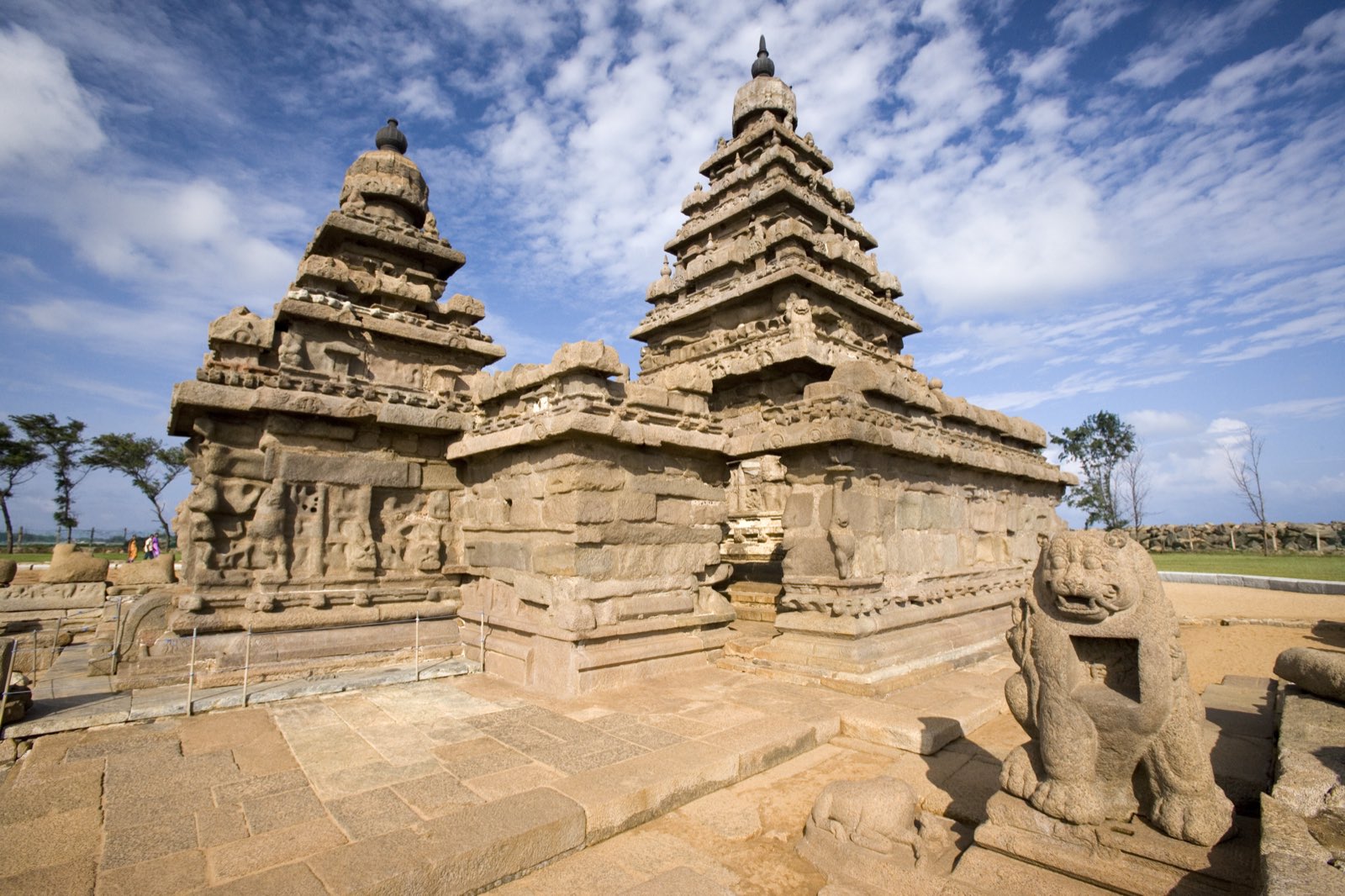
Mamallapuram: The Workshop Where the South Indian Temple Was Invented
How 7th-century Pallava carvers turned a granite shore into a full-scale sketchbook — five monolithic shrines and a temple by the sea — and worked out, in stone, the grammar of the Dravidian temple.
Some monuments are finished masterpieces. Mamallapuram — the old Pallava port on the Tamil coast, also called Mahabalipuram — is something rarer and, for an architect, more useful: a workshop left open. Scattered along a stretch of granite shore south of Chennai are shrines that were never completed, temples that experiment, and a cliff carved into a single enormous picture. Come here and you are not looking at the finished Dravidian temple; you are watching it being invented, in the 7th and 8th centuries, one experiment at a time.
That makes Mamallapuram the perfect place to open the southern thread of our Architectural Wonders series. We have already stood before the mature Dravidian tower — the thousand-year-old granite vimana of Brihadeeswara — and before the monolithic miracle of Kailasa at Ellora. Mamallapuram is where the ideas behind both were first worked out. It is the sketchbook, not the painting.
1. The Pancha Rathas — five temples, five roofs, one experiment
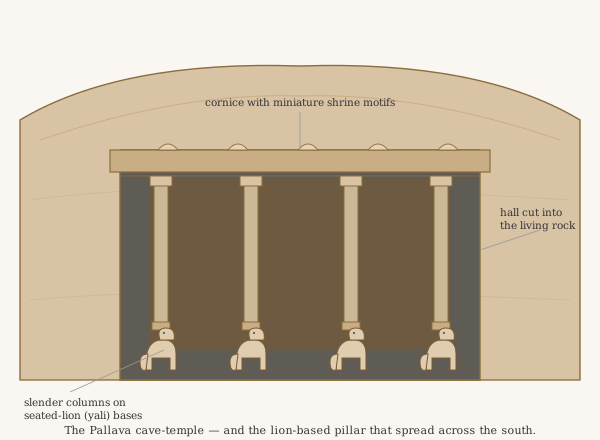
The most instructive monument on the shore is a group of five small shrines known as the Pancha Rathas — the "five chariots", named (much later, and quite arbitrarily) after the five Pandava brothers of the Mahabharata. Each is carved, whole, from a single outcrop of granite, cut downward from the top the way Kailasa would later be cut at giant scale. And each one tries a different roof.
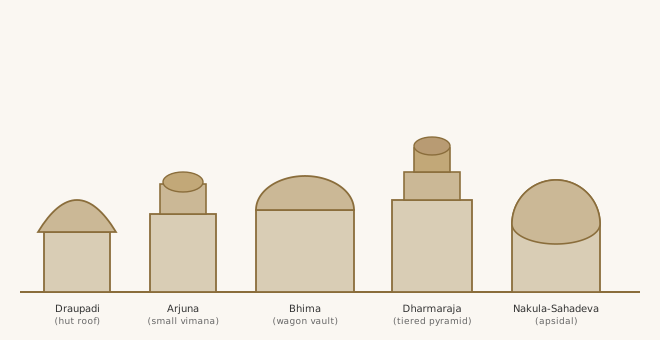
Read them left to right and you are reading a specimen board of temple types. The Draupadi Ratha is a tiny cell under a curved roof that copies a thatched hut in stone. The Arjuna Ratha is a small two-tier vimana capped by a domical crown — the seed of the Dravidian tower. The Bhima Ratha carries a long barrel-vaulted, wagon-style roof, remembering the timber halls of an earlier age. The Dharmaraja Ratha is the tallest, a stepped pyramidal tower of diminishing storeys — essentially a compact model of what the great southern vimana would become. And the Nakula-Sahadeva Ratha is apsidal, rounded at one end like an old Buddhist prayer hall. The clinching detail is that they are unfinished — so you can still see the tool marks and the half-cut forms, and read the Pallava masons' method directly. This is architectural research and development, preserved at full scale, in granite.
2. From carving to building — the great leap
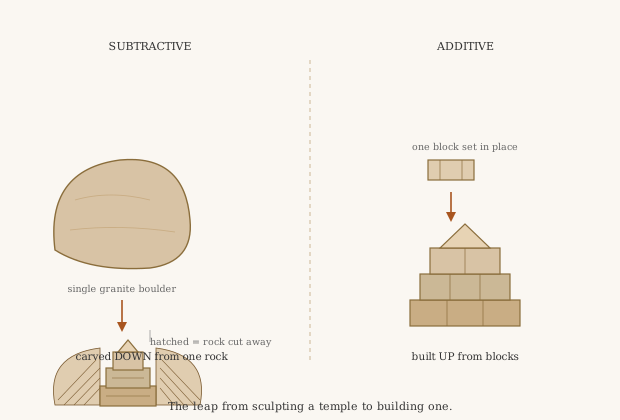
Everything so far is subtraction — form released from solid rock. The most important thing at Mamallapuram is the moment the Pallavas turned that around.
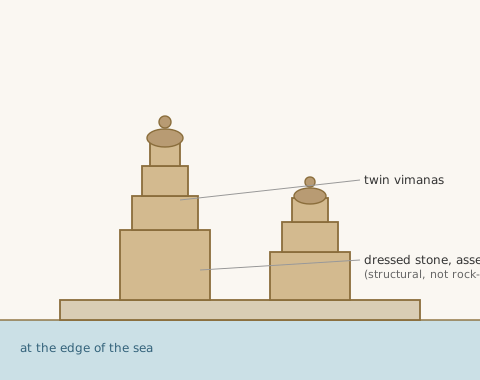
The Shore Temple, built around the early 8th century right at the water's edge, is one of the earliest structural stone temples in the south — that is, a temple assembled from dressed blocks of granite rather than carved from a single mass. Its twin stepped vimanas, of different heights, are the built version of the tower the Dharmaraja Ratha had only modelled. This is the pivotal transition in the whole southern tradition: from cutting a temple out of rock to building one up out of stones you can quarry and stack anywhere. Once you can build rather than only carve, you are no longer limited to sites with a suitable cliff — and the door opens to the vast structural temples, and eventually the towering Brihadeeswara, that define the south. The revolution at Mamallapuram is not a single building; it is a change of verb.
3. A cliff turned into a story
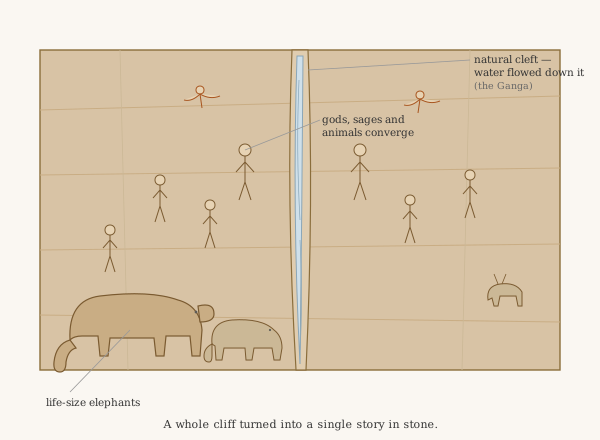
Mamallapuram also holds one of the greatest open-air sculptures in the world: an enormous bas-relief, some thirty metres long, carved across two huge boulders and usually called Arjuna's Penance or the Descent of the Ganges. Gods, sages, elephants and a cast of dozens converge on a natural vertical cleft in the rock — and there is evidence that water was once channelled to run down that cleft, so the carving became a literal, flowing river of the Ganges descending to earth. It is a masterclass in reading a site: the Pallava sculptors did not fight the boulders or the fissure between them; they made the fissure the subject. The rock's own accident became the picture's central event.
4. The port of the Pallavas
All of this was the work of the Pallava dynasty at the height of its power, in the 7th and 8th centuries. The city takes its name from the Pallava king Narasimhavarman I, titled Mamalla, the "great wrestler"; the Shore Temple belongs to the reign of the later Rajasimha. Mamallapuram was a working seaport, trading across the Indian Ocean, and its monuments were as much a display of royal ambition as of piety. The Group of Monuments at Mahabalipuram was inscribed by UNESCO in 1984.
5. What a modern architect can learn from Mamallapuram
- Prototype at full scale. The Pancha Rathas are not drawings; they are five 1:1 experiments in what a temple could be. Building the idea for real — testing the form at true size — teaches things no sketch or model ever will.
- The unfinished is a gift. Because the rathas were never completed, we can read exactly how they were made. Leaving the method visible — the marks, the logic, the half-resolved joint — can be more instructive, and more honest, than a flawless surface.
- Know whether you are subtracting or adding. Carving from rock and building from blocks are opposite acts with opposite freedoms. Mamallapuram's true breakthrough was recognising that once you build rather than carve, you are free of the site — a shift in method that unlocked a thousand years of architecture.
- Let the site set the subject. The Ganges relief made a natural crack in the rock its central event. The strongest interventions rarely impose on a site; they find the thing already there that wants to be the idea.
- One material, many possibilities. Everything here is the same coastal granite — and out of it the Pallavas drew hut, wagon, pyramid, apse, giant narrative and buildable tower. Range comes from imagination, not from a bigger material palette.
Mamallapuram is where the southern half of this series begins — not with a finished wonder, but with a shore full of experiments, and the priceless chance to watch a great architecture in the very act of being figured out.
References & further reading
1. UNESCO World Heritage Centre — Group of Monuments at Mahabalipuram (inscribed 1984). https://whc.unesco.org/en/list/249/
2. Encyclopaedia Britannica — Mahabalipuram and Pallava art and architecture. https://www.britannica.com/place/Mahabalipuram
3. Archaeological Survey of India — Group of Monuments at Mahabalipuram. https://asi.nic.in/
4. Tamil Nadu Tourism — Mamallapuram. https://www.tamilnadutourism.tn.gov.in/destinations/mamallapuram
Last verified 2026-07-04. Dates, attributions and the sequence from rock-cut to structural building follow standard archaeological and art-historical reference sources and are given as widely accepted approximations; the naming of the rathas after the Pandavas as a later convention, the unfinished state of the monoliths, and the water-channel reading of the Descent of the Ganges relief follow established scholarship.
Export this guide
Related Guides — Deep-dive reading
Pattadakal: Where India's Two Temple Grammars Meet
How the 8th-century Chalukyas built the temple at last in the open air — and set the curved spires of the North beside the stepped towers of the South, on one riverbank, as if in a single open-air showroom of styles. The site that crowned kings, named its architects, and gave Ellora its model.
Architectural WondersKailasa at Ellora: A Mountain Carved into a Temple
How 8th-century carvers made the largest monolith on earth — a complete multi-storey Dravidian temple, gateway to spire, released top-down from a single basalt hill with no scaffolding and no chance to correct a mistake. The supreme act of subtraction, and the climax of India's rock-cut story.
Architectural WondersBrihadeeswara: The Chola Tower That Never Fell
How an 11th-century Tamil emperor raised a 216-foot tower of solid granite — with no mortar, no iron and no machine — and why this colossal corbelled mountain has stood for over a thousand years where Konark's fell. The engineering, the 80-tonne capstone, and the lesson.
Architectural WondersRelated Tools — Try Free
Before & After Studio
Generate AI before-and-after renders to preview how your redesign could look.
DesignAIMain Door Design Selector
Answer a few questions and get a main-door style — traditional, contemporary, luxury or budget-smart — plus material.
Design SelectorCross-Ventilation Analyzer
Estimate airflow and air changes per hour (ACH) from room size, window areas, layout, and local wind — with NBC 2016 Part 8 compliance check.
Ventilation Calculator