
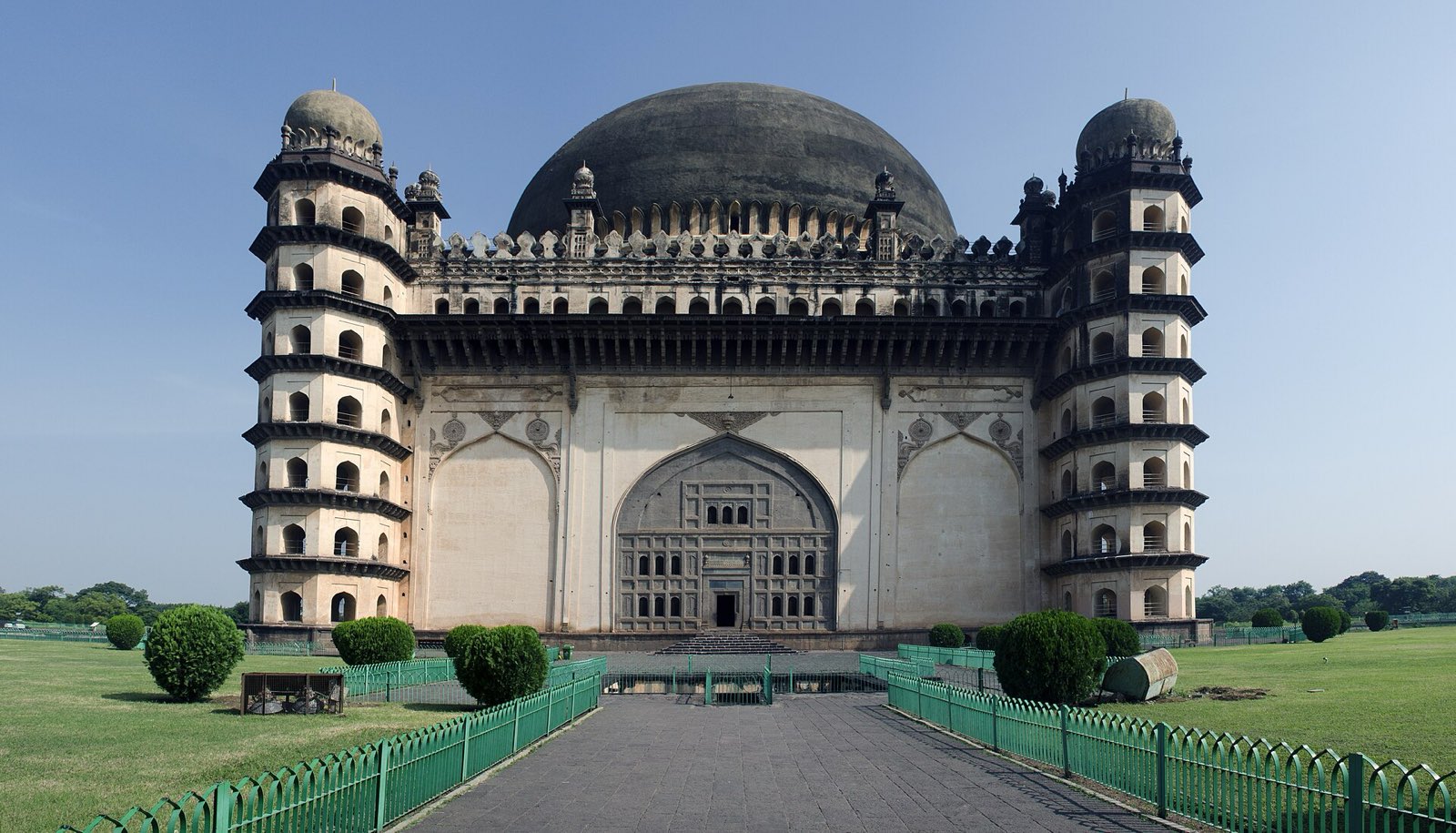
Gol Gumbaz, Bijapur: The Deccan Tomb That Roofed a Whole Hall with One Dome
How the sultans of Bijapur raised one of the largest domes in the world over a single vast room, balanced on a net of intersecting arches, with a gallery where a whisper travels right around the sky
Some buildings impress by their delicacy; the Gol Gumbaz impresses by its sheer, almost brutal audacity. It is a tomb in the Deccan city of Bijapur — now Vijayapura, in Karnataka — and it consists, essentially, of a single idea carried out at colossal scale: one vast cubic hall, roofed by one gigantic dome, with nothing in the room to hold that dome up. The dome is close to forty-four metres across on the outside, ranking it among the very largest masonry domes ever raised anywhere in the world (kin to Rome’s Pantheon, the largest unreinforced concrete dome, and to the record brick vault of the Arch of Ctesiphon), and the hall it covers is one of the largest single chambers under one roof on the planet. Standing beneath it, you feel less as though you are inside a building than inside a hollow hill.
The name means, roughly, "round dome", and the plainness of the name suits the plainness of the thing. Where the Mughals to the north pursued refinement, inlay and white marble, the Deccan sultans of Bijapur pursued mass, geometry and structural nerve. The Gol Gumbaz is the boldest thing they built, and one of the great feats of engineering in Indian architecture.
The tomb of an ambitious sultan
The building is the tomb of Mohammed Adil Shah, ruler of the Adil Shahi sultanate of Bijapur, one of the independent Muslim kingdoms of the Deccan that arose after the break-up of the older Bahmani sultanate. It was built in the mid-seventeenth century — completed around 1656, roughly contemporary with the Taj Mahal far to the north — and there is a persistent tradition that the sultan intended it to outdo, in sheer size, the tombs of his Mughal rivals. Whether or not that is literally true, the ambition is written all over it. This is a tomb built to overwhelm.
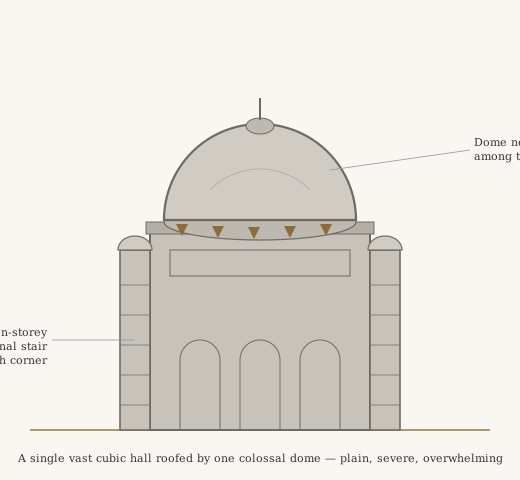
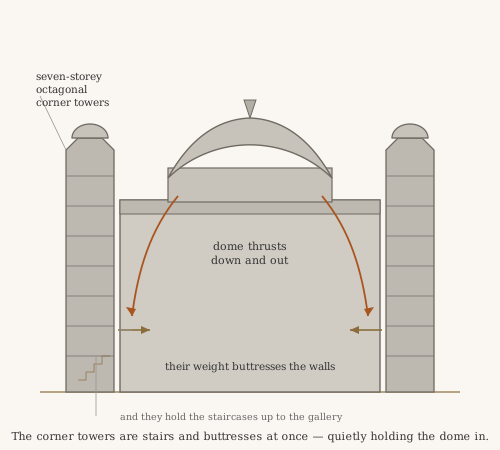
The form could not be simpler to describe: a plain cube about forty-seven metres on each side, built of dark grey basalt and mortar, crowned by a single hemispherical dome, with a seven-storey octagonal tower at each of the four corners. Those corner towers are not decoration — they contain the staircases that climb to the gallery at the base of the dome, and they also, crucially, act as heavy buttresses, their weight helping to resist the outward thrust of the enormous dome pushing down and out on the walls. The whole thing is severe, unornamented, almost military in its plainness. It relies for its effect not on carving or colour but on proportion and scale — the eternal architecture of the cube and the sphere.
The hidden genius: making a square carry a circle
The real marvel of the Gol Gumbaz is invisible from outside, and it answers a question that has troubled builders for millennia: how do you rest a round dome on a square room?
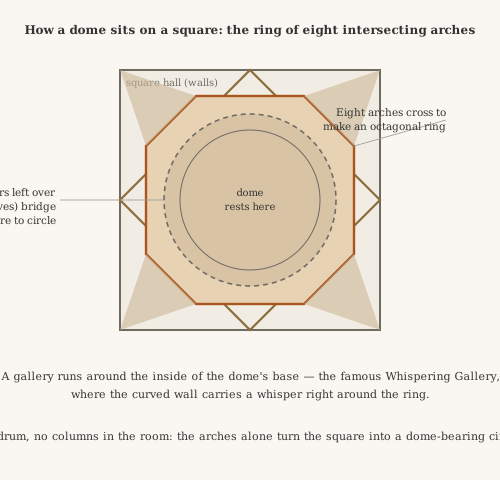
A dome is circular at its base; a room is square. The gap between them — the awkward corners where circle meets square — is the classic problem of domed architecture, and every great tradition solved it somehow. The Mughals usually solved it by first building an eight-sided drum, then filling the corners with small squinch-arches or ribbed pendentives, then setting a relatively modest dome on top. The builders of the Gol Gumbaz did something far more daring.
They threw eight great arches across the hall — two sets of arches, each set spanning between the midpoints of the walls, one set rotated against the other. Where these arches cross, they intersect and interlock to form a ring of eight stone segments, an octagon floating inside the square. The leftover triangles in the corners — the pendentives — bridge smoothly from the square walls up to this octagonal ring. And on that ring, and on the mutual support of those interlocking arches, the whole dome rests. There is no drum, no forest of internal columns, nothing standing in the room. The arches carry the load out to the walls and down through the buttressing corner towers. It is a piece of pure structural reasoning, and it lets the entire floor of the hall stay open and empty beneath the largest dome in the country.
The Whispering Gallery
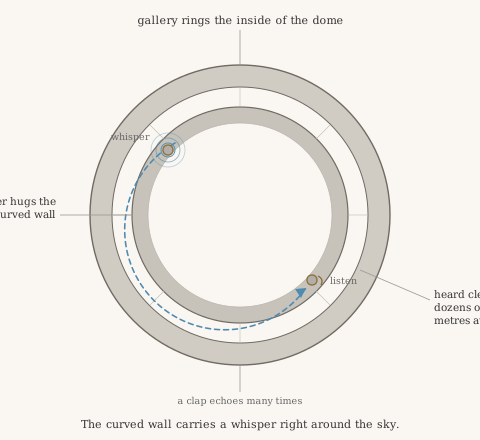
That intersecting-arch ring has a famous side effect. Around the inside base of the dome runs a narrow gallery, reached by climbing the corner towers, and its curved, hard, perfectly continuous surface makes it one of the most celebrated acoustic spaces in the world — the Whispering Gallery. A whisper spoken against the wall on one side travels around the smooth curve and can be heard clearly on the far side, dozens of metres away; a clap or a shout echoes many times over. The gallery is not an acoustic trick deliberately engineered so much as an accidental consequence of building a vast, smooth, circular vault — but it has delighted visitors for centuries, and it turns the abstract geometry of the dome into something you can hear as well as see.
The Deccan's own voice
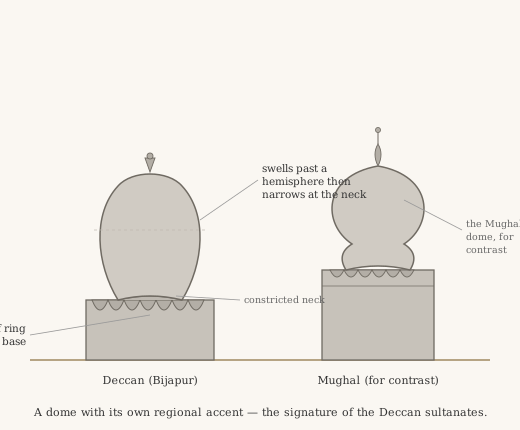
It is worth placing the Gol Gumbaz carefully, because it belongs to a strand of Indian architecture that gets less attention than the Mughal mainstream. The Deccan sultanates — Bijapur, Golconda, Ahmadnagar and their neighbours — were independent Muslim kingdoms of the peninsula, in constant rivalry with the Mughals to the north and drawing on their own mix of Persian, Turkish and local traditions. Their architecture has a distinct flavour: bulbous domes rising from a ring of petal-like leaves, slender minarets, and a taste for bold structural experiment and dark stone rather than the Mughals' red sandstone and marble. Bijapur is full of it — the elegant Ibrahim Rauza, the great Jama Masjid — but the Gol Gumbaz is its most extreme statement.
Set against the other Indo-Islamic monuments in this series, the contrast is instructive. The Taj Mahal seduces; the Gol Gumbaz confronts. Humayun's Tomb refines a Persian model; the Gol Gumbaz strips it back to raw geometry and then supersizes it. Where the Mughals hid their structure behind marble and inlay, the Deccan builders here let the structure — the cube, the sphere, the ring of arches — simply be the architecture. It is the difference between a jewel and a mountain.
Walk into that single stupendous hall, look up into the dark curve of the dome forty metres overhead, whisper a word to a friend across the gallery and hear it come back around the ring, and you understand why the Gol Gumbaz has awed everyone who ever stood in it. It is proof that in seventeenth-century India, the boldest architectural imagination was not only at Agra and Delhi, but in the sultanates of the Deccan, roofing a hall the size of the sky with a single astonishing dome.
Part of the Architectural Wonders series. For the Mughal domed tombs it rivalled, read about Humayun's Tomb and the Taj Mahal; for the Deccan's Hindu-empire neighbour and rival, see the ruined capital at Hampi.
Hero photograph: “Gol Gumbaz, Bijapur” by Rangan Datta, via Wikimedia Commons, licensed under CC BY-SA 4.0.
Export this guide
Related Guides — Deep-dive reading
The Pantheon: The Dome That Has Never Been Beaten
Nearly nineteen centuries ago the Romans poured a hemisphere of concrete 43 metres across, left a single round hole open to the sky at its summit, and walked away — and it is still, today, the largest unreinforced concrete dome on Earth. A temple to all the gods that became a church, the best-preserved building of ancient Rome, and the ancestor of every great dome from Florence to the United States Capitol.
Architectural WondersThe Jama Masjid, Delhi: A Courtyard for Twenty-Five Thousand, Facing Mecca
How Shah Jahan built the great congregational mosque of his new capital — a vast raised courtyard, three marble domes and two soaring minarets — and why a mosque is a building defined not by a centre but by a direction
Architectural WondersHampi: The Stone City of Vijayanagara
How a medieval South Indian empire built an entire capital out of the boulder field it stood on — granite that sings, a chariot carved in rock, two architectural worlds fused into one — and how the whole of it fell in a single year.
Architectural WondersRelated Tools — Try Free
Before & After Studio
Generate AI before-and-after renders to preview how your redesign could look.
DesignAIAcoustic Privacy (STC) Visualizer
Indian healthcare acoustic visualizer — compare wall assemblies and noise sources, see received SPL after STC attenuation, and check FGI 2018 / IS 1950 / NABH speech-privacy compliance with live dual-canvas waveform.
Acoustic ToolCircadian Light Meter
Patient-centric circadian lighting visualizer for Indian healthcare design — time-of-day × intensity → CCT, melanopic lux (EML / mEDI), melatonin suppression, and an alertness curve. Calibrated against WELL v2 L03 Circadian Lighting Design, CIE S 026:2018, Brainard 2001, and Lucas et al. 2014.
Circadian Tool