
Future-Proofing a Plot Investment
Land as an asset — buying ahead of the city's growth, reading the master plan and infrastructure trajectory, protecting value through clear title and RERA, and the carrying-cost and climate-risk realities of holding land
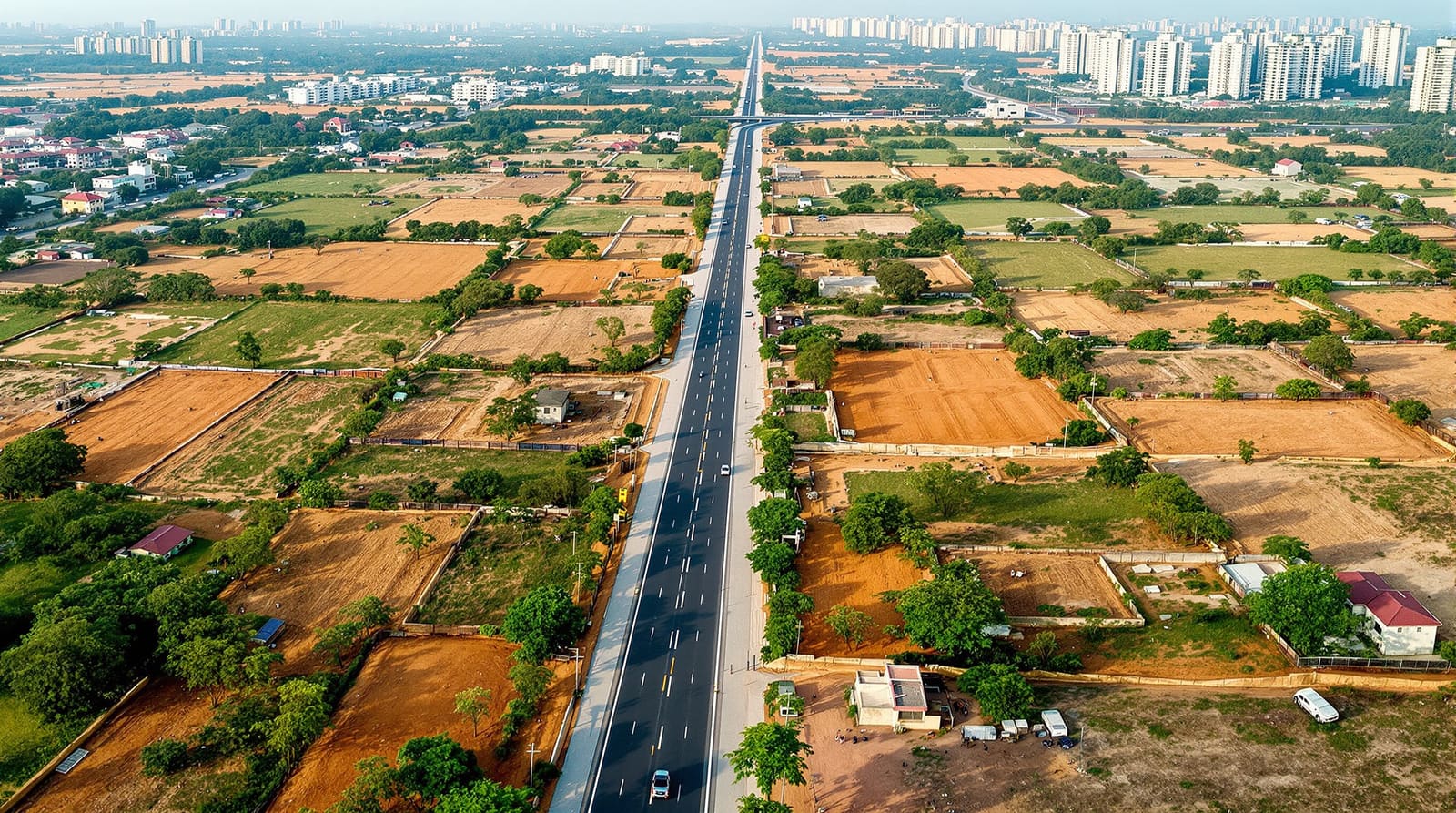
A retired bank manager in Hosur once told me, with quiet pride, that he had bought a plot in 2008 for what he could now barely buy a small car. The parcel sat on what was then a dusty link road past the edge of town — goats, a brick kiln, a single tea stall. He nearly sold it twice in the lean years, when the land just sat there earning nothing while the property tax demand arrived faithfully every spring. Then the road was widened, an electronics cluster announced a unit nearby, and a feeder bus route appeared. The land he had almost given away became the most sensible thing he ever did with his savings.
For every story like his there are three that end the other way: a plot bought in a layout that never got services, a corner that lost a strip to road-widening, a title that turned out to be tangled in a family dispute, or a low-lying parcel that floods every second monsoon and now finds no buyer. The difference between the two outcomes is rarely luck. It is almost always whether the buyer read the land as an asset that has to survive time, taxes, litigation, climate and the slow grind of a city's growth — not just as a nice spot to build a house someday.
A plot is not just where your house will stand; it is capital parked in the ground, and whether that capital grows or quietly erodes depends on the path of the city, the soundness of the title, the trajectory of services, and the climate of the place — far more than on the plot itself.
The land-as-investment lens
It helps to separate two things that buyers routinely blur together. One is the house you might build — its design, its rooms, its eventual resale appeal. That is a real concern, and we treat it separately in designing for future resale value and more broadly in future-proof home design. The other, the subject of this guide, is the land — the plot as a standalone asset that you may hold for years, possibly before a single brick is laid.
Land behaves differently from a building. A house depreciates the moment you finish it; fittings age, tastes change, and the structure needs maintenance to hold its value. Land, in principle, does the opposite — it can appreciate while you do nothing. But "in principle" hides a great deal. Raw land does not appreciate evenly or automatically. It appreciates because something happens around it: a road, a transit line, an employer, a relaxation of land-use rules, a flood-control project. And it can stagnate or lose value just as decisively when the things around it go the wrong way. Future-proofing a plot investment is the discipline of buying so that the probable forces of the next decade push your value up, and protecting against the forces that could push it down.
This is not a get-rich scheme, and nothing here is financial advice — it is the prudent reading any careful buyer should do before locking capital into the ground for years.
Location and the path of growth
The single largest driver of plot value is where the city is going, not where it is today. Cities grow along corridors — ring roads and outer ring roads, arterial widenings, metro and suburban-rail alignments, expressways, and the access roads to new airports, IT parks and industrial estates. Value tends to ride ahead of these along the announced path, then consolidate once the infrastructure actually opens. The seasoned buyer's instinct is to buy ahead of confirmed infrastructure — close enough to benefit, early enough that the price has not already absorbed the news.
The word that matters is confirmed. A line on a glossy brochure is not a metro. The discipline is to trace the announcement back to a credible source: a sanctioned alignment in the development authority's plan, a tendered or funded road project, an industrial allotment that has actually broken ground. Many corridors are announced, re-announced and quietly shelved for a decade. Buying on a real, funded, under-construction corridor is investing; buying on a rumour is speculating, and you should know which one you are doing.
Equally, proximity can cut both ways. Being near a transit corridor is usually good for value; being on the land that gets acquired for it is not. Understanding what could change around your parcel — and what the authorities can do to it — is its own skill, covered in understanding site constraints, and at the wider neighbourhood scale in how to design a residential layout.
Reading the master plan and land use
Before you fall for a view or a price, read the development plan. Every planning authority maintains a master plan or development plan that zones land — residential, commercial, mixed, industrial, agricultural, green belt, public/semi-public — and marks proposed roads, reservations and infrastructure. This document, more than the seller's optimism, tells you the legal future of the parcel.
Three questions are worth real effort. First, what is the land use, and will it stay that way? A plot zoned residential in a stable residential pocket is a different asset from one in a green belt or an agricultural zone awaiting conversion that may never come. Second, is there a reservation or a proposed road over the plot? Master plans routinely mark widened roads, parks, schools and utility corridors across private land; if a 30-metre road is proposed through your frontage, a chunk of your area is effectively spoken for. Third, what is happening to the neighbours? A purely residential surrounding that the plan shows turning into a commercial or industrial belt will change the character — sometimes raising value, sometimes ruining residential desirability. The local Development Control Regulations also govern how much you can eventually build — FSI/FAR, ground coverage and setbacks all vary by city and by plot size, and a generous or rising FSI is itself a value driver, as explained in FSI and FAR computation.
Legal soundness as value protection
Nothing destroys plot value faster or more completely than a legal defect. Appreciation is irrelevant if you cannot sell, mortgage or build without a court case. Treat legal due diligence not as paperwork but as the foundation of the asset's worth.
A clear, marketable title is the floor. That means a clean chain of ownership, an encumbrance certificate showing no undisclosed loans or charges, and mutation/khata records in the right name with taxes paid up to date. In Bengaluru, the A-khata versus B-khata distinction alone can swing value and bankability sharply; equivalents exist under other names elsewhere. The layout matters too: a plot in an approved layout — sanctioned by the planning authority, and for newer projects registered under RERA — is a fundamentally sounder asset than one in an unapproved or "revenue" layout where regularisation is uncertain and bank finance is hard to get. RERA registration for a project gives you a documented, accountable promoter and recorded approvals; its absence on a new layout should make you ask why.
A title problem does not merely cap upside; it removes liquidity entirely. Litigated land is nearly unsellable except at a steep discount to a buyer willing to inherit the fight. The prudent move is an independent advocate's title opinion before money changes hands — a small cost against the size of the capital at risk. This legal-soundness lens overlaps closely with the buy-or-pass decision itself, which we walk through in how to evaluate a residential plot.

Infrastructure and services trajectory
A plot with a clear title in the right zone can still disappoint if the services never arrive. The question is not only "is there water, sewerage, power and a proper road today?" but "is there a credible, funded plan for them to arrive, and when?" A serviced plot commands a premium and is buildable now; an unserviced one is cheaper for a reason and may stay that way.
Be specific. Is there a metalled approach road of adequate width with legal access — not a courtesy path across someone else's land? Is the area on the municipal water and underground-drainage network, or does it depend on borewells and septic tanks (with all the water-table and recharge worries that implies)? Is there a sanctioned power connection, or only a promise? An honest reading of where services are heading separates a parcel that will quietly become buildable from one that will quietly remain a field with a fence.
The appreciation versus liquidity trade-off
Here is the trade-off that catches patient buyers off guard. The plots with the highest appreciation potential — far out along a future corridor, early in an emerging layout — are usually the least liquid. Few buyers want them yet, so if you need to exit, you sell slowly and at a discount. The plots that are easy to sell quickly — established residential pockets, fully serviced, near demand — have usually already priced in their growth, so the upside is gentler.
Neither is wrong; they suit different purposes. But you should never confuse them. Money you might need within a few years has no business in an illiquid frontier plot, however exciting the corridor. Money you can genuinely leave alone for a decade can afford to be patient and take the appreciation bet. Match the plot's liquidity profile to your own timeline before you fall for the price.
Carrying costs and the risk of holding raw land
Raw land is not a passive asset that sits politely earning. It carries costs and risks every year you hold it, and these quietly eat into the eventual gain.
There is property tax, payable whether or not you build. There is the maintenance and defence of the boundary — an unbuilt, unwatched plot is the classic target for encroachment, and reclaiming land from a squatter or a neighbour's "temporary" extension is slow, costly and sometimes impossible. There is the opportunity cost of idle capital sitting in the ground earning nothing while it could be working elsewhere. And there is the simple risk of time: zoning can change against you, a corridor can shift, a flood can redraw desirability. Holding land is a position with running costs, not a one-time purchase. Budgeting for those costs honestly is part of deciding whether the appreciation will actually beat them.
This is the strongest argument for building sooner rather than later once a plot is sound and serviced. A built, occupied house earns rent or saves it, marks your presence against encroachment, and crystallises the land's potential. Holding raw land indefinitely "to see how it grows" can be the costliest patience of all if the carrying costs outrun the gains.
Future FSI and transit-oriented upside
Some of the largest, least visible value moves come from regulatory change. When a planning authority raises permissible FSI/FAR in an area, every plot there can suddenly support more built-up area — and value tends to follow buildability. Transit-oriented development (TOD) policies, which allow higher density along metro and suburban-rail corridors, are a deliberate version of this: land within the TOD influence zone of a new line can see its development potential — and price — step up.
You cannot bank on a policy that has not happened, and chasing rumoured FSI hikes is its own form of speculation. But it is worth knowing whether your plot sits where such upside is plausible — along a real transit corridor, in an area the plan flags for densification — because it shifts the long-run odds in your favour without any effort on your part.
Climate and ESG risk to value
A factor that barely registered a decade ago now moves prices: climate resilience. As Indian cities flood more often and water stress deepens, the location of a plot relative to these risks increasingly determines its desirability and its value. Buyers, lenders and insurers are all beginning to discriminate.
A low-lying, flood-prone parcel — in a filled-up tank bed, on a natural drainage line, below the surrounding road level — is a depreciating risk dressed as a bargain. Each flood erodes its appeal and its price, and no amount of design fully fixes a fundamentally wet site. A plot in a severely water-stressed zone, dependent on a falling water table with no municipal supply in sight, carries a quieter version of the same problem. Conversely, well-drained, well-serviced, resilient locations increasingly command a premium precisely because buyers have learned to fear the alternative. Reading the contours, levels, drainage and water table is core site-reading work — covered in why topography matters — and here it is also a direct reading of future value.
| Value driver | What to check | The risk if you don't |
|---|---|---|
| Growth corridor & access | Sanctioned, funded road / metro / employer alignment near the plot | Buying on a rumour that is shelved; value never arrives |
| Master plan & land use | Zoning, reservations & proposed roads over or beside the plot | Road-widening or down-zoning quietly takes area or character |
| Title & khata | Clear chain, encumbrance certificate, correct khata, taxes paid | Litigation freezes the asset; near-zero liquidity |
| Approved layout & RERA | Planning sanction; RERA registration on newer projects | Unapprovable plot; no bank finance; hard resale |
| Services trajectory | Road width, water, sewerage, power — present or funded | Cheap "land" that stays unbuildable for years |
| Liquidity vs horizon | How fast you could sell, against when you need the money | Capital trapped in an illiquid frontier plot |
| Carrying cost | Property tax, boundary defence, idle-capital cost | Holding costs & encroachment erode the gain |
| Climate & water | Flood lines, levels, drainage, water-table trend | Flood-prone or water-stressed land loses value over time |
Diversification and not over-leveraging
A final, sober point. Land is one asset class, and an illiquid, lumpy, slow-moving one. Putting nearly all of a family's savings into a single plot — and borrowing heavily to do it — concentrates risk in exactly the way prudent investing warns against. If the corridor stalls, the title turns out clouded, or you need cash in a hurry, a single large plot gives you no room to manoeuvre.
The prudent posture is restraint: size the plot to a sensible share of your wealth, keep the leverage modest enough that the carrying costs and any EMIs do not strain you through the lean holding years, and keep enough liquid elsewhere that you are never forced to sell the land at the wrong moment. The best plot investment is one you can afford to be patient with — and patience, not cleverness, is what usually turns ground into gain.
References
- National Building Code of India 2016 (Bureau of Indian Standards) — Part 2 on development control and general building requirements.
- The relevant State Town & Country Planning Act and the local Development Control Regulations / building bye-laws (FSI/FAR, ground coverage, setbacks, land-use zoning — vary by authority).
- The Real Estate (Regulation & Development) Act, 2016 (RERA) and the applicable State RERA rules.
- The development authority's Master Plan / Comprehensive Development Plan and Transit-Oriented Development policy for the relevant city.
- Kevin Lynch & Gary Hack, Site Planning (3rd ed., MIT Press) — siting, growth and land suitability.
- Joseph De Chiara & Lee Koppelman, Site Planning Standards — services, access and layout norms.
Read this alongside how to evaluate a residential plot for the buy decision and understanding site constraints for what could change around your land — then, when you are ready to picture the home itself, explore the possibilities with DesignAI.
Export this guide
Related Guides — Deep-dive reading
Plot Due Diligence in India: The Complete Pre-Purchase Check (2026)
Before you pay a rupee for a plot, run the full pre-purchase check with your lawyer and a licensed surveyor - legal title, revenue records, planning approvals, physical survey and financial dues. This guide walks through each pillar, gives you a checklist and tells you when to walk away.
Buying LandUnderstanding Building Bye-Laws in India: A Homeowner's Guide
What municipal building bye-laws are, who makes them, and how to find and read the ones that actually govern your plot
Building Regulations & ComplianceUnderstanding Site Planning for Residential Projects
A homeowner's landscape guide to reading your plot's sun, wind, water, soil and trees before zoning and building the grounds.
LandscapeRelated Tools — Try Free
Stamp Duty Calculator — All Indian States
Stamp duty + registration charges for all 28 states and 8 UTs — gender concessions, urban/rural variants, metro cess built in.
Stamp DutyRainwater Tank Sizer
How big should your rainwater tank be? Computes annual harvest, recommended tank capacity in litres, water-bill savings, and payback — for 10 Indian cities.
RWH CalculatorMonsoon-Readiness Checklist
Pre-rain home audit across 9 categories — terrace, drains, waterproofing, electrical, HVAC, pest, vehicles, documents.
Seasonal Audit