

Understanding Building Bye-Laws in India: A Homeowner's Guide
What municipal building bye-laws are, who makes them, and how to find and read the ones that actually govern your plot
You have the plot. You have a rough idea of the home you want. And then someone says a sentence that stops you cold: "Check the bye-laws first." Suddenly there are setbacks, FAR, ground coverage, sanctioned plans, and a development authority you have never dealt with. It feels like a foreign language written by people who do not want you to build.
Here is the calmer truth. Building bye-laws are simply the rulebook that says what you are allowed to build on your particular plot, in your particular city. They decide how much of the land you can cover, how tall you can go, how far the building must sit from the boundary, how many cars you must park, and dozens of smaller things like the minimum size of a bedroom or the width of a staircase. They are not optional, and they are not the same in every city. This guide explains, in plain language, what these rules are, who writes them, how they are layered on top of each other, and how an ordinary homeowner can find and read the ones that actually govern their plot, before a single brick is laid.
1. What "building bye-laws" actually are
A building bye-law is a piece of local law. "Bye-law" (also spelled by-law) just means a rule made by a local body rather than by Parliament or a state legislature directly. Your municipal corporation or development authority is given the power, under a state law, to write these rules and to enforce them when it sanctions (approves) your building plan.
Think of them as the conditions attached to permission to build. Before you start construction on most plots, you must get your plan sanctioned by the local authority. The authority checks your drawings against the bye-laws. If the drawings comply, you get a building permit (sanctioned plan). If they do not, the plan is returned for correction. The bye-laws are the yardstick used in that check.
Bye-laws cover two broad things. First, the planning envelope: where on the plot the building may sit, how big and how tall it may be. Second, the construction and safety details: room sizes, ventilation, staircases, sanitation, fire safety, structural and electrical standards. The first set protects the neighbourhood and the city; the second set protects the people who will live in the building. (For a fuller answer to the deeper question of why any of this exists, see why building rules exist.)
2. Who makes them, and the hierarchy you need to understand
This is where most homeowners get confused, because several different documents seem to claim authority. They actually sit in a clear hierarchy, from national model to local law.
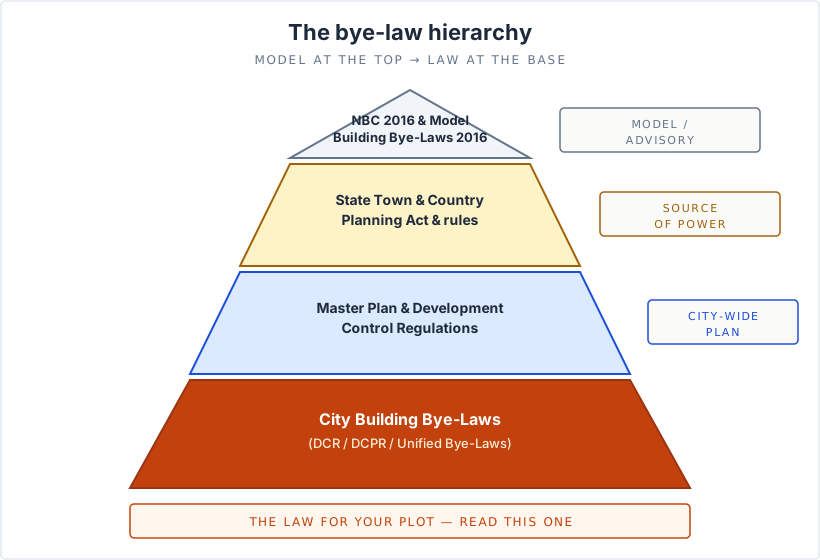
The national model code (advisory). At the top is the National Building Code of India, NBC 2016, published by the Bureau of Indian Standards as document SP 7. The NBC is a model code. It is technically a recommendation, not automatically law. It covers structural design, fire and life safety, plumbing, electrical and similar standards in great detail. Alongside it, the Ministry of Housing and Urban Affairs (through its Town and Country Planning Organisation, TCPO) published the Model Building Bye-Laws 2016, a template that states and cities can adapt. Neither becomes binding on you by itself.
State law (the source of power). Each state has a Town and Country Planning Act (the exact name varies) plus rules made under it. This state law creates development authorities and gives municipal bodies the power to make and enforce bye-laws. This is the legal layer that turns a model into something enforceable.
Local bye-laws and development control regulations (the actual law for your plot). Finally, your city's municipal corporation or development authority issues the document that actually governs your plot. It may be called Building Bye-Laws, Development Control Regulations (DCR), Development Control and Promotion Regulations (DCPR), or Unified Building Bye-Laws. Many cities adopt large parts of the NBC and the Model Bye-Laws into this local document, which is how a "model" code ends up being mandatory for you in practice.
The key takeaway: the document that binds you is the local one. The NBC and the Model Bye-Laws are where many of its provisions come from, but you must read your own city's regulations.
3. What bye-laws typically regulate
Bye-laws cover a long list. Here are the items that matter most to a homeowner building or extending a house, with a one-line plain-English explanation of each.
| Item | What it means in plain language |
|---|---|
| Permitted land use / zoning | Whether your plot is marked residential, commercial, mixed, industrial, etc. A residential plot generally cannot become a shop or factory. |
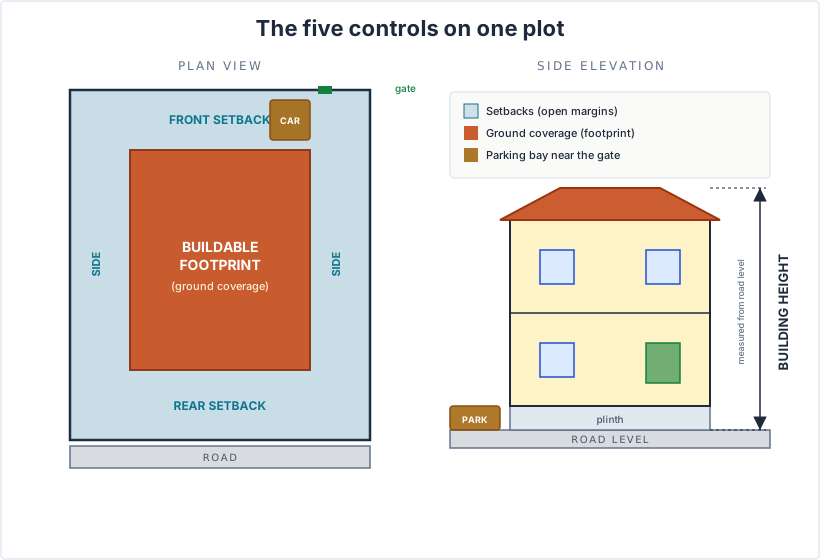
| FAR / FSI | Floor Area Ratio (also Floor Space Index): the total built-up floor area you may construct, expressed as a multiple of the plot area. Caps overall bulk. |
| Ground coverage | The maximum footprint of the building on the ground, as a percentage of plot area. |
| Setbacks | The compulsory open gap between the building and each boundary: front, rear and two sides. |
| Building height | The maximum height, often linked to the width of the road in front and to fire-service reach. |
| Parking provision | Number of car/two-wheeler spaces you must provide on your own plot. |
| Minimum room sizes and ceiling heights | Smallest allowed area for habitable rooms, kitchens, bathrooms, and the minimum floor-to-ceiling height. |
| Ventilation and open space | Minimum window/opening area and internal courtyards or shafts for light and air. |
| Plinth | Minimum height of the floor above ground, partly for flood and drainage protection. |
| Staircase width and headroom | Minimum stair dimensions so people can move and escape safely. |
| Sanitation and drainage | Required toilets, septic/sewer connection, drainage. |
| Fire safety | Escape routes, materials and equipment, scaled to building height and use. |
| Rainwater harvesting | Mandatory rainwater capture above a certain plot size in many cities. |
| Solar / green norms | Solar water heating or panels, and green-building measures, required in some cities. |
Four of these deserve their own deeper reading because they cause the most disputes: FAR/FSI (see how FSI/FAR is computed), setbacks (see why setbacks matter), and height (see building height restrictions explained).
4. The numbers vary, so think in ranges
The single most important habit to build is this: never assume a number. Setbacks, FAR and coverage change by city, by zone within a city, by plot size, and by the width of the road in front of your plot. A figure that a neighbour quotes, or one you read on a generic blog, may be wrong for your exact plot.
To give you a feel for the variation without inviting you to copy figures, here is how a few well-known regimes differ in character. Treat every value as indicative only, and verify against your local bye-law or DCR.
| City / regime | Governing document (real instrument) | What tends to stand out |
|---|---|---|
| Delhi | Unified Building Bye-Laws for Delhi 2016, read with the Master Plan | A single unified bye-law adopted across Delhi's municipal bodies; FAR and coverage banded by plot size. |
| Mumbai (Greater Mumbai) | Development Control and Promotion Regulations (DCPR) 2034 | High-density rules; FSI strongly tied to road width and to chargeable/fungible components; very different from the rest of Maharashtra. |
| Rest of urban Maharashtra | Unified DCPR (UDCPR) 2020 | A single state-wide regime for most cities, but it explicitly excludes Greater Mumbai. |
| Bengaluru | BBMP building bye-laws and BDA regulations | Different rules inside BBMP city limits versus BDA layout areas; jurisdiction itself matters. |
| Many Tier-2 cities | State Town and Country Planning department rules, adopted locally | Often closely follow the Model Building Bye-Laws 2016, sometimes with a separate authority for the planned versus older parts of the city. |
Notice what this table is really telling you. The hard part is often not the number itself but knowing which document and which authority applies to your specific plot. In Mumbai it depends on whether you are inside Greater Mumbai. In Bengaluru it depends on whether your plot falls under BBMP or BDA. Establishing jurisdiction is step one.
5. How to find and read your own city's bye-laws
You can do most of this yourself before you ever pay a professional.
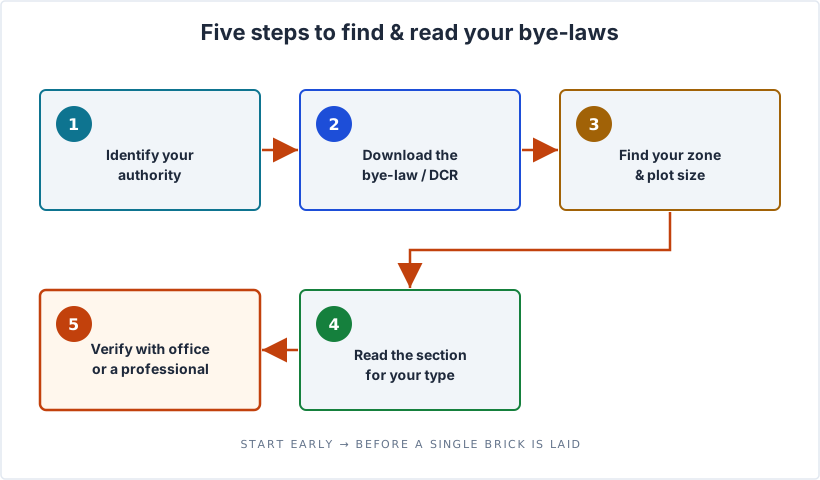
1. Identify the authority for your plot. Find out whether your plot falls under a municipal corporation, a development authority, a planning authority, or a panchayat. Your property tax bill, sale deed, or the local revenue office can tell you. This single fact decides which rulebook applies.
2. Download the actual document. Go to the official website of that authority or the state Town and Country Planning department. Look for "Building Bye-Laws", "Development Control Regulations", "DCPR", or "Unified Building Bye-Laws". Use the official source, not a forwarded PDF of unknown vintage, because these documents are amended often.
3. Find your zone and plot category. The document usually groups rules by land-use zone (residential, commercial, etc.) and by plot size band and road width. Locate the row or section that matches your plot.
4. Read the section for your building type. A single house, a row of houses and an apartment block follow different sub-rules. Read the part that matches what you intend to build.
5. Verify with a human. Bye-law language is dense and cross-referenced, and amendments may not be obvious. Confirm your reading with the authority's helpdesk or a licensed architect/engineer empanelled with that authority. Our Building Bye-Law Checker tool can give you a quick first-pass estimate, and the India Regulatory Atlas, city by city helps you locate the right authority and document. Use these as a starting point, not as the final word.
When you read, keep a simple notebook with five answers: my zone, my permitted FAR, my ground coverage, my four setbacks, my maximum height. Those five numbers shape almost every early design decision.
6. What needs sanction, and what is usually exempt
Not every act of construction needs a fresh sanction, but the safe default is to assume it does and check.
New construction of a house, and any addition that increases floor area or changes the structure, almost always needs a sanctioned plan before you start. Building without sanction, or building differently from the sanctioned plan (for example eating into a setback or exceeding your FAR), is unauthorised construction.
Minor works are often treated more lightly. Many bye-laws allow ordinary repairs, replastering, repainting, replacing fixtures, or putting up a compound wall within limits without a full sanction, and some cities have fast-track or self-certification routes for small plots. But the exact list of exempt works, and any size or height limits on them, is set by your local bye-law. What is exempt in one city is not necessarily exempt in another. Never treat "my contractor said it is fine" as permission.
7. What happens if you ignore the bye-laws
The consequences are real, escalating, and sometimes irreversible.
- Notice and stop-work. The authority can issue a notice and order construction to halt.
- Penalty. Many regimes allow monetary penalties, and a few permit limited regularisation (compounding) of small deviations on payment, but only within tight limits and never as a guaranteed right.
- Sealing or demolition. Portions built in violation, such as an encroached setback or an extra unauthorised floor, can be sealed or demolished at the owner's cost. Indian courts have repeatedly upheld demolition of unauthorised construction and have warned against treating long occupation or money already spent as a reason to spare it.
- No occupancy certificate. After construction, you apply for a completion/occupancy certificate (OC), confirming the building was finished as sanctioned and is fit to occupy. If your building violates the bye-laws, you may not get an OC. Without an OC, occupying the building can be illegal, and you can face problems with utility connections, loans, insurance and resale.
- Resale and finance trouble. Buyers, banks and lawyers check the sanctioned plan and OC. Deviations can stall a sale or a loan for years.
In short, the cheap-looking shortcut of skipping or bending the bye-laws is usually the most expensive path of all.
What this means for you
You do not need to become a planning expert. You need to do four things, in order. Establish which authority governs your plot. Download that authority's current bye-laws or DCR from the official source. Read out your five core numbers: zone, FAR, ground coverage, setbacks and height. Then design within them, and get the plan sanctioned before you build. Treat every figure you find as something to verify, not to trust blindly, because these rules genuinely vary by city and change over time.
If you do that, the bye-laws stop being a threat and become what they were meant to be: a clear, public statement of what you may build, so that the home you create is safe, legal, financeable and yours to keep.
To go deeper, read the companion guides in this cluster: why building rules exist, why setbacks matter, building height restrictions explained, and the technical how FSI/FAR is computed. When you are ready to check your own plot, start with the Building Bye-Law Checker tool and the India Regulatory Atlas, city by city.
Sources
- Bureau of Indian Standards, National Building Code of India 2016 (SP 7), publisher: Bureau of Indian Standards. https://www.bis.gov.in/standards/technical-department/national-building-code/
- Town and Country Planning Organisation (Ministry of Housing and Urban Affairs), Model Building Bye-Laws 2016, hosted by NIUA SmartNet. https://smartnet.niua.org/content/498286ad-1f8b-4c41-88d8-f58e98ed20fa
- Delhi Development Authority, Unified Building Bye-Laws for Delhi 2016, publisher: DDA. http://ddaservices.dda.org.in/ddaweb/ubbl.aspx
- NITI for States (Government of India), Model Building Bye-Laws 2016 policy record, publisher: NITI Aayog. https://www.nitiforstates.gov.in/policy-viewer?id=RNANAL000332
- Supreme Court Cases (SCC Online), "Supreme Court issues directions on unauthorised constructions and violation of building permission/plans" (2024), publisher: SCC Online. https://www.scconline.com/blog/post/2024/12/18/unauthorised-construction-building-plans-directions-issued-sc-legal-news/
Export this guide
Related Guides — Deep-dive reading
Rainwater Harvesting Rules in India: When RWH Is Mandatory & How to Comply
A plain-English guide to India's mandatory rainwater-harvesting rules for homeowners — why so many states and cities require RWH for buildings above a certain size, how it becomes a condition for plan sanction and completion certificate, and why the exact trigger, structure and rebate always come from your own local bye-laws.
PlumbingCompound Wall Regulations in India: Height Limits, Setbacks and Bye-Laws (2026)
A regulatory-literacy guide to the rules that govern a boundary wall in India — the things municipal bye-laws and development-control regulations typically cover, from maximum height and the open-grille front-wall rule to setbacks, corner-plot sight lines, gate swing, fire-tender access and neighbour law — and, most importantly, a plain method for finding and confirming the rule that actually applies to YOUR plot.
Compound WallsWhy Setbacks Matter: A Homeowner's Guide to the Open Space Around Your House
What setbacks are, the daylight, air, fire-access and privacy jobs they do, how they scale with plot and height, and why eating them up costs you your occupancy certificate and resale value
Building Regulations & ComplianceRelated Tools — Try Free
Building Bylaw Checker
Check FAR, setbacks, and height limits for 12 Indian cities (BBMP, CMDA, BMC, DDA, and more).
ArchitectAICross-Ventilation Analyzer
Estimate airflow and air changes per hour (ACH) from room size, window areas, layout, and local wind — with NBC 2016 Part 8 compliance check.
Ventilation CalculatorProperty Tax Calculator — 10 Indian Cities
Estimate annual municipal property tax across BBMP / MCD / MCGM / GHMC / GCC / KMC / PMC / AMC / TMC / PCMC — with self-occupied, tenanted, and age-rebate adjustments.
Property Tax