

Plot Due Diligence in India: The Complete Pre-Purchase Check (2026)
Before you pay a rupee for a plot, run the full pre-purchase check with your lawyer and a licensed surveyor - legal title, revenue records, planning approvals, physical survey and financial dues. This guide walks through each pillar, gives you a checklist and tells you when to walk away.
A plot looks simple. It is a rectangle of earth with a "For Sale" board and a confident seller. But land in India carries a long history - of owners, heirs, loans, court cases, revenue entries and planning rules - and none of that is visible when you stand on the site. Due diligence is the disciplined process of uncovering that hidden history before you part with money. Skip it and you may buy a title someone else can challenge, a plot you cannot legally build on, or land that is smaller than the papers claim.
This guide explains, in plain language, the full pre-purchase check a careful buyer runs. It is organised around four pillars - legal, revenue, planning and physical - plus a financial layer. Read it so you understand what is happening and can brief your professionals well. It does not replace them: title opinions belong to a property lawyer, ground measurement to a licensed surveyor, and statutory confirmations to the sub-registrar and local authority.
Scope and disclaimer: This is an educational overview, not legal or financial advice. Land laws, record systems (khata, RTC, patta, 7-12 extract, Bhulekh, Dharani, Kaveri and similar portals), stamp duty, conversion rules and charges VARY BY STATE and change over time. Every figure and rule here is indicative only. Do not act on this guide alone - engage a qualified property lawyer or advocate for the title opinion, a licensed surveyor for the boundary and area, and confirm records with the sub-registrar, revenue office and local planning authority for your specific state and plot.
The four pillars of due diligence
Think of the check as four pillars standing on one foundation. If any pillar is weak, the whole purchase is at risk - a clean title means nothing if the land use forbids a house, and a perfect approval means nothing if the seller does not actually own the land.
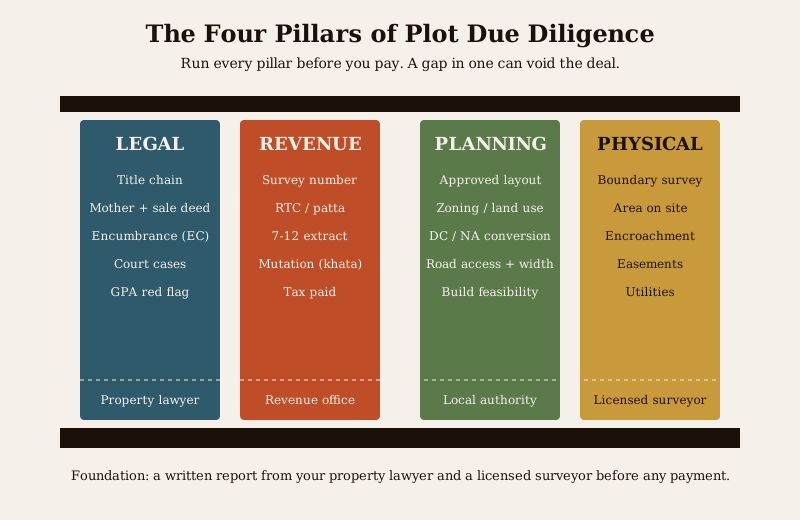
Run all four in parallel, but do not sign or pay until every one comes back clean and in writing. Our pillar guide to buying a residential plot sets these steps in the wider journey from search to registration.
Pillar 1: Legal - who really owns it, and can they sell?
The legal pillar answers one question: does the seller hold a clear, marketable title that they are entitled to transfer to you?
- Title chain. Your lawyer traces ownership backward - ideally 30 years or more - through the "mother deed" and every sale, gift, partition or inheritance since. Each link must be valid and unbroken. See our guide on how to verify land title before buying.
- Encumbrance certificate (EC). The EC, drawn from the sub-registrar records, lists registered charges - mortgages, liens and prior sales - over a period. A clean EC suggests the land is free of registered dues. Read the encumbrance certificate explained for how to obtain and read one.
- Litigation and court cases. Ask directly whether the land is subject to any pending suit, partition dispute, injunction or acquisition. Your lawyer checks court and revenue records; an unregistered family dispute may not show in the EC.
- The GPA red flag. Be very cautious of a plot sold only through a General Power of Attorney rather than a proper registered sale deed. A GPA does not by itself transfer ownership, and "GPA sales" are a common route for disputed or defective titles. Treat GPA-only offers as a warning to dig much deeper with your lawyer.
Pillar 2: Revenue - what the land records say
Revenue records are the state government view of who holds and pays for the land. They must agree with the legal documents.
- Survey number. Every parcel has a survey or sub-division number. Confirm the number on the seller papers matches the record and the actual plot on the ground.
- RTC, patta or 7-12 extract. These state-specific records (Record of Rights, Tenancy and Crops in the south; the 7-12 extract in the west; patta elsewhere) show the recorded holder, extent and nature of the land. The holder should match your seller.
- Mutation. Mutation is the updating of revenue and municipal records to a new owner after a transfer. Confirm past mutations were completed so ownership is properly reflected - and plan for the mutation into your own name after purchase. In many states this ties into the khata or e-khata that also records the property for tax.
Pillar 3: Planning - can you actually build here?
A plot you cannot legally build a home on is not a homesite, whatever the price. The planning pillar confirms the land is developable for your purpose.
- Approved layout versus unapproved. A plot inside a layout approved by the local development or planning authority is far safer than one carved out of farmland without sanction. Unapproved or "revenue layout" plots may be cheaper but can be impossible to get building approval, water or power connections for, and may face regularisation risk.
- Zoning and land use. Confirm the master plan or zoning marks the area for residential use. Land zoned agricultural, industrial, green-belt or reserved for a road or public purpose cannot simply be built on.
- DC or NA conversion. Agricultural land usually must be converted to non-agricultural (NA) or receive a "change of land use" or DC conversion order before a house is legal. See DC and NA land-use conversion for how this works and why it matters.
- Building feasibility and road access. Check that the setbacks, floor area and access allowed by the bye-laws let you build the home you want. Crucially, confirm legal access - a plot must front a public road or a legally recorded access of adequate width, or you may own land you cannot reach or service.
Once you are past the legal blockers, the design and buildability of the plot itself - shape, slope, orientation and layout potential - is a separate assessment. Our how to evaluate a residential plot guide and the wider site-planning hub cover that design side.
Pillar 4: Physical - does the plot on paper exist on the ground?
Documents describe an ideal plot. A licensed surveyor tells you what is actually there.
- Boundary and survey. A surveyor pegs the corners against the survey records so you know exactly where your land begins and ends. Fences and walls often sit in the wrong place.
- Actual versus recorded area. Measure the plot on the ground and compare it to the deed and revenue extent. Shortfalls are common and directly reduce what you are paying for.
- Encroachment. Check that no neighbour structure, road widening, drain or overhead line eats into the plot, and that the plot itself does not encroach on adjoining land or public property.
- Easements. Confirm any rights of way, drainage or utility easements across the plot - and whether the plot depends on crossing someone else land for access, water or sewage.
- Utilities. Verify the practical availability of water, power, drainage and road so the site is genuinely serviceable, not just legally clear.
The financial layer: dues, mortgage and the bank as a proxy check
Money problems attached to the land become your problems after purchase.
- Outstanding dues and property tax. Confirm property tax, betterment charges, layout or society dues and any utility bills are fully paid, with receipts. Unpaid dues can attach to the property.
- Loan or mortgage on the land. If the seller has pledged the plot for a loan, it must be released and the charge cleared before or at the point of sale, with documentary proof.
- The bank approval proxy. A useful informal test: apply for a plot loan or ask a lender to appraise the land. Banks run their own legal and technical vetting, so a bank that refuses to fund a plot, or flags a title or approval defect, is telling you something important - even if you intend to pay cash.
The due-diligence checklist
Work through every item below, get each confirmed in writing, and note who is responsible for signing it off.
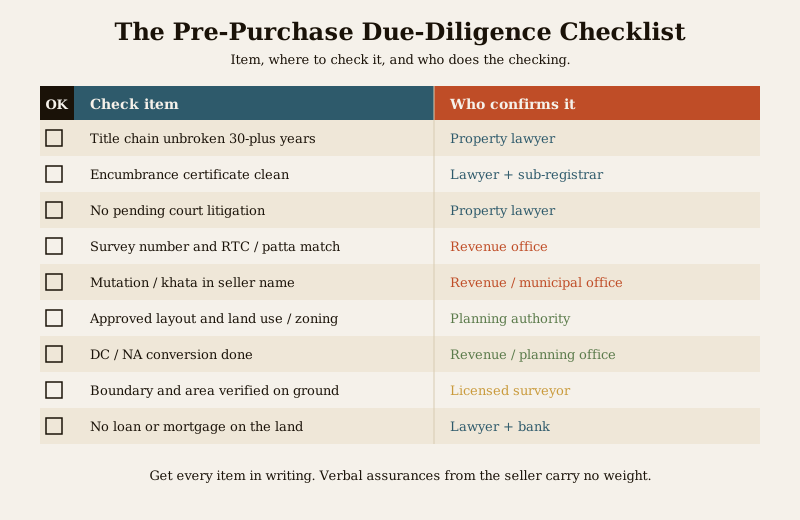
| Check item | How to check | Who checks |
|---|---|---|
| Title chain (30-plus years, unbroken) | Trace mother deed and every subsequent deed | Property lawyer |
| Encumbrance certificate is clean | Obtain EC from sub-registrar for the period | Lawyer, sub-registrar |
| No pending litigation or dispute | Search court and revenue records; question seller | Property lawyer |
| GPA-only sale flagged and investigated | Insist on a registered sale deed, not just a GPA | Property lawyer |
| Survey number matches on all documents | Compare deed, revenue record and ground | Revenue office |
| RTC / patta / 7-12 holder matches seller | Pull the state land record | Revenue office |
| Mutation and khata in seller name | Check revenue and municipal records | Revenue / municipal office |
| Approved layout and correct land use / zoning | Verify with development or planning authority | Planning authority |
| DC / NA conversion completed | Confirm conversion order exists | Revenue / planning office |
| Legal road access of adequate width | Check access record and bye-laws | Planning authority, surveyor |
| Boundary and actual area verified on site | Physical survey against records | Licensed surveyor |
| No encroachment or adverse easement | Ground inspection and record check | Licensed surveyor |
| All dues and property tax paid | Collect paid receipts | Lawyer, revenue office |
| No loan or mortgage on the land | Confirm charge released; bank appraisal | Lawyer, bank |
When to walk away
Not every problem is fatal - some can be fixed or renegotiated - but certain findings should stop you cold. The table below and the decision tree that follows separate the deal-breakers from the fixable.
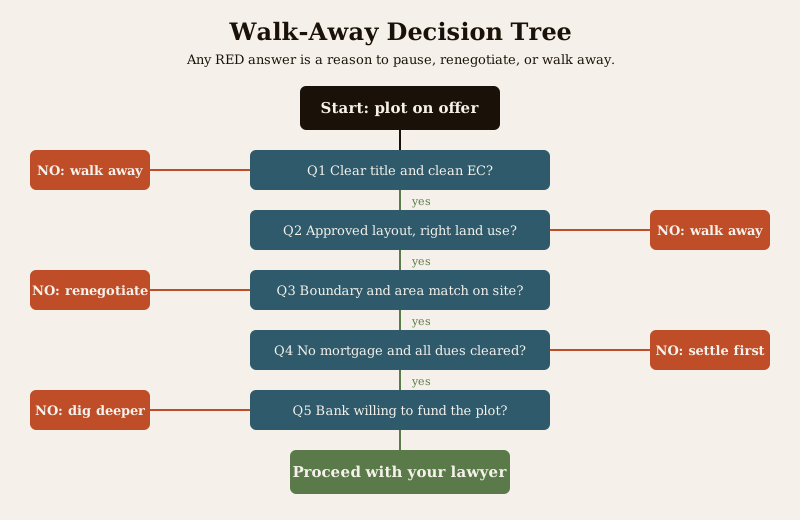
| Walk away if... | Why it is serious |
|---|---|
| The title chain is broken or the EC shows an unresolved charge | Ownership may be challenged; you could lose the land |
| The only "proof" of sale is a GPA, not a registered deed | GPA does not transfer clean ownership; classic disputed-title route |
| There is pending litigation or a family / partition dispute | You inherit the case and the risk of losing the plot |
| The plot is in an unapproved layout with no path to approval | You may never get building sanction or connections |
| Land use is agricultural / reserved and conversion is refused | Building a home may be illegal |
| The plot has no legal road access | You may own land you cannot reach or service |
| Ground area is materially less than the papers, unexplained | You are paying for land that is not there |
| A mortgage or dues cannot be cleared before sale | The charge follows the property to you |
| A bank refuses to fund the plot on legal / technical grounds | An independent expert has found a defect worth heeding |
Engage the right professionals
Due diligence is not a solo task. Two people are non-negotiable. A property lawyer or advocate gives you the title opinion, reads the deeds and EC, checks for litigation and drafts the agreement so your interests are protected. A licensed surveyor confirms the boundary, the area and any encroachment on the ground against the survey records. For financial specifics, involve a CA or your bank; for statutory confirmations, go to the sub-registrar, revenue office and local planning authority. Their combined written sign-off - not the seller assurances - is what makes it safe to pay.
Key takeaways
- Run four pillars before paying: legal (title, EC, litigation, GPA), revenue (survey number, RTC / patta, mutation), planning (approved layout, land use, DC / NA, road access) and physical (boundary, area, encroachment, easements, utilities).
- Treat a GPA-only sale, a broken title chain, unapproved layout, wrong land use, no legal access, an unexplained area shortfall or an uncleared mortgage as walk-away or renegotiate signals.
- A bank refusing to fund the plot is a valuable second opinion, even if you plan to pay cash.
- Get everything in writing. Verbal promises from the seller carry no legal weight.
- Engage a property lawyer and a licensed surveyor - and confirm state-specific records with the sub-registrar, revenue office and planning authority.
References
- Registration Act, 1908 and Transfer of Property Act, 1882 - the general legal framework for transfer and registration of immovable property in India (named generally; confirm current provisions with your lawyer).
- State revenue and land-record portals (for example Bhulekh, Dharani, Kaveri and equivalents) - for survey number, RTC, patta and 7-12 records; systems and access vary by state.
- Local development / planning authority and municipal records - for approved layouts, zoning, land use, khata and building bye-laws.
- Sub-registrar office - for the encumbrance certificate and registered deeds.
- Your property lawyer, licensed surveyor, CA and bank - for the binding, plot-specific and state-specific verification this guide cannot provide.
Export this guide
Related Guides — Deep-dive reading
How to Verify Land Title Before Buying in India: Clear and Marketable Title Explained (2026)
What a clear and marketable title really means, and how it is verified before you buy a plot in India - tracing the chain of ownership back thirty years from the mother deed to the current sale deed, a lawyer's title search at the sub-registrar, a public notice, the encumbrance check, and the legal opinion that decides whether you should pay.
Buying LandLand Documents Checklist Before Buying a Plot in India (2026)
Every document to collect and verify before you buy a residential plot in India - the title chain, encumbrance certificate, khata or patta, mutation, survey and layout, land-use conversion and tax dues - what each one proves, the red flag if it is missing, and how the same record is named differently in each state.
Buying LandProperty Registration Process in India: How a Plot Is Registered in Your Name (2026)
Registration is the step that makes you the legal owner. This guide walks through the sequence - agreement to sell, drafting the sale deed, calculating and paying stamp duty and registration fee, the sub-registrar appointment, the registration day, and the mutation and khata transfer that follow.
Buying LandRelated Tools — Try Free
Stamp Duty Calculator — All Indian States
Stamp duty + registration charges for all 28 states and 8 UTs — gender concessions, urban/rural variants, metro cess built in.
Stamp DutyStructural Modification Approval Checklist
41 items across structural assessment, society approval, municipal compliance, and safety.
Approval ChecklistInterior Red Flag Checklist — Before Signing
54 red flags across 8 categories with a live risk score and personalised PDF.
Red Flag Checklist