
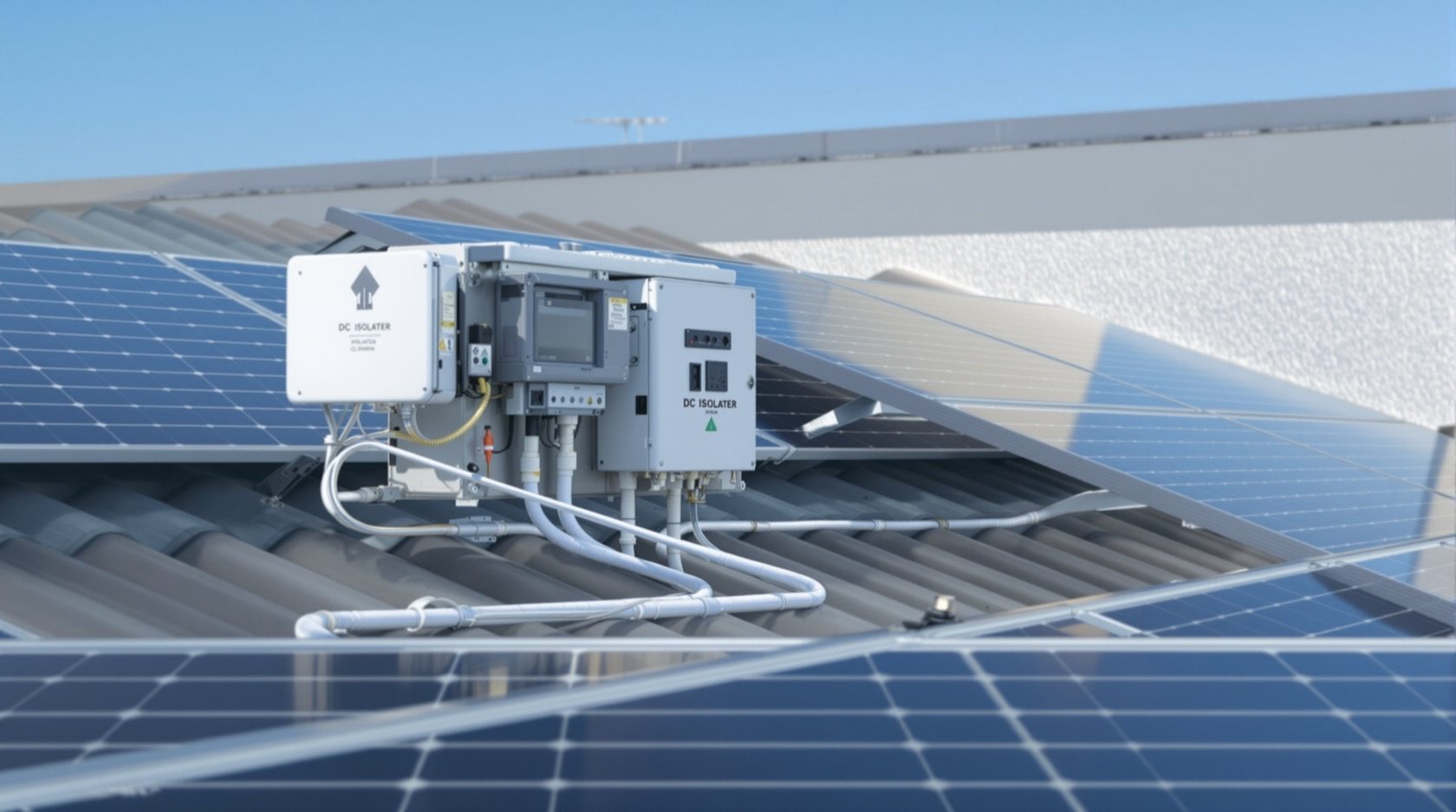
Solar System Fire Safety in India (2026): Rooftop PV, DC Arcs and Firefighter Access
Rooftop solar stays live in daylight even with the grid off. This guide explains the real PV fire risks, the protections that matter, and how to keep firefighters and your escape route safe.
Rooftop solar has swept across Indian homes and housing societies faster than almost any other building upgrade of the decade. Subsidies, falling panel prices and rising tariffs have put photovoltaic (PV) arrays on lakhs of terraces — and in the rush, a great many were fitted by under-qualified installers chasing the cheapest quote. That matters, because a solar array is not a decorative panel: it is a live electrical generator sitting on your roof, and it introduces a new, less-understood fire risk that most homeowners have never been told about. Solar system fire safety is about understanding that risk honestly, insisting on a proper installation, and keeping your roof reachable for the fire brigade.
This is a chapter of Studio Matrx's fire-safety library, sitting under the complete guide to fire safety in India. It pairs closely with the electrical fire-safety guide, because a solar fire is fundamentally an electrical fire with two dangerous twists — high-voltage DC and a source you cannot simply switch off. If you are planning or already own a system, read this alongside the practical rooftop solar for homes guide.
Scope and safety — read this first. This guide helps you understand the risk, specify a safe installation, do safe upkeep and plan your escape. It does not teach you to work on the system. A rooftop PV array carries high-voltage DC that can be lethal, and all design, installation, isolation, earthing and repair MUST be done by a licensed electrical contractor or an OEM-certified solar EPC (engineering, procurement and construction) firm, working to the CEA (Measures relating to Safety and Electric Supply) Regulations, the relevant BIS/IEC PV standards and IS 1646 : 2015 for the electrical installation. Never open a combiner box, touch DC cabling or attempt to "switch off" the array yourself. This is educational guidance, not legal advice or a substitute for a licensed professional. And the overriding rule: if the array or inverter is involved in a fire, get everyone out and call 101 or 112 — tell them there is solar on the roof.
Why solar fire is different: you cannot just switch it off
A normal house fire lets the fire brigade cut the mains and work in a de-energised building. Solar breaks that assumption, and this single fact is the heart of the danger.
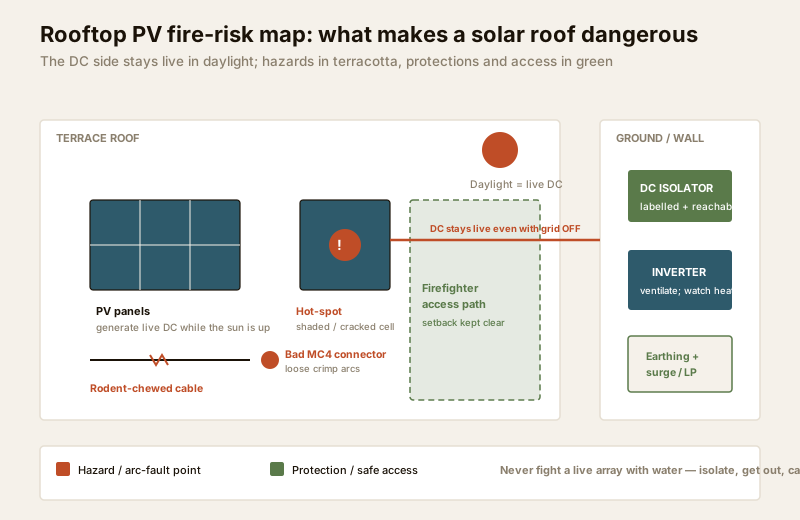
- The DC side is live whenever there is daylight. The panels generate voltage the moment light hits them. Turning off your main switch, or even a grid outage, stops the AC side — but the wires running from the roof panels down to the inverter can still carry hundreds of volts of DC. You cannot make the panels "off" while the sun is up; you can only isolate sections with the correct switches.
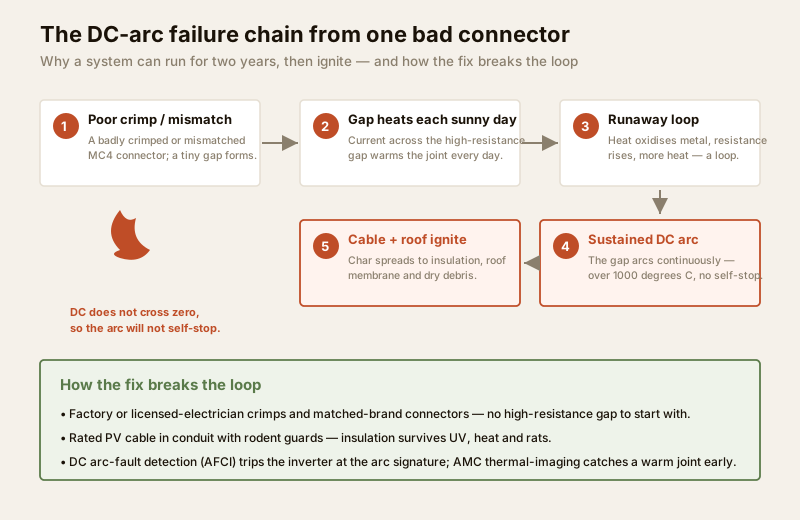
- DC arcs are harder to extinguish than AC. Alternating current crosses zero volts a hundred times a second, which naturally helps an arc self-extinguish. Direct current does not — so a DC arc fault at a loose connector can sustain a hot, sputtering arc that quietly ignites the surrounding cable, roof membrane or dry leaves.
- The array is a shock hazard to firefighters. A firefighter directing a hose at a burning roof, or cutting through it to vent smoke, can be electrocuted by a live, damaged array. Because the panels cannot be switched off, the crew may be forced to fight the fire defensively from a distance — which is exactly why access, labelling and isolation matter so much.
Bold honesty up front: the large majority of rooftop-solar fires trace back not to faulty panels but to poor installation — bad MC4 connector crimps, mismatched connectors forced together, undersized or unprotected cable, missing isolators, and no earthing. Get the installation right and you remove most of the risk.
Where solar fires actually start
Understanding the failure points tells you what to insist on when you commission a system and what to watch for over its twenty-five-year life.
| Failure point | What goes wrong | Why it ignites |
|---|---|---|
| DC connectors (MC4) | Loose crimp, mismatched brands mated together, water ingress | High-resistance joint heats up, then arcs; the single most common cause |
| DC cabling | Undersized cable, sharp roof edges, UV-degraded or rodent-chewed insulation | Short circuit or arc between conductors or to the frame |
| Panel hot-spots | A shaded, cracked or soiled cell forced to dissipate power instead of generating it | Localised overheating, browning, delamination and eventually fire |
| Combiner / junction box | Water ingress, loose terminals, no isolation | Arcing and heat build-up at a hidden, unmonitored point |
| Inverter | Overheating, dust, poor ventilation, internal fault | Fire at the inverter, often sited in a garage, utility area or living space |
| Earthing / lightning | Missing or poor earthing and surge/lightning protection | Surge or fault voltage with nowhere safe to go; strike damage |
Two India-specific realities make these worse. First, rodents — rats on terraces chew through cable insulation, and unprotected DC runs are a favourite. Second, retrofit shortcuts — a cheap installer skips the rooftop DC isolator, uses residential cable instead of rated PV cable, or forces two incompatible connector brands together because that is what was in the van. Each is invisible from the ground and each is a future arc.
The DC-arc chain: how one bad connector burns a roof
It is worth seeing the sequence, because it explains why a system can run perfectly for two years and then fail. A poorly crimped or mismatched MC4 connector develops a tiny high-resistance gap. Every sunny day, current flowing across that gap heats it. Heat oxidises the metal, which raises resistance further, which makes more heat — a runaway loop. Eventually the gap widens enough to sustain a DC arc, a continuous spark reaching well over a thousand degrees, which chars the connector housing, ignites the cable insulation, and spreads to the roof membrane or any dry debris nearby.
The protections that actually matter
You do not install these yourself — but you should insist on them, see them, and know they exist. This is the specification you hold your EPC accountable to.
| Protection | What it does | Insist on it because |
|---|---|---|
| OEM-certified EPC installation | Correct design, rated PV cable, factory-standard crimps, matched connectors | Removes the root cause of most fires — bad workmanship |
| DC arc-fault detection (AFCI) | Senses the signature of a DC arc and trips the inverter | Catches the number-one failure before it ignites |
| Rooftop DC isolator | A switch that isolates the array's DC at the roof, clearly labelled | Lets a section be isolated near the source, not just at the inverter |
| Rapid shutdown (where available) | De-energises the DC conductors quickly to a safe voltage | Reduces the live-array hazard to firefighters; increasingly specified |
| Proper earthing + surge/lightning protection | Gives fault and strike energy a safe path | India's monsoon lightning and long DC runs demand it |
| Clear labelling and a site diagram | Warns the fire brigade there is solar and shows the isolation points | A crew that knows the roof is live can work safely |
A few of these deserve emphasis. The rooftop DC isolator must be reachable and unmistakably labelled — "SOLAR DC ISOLATOR" — so that a responder, or you, can isolate the array without hunting. Rapid shutdown is a newer feature (mandatory in some countries, increasingly offered in India) that drops the DC voltage to a safe level within seconds of a trigger; specify it if your OEM supports it. And earthing plus surge protection is non-negotiable in India, where a monsoon lightning strike on an unearthed array is both a fire and an electrocution risk. For the household backup side — inverters and battery banks that often share the same utility space — see the home battery backup guide; a lithium battery pack adds a thermal-runaway risk that the battery-room fire-safety guide covers in full.
Keep the roof safe for firefighters — and for you
A rooftop array changes how a fire can be fought, so how you lay it out is a genuine life-safety decision, governed in principle by the National Building Code (via SP 7 : 2026, Part 4 Fire and Life Safety).
Access, setbacks and pathways
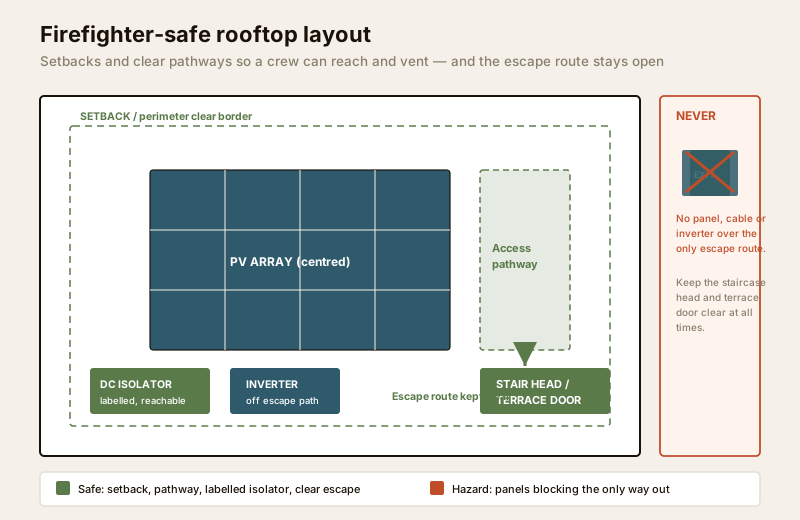
Firefighters need to reach a burning roof, walk on it safely, and cut vents to release smoke and heat. An array that carpets the entire terrace edge-to-edge leaves them no footing and no vent point. Good practice — and the direction Indian codes are moving — is to leave clear pathways and setbacks: a border around the roof perimeter and clear routes to ridges and roof access, so a crew can move without stepping on live panels. Discuss setbacks with your EPC at the design stage; they cost a little generation and buy a lot of safety.
Never mount panels over your only escape route
This is the homeowner mistake that turns a manageable fire into a trap. Do not let an array, its cabling or the inverter sit over or across the only way off your roof or out of your home. On many Indian buildings the terrace is both a solar site and an emergency refuge or secondary escape; an array and its live DC wiring must never block the staircase head, the terrace door, or a route to the neighbour's roof. Keep the inverter and combiner box out of the escape path too — an inverter fire in a stairwell is a double disaster.
Safe upkeep you can do — and the line you must not cross
You can, and should, keep the system healthy from the ground and by observation, without ever touching the live parts:
- Watch the monitoring app. A panel or string whose output drops for no weather reason may have a hot-spot or a failing connector — report it to your AMC.
- Look and smell. A burnt-plastic smell, discolouration, scorch marks, a buzzing or crackling from the inverter, or repeated inverter trips are all warnings. Stop, keep clear, and call your installer — do not investigate the DC side yourself.
- Keep the roof clear. Remove dry leaves, nesting material and stored combustibles from around the array and the inverter; keep the pathways and the isolator unobstructed.
- Guard against rodents. Ask your installer about cable conduit and rodent guards; a chewed cable is a future arc.
- Service the AMC. Insist on periodic professional inspection of connectors, torque checks and thermal imaging — this is where a failing joint is caught before it arcs.
The hard line: never open a combiner box, never handle DC cabling, never try to fight a solar fire with water on the live array. Isolate only if you can safely reach a clearly labelled isolator, then get out and call the fire brigade. A live PV array plus a water jet is an electrocution risk.
The deadly shortcuts to design out
These recur in Indian rooftop-solar problems. Fixing them addresses the failures that actually cause fires.
- The cheapest quote from an unlicensed installer. The single biggest risk. Choose a licensed electrical contractor / OEM-certified EPC with references, not the lowest bidder in the WhatsApp group.
- No rooftop DC isolator, or an unlabelled one. Insist on a reachable, clearly marked DC isolator, plus arc-fault detection.
- Residential cable instead of rated PV cable, and forced mismatched connectors. Both are invisible and both arc. Ask to see the cable and connector spec sheets.
- No earthing or surge/lightning protection. Non-negotiable in monsoon India.
- Panels carpeting the roof with no setbacks, or an inverter and array over the only escape route. Design in pathways and keep escape routes clear.
- A dead AMC. An unserviced array is an ageing array; connectors loosen and insulation degrades over twenty-five years.
For the wider terrace-safety picture in apartments — shared roofs, refuge areas and tender access — read the apartment fire-safety guide and the high-rise fire-safety guide; on a shared roof, the solar array must never compromise the building's refuge or access.
When the law or your insurer requires a professional or a Fire NOC. Grid-connected rooftop solar in India is not a free-for-all: it requires a licensed electrical contractor / OEM-certified EPC, compliance with the CEA (Measures relating to Safety and Electric Supply) Regulations and the relevant BIS/IEC PV standards (verify the current numbers via the BIS catalogue), your DISCOM's net-metering approval, and — for larger buildings — an installation consistent with the National Building Code (SP 7 : 2026, Part 4) and your State Fire Services requirements. Whether your building needs a Fire NOC depends on its occupancy and height. Your property insurer may also require a certified installation and periodic inspection to keep cover valid. Route all design, installation, isolation and repair to qualified professionals — never DIY the DC side.
Key takeaways
- Solar is a live generator on your roof — you cannot just switch it off. The DC side stays energised in daylight even with the grid down, so isolation, labelling and firefighter access matter more than for any other electrical fire.
- Most rooftop-solar fires are installation faults, not panel faults — bad MC4 crimps, mismatched connectors, undersized or rodent-chewed cable, missing isolators and no earthing. A licensed EPC and rated components remove most of the risk.
- Insist on the protections you cannot see: OEM-certified installation, DC arc-fault detection, a clearly labelled rooftop DC isolator, rapid shutdown where available, and proper earthing plus surge/lightning protection.
- Keep the roof reachable and your escape clear — setbacks and pathways so firefighters can walk and vent, and never mount panels, cabling or the inverter over the only way off the roof or out of the home.
- Do safe upkeep only: watch the monitoring app, act on burnt smells or inverter trips, keep the array and isolator clear, guard against rodents and maintain the AMC — but never open a combiner box, handle DC cabling, or fight a live-array fire with water. Get out and call 101 or 112, and tell them there is solar on the roof.
References
- National Building Code of India, SP 7 : 2026 (the NBC), Part 4 "Fire and Life Safety" — the fire and life-safety framework, including roof access and life-safety principles relevant to rooftop installations; the older SP 7 : 2016 edition is withdrawn but still widely quoted. Verify the current edition via the BIS catalogue: https://www.services.bis.gov.in/
- IS 1646 : 2015, "Fire Safety of Buildings (General): Electrical Installations — Code of Practice" (third revision, reaffirmed 2020), Bureau of Indian Standards — the electrical-installation fire-safety code underpinning the AC and DC wiring of a PV system. Confirm the applicable BIS/IEC photovoltaic standards (PV modules, connectors, DC cable, arc-fault and isolation devices) for your installation via the BIS catalogue: https://www.services.bis.gov.in/
- The CEA (Measures relating to Safety and Electric Supply) Regulations and the requirement for a licensed electrical contractor, plus your DISCOM's net-metering and interconnection rules — these govern who may design, install and connect a grid-tied rooftop solar system in India.
- Your State Fire Services Act and Rules and the Model Building Bye-Laws (MoHUA) — these set when a Fire NOC, roof access, setbacks and building-wide fire systems are legally required for your building's occupancy and height.
This is an educational overview, not legal advice, and not a substitute for a licensed electrical contractor, OEM-certified solar EPC or fire-safety consultant. All rooftop-solar design, installation, isolation, earthing and repair are qualified professional tasks — the DC side is live and lethal in daylight. Verify any standard's current status via the BIS catalogue before relying on it.
Export this guide
Related Guides — Deep-dive reading
Electrical Fire Safety in India (2026): Overloads, Wiring and the Right Protection
Why electrical faults cause so many Indian building fires, and the fix: correct cable sizing and a properly designed board by a licensed electrician, MCB plus RCCB protection, no overloading, and never water on a live fire.
SecurityElectrical Safety for Security Systems in India (2026): Powering It Without Peril
A homeowner's guide to the power side of home and RWA security systems, CCTV, alarms, gates, access control and NVRs, done so it protects you instead of quietly becoming a shock or fire hazard. What makes a supply safe, what to insist on, and why the mains work belongs to a licensed electrician.
SecurityBattery Room Fire Safety in India (2026): Lead-Acid Hydrogen Venting and Lithium-Ion Thermal Runaway
How the dedicated battery bank behind an apartment, office, data centre, hospital or solar-storage install should be compartmented, ventilated, detected and isolated, and why the two chemistries need two different controls.
SecurityRelated Tools — Try Free
Cross-Ventilation Analyzer
Estimate airflow and air changes per hour (ACH) from room size, window areas, layout, and local wind — with NBC 2016 Part 8 compliance check.
Ventilation CalculatorElectrical Safety & Load Audit
Home electrical audit — 10 categories, 65+ checkpoints across earthing, RCCB, MCB, wiring, switchboards, appliance circuits, DG/inverter backup.
Safety AuditConstruction Approval Checklist — 24-Stage Tracker
Track every approval, permit, and NOC from land title to occupancy certificate across 24 stages.
Approvals