
Watts, Volts, Amps & Units Explained: Electrical Basics for Homeowners
The four words behind every electrical decision — volts, amps, watts and units (kWh) — explained with a simple water analogy, so you can read an appliance rating, understand your bill, and follow every other guide with confidence.
Almost every electrical decision — which MCB, which cable, how big an inverter, why the bill is high — comes down to four words: volts, amps, watts and units. Get these straight and the rest of electricity stops being mysterious. This short guide explains them in plain language with a simple analogy, so you can read an appliance's rating plate, understand your electricity bill, and follow every other guide in this hub with confidence.
It is the foundational-literacy guide of the Electrical Knowledge Hub, underpinning the complete systems guide.
The safety line. Understanding units is knowledge, not a licence to work on electrics. All wiring stays with a licensed electrician — but knowing these four words helps you specify, size and question things correctly.
The water analogy
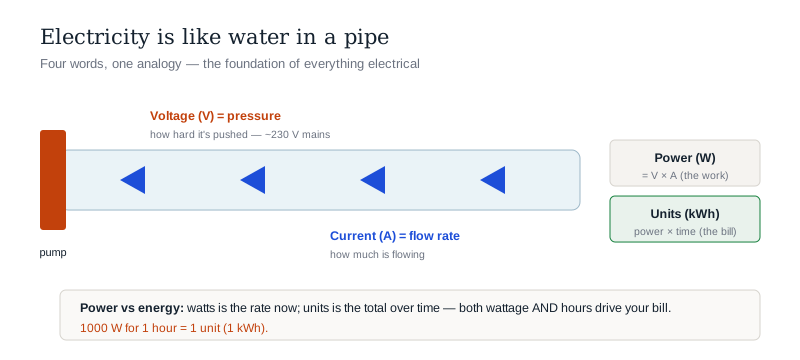
Electricity flowing in a wire is a lot like water in a pipe — the analogy makes everything click:
- Voltage (volts, V) = pressure. How hard the electricity is "pushed". India's mains is about 230 V. Higher pressure, more push.
- Current (amperes, amps, A) = flow rate. How much electricity is actually flowing. A heavy appliance draws more amps, like a wide-open tap.
- Power (watts, W) = the work being done. It's voltage × current — pressure times flow. A 2000 W geyser does a lot of work; a 9 W LED does little.
- Energy (units, kWh) = the total used over time. Power used for a duration. Run 1000 W for 1 hour and you've used 1 unit (1 kWh) — this is what your bill charges for.
That's the whole foundation: pressure (V), flow (A), power (W = V×A), and total-over-time (units).
Power vs energy: the key distinction
The one confusion worth clearing up: power is not energy.
- Power (watts) is the rate — how fast energy is used right now. An appliance's wattage is on its rating plate.
- Energy (units/kWh) is the total — power multiplied by how long it runs. This is what you pay for.
- Why it matters: a high-wattage appliance used briefly (a 2000 W iron for 10 minutes) can use less energy than a low-wattage one running constantly (a 200 W fridge all day). Your bill is about units, so both wattage and hours matter — see the appliance running cost calculator.
Watts = volts × amps (and why it's useful)
The relationship W = V × A (power = voltage × current) is the most useful formula in a home:
- Find the current an appliance draws: amps = watts ÷ volts. A 2300 W geyser on 230 V draws about 10 A — which tells you the circuit and MCB it needs.
- Size cables and breakers — the current (amps) a circuit carries decides its cable size and MCB rating.
- Add up your load — total watts across appliances tells you your connected load and whether you need a bigger connection or three-phase.
- Convert quickly with the watts-to-amps calculator.
Reading a rating plate
Now the rating plate on any appliance makes sense:
- "230 V" — the voltage it runs on (India's mains).
- "2000 W" (or "2 kW") — its power; how much it draws when running.
- "50 Hz" — the mains frequency in India (how many times per second the AC supply cycles) — you'll see it but rarely need to act on it.
- Amps — sometimes shown; or work it out (watts ÷ 230).
From this you can tell how heavy the appliance is, what it costs to run, and what circuit it needs.
The one-line answer
Four words explain almost all of home electricity, and a water-pipe analogy makes them stick: voltage (volts) is the pressure (India's mains ≈ 230 V), current (amps) is the flow rate, power (watts) is the work being done — voltage × current, and energy (units, kWh) is power used over time — the units your bill charges for. The key distinction is power vs energy: watts is the rate right now, units is the total over time, so both an appliance's wattage and its hours of use drive your bill. The formula watts = volts × amps lets you find the current an appliance draws (watts ÷ 230), which in turn decides the cable and MCB it needs — the thread running through every other electrical guide.
Where to go next
- Put it to use sizing a circuit: Choosing MCB Rating Guide · Cable Size Selection Guide.
- Convert power and current: Watts to Amps Calculator.
- See what appliances cost: Appliance Running Cost Calculator.
- The complete picture: Residential Electrical Systems Guide.
References
- National Electrical Code of India, SP 30 : 2023, Bureau of Indian Standards.
- IS 732 : 2019, Code of Practice for Electrical Wiring Installations, BIS.
- Bureau of Energy Efficiency (BEE) — units of electricity and efficiency: https://beeindia.gov.in/
This is educational literacy; all electrical work must be done by a licensed electrician. Verify any standard's status via the BIS catalogue before relying on it.
Export this guide
Related Guides — Deep-dive reading
Residential Electrical Systems: The Complete Guide for Indian Homes
How the electricity in an Indian home actually works — from the utility supply and meter through the distribution board, circuits, wiring, earthing and protection, to lighting, safety, energy efficiency, smart controls, solar and backup — written so a homeowner can understand, plan and judge it, and know exactly where a licensed electrician must take over.
Electrical & WiringLift Power Requirements (India): Load, Wiring, Earthing and Supply
What a home lift actually draws, and the dedicated circuit, cable, protection and earthing it needs
Home Lifts & AccessibilityBody Jets Shower India: Body Spray Massage Systems, the Flow & Pressure They Really Need, and What It Costs (2026)
Wall-mounted horizontal body jets turn a shower into a spa massage — but every jet is a thirsty extra outlet. How many jets, at what heights, the big pump and geyser they force, the pipe sizing and concealed valves you must plan before tiling, the water and running cost, and exactly who it is worth it for.
BathroomsRelated Tools — Try Free
Electrical Safety & Load Audit
Home electrical audit — 10 categories, 65+ checkpoints across earthing, RCCB, MCB, wiring, switchboards, appliance circuits, DG/inverter backup.
Safety AuditInverter & Battery Calculator
Size a home inverter (VA) and battery (Ah) for the load you want to back up and the hours of backup you need.
Backup PowerElectrical Load Calculator
Estimate a home's connected load and realistic maximum demand from its appliances, whether it needs single or three-phase supply, and a suggested main switch rating.
Electrical