
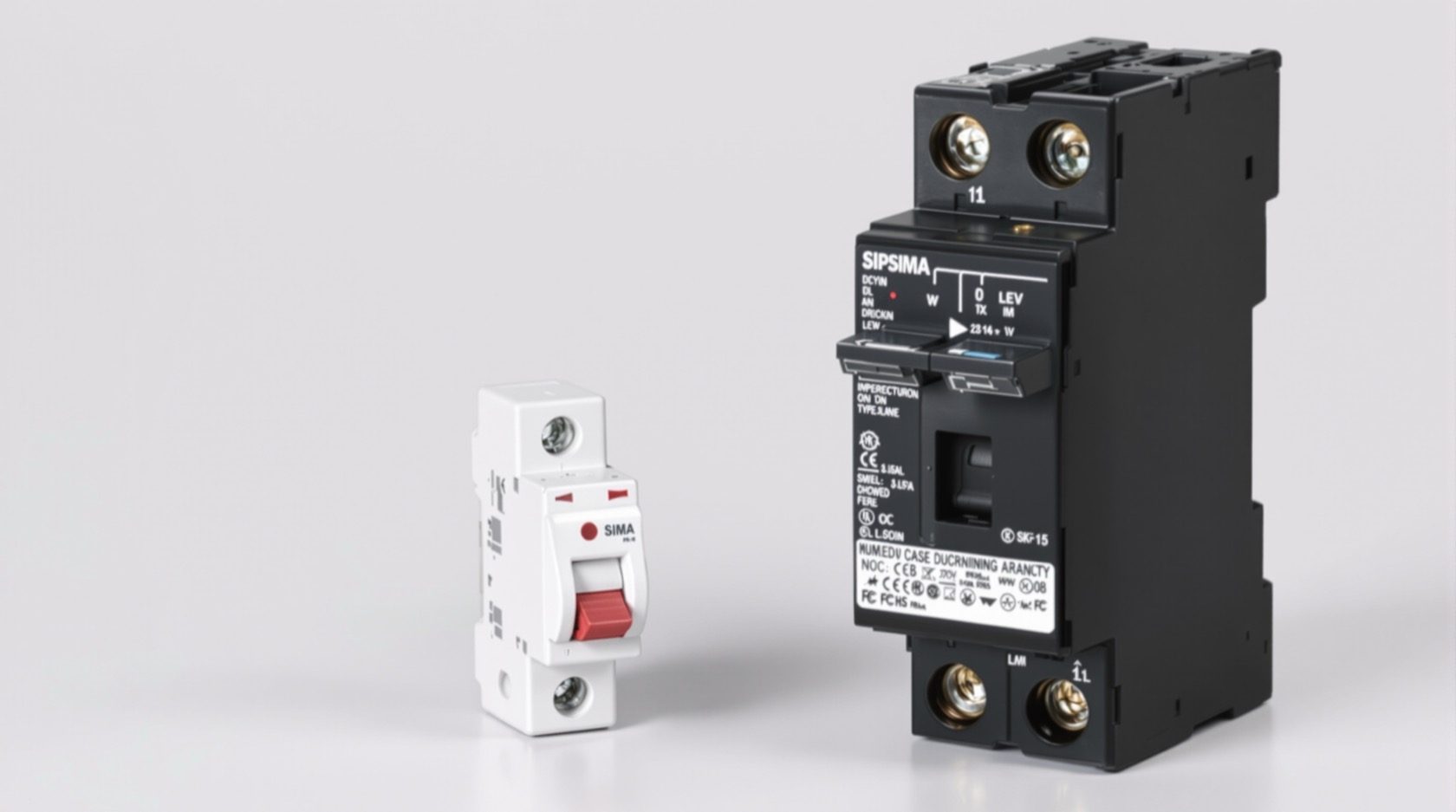
MCB vs MCCB: What They Do & Which Your Home Needs
The two circuit breakers that protect wiring from overload and short circuit — the MCB in every home distribution board and the larger MCCB in bigger installations. What each does, the trip curves and ratings, when you need which, and why a bigger breaker is never the fix for tripping.
An MCB — miniature circuit breaker — is the small switch that trips and cuts a circuit when something goes wrong. There is a row of them in every modern home's distribution board, and they replaced the old rewirable fuse for good reason: they trip reliably and reset in a second. Its bigger sibling, the MCCB (moulded case circuit breaker), does the same job at higher currents in larger installations. This guide explains what each does, how to read their ratings, and — importantly — why the answer to a breaker that keeps tripping is never simply "fit a bigger one".
It sits under the distribution board guide. For earth-leakage (shock) protection, which is a different job, see the RCCB, RCBO & ELCB guide.
The safety line. Understanding and resetting a tripped MCB is fine. Selecting, wiring or replacing breakers is a licensed electrician's job, and the breaker must coordinate with the cable it protects. This guide helps you understand what is in your board, not modify it.
What an MCB protects against
An MCB guards a circuit's cable against two dangers, and it is vital to understand that it protects the wiring, not people:
- Overload — drawing more current than the cable can safely carry for a sustained period (too many appliances on one circuit). The MCB trips after a delay, before the cable overheats.
- Short circuit — a sudden, massive current from a live-neutral or live-earth fault. The MCB trips almost instantly.
A blown fuse did the same job but had to be rewired; an MCB simply trips and resets. Crucially, an MCB does not protect against electric shock — that is the RCCB's job. A home needs both.
Reading an MCB: rating and trip curve
Two numbers define an MCB:
- Current rating (In) — the current it will carry continuously (e.g. 6 A, 10 A, 16 A, 20 A, 32 A). It must be chosen to protect the cable: no larger than the cable can safely carry, and no smaller than the circuit's normal load.
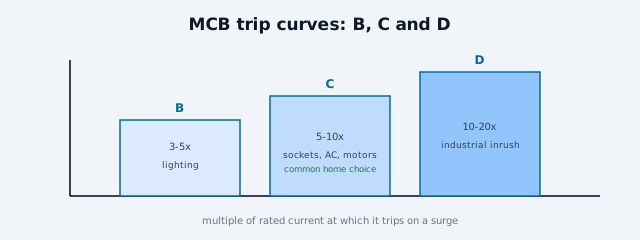
- Trip curve (type B, C or D) — how quickly it trips on a surge, matched to the load's inrush:
- Type C — trips at ~5–10×; for loads with moderate inrush like motors, ACs and mixed circuits (the common home choice).
- Type D — trips at ~10–20×; for high-inrush industrial loads.
MCBs for homes are made to IS/IEC 60898-1 : 2015. Choosing the rating and curve is a design decision — the choosing the right MCB rating guide and the MCB & RCCB selector help you understand it, but a licensed electrician sets it against the actual cable and load.
MCB vs MCCB
The MCCB is the same idea scaled up — for main incomers, sub-mains and large circuits where currents exceed what an MCB handles.
| Feature | MCB | MCCB |
|---|---|---|
| Full name | Miniature Circuit Breaker | Moulded Case Circuit Breaker |
| Typical current | up to ~63–100 A | ~100 A to 1000+ A |
| Breaking capacity | Lower | Higher (bigger fault currents) |
| Adjustable trip | Fixed | Often adjustable settings |
| Standard | IS/IEC 60898-1 | IS/IEC 60947-2 |
| Used in | Home final circuits | Main incomers, sub-mains, larger buildings |
For a typical home, the board is full of MCBs (and possibly one MCB or MCCB as the main). An MCCB appears as the main incomer of a large home, or throughout commercial and industrial building electrical services.
Why a bigger breaker is never the fix for tripping
This is the most important — and most abused — point. When a circuit trips repeatedly, the tempting "fix" is to swap in a higher-rated breaker so it stops tripping. This is dangerous. The MCB is sized to protect the cable; fit a breaker bigger than the cable can carry and you have removed the cable's protection. The wire can now overheat without the breaker ever tripping — a hidden fire risk.
A breaker that keeps tripping is telling you something: the circuit is overloaded, or there is a fault. The right response is to reduce the load or find the fault — never to fit a bigger breaker so the warning stops.
If a circuit genuinely needs more capacity, the correct fix is for an electrician to upgrade the cable and the breaker together, as a matched pair — not to oversize the breaker alone.
The one-line answer
An MCB is the small circuit breaker in every home board that protects a circuit's cable from overload and short circuit, chosen by current rating and trip curve (B/C/D) to IS/IEC 60898; an MCCB is the larger version for main incomers and bigger installations to IS/IEC 60947. Both protect the wiring, not people (that is the RCCB's job), so a home needs both kinds of protection. And never cure a tripping circuit by fitting a bigger breaker — that removes the cable's protection; reduce the load or fix the fault instead, and let a licensed electrician size any change.
Where to go next
- Where they live: Distribution Board Guide.
- Shock protection: RCCB, RCBO & ELCB Guide.
- Picking a rating: Choosing the Right MCB Rating.
- Try it: MCB & RCCB Selector.
References
- IS/IEC 60898-1 : 2015, Circuit-Breakers for Overcurrent Protection for Household and Similar Installations (MCBs), Bureau of Indian Standards.
- IS/IEC 60947-2 : 2016, Low-Voltage Switchgear and Controlgear — Part 2: Circuit-Breakers (MCCBs), BIS.
- IS 732 : 2019, Code of Practice for Electrical Wiring Installations, BIS.
- National Electrical Code of India, SP 30 : 2023, BIS: https://www.bis.gov.in/
Ratings and trip curves are indicative; breaker selection must coordinate with the cable and be done by a licensed electrician. Verify any standard's status via the BIS catalogue before relying on it.
Export this guide
Related Guides — Deep-dive reading
Electrical Fire Safety in India (2026): Overloads, Wiring and the Right Protection
Why electrical faults cause so many Indian building fires, and the fix: correct cable sizing and a properly designed board by a licensed electrician, MCB plus RCCB protection, no overloading, and never water on a live fire.
SecurityMCB vs RCCB vs RCBO vs MCCB: Which Protection Does What
Four devices in your distribution board, four different jobs — an at-a-glance guide to what protects against overload and short circuit, what protects against electric shock, what does both, and where each belongs, so you can read your own board and know it's complete.
Electrical & WiringChoosing the Right MCB Rating for Each Circuit
How the correct MCB is chosen — sized to protect the cable, above the circuit's normal load, with the right trip curve for the appliance. The common ratings for lighting, sockets, geysers, ACs and kitchens, and the golden rule that ties the breaker to the wire.
Electrical & WiringRelated Tools — Try Free
Electrical Safety & Load Audit
Home electrical audit — 10 categories, 65+ checkpoints across earthing, RCCB, MCB, wiring, switchboards, appliance circuits, DG/inverter backup.
Safety AuditMCB & RCCB Selector
Suggests an MCB current rating and trip curve for a home circuit, the minimum matching cable, and the RCCB sensitivity for shock protection.
ElectricalElectrical Load Calculator
Estimate a home's connected load and realistic maximum demand from its appliances, whether it needs single or three-phase supply, and a suggested main switch rating.
Electrical