
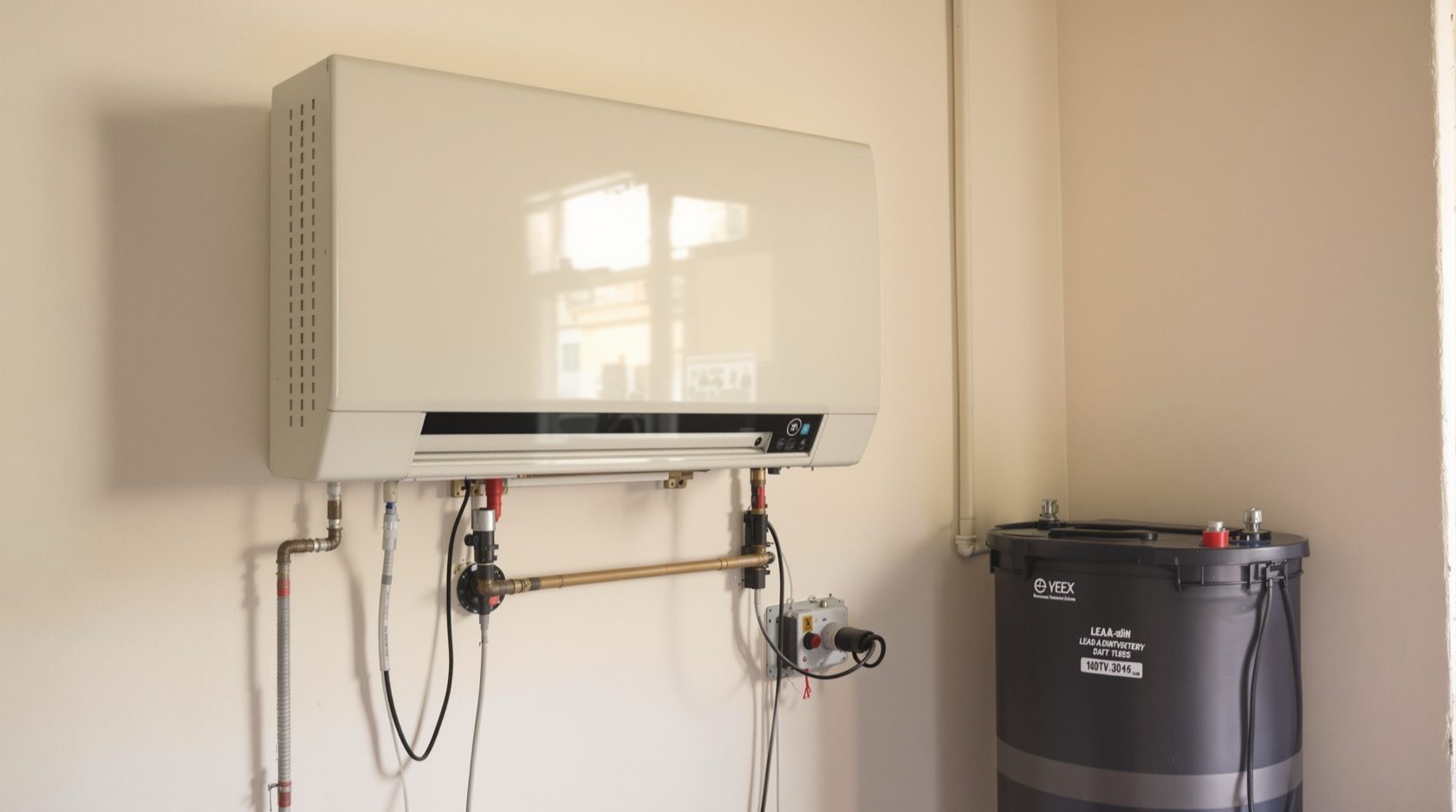
Inverters & Batteries: How They Work & How to Size Them
The silent workhorse of Indian home backup — how an inverter turns battery power into mains, what the VA rating means, why sine-wave matters, how to size the inverter to your load and the battery to your backup hours, and how to keep the system healthy.
The inverter-and-battery is the quiet hero of the Indian home: it sits in a corner, keeps the battery charged from the mains, and the instant the power cuts, it switches over so silently you barely notice. Choosing one well comes down to two numbers — the inverter's VA rating (can it run your load?) and the battery's capacity (for how long?) — plus one quality decision: sine wave or not. This guide explains how the system works and how to size it, so you buy exactly what you need.
It sits under the home backup power guide and pairs with the battery types guide.
The safety line. Choosing and sizing an inverter is the homeowner's job; installation — wiring it to a backup circuit through a proper changeover, and the battery connections — is a licensed electrician's job. Batteries store large energy and can be hazardous; installation and ventilation matter. Inverters/UPS should conform to IS 16242.
How an inverter-battery works
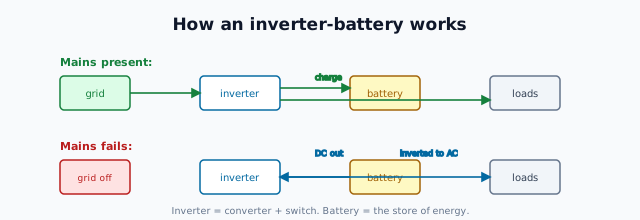
The system has a simple, elegant cycle:
1. When mains is present: the inverter passes grid power through to your backed-up loads and uses it to charge the battery, keeping it topped up.
2. When mains fails: the inverter instantly draws DC from the battery and inverts it into 230 V AC to run your loads — in a fraction of a second, so lights and fans barely flicker.
3. When mains returns: it switches back to grid and resumes charging.
So the battery is the store of energy and the inverter is the converter and switch. The inverter's electronics decide how big a load you can run; the battery's capacity decides for how long.
Sizing the inverter: the VA rating
An inverter is rated in VA (volt-amperes) — its capacity to supply load. To size it:
- Add up the wattage of the loads you want to run at once (lights, fans, TV, router, fridge…).
- Divide by the power factor (typically ~0.8) to get VA: VA ≈ total watts ÷ 0.8.
- Choose the next standard inverter size above that (common home sizes: 600, 800, 1,100, 1,500, 2,000 VA…).
For example, ~500 W of essential loads needs roughly 500 ÷ 0.8 ≈ 625 VA, so an 800 VA inverter comfortably covers it with headroom. Size for the loads you'll actually run together, plus a margin — not the whole house. The inverter & battery calculator does this for you.
Sizing the battery: capacity and backup time
The battery, rated in ampere-hours (Ah) at its voltage (commonly 12 V for home inverters), decides how long the backup lasts. The more Ah, the longer the runtime — and the bigger and costlier the battery.
A practical way to estimate the Ah you need:
Battery Ah ≈ (Load in watts × backup hours) ÷ (battery voltage × ~0.8)
The ~0.8 accounts for inverter efficiency and losses (real usable capacity is further limited by how deeply you should discharge the battery). So ~300 W of load for ~3 hours on a 12 V battery needs roughly (300 × 3) ÷ (12 × 0.8) ≈ 94 Ah, so a 100–150 Ah battery suits it. Larger backup or load means a bigger battery (or more batteries in series for 24 V/48 V systems). Again, the calculator handles the arithmetic; treat the result as indicative and confirm with your electrician and battery supplier.
Size the inverter to the load (what runs at once) and the battery to the time (how long you need it). They are two separate decisions — a big battery on a small inverter still can't run a big load, and a big inverter on a small battery runs it only briefly.
Sine wave vs square wave
Inverters produce AC in one of two waveforms, and it genuinely matters:
- Pure sine wave — smooth AC, identical to the grid. Runs everything cleanly, including sensitive electronics, motors, and modern appliances, without buzzing or overheating. The right choice for a modern home.
- Modified / square wave — a cheaper, cruder approximation. It runs simple loads (some lights, fans) but can cause buzzing, humming, reduced efficiency, and trouble with sensitive electronics and some appliances.
The small extra cost of a pure sine wave inverter is almost always worth it in a home full of electronics — it protects your gadgets and runs everything smoothly.
Keeping the system healthy
- Ventilation — batteries and inverters produce heat (and flooded batteries can vent gas); keep the space airy and cool. Heat shortens battery life.
- Battery maintenance — flooded (tubular/flat-plate) batteries need their water topped up periodically with distilled water; sealed (VRLA/lithium) batteries do not. See the battery types guide.
- Don't over-discharge — deep, repeated full discharges shorten battery life; size with margin so you rarely drain it flat.
- Location — accessible, dry, ventilated, away from living space (for flooded types), and installed by an electrician.
The one-line answer
An inverter-battery keeps essential home loads running silently through a power cut by charging a battery from the mains and, on failure, inverting the battery's DC into 230 V AC. Size the inverter in VA to the load you'll run at once (watts ÷ 0.8, round up to a standard size) and the battery in Ah to how long you need it (roughly watts × hours ÷ (voltage × 0.8)), choose a pure sine wave inverter for a modern electronics-filled home, and keep it ventilated and (for flooded batteries) watered — with a licensed electrician doing the install through a proper changeover.
Where to go next
- The strategy: Home Backup Power Guide.
- Which battery: Inverter Battery Types.
- The safety switch: Automatic Transfer Switch.
- Size it now: Inverter & Battery Calculator.
References
- IS 16242 (Parts 1–5), Uninterruptible Power Systems (UPS), Bureau of Indian Standards.
- IS 15549 : 2005, Stationary Regulated Lead Acid Batteries, BIS.
- Bureau of Energy Efficiency, Standards & Labelling (inverters/appliances): https://beeindia.gov.in/
- IS 732 : 2019, Code of Practice for Electrical Wiring Installations; National Electrical Code SP 30 : 2023, BIS: https://www.bis.gov.in/
Sizing formulae and figures are indicative for typical Indian homes; the actual inverter, battery, wiring and changeover must be sized and installed by a licensed electrician and battery supplier. Verify any standard's status via the BIS catalogue before relying on it.
Export this guide
Related Guides — Deep-dive reading
Residential Electrical Systems: The Complete Guide for Indian Homes
How the electricity in an Indian home actually works — from the utility supply and meter through the distribution board, circuits, wiring, earthing and protection, to lighting, safety, energy efficiency, smart controls, solar and backup — written so a homeowner can understand, plan and judge it, and know exactly where a licensed electrician must take over.
Electrical & WiringInverter Battery Types: Tubular, Flat-Plate, VRLA & Lithium Compared
The battery is where most of the money and most of the trouble in a backup system lives — so choose it well. Flooded tubular and flat-plate lead-acid, sealed VRLA, and lithium compared on life, maintenance, cost, safety and where each fits an Indian home.
Electrical & WiringLithium vs Lead-Acid: Choosing a Home Battery for Inverter & Solar
The battery is where most of a backup system's cost and lifespan live — an honest comparison of lithium and lead-acid for home inverters and solar storage: upfront cost versus lifespan, usable capacity, maintenance, space and safety, and which genuinely works out cheaper over time.
Electrical & WiringRelated Tools — Try Free
Inverter & Battery Calculator
Size a home inverter (VA) and battery (Ah) for the load you want to back up and the hours of backup you need.
Backup PowerAccess-Control Battery-Backup Calculator
Size the standby battery so an access system keeps running through a power cut, with an egress life-safety note.
Battery BackupSecurity Backup Power Calculator
Size a UPS/inverter and battery to keep CCTV, NVR, router and alarm running through a power cut — load, Ah, VA and cost.
Backup Power