
Single-Phase vs Three-Phase: Which Connection Does Your Home Need?
The supply decision most homeowners never think about — until an AC won't start or the load trips. What single-phase and three-phase connections actually are, how to tell which your home needs from its total load, and what switching involves.
Most homeowners never think about how many phases their electricity supply has — until the total load grows, appliances trip the main, or an electrician says the home "needs three-phase". The choice between a single-phase and a three-phase connection comes down to one thing: how much power your home draws at once. This guide explains the difference in plain language, how to tell which your home needs, and what changing involves.
It is the supply comparison in the Electrical Knowledge Hub, building on the residential electrical systems and electrical planning guides.
The safety line. The phase of your connection is set with your DISCOM and the wiring done by a licensed electrician. This guide helps you understand the choice and discuss it; the supply change and any rewiring are professional work.
What "phase" means
Grid electricity is generated and distributed as three phases. What arrives at your home is either:
- Single-phase — one of those phases (plus neutral); the common connection for most homes, delivering the standard ~230 V.
- Three-phase — all three phases (plus neutral); more total power-carrying capacity, delivering ~230 V per phase (and ~400 V across phases), able to supply heavier total loads.
The key difference for a homeowner isn't the voltage at a socket (still ~230 V) — it's the total load the connection can carry.
At a glance
| Single-phase | Three-phase | |
|---|---|---|
| Phases supplied | One (+ neutral) | Three (+ neutral) |
| Total load capacity | Lower | Higher |
| Typical home | Most flats & smaller homes | Larger homes/villas, heavy loads |
| Big appliances | Fine up to the limit | Comfortably runs many at once |
| Load balancing | N/A | Loads spread across 3 phases |
| Cost/complexity | Simpler, cheaper | Higher fixed charges, more wiring |
When single-phase is enough
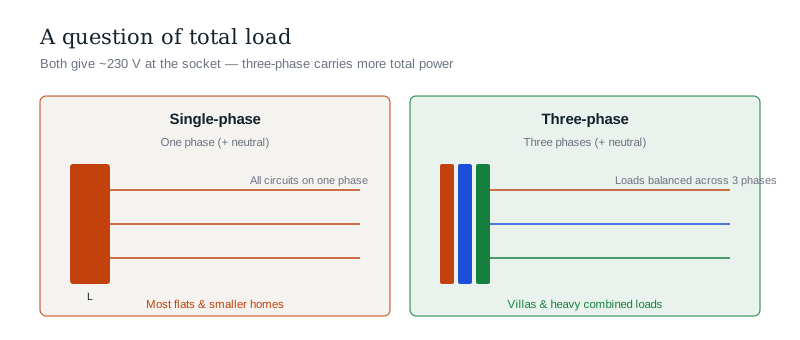
A single-phase connection suits the majority of Indian homes:
- Flats and smaller/medium homes with a normal appliance load.
- Where the total simultaneous load stays within the single-phase limit your DISCOM allows.
- Simpler and cheaper — lower fixed charges and straightforward wiring.
For most homes, single-phase is perfectly adequate — the question only arises as loads grow.
When you need three-phase
A three-phase connection becomes the right choice when the total load is high:
- Larger homes and villas with multiple ACs, a lift, heavy pumps, an EV charger and other big loads running together.
- When the total load exceeds what single-phase can comfortably supply, or your DISCOM requires three-phase above a load threshold.
- When you want loads balanced across three phases for a stable, efficient supply.
- Heavy or three-phase appliances (some large motors, certain EV chargers, big HVAC) may need it.
The trigger is total simultaneous load, not any single appliance — add up the heavy loads (see the load calculator).
How to tell which you need
- Estimate your total connected and simultaneous load — sum the big items (ACs, geysers, pump, EV charger, kitchen) with the electrical load calculator.
- Compare to your sanctioned load and the single-phase limit your DISCOM sets.
- Watch the symptoms — the main tripping when several heavy appliances run together, or an inability to add load, signals you're near the single-phase limit.
- Ask your electrician and DISCOM — they'll confirm from your load whether single- or three-phase fits, and the sanctioned load you need.
What switching involves
Moving from single- to three-phase isn't just a meter swap:
- A DISCOM application to change the connection and sanctioned load (with revised charges).
- A new three-phase meter and often service line.
- Distribution-board changes — a three-phase board with loads balanced across the phases by your electrician.
- Cost — higher fixed charges and the wiring work, weighed against the capacity gained.
Plan it with your electrician; balancing the loads across phases is what makes a three-phase board work well.
The one-line answer
Single-phase vs three-phase is a question of total simultaneous load, not socket voltage (both give ~230 V at the outlet). Single-phase (one phase + neutral) suits the majority of homes — flats and smaller/medium houses — and is simpler and cheaper. Three-phase (all three phases + neutral) is for larger homes and villas with heavy combined loads — multiple ACs, a lift, big pumps, an EV charger running together — or where the DISCOM requires it above a load threshold, and it lets loads be balanced across phases. Add up your heavy loads to see which side of the line you're on; switching means a DISCOM application, a new meter and a rebalanced board, all handled with your electrician and utility.
Where to go next
- The whole supply picture: Residential Electrical Systems Guide.
- Size your load: Electrical Load Calculator.
- Plan the home's electrics: Home Electrical Planning Guide.
- A heavy load that may tip the balance: Home EV Charging Guide.
References
- IS 732 : 2019, Code of Practice for Electrical Wiring Installations, Bureau of Indian Standards.
- National Electrical Code of India, SP 30 : 2023, BIS.
- Central Electricity Authority (Measures relating to Safety and Electric Supply) Regulations, 2010 (as amended) — supply & connection (state/DISCOM-specific): https://cea.nic.in/
Connection type, sanctioned load and charges are DISCOM- and load-specific and evolve; confirm with your utility and a licensed electrician. Verify any standard's status via the BIS catalogue before relying on it.
Export this guide
Related Guides — Deep-dive reading
Residential Electrical Systems: The Complete Guide for Indian Homes
How the electricity in an Indian home actually works — from the utility supply and meter through the distribution board, circuits, wiring, earthing and protection, to lighting, safety, energy efficiency, smart controls, solar and backup — written so a homeowner can understand, plan and judge it, and know exactly where a licensed electrician must take over.
Electrical & WiringSingle Phase vs Three Phase Lift Systems (India): Which Supply Does Your Lift Need?
What 230 V single-phase can drive, what needs a sanctioned 415 V three-phase connection, and a clear method to decide for your Indian home.
Home Lifts & AccessibilityKitchen Electrical: Wiring, Circuits & Points for an Indian Kitchen
The highest-load, highest-risk room in the home — how to plan a kitchen's electrics: enough 16A socket points at counter height, dedicated circuits for heavy appliances, RCCB protection near water, and the layout that makes a modular kitchen work, all specified before the tiles go up.
Electrical & WiringRelated Tools — Try Free
Electrical Load Calculator
Estimate a home's connected load and realistic maximum demand from its appliances, whether it needs single or three-phase supply, and a suggested main switch rating.
ElectricalElectrical Safety & Load Audit
Home electrical audit — 10 categories, 65+ checkpoints across earthing, RCCB, MCB, wiring, switchboards, appliance circuits, DG/inverter backup.
Safety AuditLift Power Requirement Calculator
Connected load, single vs three phase, MCB and cable guidance for a home lift.
Lift Calculator