
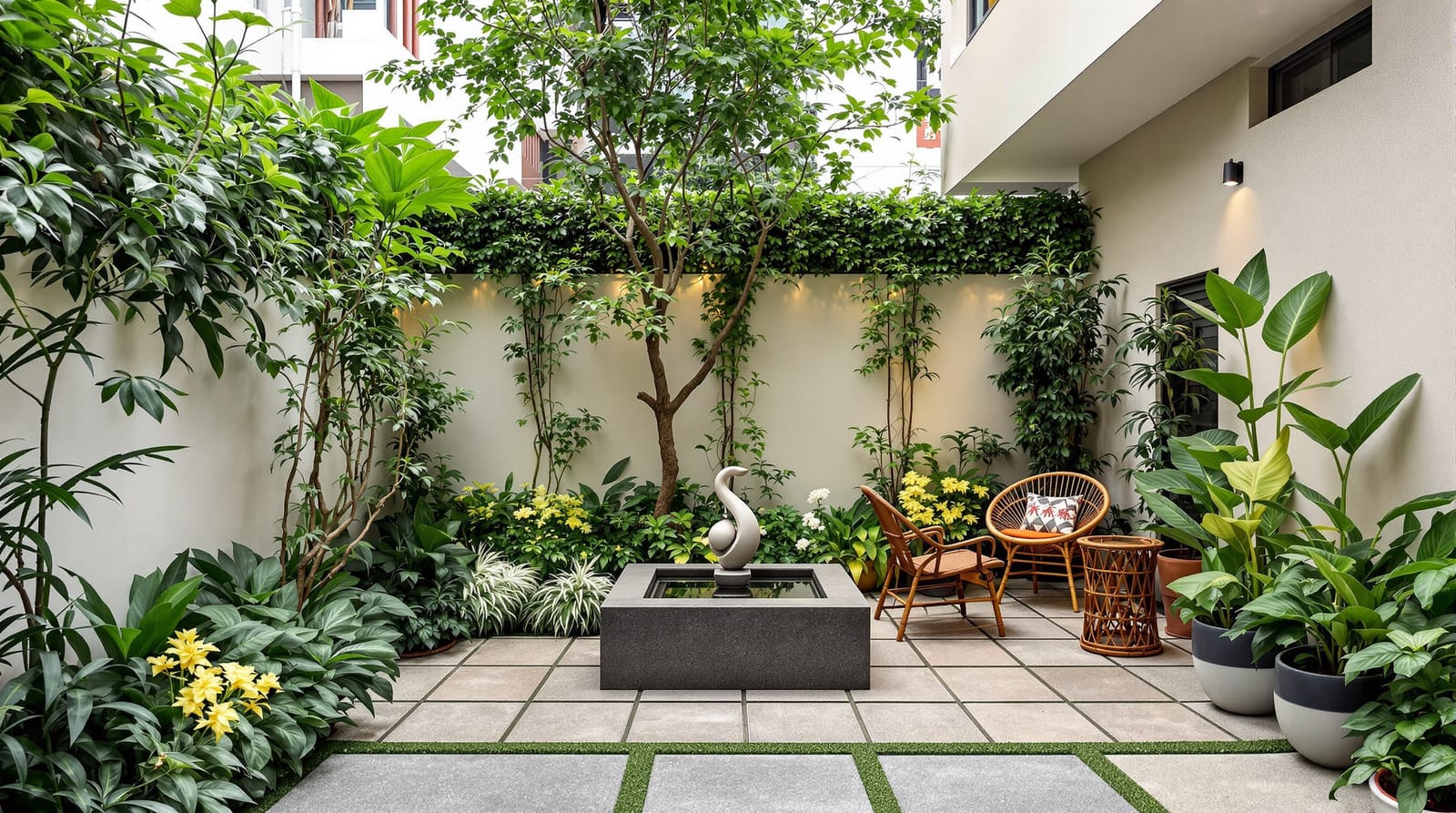
Small Garden Design for Urban Homes
Make a tight city garden feel bigger — the space-expanding tricks, vertical greening, multi-function layouts and the right plants for small ground gardens
A small urban garden is not a shrunken big garden — it is a different discipline, where the tight square metres of a city plot become an advantage, because constraint forces every plant, path and corner to earn its place. If your home has a sliver of ground at the front, a side strip beside the compound wall, a pocket behind the kitchen, or a townhouse courtyard barely wider than a car, you have enough to make something genuinely lovely. The trick is to stop apologising for the size and start designing for it.
This guide is about a small ground-level garden — soil you can dig, planted into the earth or into deep raised beds on a plot. It is deliberately not about balconies and terraces. Containers on a slab behave differently: weight limits, waterproofing, society byelaws, wind at height, and drainage onto a neighbour's washing all change the rules. If your green space is a balcony or open terrace, read Balcony Design Ideas for Indian Apartments instead — that guide is built for exactly those constraints. Here we keep our feet on the ground.
The mindset: one clear idea, not a collection
The single most common mistake in a small Indian garden is treating it like a sample tray — a rose here, a hibiscus there, a money plant, a curry leaf, a row of crotons, a fountain from the nursery sale, and three different paving materials. The eye reads clutter, and clutter reads small.
A good small garden has one clear idea and commits to it. That idea might be:
- A green, layered, jungly retreat — all foliage, few flowers, deep shade.
- A calm minimalist court — one specimen tree, gravel, a single bench, restraint everywhere.
- A productive corner — a tight, beautiful arrangement of edibles and herbs (see Edible Landscapes for the full kitchen-garden treatment).
- A flowering, fragrant space — jasmine, parijat, raat ki rani, designed around evening scent.
Pick one. Edit ruthlessly. In a 3 m × 4 m space, three plant species repeated with intent will always look better than fifteen specimens fighting for attention. This decision should come early — ideally at the Landscape Planning Before Building Design stage, so the garden is shaped by the house rather than squeezed in afterwards.
The tricks that make a small garden feel bigger
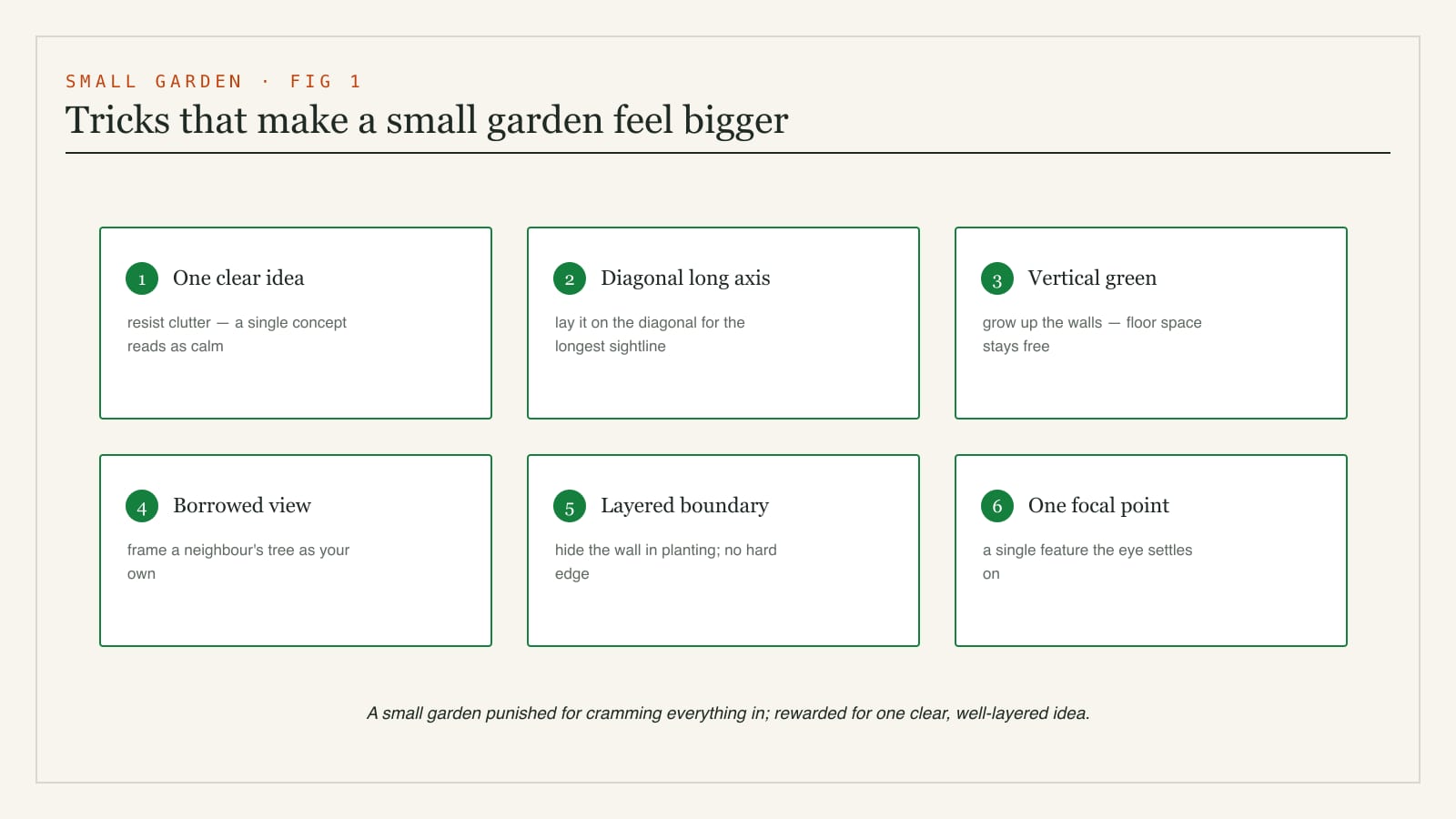
There is a real craft to spatial illusion, and it is mostly about controlling what the eye sees and in what order. The figure below summarises the moves; the text after it explains each one.
Design on the diagonal — use the longest axis
The longest straight line in any rectangle is the diagonal. Laying a path, a sightline, or the main planting line on the diagonal rather than parallel to the walls makes the space feel measurably longer and disguises its true dimensions. A square 4 m × 4 m court feels boxy when furnished square-on; turn the paving and the bed 45 degrees and the same court gains depth. This single move does more than any other.
Layering and a focal point
Depth comes from layers: low groundcover in front, mid-height shrubs behind, a taller backdrop at the rear. The eye travels through the layers and reads distance. Then give it somewhere to land — one focal point. A single specimen plant, a glazed urn, a small water bowl, a piece of sculpture, a lit tree. One. A small garden cannot afford competing focal points; they cancel each other out and the space shrinks.
Borrowed views — borrow the neighbour's tree
The Japanese call it shakkei, borrowed scenery, and it is the most generous trick available to the small-garden owner. If there is a fine tree in the neighbour's compound, a temple gopuram, a flowering gulmohar on the street, or even a well-kept hedge next door, frame it and let it become the backdrop to your garden. Your boundary then reads as the edge of a much larger landscape. Position your sit-out and your gap in the planting to capture that view. You maintain a few square metres; you appear to own the skyline.
Hide the boundary
Nothing announces "small" like a visible compound wall standing four-square around you. Dissolve it. Plant climbers and a layered green edge against it so the eye never finds where the garden stops. Madhumalti (Rangoon creeper), bougainvillea, jasmine, or a clipped backdrop of plumeria and hamelia will swallow a wall within two seasons. When the boundary disappears into green, the brain assumes the garden continues. This overlaps usefully with screening for privacy — handled in depth in our sibling guide, Landscape Privacy Design.
Light colours and mirrors — carefully
Pale paving, cream walls and silver-foliage plants (think Plectranthus or dusty miller) bounce light and open a shaded city court. Mirrors can extend a space dramatically — a framed mirror set into a wall, half-hidden by foliage, doubles a corner. But use mirrors with real caution in India: birds fly into them, they cook in west sun, they need a frame and a slightly off-square angle so people do not see themselves walking towards a reflection. One well-placed mirror is magic; a wall of them is a gimmick.
Vertical greening
When you cannot grow outward, grow upward. A green wall is the small garden's best friend — it adds enormous leaf area without stealing a single square metre of floor.
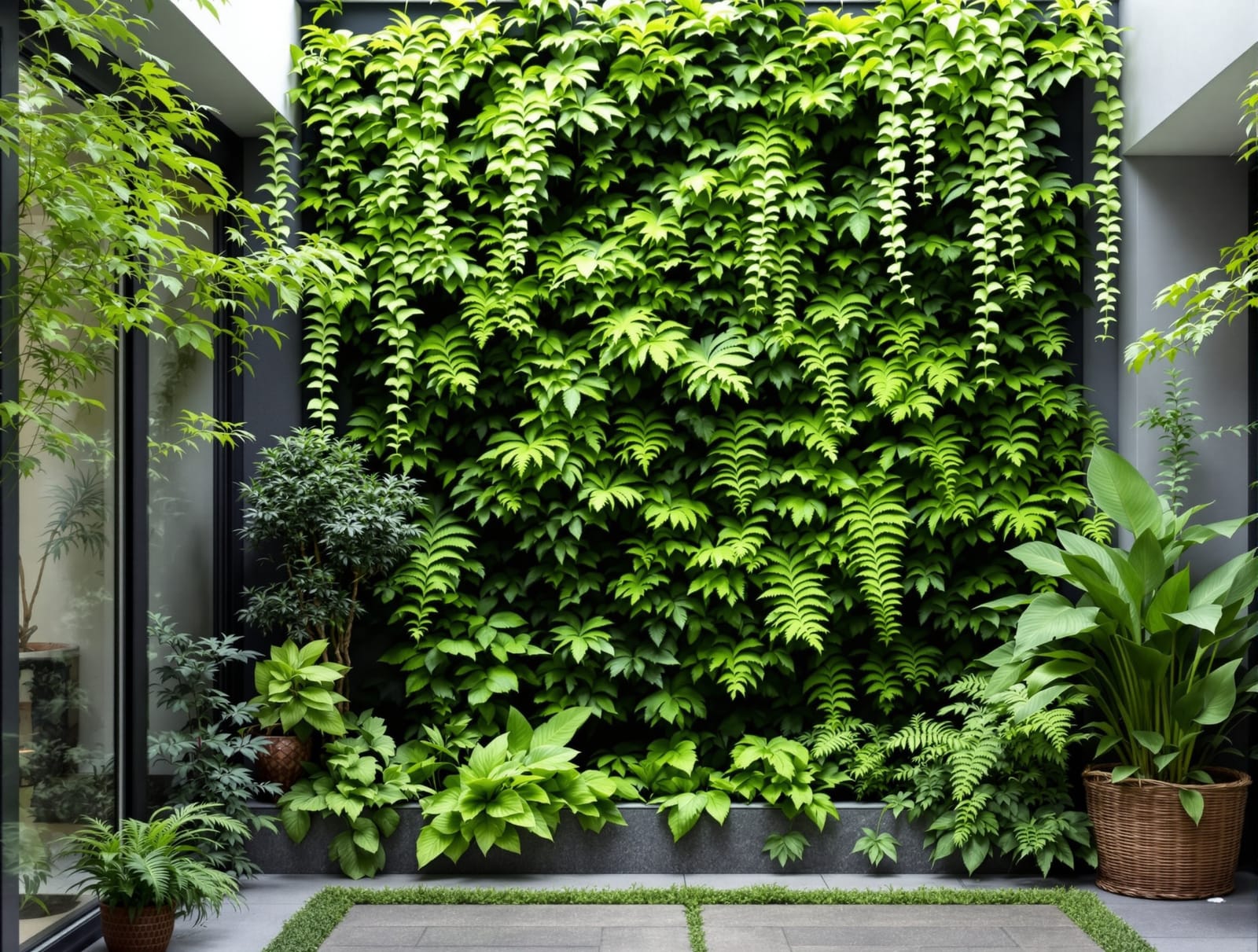
In Indian conditions, the most reliable vertical options are:
- Climbers on a trellis or wire mesh — cheapest and lowest-maintenance. Madhumalti, money plant (Epipremnum) on a moist shaded wall, passion flower, or thunbergia.
- Modular pocket / felt living-wall systems — lush but thirsty; they need drip irrigation and feeding, and ferns, syngonium, philodendron and spider plant suit a shaded north or east wall.
- Stepped shelves of pots against a wall — the low-tech living wall; flexible and forgiving.
A north- or east-facing wall is kindest; a west-facing living wall in a hot-dry city will scorch without serious irrigation.
A sample small-garden layout
The plan below shows how these ideas combine on a compact rectangular plot — a paved sit-out turned slightly off-axis, a layered planted border wrapping the boundary, a single small specimen tree for the canopy, and a vertical green wall on the shaded side.
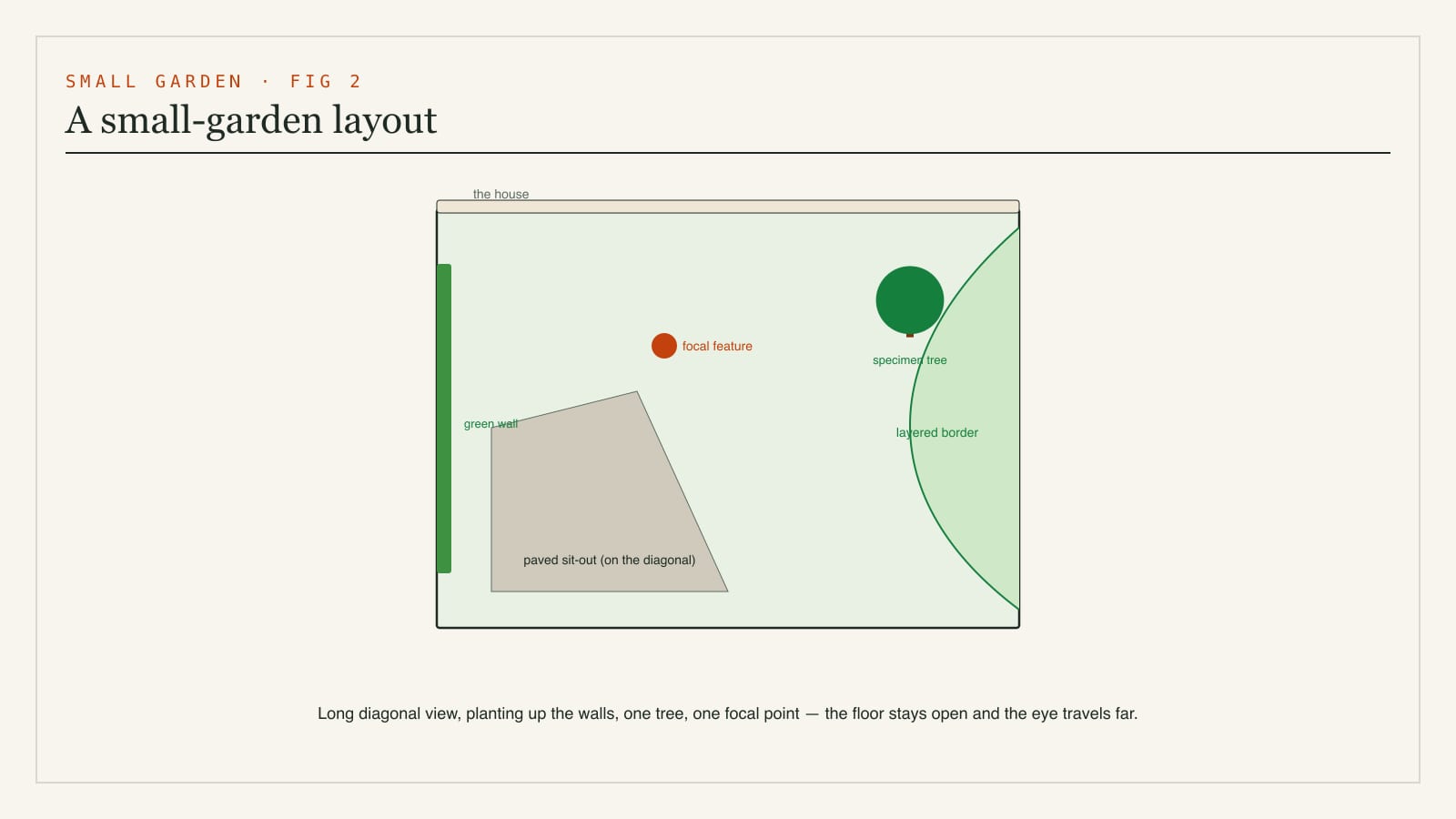
Note how little is paved and how the planting is pushed to the edges to keep the centre open — emptiness in the middle is what makes a small space breathe. For laying out paths and the sit-out so they actually work, see Outdoor Circulation Design; for dividing even a tiny plot into purposeful zones, Landscape Zoning for Family Activities.
Make it multi-functional
A small garden cannot be single-use. The same few square metres must, across a day, be a morning chai spot, an evening sit-out, a play patch for a child, and occasionally the place where two extra chairs go for guests. Design for overlap:
- A bench with storage underneath for cushions, tools and the hose.
- A fold-down or movable café table rather than a fixed heavy set.
- A paved zone that doubles as standing room for a gathering and as the dry route to the gate during monsoon.
- Raised bed edges built at 450 mm so they double as casual seating.
The discipline is the same one good architects apply to a small flat: every element does at least two jobs.
Choosing plants for a small garden
Plant choice is where most small gardens go wrong, because nursery plants are sold as small specimens that grow into the wrong size. The governing rule: choose plants whose mature scale suits the space, not their pot size today. A single ashoka or rain tree will overwhelm a 4 m court within five years, lift your paving and steal all the light. Reach for small trees, columnar forms and well-behaved shrubs.
| Role | Good for small gardens (India) | Why it works | Avoid in tight spaces |
|---|---|---|---|
| Small specimen tree | Plumeria (frangipani), pomegranate, Bauhinia (kachnar), curry leaf, guava | Stay 3–5 m, light canopy, non-invasive roots | Rain tree, ficus/peepal, gulmohar, ashoka — too large, aggressive roots |
| Columnar / upright | Bottle palm, Areca palm clump, cypress, columnar bamboo (clumping only) | Height without width; structure in a narrow strip | Running bamboo (invasive), spreading palms |
| Layered shrubs | Ixora, hamelia, dwarf bougainvillea, raphis palm, philodendron | Form the green middle layer; clip to keep tidy | Overgrown hibiscus left unpruned, kaner thickets |
| Vertical / climbers | Madhumalti, jasmine, money plant, thunbergia, passion flower | Cover walls, add leaf area, hide boundaries | Rampant creepers on weak supports |
| Groundcover | Wedelia, Mondo grass, Portulaca, native sedges | Carpet the front layer, suppress weeds | Thirsty lawn turf in a shaded pocket |
Two India-specific cautions. First, roots and pipes: in a tight plot your underground services run close to the planting, so keep aggressive-rooted trees away from drains and the compound wall foundation. Second, scale honestly: if you want a tree for shade, a single small-canopy species placed off-centre is plenty. Our companion guide Best Trees for Indian Homes has a fuller species-by-species treatment, and Climate-Responsive Landscape Design covers matching plants to your zone — a north-facing Pune court and a west-facing Chennai strip want very different palettes.
Maintenance and watering for a tiny garden
The good news about a small garden is that intensive care is feasible — you are tending square metres, not a quarter-acre. The bad news is that small gardens are unforgiving: one dead shrub in a bed of five is 20% of the view gone. Build in resilience.
- Drip irrigation on a timer is the single best investment. A simple battery tap-timer plus 12 mm inline drip line costs roughly ₹2,500–6,000 for a small garden and removes the daily-watering chore — vital for travelling city families. A living wall almost mandates it.
- Mulch every bed. A 50–75 mm layer of bark, dry leaves or cocopeat cuts watering by a third and suppresses weeds — and in a small bed you can afford to do it properly.
- Match plants to one watering regime. Do not mix cactus-and-succulent xeric plants with thirsty ferns on the same line.
- Prune little and often. In a small space, growth that would be invisible in a large garden becomes overcrowding fast. A monthly 15-minute tidy beats an annual hack.
Rough running costs for a well-kept small urban garden: a visiting mali at ₹500–1,500 per visit, fortnightly, plus ₹3,000–8,000 a year on compost, replacement seasonals and feed. Drip irrigation pays for itself in saved plant losses within a season or two.
| Task | Frequency | Notes |
|---|---|---|
| Watering | Daily in summer (or automate) | Drip + timer removes the chore |
| Light pruning / deadheading | Fortnightly | Keeps scale in check |
| Feeding (organic / vermicompost) | Monthly in growing season | Small beds reward little-and-often |
| Mulch top-up | Twice a year | Pre- and post-monsoon |
| Pest check (mealybug, scale) | Weekly glance | Caught early, neem oil is enough |
Lighting: where a small garden truly earns its keep
Most city homeowners use the garden more after dark than in the punishing daytime sun, so lighting is not an afterthought — it is what makes the space usable from 7 pm onwards. The principle is the same as indoors: light objects, not the whole space. A flat wash of bright light flattens a garden and kills depth; a few pools of warm light create mystery and make a small space feel layered and larger after dark.
- Uplight your one specimen tree or focal point — a single 3 W warm-white (2700–3000 K) spike spotlight throwing light up through the canopy is the most dramatic, cheapest move available.
- Graze a textured wall or the green wall with a low light to reveal leaf texture and, again, hide the boundary in shadow.
- Mark the path and steps with low-level glow for safety, never glare.
- Keep colour temperature warm and consistent; mixed cool and warm LEDs look cheap.
- Use IP65-rated outdoor fittings — Indian monsoon is brutal on garden electrics — and run everything on a separate RCD-protected circuit.
A complete small-garden lighting scheme — three or four good fittings — can be done for ₹6,000–20,000 and transforms the space more than any amount of additional planting.
Bringing it together
A small urban garden succeeds when it stops competing with gardens it can never be and commits fully to being itself: one clear idea, designed on the diagonal, layered for depth, with the boundary dissolved in green, the neighbour's tree quietly borrowed, a single thing to look at, and warm light for the evening. That is a real garden — not a consolation prize. The discipline of the small plot, in fact, tends to produce the most thoughtful gardens of all. For larger plots and the full design process the same principles scale up through Villa Landscape Design and Residential Site Planning; and once more, if your green space is up in the air rather than on the ground, the Balcony Design Ideas for Indian Apartments guide is the one you want.
References & further reading
- Indian Society of Landscape Architects (ISOLA) — practice resources and member guidance on small-space and urban residential landscape design.
- National Building Code of India 2016, Part 10 (Landscape, Signs and Outdoor Display Structures) — planting, soft-landscape and site-development provisions.
- ICAR – Indian Institute of Horticultural Research (IIHR), Bengaluru — ornamental and small-garden plant selection for Indian climates.
- Royal Horticultural Society (RHS) — "Small gardens" and "Designing small spaces" guidance on scale, layering and illusion of space.
- John Brookes, "The Book of Garden Design" — foundational text on space-making, the diagonal layout and focal points in small gardens.
- M. S. Randhawa, "Flowering Trees" / standard Indian horticulture references — for mature-size and root-behaviour data on Indian trees and shrubs.
Export this guide
Related Guides — Deep-dive reading
The Best Trees for Indian Homes
A research-grade guide to choosing and placing trees around an Indian home — the real cooling and clean-air numbers, the right species for shade, flowers, fragrance and fruit, and the placement science that keeps roots out of your walls and drains.
LandscapeVilla Landscape Design — Indian Villa Gardens, Hardscape & Vastu Landscape (2026)
8 landscape zones · Climate-zone tree palette · Vastu landscape · NBC 2016 Part 10 · 1.5 acre worked example
Design StylesDesigning for Views and Privacy
The site-level craft of capturing the good view while screening the neighbour's window three metres away — tuned for dense Indian plots.
Site PlanningRelated Tools — Try Free
Monsoon-Readiness Checklist
Pre-rain home audit across 9 categories — terrace, drains, waterproofing, electrical, HVAC, pest, vehicles, documents.
Seasonal AuditApartment vs Villa Interior Planning Guide
Compare ceiling height, structural flexibility, lighting, storage, and services between apartments and villas.
Planning GuideGarden Planning Toolkit
Get a tailored garden plan — planting layers, Indian species, features and a checklist — from your climate, space, sun and goals.
Planner