
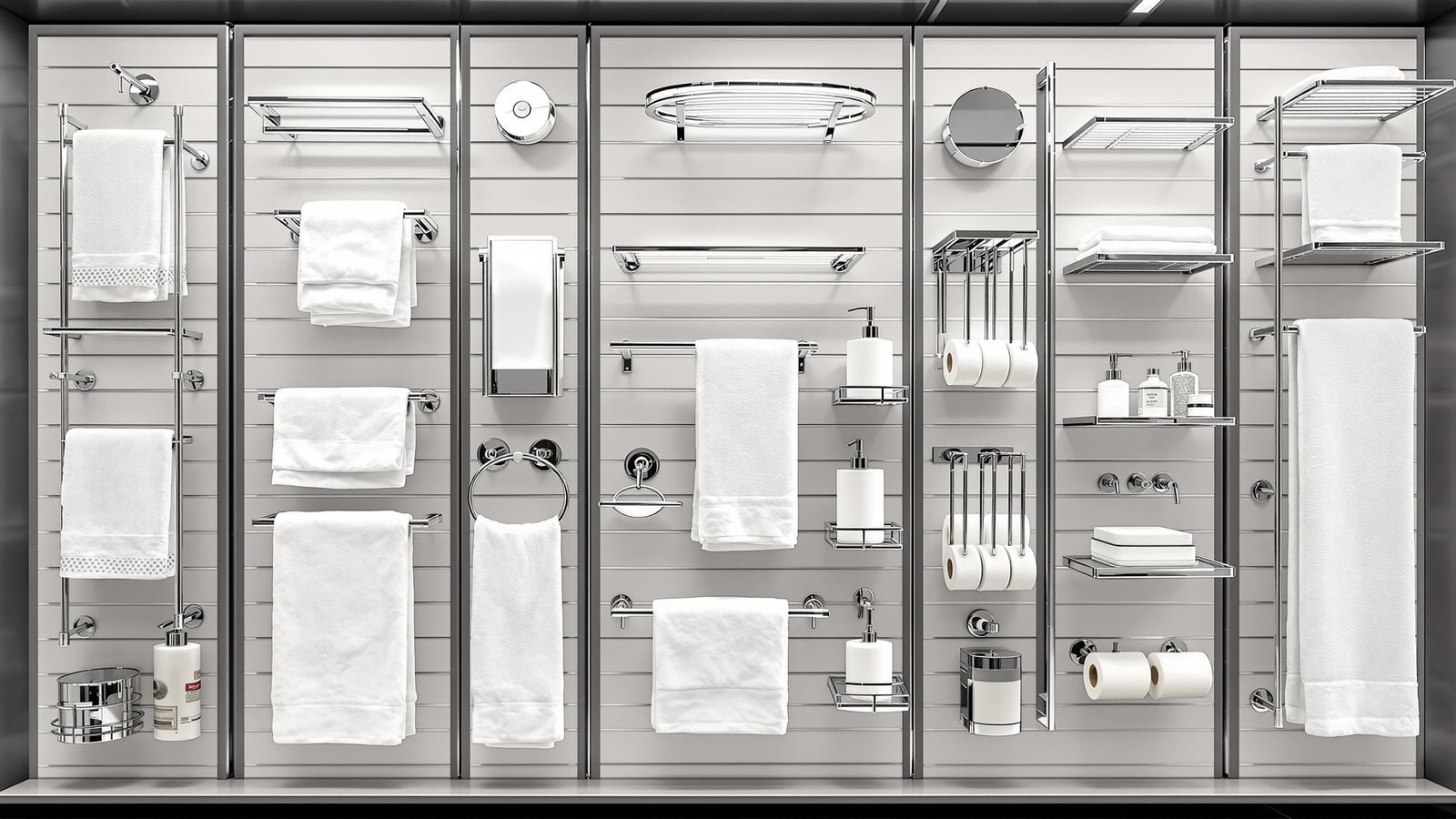
Bathroom Accessories Buying Guide India: How to Choose Towel Bars, Hooks, Holders & Hardware That Won't Rust
A buyer's decision guide to bathroom accessories and hardware for Indian homes — which material actually survives humidity (SS304 vs SS202 vs brass vs zinc vs plastic), concealed vs exposed fixing, matching finishes, ready-made sets vs individual pieces, good/better/best budget tiers, warranty, and how to spot cheap chrome-plated plastic sold as steel.
Bathroom accessories are the cheapest things in the bathroom and the first things to fail. A towel bar, a robe hook, a soap dish, a tumbler holder, a toilet-paper holder, a corner shelf — each costs a few hundred rupees, so most people buy on looks and price at the counter and never think about the metal underneath. Two monsoons later the "steel" bar is weeping orange from its joints, the hook has snapped its zinc casting, and the whole wall looks tired. This is a buying guide, not a product explainer: it is about the decision at the counter and the checklist before you pay, so the ₹300 piece you choose is still there in ten years.
The single fact that decides everything is material. Almost every accessory failure in an Indian bathroom is a material failure — the wrong alloy, or plastic disguised as metal, put into 90% humidity and daily health-faucet splash. Get the material right and finish, fixing and brand become finishing touches. Get it wrong and no warranty saves you.
This is a buyer's guide in the Studio Matrx bathroom hub. Read it alongside the main bathroom shopping guide for India, and for deep material specs see the stainless steel bathroom guide. For the wet-zone essentials go to bathroom safety accessories and the bidet and health faucet guide.
The rule at the counter: buy the grade, not the shine. A mirror-polished fitting stamped "stainless" tells you nothing — SS202 and chrome-plated zinc both gleam in the showroom and both rust in the bathroom. Ask for the grade in writing on the invoice, or walk.
The selection framework — six things that decide the choice
Every accessory purchase comes down to the same six questions. Answer them in order and the rest is detail.
- Material and grade. SS304 stainless is the sane default for a wet Indian bathroom; brass is the premium option; zinc alloy and plastic are the traps. This decides lifespan more than anything else.
- Fixing type — concealed or exposed. A concealed base plate hides the screws and looks cleaner but is harder to align; an exposed base is easier to fit and replace. Both are fine; know which you are buying.
- Finish, and whether it matches the rest of the bathroom. Chrome, brushed/satin nickel, matte black, gold/rose gold. Pick one finish family and carry it across taps, showers, hinges and accessories.
- Load and use. A towel bar and a grab bar look similar and are not the same product. Anything that bears body weight — grab bars, folding seats — must be rated and fixed into structure, never into tile alone.
- Set versus individual. A ready-made set guarantees a matched finish and is cheaper per piece; individual buying lets you place exactly what you need. Most homes do best mixing both.
- Warranty and brand backing. A written surface/finish warranty and a brand that stocks spares is worth a small premium, because accessories are the parts you most often need to replace.
Material — the one decision that decides lifespan
"Stainless" is not one material, and this is where India's counter tricks live. The same shiny bar can be any of five very different things.
- SS304 stainless (18/8) — the right default. Around 18% chromium and 8% nickel; resists rust in humid, hard-water bathrooms for a decade or more. Look for IS 6911 and a grade written on the bill.
- SS202 — the counterfeit's favourite. Low nickel, high manganese; looks identical to 304 in the showroom and streaks orange within months in a wet bathroom. It is routinely sold as "304-quality" or just "steel". Refuse it for anything in the splash zone.
- Brass (chrome or PVD plated) — the premium metal. Solid brass is heavy, does not rust, and takes a superb finish; it is what better Jaquar, Kohler and similar accessory lines are made from. Costs more and is worth it near taps and showers.
- Zinc alloy / die-cast (Zamak) — mid-tier. Fine in the dry zone with good plating, but the casting can crack and the plating blisters under constant splash. Common in budget "chrome" sets.
- Plastic / ABS chrome-plated — the cheapest, and the one most often mis-sold. A metallised plastic core wrapped in a chrome skin. Light as a feather, warm to the touch, and it is the piece that fools most buyers into thinking they bought steel.
The field test that catches fakes: pick the piece up. Real SS304 and brass have weight and feel cold; chrome-plated plastic is suspiciously light and warm. Carry a small magnet — a fitting that grabs hard is low-grade ferritic steel, while 304 is only weakly magnetic; plastic ignores the magnet entirely. Tap it: metal rings, plastic knocks dull. None of these is proof on its own, but weight + magnet + a grade on the invoice keeps most 202 and plastic out of your bathroom.
Concealed vs exposed fixing
Every wall-mounted accessory attaches one of two ways, and it changes both the look and the fitting difficulty.
- Exposed fixing — the base plate shows the screws, or the piece screws directly to the wall. Easiest to install and to replace later, more forgiving of a slightly off drill hole. The honest, practical choice for most homes and rentals.
- Concealed fixing — a hidden base plate is screwed to the wall first, then the visible accessory clips or grub-screws over it. Cleaner, no visible fasteners, but it demands accurate marking and is fiddlier to align. Standard on premium sets.
Whatever the type, the fixings matter as much as the metal: insist on stainless or brass screws and wall plugs, never the mild-steel screws that some kits include — those rust and bleed a brown stain down the tile within a year. Drill into the tile body with a proper masonry bit, and for anything load-bearing hit the brick or block behind, not just the 8 mm tile skin.
Matching finishes across the bathroom
The fastest way to make a bathroom look considered is one finish family everywhere; the fastest way to make it look assembled from three shops is not. Decide the finish before you buy the first piece.
- Chrome — the default, bright and easy to clean, matches almost every tap range. Safe and timeless.
- Brushed / satin nickel or stainless — hides water spots and fingerprints far better than mirror chrome; the practical choice for hard-water cities.
- Matte black — striking, but shows white hard-water scale; commit to wiping it, or it looks neglected.
- Gold / rose gold (PVD) — premium; insist on PVD coating, which is bonded and durable, not a cheap lacquer that wears off.
Carry the chosen finish across taps, shower, accessories, mirror frame and even door and cabinet hinges. Buying a matched brand range is the easy route; mixing brands works only if you physically compare samples in daylight, because "chrome" varies in warmth between makers.
Ready-made sets vs individual pieces
A boxed set — typically towel bar, towel ring, robe hook, soap dish, tumbler holder and toilet-paper holder — guarantees an identical finish and costs noticeably less per piece. Individual buying lets you put exactly what each wall needs and add specialised items (a double robe hook behind the door, a corner shelf in the shower, a longer towel rail).
Most homes do best with a hybrid: buy the six-piece set for the matched core, then add individual pieces — grab bar, extra hooks, corner unit, health-faucet holder — in the same finish. Never buy a grab bar as part of a decorative "set"; a genuine grab bar is a load-rated safety product, covered in the bathroom safety accessories guide, and must be fixed into structure.
Good / better / best — what your money buys
Prices are indicative 2026 Indian retail for a standard six-piece core set, before installation. Individual pieces scale roughly with the same tiers.
| Tier | Material & finish | Fixing | Typical brand level | Set price (approx) |
|---|---|---|---|---|
| Good | SS304, chrome | Exposed | Value ranges from major brands / reputable local | Rs 2,500-5,000 |
| Better | Premium SS304 or solid brass, brushed / PVD | Concealed | Mid Jaquar, Hindware, Cera | Rs 6,000-14,000 |
| Best | Designer solid brass, PVD gold/black, coordinated range | Concealed | Kohler, premium Jaquar / imported | Rs 15,000-40,000+ |
Two items sit outside this table and deserve their own budget. A proper grab bar in SS304 runs roughly Rs 800-3,500 depending on length and whether it folds; do not economise on the one that holds a person. A health faucet set (spray, hose, holder and stop valve) runs roughly Rs 350 for throwaway plastic to Rs 3,000+ for a full-brass unit — see the bidet and health faucet guide for how to choose it well.
What to check before you pay
| Check | What good looks like |
|---|---|
| Material grade | SS304 or solid brass stated on the invoice; IS 6911 for stainless |
| Weight & feel | Heavy and cold in the hand; light and warm means plastic |
| Fixings included | Stainless or brass screws and plugs — not mild steel |
| Finish | Even, no pinholes or dull patches; PVD for gold/black |
| Warranty | Written finish/surface warranty, ideally 5-10 years on premium |
| In the box | All pieces, base plates, screws, template if concealed |
| Installation | Included or quoted separately; who guarantees the fixing |
| After-sales | Brand stocks spares; showroom will replace a defective piece |
Questions to ask the showroom or online seller:
- "What grade is this — SS304, SS202, brass or zinc? Will you write it on the bill?" A vague "it's stainless steel" is a red flag.
- "Is the finish PVD or plated, and what is the finish warranty in years?"
- "Are the screws and wall plugs stainless or brass?"
- "Is this a genuine branded set or an unbranded lookalike?" Online marketplaces list many counterfeits under famous names — buy from brand stores or authorised sellers, and match the model code.
Red flags and how mis-selling works
The most common India scam is chrome-plated plastic or SS202 sold as "steel" or "304 quality". The giveaways: an unusually low price for a "steel" set, no grade on the bill, a fitting that is light and warm, and a seller who deflects the grade question. On coastal homes, even 304 accessories near constant salt spray do better in SS316 or solid brass. And treat any "lifetime" verbal promise with suspicion — only a written warranty from a brand that stocks spares means anything. When the accessories are this cheap relative to the bathroom, the right move is always to buy the honest material once rather than the shiny fake twice.
For the room-wide purchase strategy — sequencing, where to spend and where to save across the whole bathroom — read the bathroom shopping guide for India.
References
- Bureau of Indian Standards (BIS) — IS 6911: Stainless steel plate, sheet and strip (grade designations for SS202, SS304, SS316).
- National Building Code of India (NBC) 2016 — Part 9, plumbing and sanitation, and accessibility provisions for grab bars and fixtures.
- Bureau of Indian Standards — ISI mark and CRS (Compulsory Registration) verification for genuine branded products.
- Manufacturer product literature and finish warranties — Jaquar, Hindware, Cera, Kohler (material grade and PVD finish specifications).
Export this guide
Related Guides — Deep-dive reading
How to Choose a Bathroom Faucet in India: A Buyer's Guide to Cartridges, Brass & Fakes (2026)
A buyer's decision guide to CP fittings — the ceramic-disc cartridge that decides life in hard water, the brass-vs-zinc weight test, finish durability, warranty, honest good/better/best rupee tiers, and how to spot the huge fake-faucet problem in the Indian market.
BathroomsHow to Choose a Wash Basin in India: Mount Type, Size, Tap Holes & Budget (2026 Buyer's Guide)
A buyer's decision guide to picking the right wash basin — matching the mount type to your vanity and space, sizing it to the room, getting the tap-hole config right for your faucet, judging material and durability, checking what's in the box, good/better/best rupee tiers, the IS 2556 vitreous-china mark, and how to spot seconds, hairline cracks and warranty traps.
BathroomsHow to Choose a Toilet in India: A Buyer's Guide to WCs, Traps, Flush & Budget (2026)
The make-or-break trap and rough-in check, floor-mounted vs wall-hung, one-piece vs two-piece, flush type and water use, seat and rimless upgrades, good/better/best rupee tiers, what's actually in the box, and how to spot a fake before you pay.
BathroomsRelated Tools — Try Free
Stamp Duty Calculator — All Indian States
Stamp duty + registration charges for all 28 states and 8 UTs — gender concessions, urban/rural variants, metro cess built in.
Stamp DutyBefore & After Studio
Generate AI before-and-after renders to preview how your redesign could look.
DesignAICross-Ventilation Analyzer
Estimate airflow and air changes per hour (ACH) from room size, window areas, layout, and local wind — with NBC 2016 Part 8 compliance check.
Ventilation Calculator