
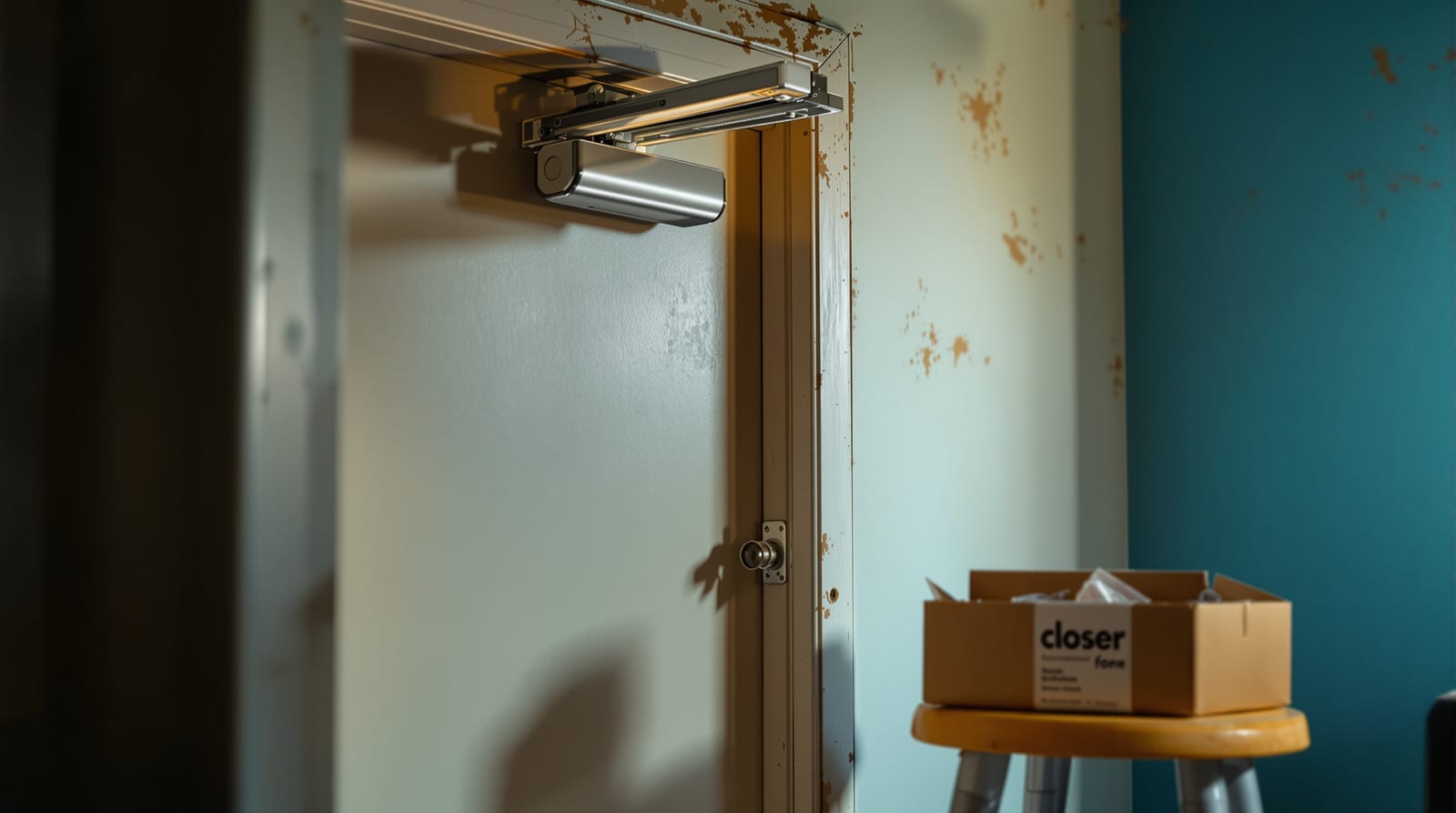
Door Closer Repair: Fix or Replace a Failed Unit India 2026
Loose mount, bent arm or a leaking oil closer? Here is how to diagnose, fix what is fixable and pick the right replacement.
A door closer is the small hydraulic box at the top of your door that pulls it shut on its own. When it fails, the door either slams, drifts half-open, or sticks part-way, and on a main door or office door that quickly becomes a daily annoyance and a security gap. Good news: a lot of door closer repair is genuinely DIY-friendly. Loose mounting screws, a bent or disconnected arm and plain wrong installation are all fixable in under an hour. The one honest exception is a closer that is leaking oil, that one cannot be refilled and must be replaced. This guide helps you tell the difference and fix or swap yours the right way.
Door closer repair: first, diagnose the fault
Before you touch a screwdriver, watch the door do one full cycle. Open it slowly and let go. The way it misbehaves tells you almost everything. Most overhead closers in Indian homes and offices are the surface-mounted hydraulic type, a sealed body full of oil with one or two adjustment screws and a folding arm. A few premium and commercial doors sit on a floor spring instead, the closer is buried in the floor below the bottom pivot.
| Symptom | Likely cause | Repair | DIY difficulty |
|---|---|---|---|
| Oil weeping from the body or arm | Internal seal failed | Replace the closer (cannot refill) | Easy (swap), but unfixable |
| Door slams hard | Closing/latch speed valve open too far, or oil low | Adjust valve; if no oil left, replace | Easy |
| Door won't close fully | Loose mounting, wrong arm setting, low oil | Re-tighten, reset arm; replace if leaking | Easy to moderate |
| Closer pulls away from door/frame | Stripped or loose screws | Re-fix into solid material, longer screws | Easy |
| Arm bent or sagging | Door slammed or forced | Straighten or replace arm/bracket | Moderate |
| Closer rated too small | Wrong EN size for door weight | Replace with correct EN size | Easy (sizing matters) |
| Floor-spring door tilting/grinding | Spring oil leaked, pivot worn | Pro replacement of floor spring | Pro only |
The single most important check: wipe the closer body and arm with a dry cloth, then look for a fresh oily film an hour later. If oil is appearing, stop planning a repair. A leaking hydraulic closer is sealed and not designed to be opened or refilled; the fluid is gone or going and the damping will never return. Budget for a replacement instead.
Tools & materials you'll need
- Screwdriver set (Phillips and flat) and a small spanner or Allen key set
- Cordless drill with bits, plus longer screws or wall plugs if mounts are stripped
- Pencil, measuring tape and the closer's paper template (or trace the old one)
- Replacement closer of the correct EN size (only if leaking, undersized or cracked)
- Spirit level, masking tape and a cloth
- Optional: thread-lock or a dab of wood glue for loose screw holes
Difficulty for adjustment and re-mounting: easy, 15-40 minutes. Full closer replacement: moderate, 45-90 minutes. Floor-spring work: pro, call a carpenter or hardware fitter.
Step-by-step: fixing a closer that still has its oil
Work through these in order. Many doors are cured by the time you reach step 3.
1. Tighten every mounting screw. A closer that drifts open or rattles is very often just loose. Snug up the screws on the body bracket (frame side) and the arm shoe (door side). If a screw spins freely, the hole is stripped, see step 6.
2. Set the two speed valves. Look for two small screws on the closer face, usually marked S (sweep, the main swing) and L (latch, the last few degrees). Turn clockwise to slow that phase, anticlockwise to speed it up. Turn in tiny quarter-turns and test, never remove these screws fully, they are the oil valves and backing them out can release fluid.
3. Check the arm geometry. The folding arm should sit roughly perpendicular to the door when closed (the exact angle depends on model). If the arm is at a lazy angle, the closer loses leverage and won't latch. Loosen the arm's connecting nut, swing it to the correct preset, and re-tighten.
4. Straighten or replace a bent arm. A slammed or propped-open door often bends the linkage. A lightly bent steel arm can sometimes be eased back in a vice, but a kinked or cracked arm should be replaced, spare arms are sold for most common brands.
5. Confirm the closer suits the door. If a tiny closer is fighting a heavy teak main door, no adjustment will save it, it is simply undersized. See the EN sizing table below.
6. Re-fix stripped screw holes. Plug the old hole with matchsticks and wood glue or a wall plug, let it set, then re-screw. For a heavy door, move to longer screws or relocate the bracket onto solid timber, not just the architrave. Our stripped hinge screw fix guide covers the same plug-and-reseat trick in detail.
7. Re-test a full cycle. Open fully, release, and watch. Aim for a smooth sweep, then a controlled positive latch with no slam. Fine-tune the S and L valves until it feels right.
If, after all this, the door still slams or won't latch and there is no oil leak, the closer's internals are worn out and it is replacement time, which is the same job as below.
How to choose a replacement closer
Closers are rated by EN sizes 1 to 6 under the European standard most Indian-sold units quote. The size matches the closer's power to the door's width and weight, get this wrong and a good closer still fails.
| EN size | Max door width | Approx door weight | Typical Indian use |
|---|---|---|---|
| EN 1-2 | up to ~850 mm | up to ~40 kg | Light interior/bedroom doors |
| EN 3 | up to ~950 mm | up to ~60 kg | Standard flush room door |
| EN 4 | up to ~1100 mm | up to ~80 kg | Heavy main door, office entry |
| EN 5-6 | up to ~1250-1400 mm | up to ~100-160 kg | Solid teak main doors, commercial |
Many good closers are adjustable across sizes (for example EN 2-4 or EN 3-6), which is the safest buy if you are unsure. Match the mounting type to your door too: a standard surface-mounted overhead closer is fine for most timber, WPC and steel doors; a glass door typically needs a patch fitting or a floor spring, which is pro-installed and not a DIY swap. If you are unsure of your door's weight, the repair-vs-replace door calculator can help you decide whether the whole leaf is worth keeping, and the door repair cost estimator ballparks the spend.
Replacing a surface-mounted closer, in brief
1. Unscrew the arm from the door, then unscrew the body from the frame (or vice versa, depending on your mounting).
2. Hold the new closer's paper template to the door, level it, and mark the holes. Reusing old holes only works if the new model matches, usually it won't line up exactly.
3. Drill pilot holes, screw the body and the arm shoe into solid material, never just the thin architrave.
4. Connect and pre-load the arm per the instructions, then set the S and L valves as in step 2 of the repair section.
5. Test several full cycles and fine-tune.
A closer itself costs roughly ₹600-3,000 (plus 18% GST), with branded EN 4-6 units at the higher end. Fitting it yourself is free; a carpenter or hardware fitter charges around ₹400-800 for a half-day visit, so a complete supplied-and-fitted swap typically lands at ₹1,000-3,500.
When to stop and call a professional
- Floor springs. If your door pivots on a floor spring and it is leaking, tilting or grinding, that is a buried hydraulic unit, leave it to a fitter. It involves lifting the door off its pivot.
- Glass and frameless doors. Toughened-glass doors use patch fittings and floor springs that must be handled carefully; a cracked glass door is a replacement job.
- Automatic and sensor doors. A powered auto-operator is not a hydraulic closer. Isolate the power first and call the supplier, see our automatic door troubleshooting guide.
- A sagging or binding door. If the door no longer hangs square, the closer is not your problem, fix the hinges and frame first. See fix sagging door.
For smaller related niggles, our door closer adjustment guide goes deeper on the speed valves, and if your door also refuses to latch shut, work through door not latching and door not closing properly alongside this. For the full picture, see the complete door guide and the cluster's door troubleshooting hub.
Frequently asked questions
Can a leaking hydraulic door closer be refilled?
No. Hydraulic closers are sealed units; once the oil seal fails, the fluid escapes and cannot be topped up or replaced. A weeping or oily closer must be swapped for a new one. The good news is the body itself is inexpensive at ₹600-3,000.
Why does my door slam even after I adjusted the closer?
Usually one of three things: the latch-speed (L) valve is open too far, the closer has lost oil and no longer damps, or it is undersized for a heavy door. Slow the L valve in tiny quarter-turns first. If there is no improvement and no oil leak, the closer is worn out; if there is oil, replace it.
How do I know what EN size to buy?
Measure your door's width and estimate its weight, then match the table above. A solid teak main door usually needs EN 4-6; a light interior door EN 2-3. When in doubt, buy an adjustable closer (such as EN 3-6) so you can dial in the right power.
Is replacing a door closer a DIY job?
For a standard surface-mounted overhead closer on a timber, WPC or steel door, yes, it is a moderate 45-90 minute job with a drill and screwdriver. Floor springs, glass-door fittings and automatic operators are not DIY, call a fitter.
My closer keeps coming loose from the frame. What now?
The screw holes are stripped or the closer is fixed into thin architrave rather than solid timber. Plug the holes with wall plugs or matchsticks and glue, then re-screw with longer screws into the solid frame or door. An undersized closer also strains its mounts, so check the EN size while you are at it.
Export this guide
Related Guides — Deep-dive reading
Door Hinge Replacement: DIY Step-by-Step Guide (India 2026)
Match the size, type and finish, then swap a worn or rusted hinge yourself without taking the whole door off its frame.
Home Doors & EntrancesDoor Troubleshooting Guide: Fix Any Door Fault (India 2026)
Symptom to cause to fix for every common door problem in Indian homes, with difficulty, time, cost and when to call a carpenter.
Home Doors & EntrancesFitting Door Closers: New Install Guide (India 2026)
Fit an overhead door closer from new — choose the mounting, template and drill the fixings, mount body and arm, set closing and latching speed.
Home Doors & EntrancesRelated Tools — Try Free
Door Hardware Cost Estimator
Estimate the all-in hardware cost for a door — hinges, lock, handle, closer, bolts, stopper and fitting — with GST.
Door CalculatorDoor Material Comparison Tool
Compare 2–4 door materials on cost, durability, maintenance, security and moisture resistance.
Comparison ToolDoor Security Rating Calculator
Score your main door out of 100 across leaf, frame, lock and hardware — and see the top upgrades.
Security Tool