
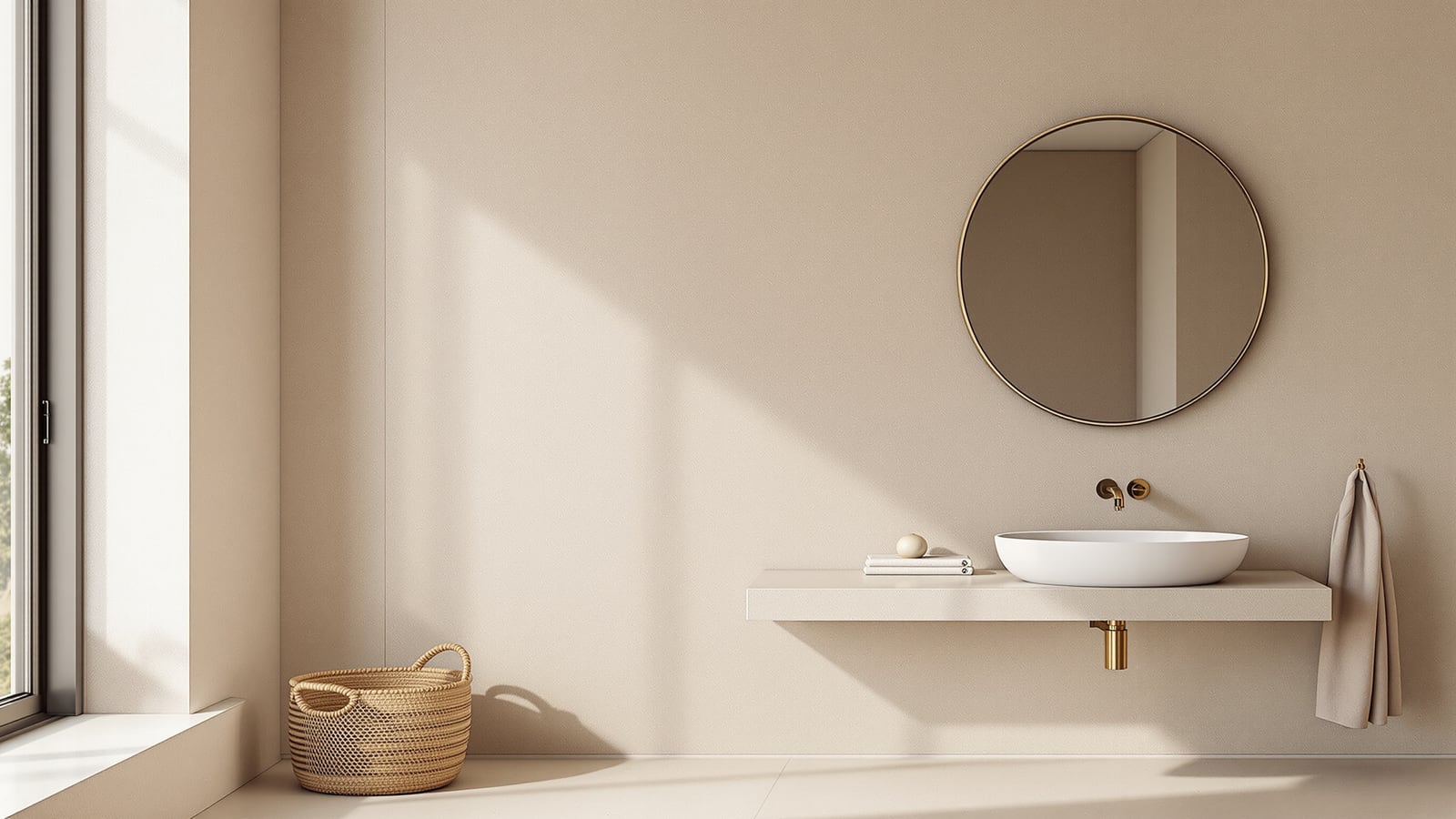
Decorative Bathroom Wall Finishes India: Microcement, Tadelakt, Venetian Plaster, 3D Tiles & Fluted Panels
A comparison guide to statement bathroom wall finishes in India — microcement and tadelakt, Venetian plaster, textured and 3D tiles, mosaic feature walls and fluted panels — which suit wet versus dry zones, what waterproofing (tanking) each needs behind it, and honest ₹/sq ft cost and upkeep.
A bathroom wall does two jobs at once. It has to keep water out of your building, and it can, if you let it, be the single most memorable surface in the room. For decades the default answer in India was floor-to-ceiling ceramic tile, and there is nothing wrong with that. But a growing set of decorative finishes — seamless microcement, waxed tadelakt, polished Venetian plaster, sculptural 3D tiles, jewel-like mosaic and warm fluted panels — now let you turn one wall into a statement without giving up waterproofing.
The catch is that "decorative" and "waterproof" are two different properties, and the market blurs them. A finish that looks like solid stone may be a 2 mm skin that soaks up water unless something underneath stops it. This guide compares the popular options honestly: where each belongs in the wet zone versus the dry zone, what tanking (the continuous waterproof barrier) each needs behind it, and what they cost and demand in upkeep under Indian hard water and monsoon humidity.
This is a materials guide in the Studio Matrx bathroom hub. Read it up to the bathroom wall tiles guide for India for the tile fundamentals, and alongside bathroom stone cladding, WPC wall panels for bathrooms and luxury bathroom design. For the barrier under everything, see the waterproofing guide.
A decorative finish decorates. It rarely waterproofs on its own. Get the tanking right first, then choose whatever surface you love — the two decisions are independent, and confusing them is how leaks start.
Wet zone, damp zone, dry zone
Every wall in the room sits in one of three exposure bands, and the finish you can safely use depends on which band it is in.
- Wet zone — directly hit by water: the shower enclosure and the wall behind a bath spout, roughly to 1.8–2.0 m height. Also the splash zone around a health-faucet and jet spray. These walls must sit over a continuous waterproof membrane; the finish on top only needs to survive constant wetting.
- Damp zone — humidity and occasional splash: the wall behind a WC or vanity, the general room away from the shower. Wants a water-resistant, wipeable, mould-shy finish, but full tanking is optional if the shower is boxed off.
- Dry zone — feature and entry walls with no direct water: an accent wall opposite the vanity, the wall by the door in a separate dry bathroom. Here you can use the most decorative, least waterproof finishes freely.
The single most common mistake is treating a beautiful finish as if it removes the need for the membrane behind it. It does not. Tanking is a system in the wall; the finish is the skin on the wall. The waterproofing guide and bathroom leak prevention cover the membrane in depth.
Microcement and tadelakt: the seamless look
Both give you the joint-free, hand-troweled surface that has made "no grout lines" the most requested bathroom look in India. They behave very differently, though.
Microcement is a 2–3 mm polymer-modified cement skin applied in coats over almost any sound substrate — old tiles, cement plaster, board — then sealed with 2–3 coats of a PU or acrylic sealer. It is thin, seamless and available in dozens of colours. It is not inherently waterproof: its water resistance comes entirely from the sealer and, crucially, from a proper tanking membrane behind it. Reseal every 1–3 years in a wet zone.
Tadelakt is the traditional Moroccan lime plaster, burnished with a stone and treated with olive-oil soap (saponification) to become genuinely water-repellent in itself. It is the one seamless finish with real inherent water resistance, which is why it has been used in hammams for centuries. It is labour-intensive, needs a skilled applicator (still rare in India), and wants periodic re-soaping.
- Wet zone: Microcement — yes, over full tanking and well sealed. Tadelakt — yes, its native home, still best over tanking as belt-and-braces.
- Upkeep: Both dislike acidic hard-water descalers; use pH-neutral cleaners only. Hard-water scale shows on dark microcement — squeegee after showering.
Venetian plaster and lime finishes
Venetian plaster (polished marmorino, stucco) gives a deep, marble-like sheen with movement of light no tile can match. It is fundamentally a dry-zone and damp-zone finish. Sealed with the right wax or PU it will survive a powder room or a vanity wall handsomely, but it is not the surface to put inside a daily shower. Use it on the feature wall opposite the shower glass, where it catches the light without catching the water. In a luxury bathroom it reads far richer than paint at a fraction of a stone budget.
Textured and 3D tiles, mosaic and fluted panels
These are the "add a material, keep tile's waterproof track record" options.
- Textured / 3D tiles — ceramic, porcelain or cast-stone tiles with a sculpted face (waves, facets, kit-kat/finger tiles). Because they are fired tiles laid over tanking with a good adhesive, they are fully wet-zone safe and carry the reliability of any tiled wall. Check water absorption per IS 15622 and slip/abrasion per IS 13630. The only extra care is that deep relief holds more soap scum — pick a shallower relief for the shower itself.
- Mosaic feature walls — glass, stone or ceramic on mesh sheets. Beautiful in a niche or a single band; wet-zone safe, but remember they are mostly grout, so use an epoxy grout (IS-graded) to resist staining and mould, and expect more cleaning.
- Fluted panels — vertical ribbed panels in WPC, PVC, acrylic-faced MDF or fluted tile. WPC and PVC flutes are moisture-tolerant and can edge into damp zones; MDF-core flutes are strictly dry-zone. For the full material picture see WPC wall panels for bathrooms. Fluted stone or tile is the wet-zone-safe way to get the ribbed look inside a shower.
For natural stone slab and cladding — book-matched marble, granite, the honed-limestone look — that is its own discipline; the bathroom stone cladding guide covers fixing, sealing and weight.
Cost and upkeep, compared
Rates are indicative supply-plus-application for 2026 metros, over an already-tanked and prepared wall. Prep, membrane and scaffolding are extra and are where budgets quietly blow out.
| Finish | Typical ₹/sq ft (applied) | Best zone | Inherently water-resistant? | Upkeep |
|---|---|---|---|---|
| Microcement | 550–1,400 | Wet (sealed) to dry | No — sealer + tanking do it | Reseal 1–3 yrs; pH-neutral clean |
| Tadelakt | 1,200–2,800 | Wet to damp | Yes (soap-cured lime) | Re-soap periodically; skilled repair |
| Venetian plaster | 450–1,200 | Damp to dry | No | Wax/PU refresh; keep off shower |
| Textured / 3D tile | 250–900 + laying | Wet to dry | Yes (fired tile) | Wipe relief; standard grout care |
| Mosaic feature wall | 400–1,500 + laying | Wet (accent) | Yes with epoxy grout | More grout cleaning |
| Fluted WPC / PVC panel | 250–700 | Damp (WPC), dry (MDF) | WPC/PVC yes; MDF no | Wipe; check joints |
| Fluted stone / tile | 600–2,000 | Wet to dry | Yes | Seal stone; wipe flutes |
A few upkeep truths for Indian conditions:
- Hard water is the enemy of dark, seamless finishes. Scale rings show fastest on charcoal microcement and glass mosaic. A squeegee and a pH-neutral weekly wipe beat any coating.
- Ventilation protects the finish. Damp-zone plasters and any grout survive far longer with an exhaust fan that clears humidity; see the wider bathroom design guide.
- Match the sealer to the water. In hard-water belts specify a sealer your applicator will actually reseal on schedule, and keep the leftover material and colour code for touch-ups.
How to choose in one pass
1. Fix the zone. Decide which wall is wet, damp or dry before you fall in love with a sample.
2. Confirm the tanking. For any wet-zone wall, the IS 2645 membrane goes in first, tested by ponding, whatever the finish. Non-negotiable.
3. Pick for exposure, then looks. Seamless in the shower means microcement-over-tanking or tadelakt; sculptural-and-safe means 3D or fluted tile; the richest dry feature wall is Venetian plaster.
4. Budget the whole build-up, not just the ₹/sq ft of the skin — prep, membrane and labour often exceed the finish itself.
5. Plan the upkeep you will realistically do. A finish you will not reseal is the wrong finish.
Get those five right and a single decorative wall will carry the whole room — dry underneath, beautiful on the surface, and still watertight ten monsoons from now.
References
- National Building Code of India (NBC) 2016, Part 9 Plumbing Services — bathroom wet-area and finishes provisions.
- IS 15622 — Pressed ceramic tiles: classification and water-absorption groups for wall tiles.
- IS 13630 — Ceramic tiles: methods of test (water absorption, abrasion, chemical resistance).
- IS 2645 — Integral cement waterproofing compounds; guidance for tanking behind wall finishes.
- IS 2556 — Sanitary appliances (vitreous china): reference for adjacent fixtures.
- IGBC / GRIHA — Green building guidance on low-VOC finishes, sealers and durable wet-area materials.
Export this guide
Related Guides — Deep-dive reading
Moisture-Resistant Building Materials in India: The Right Material for Every Wet Zone (2026)
Moisture is the biggest enemy of Indian buildings - monsoon, rising damp, condensation, leaks and coastal humidity. This guide separates waterproofing (a system) from choosing inherently moisture-tolerant materials, then names the right material for bathrooms, exteriors, roofs, basements and finishes - with a zone-by-zone selector table. A specify-and-select guide.
Building MaterialsBathroom Wall Finishes: The Complete Guide for Indian Homes
Wet, splash and dry walls each need a different finish — the bathroom's zones, the best finish for each, why waterproofing comes first, tricks to enlarge a small bath, and three budget combinations.
Wall FinishesEpoxy Grout vs Cement Grout for Tiles in India: Which to Specify (2026)
A plain-English guide to tile grouts for Indian homes: what grout does, how cementitious grout compares with epoxy grout on cost, stain and water resistance, hygiene and durability, and exactly where each one belongs - kitchens, bathrooms, pools, dry rooms and more.
Building MaterialsRelated Tools — Try Free
Material Schedule Generator
Generate a room-wise finish schedule — walls, floors, ceilings, trim, and joinery by location.
Material ScheduleFalse Ceiling Cost Estimator
Live ₹/sqft across 8 ceiling types — POP, gypsum, designer, metal, PVC, wooden — with cove and spot lighting for 20 Indian cities.
Cost CalculatorCross-Ventilation Analyzer
Estimate airflow and air changes per hour (ACH) from room size, window areas, layout, and local wind — with NBC 2016 Part 8 compliance check.
Ventilation Calculator