
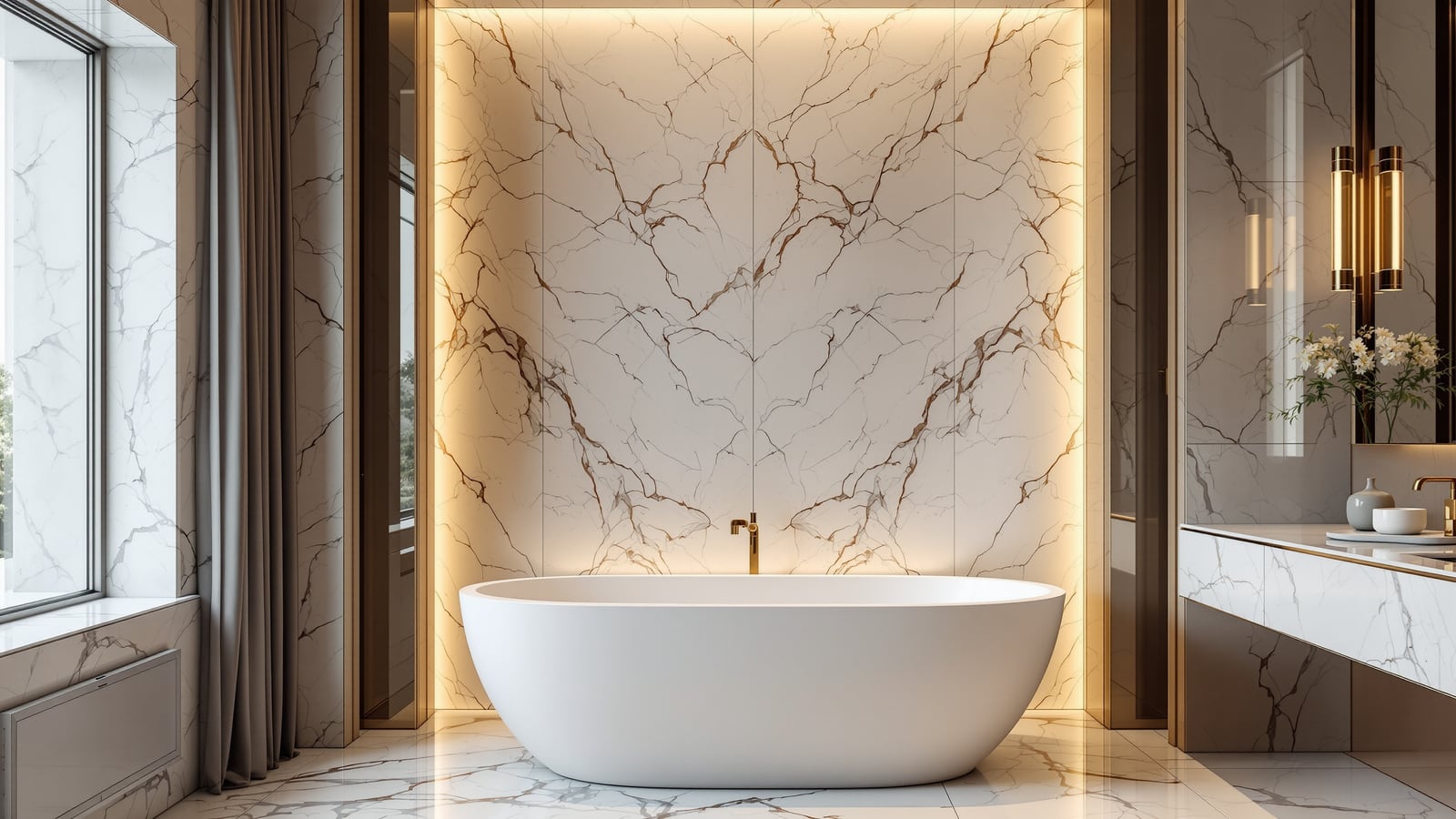
Bathroom Stone Cladding India: Marble, Granite & Stone Feature Walls
A practical, India-first guide to natural stone wall cladding in bathrooms — book-matched marble slabs, granite, ledgestone and stone veneer feature walls — with honest ₹ per sq ft costs, adhesive vs mechanical fixing, sealing against water and staining, and hard-water maintenance that keeps the stone looking new.
Few surfaces transform a bathroom the way a wall of natural stone does. A single book-matched marble panel behind a vanity, a floor-to-ceiling granite shower wall, or a rugged ledgestone strip behind a freestanding tub turns a functional room into something that reads as a private spa. But stone on a bathroom wall is unforgiving of shortcuts: it is heavy, it is porous, it stains, and India's hard water leaves it chalky within months if the wrong stone is chosen or the sealing is neglected. Done right, cladding lasts decades and improves with age; done wrong, it delaminates off the wall or etches into a dull grey haze.
This is a materials-and-components guide in the Studio Matrx bathroom hub. Read it alongside the bathroom wall tiles guide for India, which covers the tiled alternative most bathrooms actually use; the companion bathroom stone flooring guide for the same materials underfoot; the luxury bathroom design guide for how a stone wall fits a premium scheme; and the decorative bathroom wall finishes guide for microcement, Venetian plaster and the non-stone options.
Stone cladding is a structural and a chemical decision before it is an aesthetic one. Pick the stone for its porosity and weight, fix it for its dead load, seal it before it ever sees water — then enjoy the veining.
Where stone cladding belongs — and where it does not
Stone cladding is a feature, not a default. Wrapping an entire bathroom in marble is expensive, heavy and maintenance-hungry; the smart move is one deliberate surface.
- The feature wall. The single wall you see on entry, behind the vanity mirror or the tub. This is where book-matched marble earns its keep — one dramatic surface, everything else calm.
- The shower back wall. A honed granite or quartzite panel takes constant water beautifully if sealed; avoid soft calcareous marble here where it meets hard-water spray daily.
- A vanity backsplash band. A 600–900 mm high stone band above the counter, often the same slab as the countertop, is a low-cost way to get the look with little exposure.
- Not the wet zone in soft stone. Onyx, most white marbles and travertine in a jet-spray or health-faucet splash zone will etch and stain. Reserve them for the dry wall.
For an Indian home, the honest rule is: one feature wall in premium stone, the rest in matching or tonal large-format tile. It halves the cost and more than halves the maintenance.
The stone families and what they cost
India is a stone superpower — Makrana marble, Rajasthan and Andhra granites, Kota and quartzites are quarried and processed here — so material rates are competitive, but processing, book-matching and skilled fixing carry the cost.
| Stone | Look | Porosity / water behaviour | Best bathroom use | Indicative ₹/sq ft (supplied + fixed) |
|---|---|---|---|---|
| White/statuario marble | Bright, dramatic veining | High — etches and stains easily | Dry feature wall only | ₹350–1,200+ |
| Indian green/Makrana marble | Warm, classic | Medium-high | Vanity wall, dry zones | ₹250–700 |
| Granite | Speckled, hard, dense | Low — very water-tolerant | Shower & wet walls | ₹180–600 |
| Quartzite | Marble-like but hard | Low–medium | Shower feature wall | ₹400–1,500 |
| Ledgestone / stone veneer | Rugged, textured strips | Medium (sealed) | Accent/tub wall | ₹150–450 |
| Onyx (backlit) | Translucent, jewel-like | Very high — delicate | Backlit dry panel | ₹800–3,000+ |
Add to these: book-matching (cutting and mirroring adjacent slab faces so veins flow across a joint) adds roughly 20–40% for slab selection and wastage; mechanical fixing for large slabs adds ₹80–200/sq ft in framework and anchors; and premium sealing adds ₹15–40/sq ft. Get everything in writing as supply-and-fix per sq ft with a wastage allowance stated, because slab yield on a book-matched wall can be 30–40%.
Book-matching: the marble showpiece
Book-matching is what makes a marble wall look like a work of art rather than a set of tiles. Consecutive slices are cut from the same block and opened like the pages of a book, so the veins mirror across the seam. A four-way match (two mirrored horizontally and vertically) creates a butterfly of symmetry — the classic luxury hotel look.
To get it right:
- Buy the whole bundle. Book-matching only works with sequential slabs from one block. Reserve the full bundle and dry-lay it flat before fixing.
- Plan the seam. Centre the match on the wall's focal point — behind the mirror or the tub — and set out from the centre outward, not corner-inward.
- Mind the thickness. Wall slabs are usually 18–20 mm; thinner 10–12 mm slabs on a backing board reduce dead load but need a rigid substrate.
Because slabs are large and heavy, book-matched walls almost always need mechanical support, which is the next decision.
Fixing: adhesive vs mechanical
How you attach the stone is the single most important safety decision, because a slab that lets go from a wet wall is a real hazard. The choice is driven by weight and slab size.
| Factor | Adhesive (bonded) | Mechanical (anchored) |
|---|---|---|
| Best for | Tiles & thin slabs ≤ 12 mm, small format | Large slabs, heavy stone, high walls |
| Weight limit (rule of thumb) | Up to ~40 kg/sq m per adhesive class | No practical limit if frame designed |
| Substrate | Sound, flat, primed plaster/RCC | Any — frame spans unevenness |
| Water resilience | Depends fully on bond & waterproofing | Ventilated cavity dries out |
| Cost | Lower (₹40–120/sq ft labour + adhesive) | Higher (₹80–200/sq ft extra) |
| Failure mode | Delamination if bond fails | Very safe if anchors sized right |
- Adhesive fixing uses a notched-trowel bed of cement-based tile adhesive to IS 15477, ideally a C2-class polymer-modified adhesive, applied by full back-buttering (100% coverage — no spot dabs, which trap water and cause hollow, hazardous bonds). This suits tiles, mosaics and thin slabs on a sound, waterproofed wall.
- Mechanical fixing uses a stainless-steel (SS 304, or SS 316 for coastal humidity) sub-frame with kerf, undercut or dowel-pin anchors carrying the slab's dead load into the structure. This is mandatory for large marble/granite slabs — anything heavy enough or tall enough that adhesive alone is a risk. Design it to IS 14223 (natural stone cladding) principles with a ventilated cavity.
A common hybrid on feature walls is anchor-and-adhesive: SS pins or brackets take the dead load while adhesive stabilises the face against the wall.
If a slab is big enough that two people struggle to lift it, do not trust adhesive alone. Heavy stone belongs on mechanical anchors — treat it as structure, not decoration.
Waterproofing and sealing — the part that gets skipped
Natural stone is porous. Water, soap, mineral-rich hard water and the daily jet from a health faucet all soak in, and the damage is often invisible until it is permanent.
Two independent lines of defence are non-negotiable:
1. Waterproof the wall first. Before any stone goes up, the substrate — especially in the shower and splash zones — must be tanked. Read the waterproofing guide for the membrane detail; a cementitious or liquid membrane behind the cladding protects the structure regardless of what the stone does.
2. Seal the stone itself. Apply a penetrating (impregnating) sealer to all faces and edges before fixing, then a topical seal after grouting and again as periodic maintenance. Use a breathable impregnator, not a film-forming lacquer that can peel and cloud in wet zones.
- Calcareous stones (marble, onyx, travertine) are attacked by acids — a splash of toilet cleaner, lime descaler or even lemon etches them. Never use acidic cleaners; seal thoroughly and keep them out of the direct jet-spray zone.
- Siliceous stones (granite, quartzite) are far more acid- and water-tolerant, which is why they belong in the shower.
- Grout and joints are the weak line. Use an epoxy grout in wet zones — it does not absorb water or harbour the black mould that plagues cement grout in humid Indian bathrooms.
Ledgestone and stone veneer feature walls
Not all stone cladding is a polished slab. Ledgestone (thin strips of split natural stone stacked into panels) and manufactured stone veneer give a rugged, tactile accent wall — popular behind a tub or in a dry powder room. They are lighter, come in interlocking panels or loose strips, and are usually adhesive-fixed with tile adhesive plus a corrosion-resistant mesh or SS pins for tall runs.
- Pros: textural drama, forgiving of uneven walls, lower cost, no book-matching wastage.
- Watch-outs: the deep texture traps soap scum and hard-water spray, so keep ledgestone out of the direct wet zone, seal it well, and expect to brush it clean. Manufactured veneer is lighter and more uniform but must be rated for wet/humid use.
Living with a stone wall: hard water and maintenance
India's hard water — high in calcium and magnesium — is the single biggest threat to a stone bathroom wall. It leaves chalky white scale and, on marble, can dull the polish permanently.
- Squeegee and dry the wet-zone stone after use; standing droplets are where scale forms.
- Clean with pH-neutral stone cleaner only. Never vinegar, lemon, CIF, hard-water descalers or acidic toilet cleaners on marble or travertine — they etch instantly.
- Reseal on schedule: impregnating sealer every 1–3 years on marble, less often on granite. A water-drop test tells you when: if drops soak in rather than bead, it is time to reseal.
- Consider a water softener or point-of-use filter for the bathroom if scale is aggressive in your area; it protects fittings and stone alike.
- Fix leaks fast. A slow leak behind cladding wicks into the stone and shows as a dark stain that is nearly impossible to reverse.
| Do | Don't |
|---|---|
| Seal all faces before fixing | Rely on adhesive alone for heavy slabs |
| Use epoxy grout in wet zones | Use acidic cleaners on marble/travertine |
| Waterproof the substrate first | Put soft marble in the jet-spray zone |
| Squeegee wet stone dry daily | Spot-bond slabs with dabs of adhesive |
| Buy the whole bundle for book-matching | Skip the SS grade upgrade near the coast |
References
- NBC 2016 (National Building Code of India) — Part 6 Structural Design and cladding/anchorage provisions for wall finishes.
- IS 14223 (Part 1): Polished building stones and cladding practice — stone selection and fixing guidance.
- IS 1130: Marble (blocks, slabs and tiles) — specification for marble used in building work.
- IS 15477: Specification for laying of ceramic tiles / adhesive classes — polymer-modified adhesive (C2) practice for bonded cladding.
- IS 3622 / IS 3316: Sandstone and dimension stone specifications for natural stone cladding materials.
- BIS and CPWD Specifications — schedules for stone cladding, anchorage and pointing in wet areas.
Export this guide
Related Guides — Deep-dive reading
Porcelain, Ceramic & Sintered-Stone Facade Cladding in India: A Practical Guide
Thin large-format porcelain and sintered-stone slabs can clad a building with the look of marble, concrete or weathered steel at a fraction of stone's weight — but on a facade, the fixing system is a life-safety decision, not a finish choice.
Building FacadesHow to Clean Bathroom Tiles (India): Shine, Hard-Water Film & Soap Scum
A practical, India-first routine for cleaning bathroom tiles and keeping them glossy — the daily squeegee habit, weekly wash, monthly deep clean, and the safe cleaner for each tile type, including the golden rule that natural stone must never meet acid.
BathroomsMarble Bathroom India: Countertops, Vanity Tops, Cladding & Floors — Beauty vs Maintenance
An honest, India-first guide to using marble in the bathroom — Makrana, Italian Carrara and Statuario on countertops, vanity tops, walls and floors. The luxury look, but also the real downsides: staining, etching, hard-water dulling, sealing regimes, honed vs polished, where to use it and where to avoid it, plus ₹ costs.
BathroomsRelated Tools — Try Free
Material Schedule Generator
Generate a room-wise finish schedule — walls, floors, ceilings, trim, and joinery by location.
Material ScheduleBathroom Waterproofing Calculator
Work out waterproofing material (kg/L) and cost for a bathroom by area, wall band, system type and coats — cementitious, acrylic, PU or SBR.
Bathroom CalculatorMaterial Compare — Side by Side
Compare materials side-by-side: granite vs quartz vs marble, laminate vs acrylic vs PU, and more.
Comparison