
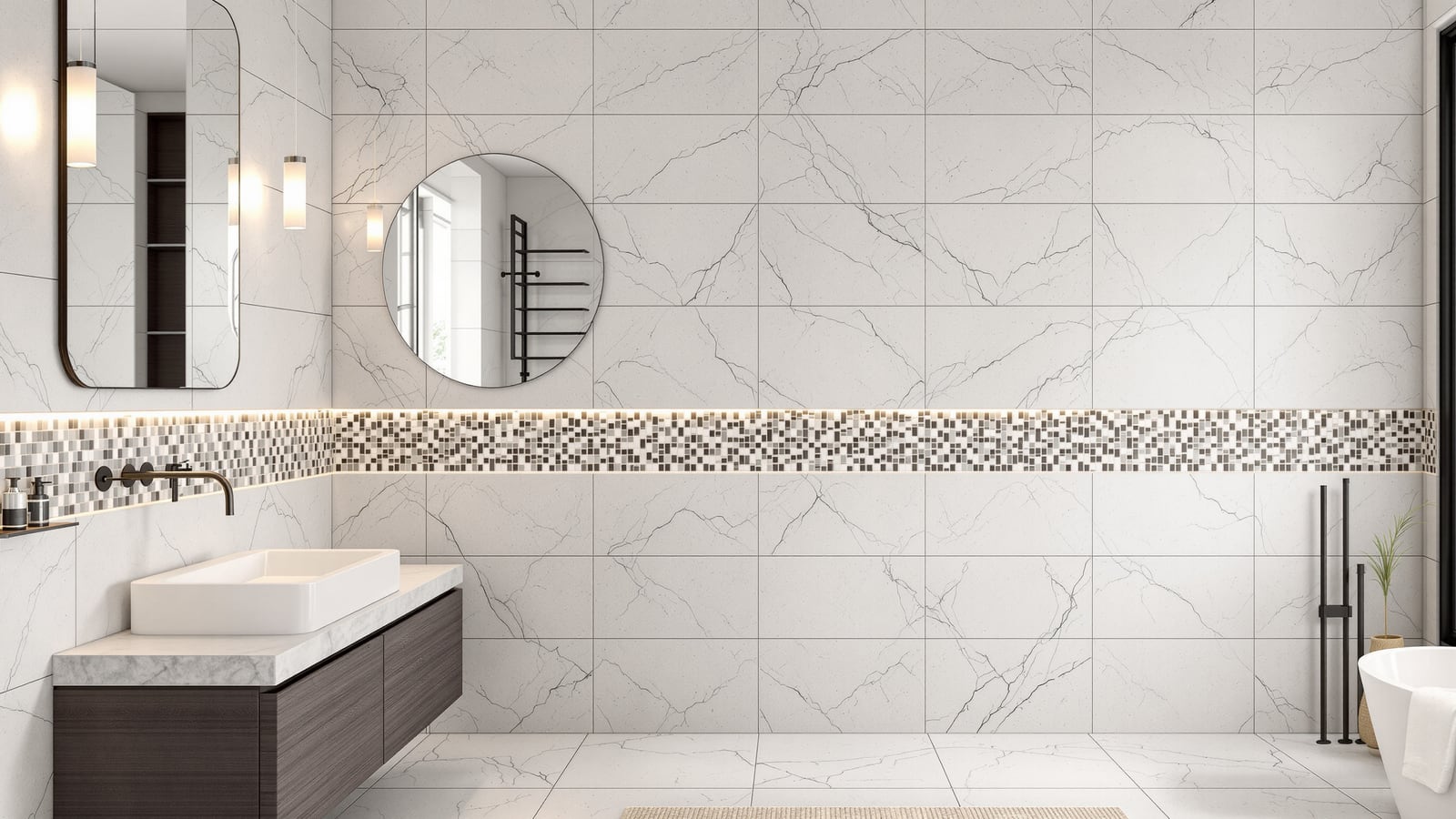
Bathroom Wall Tiles in India: The Complete Guide to Wall Finishes
Ceramic vs porcelain wall tiles, sizes and large-format, full-height vs dado, highlighter walls, layout and setting-out, adhesive vs cement, grout and epoxy grout — plus paint, panels, stone and glass alternatives. India-first, with ₹ costs and IS codes.
The wall does more work than any other surface in an Indian bathroom. It takes the direct hit of the shower, the constant splash of the health faucet, the steam of a geyser-heated bath and the daily wipe-down — and it does all of this in a room that stays humid for hours after every use. Get the wall finish right and the room stays dry, clean and good-looking for twenty years. Get it wrong and you get black grout lines, drummy tiles that sound hollow when you tap them, and water tracking behind the finish into the plaster.
This is the wall-finishes pillar for the Bathroom Design Guide (India) cluster. It covers the tile itself — ceramic vs porcelain, sizes, height, highlighters — and everything that holds it up: layout, adhesive, grout. It closes with the honest alternatives to tile, because tile is not always the right answer. Brand names (Kajaria, Somany, Nitco, Orient Bell, Pidilite, MYK Laticrete) appear only as familiar examples.
Ceramic vs porcelain: what actually goes on a bathroom wall
The two words get used loosely at the counter, but they describe a real difference in the tile body. Both are governed by IS 15622 (pressed ceramic tiles), which classifies tiles by water absorption.
- Ceramic (wall) tile — a porous red or white clay body with a glazed face. Water absorption is high (group BIII, over 10%). It is light, easy to cut, and cheap. Because the body is soft it is a wall tile, not a floor tile — never lay a pure wall-grade ceramic on the floor.
- Porcelain / glazed vitrified (GVT) — a dense, fired-harder body with water absorption under 0.5% (group BIa). It is heavier, tougher, and the same tile can go on both wall and floor, which is why designers use it to run a finish seamlessly from floor up the wall.
| Property | Ceramic wall tile | Porcelain / GVT |
|---|---|---|
| Water absorption (IS 15622) | > 10% (BIII) | < 0.5% (BIa) |
| Typical use | Walls only | Walls and floors |
| Weight | Light — easy to fix | Heavy — needs good adhesive |
| Cutting on site | Easy, hand cutter | Needs wet saw for clean edge |
| Face options | Glossy, matt, textured | Glossy, matt, carving, marble-look |
| ₹ per sq ft (finish only) | ₹35 – ₹90 | ₹65 – ₹250+ |
For a shower wall that takes daily direct water, a good glazed ceramic is perfectly adequate — the glaze, not the body, faces the water. Porcelain earns its premium when you want one material from floor to ceiling, large formats, or a stone/marble look without natural stone's maintenance.
For a deeper comparison of the two bodies, see the siblings Ceramic Bathroom Tiles (India) and Porcelain Bathroom Tiles (India).
Sizes and large-format
Indian bathroom wall tiles have grown. The old 200x300 mm "bathroom tile" still sells, but 300x600 mm is now the default and 600x1200 mm large-format is common in mid and premium jobs.
| Nominal size (mm) | Common name | Best for | Note |
|---|---|---|---|
| 200 x 300 | Small wall tile | Tiny/service baths, budget | Many joints; dated look |
| 300 x 450 | Medium | Standard flats | Good value workhorse |
| 300 x 600 | Large wall | Most bathrooms | The current default |
| 600 x 600 | Square large | Floor-to-wall runs | Needs flat wall |
| 600 x 1200 | Large-format (LFT) | Premium, seamless look | Fewer joints; skilled labour |
Large format means fewer grout lines — which means less area for water to find and fewer black lines to scrub. The trade-off is that a big rigid tile needs a flat wall. Any hump in the plaster telegraphs as lippage (one tile edge standing proud of its neighbour). Large-format wants notched-trowel adhesive with back-buttering and often tile-levelling clips, not the old dab-of-cement method.
Tile height: full-height vs dado
How high you tile is a cost and design decision, not a rule.
- Full-height (floor to ceiling / lintel). The safest choice for wet bathrooms and the standard in premium work. Every splash surface is impervious. Costs more in tile and labour.
- Dado height (roughly 2.1 m / 7 ft). Tile up to door-lintel level and paint the strip above. Common, sensible, and much cheaper — the band above 7 ft rarely gets wet. Keep the top edge clean and level; a trim or bullnose finishes it neatly.
- Half-height (~1.2 m) + paint above. Only for dry areas, powder rooms and guest baths with no shower. Not for a wet zone.
The one non-negotiable: the shower/wet zone must be full-height tile, even if the rest of the room is dado. Water thrown by a shower or health faucet reaches far higher than people expect.
Highlighter and feature walls
A single accent wall — the wall behind the WC or vanity, or the shower back wall — carries the design so the rest can stay calm and cheap. Options that work in Indian bathrooms:
- A highlighter tile — one patterned, textured or darker tile as a vertical band or full wall.
- A large-format marble-look GVT as the feature, plain tiles elsewhere.
- Mosaic or subway in the niche/shower recess only, to contain cost and labour.
Keep it to one feature surface. A highlighter on every wall reads as busy and dates fast. Match the grout tone deliberately — a contrasting grout turns a plain white subway tile into a graphic feature at almost no cost.
Layout and setting-out
Setting-out is where a tiler earns their money, and it is done before a single tile is stuck. It decides where the cuts fall.
Practical setting-out rules:
- Start from a level datum line, not the floor — floors are rarely level, and if you start off the floor the whole wall runs uphill.
- Centre the layout so end cuts are equal and no sliver thinner than about a third of a tile lands at a corner.
- Full tiles at eye level and along the top of the shower area; push cuts to the floor and ceiling where they read least.
- Align wall and floor joints where possible for large-format — mismatched grids look accidental.
Adhesive vs cement (and grout)
This is the single biggest quality decision, and the industry has moved decisively toward adhesive.
- Cement-mortar (traditional "dab" method). A bed of cement slurry behind each tile. Cheap and universal, but it leaves voids, absorbs and holds water, and on a low-absorption porcelain tile it simply does not bond well — the tile pops off as "drummy." Acceptable only for absorbent ceramic on a small budget.
- Tile adhesive (thin-set, to IS 15477). A polymer-modified cement applied with a notched trowel to a controlled thickness. Full contact, no voids, far stronger bond, and mandatory for large-format and porcelain. Type 3 / C2 adhesive is the one to ask for in wet areas. Costs more per bag but uses far less material and is faster.
| Factor | Cement mortar | Tile adhesive (IS 15477) |
|---|---|---|
| Bond to porcelain/GVT | Poor | Excellent |
| Large-format suitability | No | Yes |
| Voids behind tile | Common | Minimal |
| Water behind finish | Absorbs & holds | Sheds |
| Material used | Thick bed | Thin, controlled |
| ₹ per sq ft (material + labour) | ₹15 – ₹30 | ₹35 – ₹70 |
Grout closes the joints. Two families:
- Cement grout — cheap, wide colour range, but porous. It stains, harbours mildew and needs sealing and scrubbing. Fine above the splash zone.
- Epoxy grout — a two/three-part resin. Non-porous, stain-proof, mildew-resistant, ideal for hard-water bathrooms where cement grout goes black at the shower. Costs 4–6x more and needs a skilled hand, but it is the upgrade that pays back most visibly. Use it at least in the shower and behind the WC.
Note the order in the section: the waterproofing coat goes on before the adhesive, not behind the plaster only. Tile and grout are not waterproof by themselves — they are the wearing surface over a membrane. For the membrane itself, see Bathroom Design Guide (India).
The alternatives to tile
Tile is the default, not the only answer. Each of these earns a place in the right bathroom.
| Wall finish | Look & feel | Water resistance | ₹ per sq ft (installed) | Best for |
|---|---|---|---|---|
| Ceramic/porcelain tile | Classic, endless choice | Excellent (with grout care) | ₹80 – ₹400 | Any wet bathroom |
| Waterproof paint | Smooth, seamless, colourful | Good above splash zone | ₹25 – ₹80 | Dry areas, dado top strip |
| PVC wall panels | Jointless, quick, dry-fix | Very good, no grout | ₹120 – ₹300 | Renovations, rentals, fast jobs |
| Stone cladding | Natural, premium, textured | Good (needs sealing) | ₹150 – ₹600+ | Feature walls, luxury baths |
| Glass / back-painted glass | Sleek, seamless, reflective | Excellent | ₹250 – ₹700 | Feature panels, modern baths |
| Micro-cement / tadelakt | Seamless, artisanal | Good (sealed) | ₹300 – ₹800 | Design-led seamless look |
Reading the table: paint is the cheap, seamless partner to tile — tile the wet zone, paint above the dado. PVC panels win on speed and no grout lines, ideal when you can't wet-work a rented or occupied flat. Stone and glass are feature-wall materials — expensive per foot but used on one wall the total stays sane. Micro-cement gives the fashionable seamless look but lives or dies by the applicator's skill and the sealer.
Costs and choosing
A realistic all-in wall budget for a standard 40 sq ft of tiled wall in a mid Indian bathroom: finish ₹80–₹180/sq ft + adhesive ₹40/sq ft + grout ₹15–₹60/sq ft + labour ₹40–₹70/sq ft. Large-format and epoxy grout push the top end; ceramic on adhesive with cement grout sits at the bottom.
Choose in this order: wet zone first (full-height porcelain or good ceramic on IS 15477 adhesive, epoxy grout), then the rest of the walls (dado tile or paint), then one feature surface. Spend where water hits; save where it doesn't.
References
- NBC 2016, National Building Code of India — internal finishes and wet-area construction.
- IS 15622 — Pressed ceramic tiles: classification by water absorption (ceramic vs vitrified/porcelain).
- IS 13630 — Ceramic tiles: methods of test (water absorption, bond, chemical resistance).
- IS 15477 — Specification for laying of ceramic tiles using adhesives.
- IS 13712 — Adhesives for ceramic tiles.
- BIS, Bureau of Indian Standards — current tile and adhesive standards.
Export this guide
Related Guides — Deep-dive reading
Epoxy Grout vs Cement Grout for Tiles in India: Which to Specify (2026)
A plain-English guide to tile grouts for Indian homes: what grout does, how cementitious grout compares with epoxy grout on cost, stain and water resistance, hygiene and durability, and exactly where each one belongs - kitchens, bathrooms, pools, dry rooms and more.
Building MaterialsCeramic Bathroom Tiles India: Water Absorption, Cost & Where They Suit (2026)
What ceramic tiles actually are (glazed earthenware), how water absorption groups under IS 13630 and IS 15622 decide where they belong, why they are the smart choice for bathroom walls and low-traffic floors, glazes, finishes, sizes, PEI ratings, rupee costs, and an honest comparison with porcelain and vitrified.
BathroomsQuartz Bathroom Countertop India: Engineered Quartz Vanity Tops, Cost & vs Granite/Marble
A practical, India-first guide to engineered quartz vanity tops for bathrooms — why the non-porous, no-seal surface beats granite and marble on a wet counter, plus thickness, seams, heat caution, brand quality and honest ₹ per sq ft costs.
BathroomsRelated Tools — Try Free
False Ceiling Cost Estimator
Live ₹/sqft across 8 ceiling types — POP, gypsum, designer, metal, PVC, wooden — with cove and spot lighting for 20 Indian cities.
Cost CalculatorBathroom Renovation Cost Calculator
Cost to renovate an existing bathroom with a replace-vs-keep model — demolition, re-waterproofing, tiles, fittings and the money saved by keeping items.
Bathroom CalculatorMaterial Schedule Generator
Generate a room-wise finish schedule — walls, floors, ceilings, trim, and joinery by location.
Material Schedule