
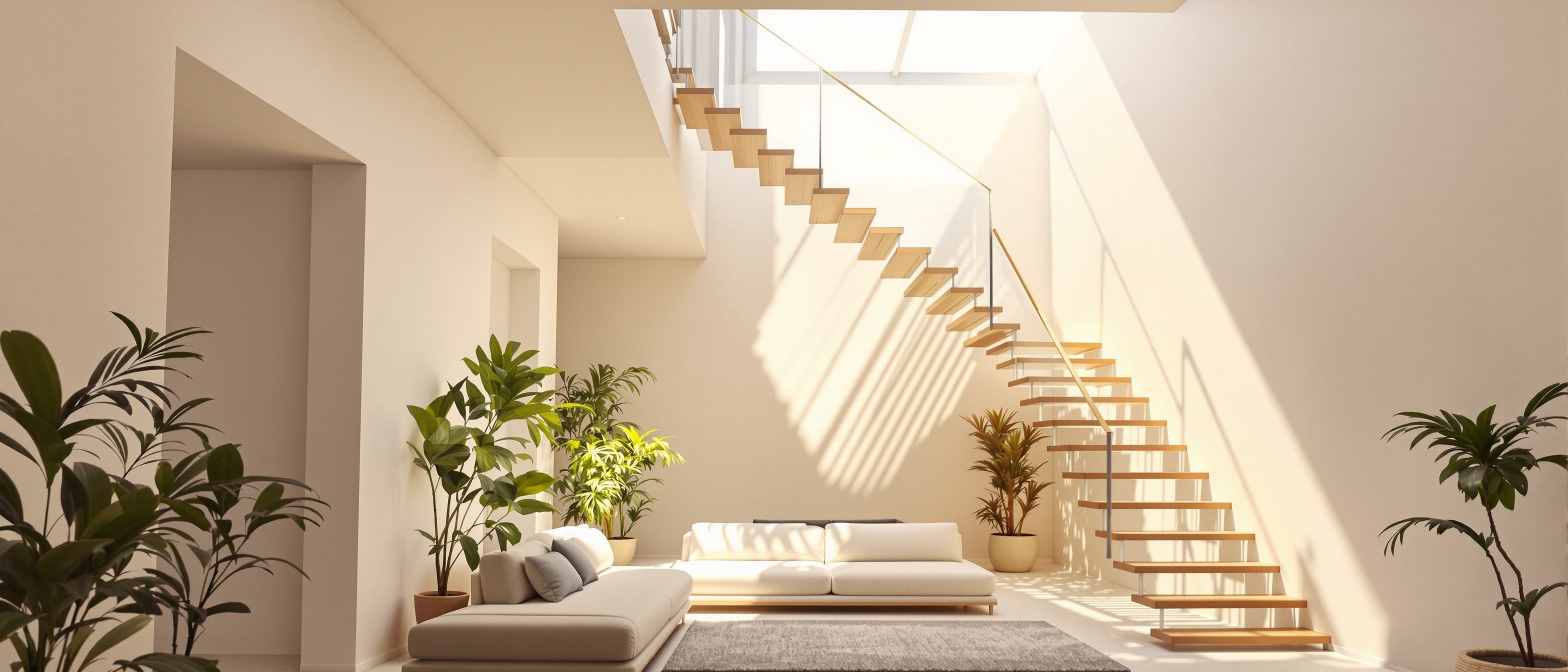
Narrow Plot Design Strategies
How to light, ventilate and live well on the long, slim row plot — 20×40, 30×40, 25×50 — that fills most Indian neighbourhoods.
Walk through almost any planned layout in Bengaluru, Pune, Chennai or Ahmedabad and you meet the same shape again and again: a plot far deeper than it is wide. A 30×40 in a BDA layout, a 20×30 in a Hyderabad colony, a 25×50 row plot in a Pune gated scheme. Houses sit shoulder-to-shoulder, sharing walls or with a token half-metre gap, and only the front and the back ever see open sky.
That geometry is efficient for the developer and brutal for the resident. The two short ends — the street side and the rear — get all the light and breeze. The middle third, often the very heart of the home where you cook and gather, becomes a dark, airless tunnel that needs lights on at noon and a fan running all day.
The good news: this is a solved problem. Indian builders have been lighting the deep middle of narrow buildings for centuries — the pol houses of Ahmedabad, the courtyard chettinad homes of Tamil Nadu, the Goan balcão row. The modern toolkit is the same logic in contemporary form.
On a narrow plot you cannot widen the building, so you must bring light and air in from above and from a hole in the middle — a courtyard, a light well, a skylight over the stair — and then let the plan stay open enough for that light and air to travel.
1. Understand the real problem: the dark, dead middle
Daylight from a window only reaches usefully about 1.5 to 2 times the head height of the window into a room — roughly 4 to 5 metres for an ordinary opening. Cross-breeze behaves similarly: it needs an inlet and an outlet on different walls, and it fades fast through a deep plan with no exit.
Now picture an 18-metre-deep house lit only from the two ends. The front rooms are bright, the rear rooms are decent, and a band of 6 to 9 metres through the centre receives almost nothing. That centre is where the dining, the stair and often the kitchen land — the rooms you use most.
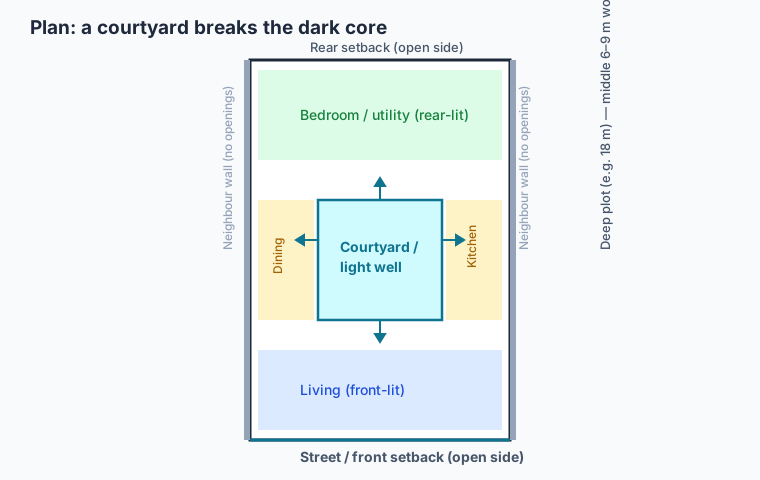
Figure 1: A central courtyard or light well turns one dark middle into four well-lit edges — every room now borders either the street, the rear, or the well.
| The dark-middle problem | Why it happens on a narrow plot | The fix |
|---|---|---|
| Centre rooms need lights on at noon | Side walls are shared/blank; light only from two ends | Central courtyard, light well or skylit stair |
| Stuffy, smelly core (kitchen, dining) | No cross-path; air enters and dies before it crosses | Stack ventilation up a shaft; high + low openings |
| Long dark corridor down the middle | Rooms strung along a deep spine | Pull circulation to one side; open-plan the core |
| Damp, fungal rear rooms | Trapped humidity, no through-draught | Rear opening + courtyard draws air across |
| Hot upper floor under the roof | Flat terrace bakes; heat sinks down | Insulated/shaded terrace; openable skylight to vent heat |
Before you commit to a layout, test how air would actually move through your specific plot shape and opening positions with our cross-ventilation analyzer — it will show you instantly whether a breeze can cross the middle or whether it stalls.
2. The courtyard and the light well: a hole that earns its keep
The single most powerful move on a deep plot is to give up a piece of floor in the middle and open it to the sky. A courtyard (open to the ground, usable) or a light well (a smaller vertical shaft, sometimes glazed at the bottom) does three jobs at once: it floods the surrounding rooms with daylight, it gives every wall around it a window, and it becomes the chimney that pulls hot air up and out.
Even a modest well of 1.2 × 1.5 metres transforms the rooms it touches. A true courtyard of 3 × 3 metres or more becomes a green, breathable outdoor room in the centre of the house — a place for a tulsi plant, morning light and monsoon rain.
"A building cannot be a healthy place to live unless it is filled with light and air... Place every part of the building so that no point inside is more than fifteen feet from a window."
>
— Christopher Alexander, A Pattern Language, Pattern 159 (Light on Two Sides) & Pattern 105 (South Facing Outdoors)
Courtyard sizing rule of thumb
- Keep the well roughly as wide as the rooms beside it are tall, or you only light the top floor. A two-storey well wants to be at least ~2 m across; a three-storey well, wider still.
- Glaze or net the top against monsoon and pigeons, but keep it openable so heat can escape.
- Drain it properly — a buried courtyard floods in a Mumbai or Chennai downpour. Slope to a covered floor trap and oversize the outlet.
- A courtyard on the south or west can be planted or screened so it shades itself rather than becoming a heat trap.
3. The skylight and the staircase as a single light-and-air shaft
If you cannot spare floor area for a courtyard — common on a 20-foot frontage — the staircase becomes your best friend. Run the stair as an open vertical void from ground to roof and cap it with an operable skylight. You have just built a light shaft and a ventilation chimney in the space you were going to lose to the stair anyway.
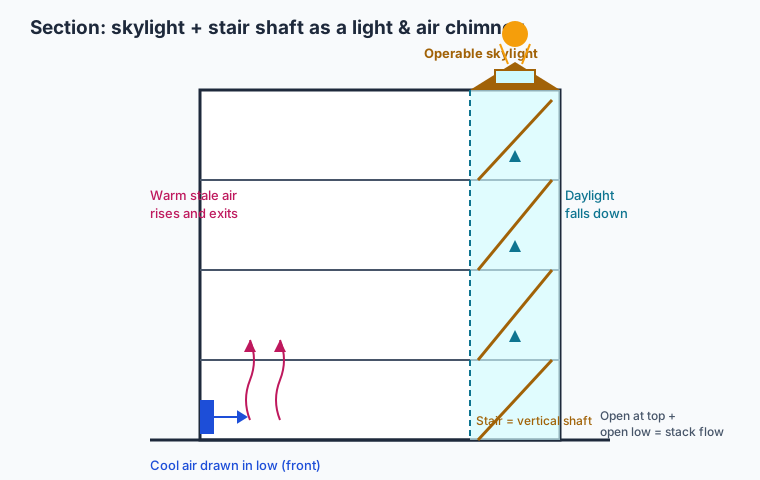
Figure 2: An openable skylight over an open stairwell drops daylight to every landing and drives the stack effect — cool air in low at the front, hot air out high at the skylight.
The physics is the stack effect: warm air is lighter, so it rises up the open shaft and escapes through the skylight, drawing fresh air in through low openings at the front and rear. On a still, humid Chennai afternoon when there is no cross-breeze at all, this vertical draught is often the only ventilation that works. To see the difference between a wind-driven cross-breeze and this buoyancy-driven stack flow, read the sibling guide on understanding wind analysis.
Practical notes:
- Make the skylight openable, not fixed glass — a sealed skylight lights the house but turns the stair into an oven.
- Use a louvred or projecting skylight to keep direct monsoon rain out while staying vented; orient any clerestory glazing north or shade it, so you get light without the harsh afternoon sun load.
- Keep the stairwell visually open (a void over the landings, not boxed walls) so the daylight actually spills into the adjoining rooms.
- Check where that skylit shaft sits relative to the sun across the year using our sun path analyzer — it tells you when the shaft will be a bright joy and when it will need shading.
4. Windows on the open sides, and open-plan so light travels
On a narrow plot you usually have only two facades you can legally and physically open: the front and the rear. The side walls are party walls — shared with the neighbour or sitting on the boundary — and the bylaws of most municipalities forbid openings within the side setback if it is less than about a metre, because they overlook your neighbour. So the front and rear windows must work very hard.
Maximise them. Tall windows reach light deeper than wide ones. A window taken close to the ceiling throws daylight further into the room than one stopping at lintel height. Then keep the plan open — every internal wall you remove lets the light from the front, the rear and the well flow through the middle instead of stopping at a partition. An open kitchen-dining-living spine down a narrow house can be lit from three directions at once.
Where you do need privacy on the open sides, do not blank the wall — screen it. Jaali (perforated screens), louvres, deep reveals and high clerestory windows all let light and air through while blocking the direct sightline from the street or the neighbour's terrace. This balance of openness and privacy is a craft in itself; the sibling guide on designing for views and privacy covers the screening vocabulary in depth.
| Surface | On a narrow plot, treat it as | Move |
|---|---|---|
| Front facade | Primary light + entry, but dusty/noisy/public | Large but screened openings; recessed entry |
| Rear facade | Quietest light + service court | Generous glazing; kitchen/utility breathe here |
| Side (party) walls | Effectively blind | No openings; insulate against neighbour's heat |
| The roof | Your hidden third facade | Skylight, courtyard cap, terrace, solar, RWH |
| The middle | The battleground | Courtyard / light well / skylit stair |
5. Vertical zoning: build up, and sort the floors by light and quiet
When you cannot spread out, you stack up — and a deep narrow house almost always becomes a G+2 or G+3. That vertical stack is an opportunity: the higher you go, the more daylight, the more privacy from the street, and the quieter it gets. So zone the floors accordingly.
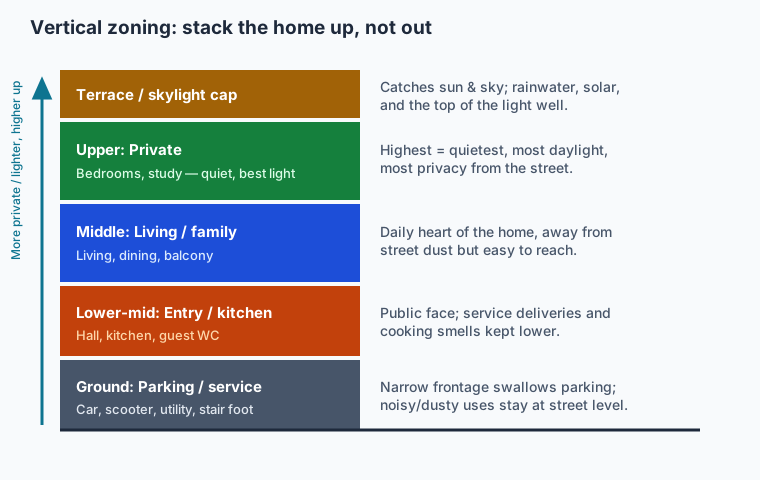
Figure 3: Stack the home by light and privacy — noisy, dusty, service uses sit low; the daily living heart sits in the middle; the quietest, brightest bedrooms sit high.
| Floor | Best use | Why it belongs here |
|---|---|---|
| Terrace (roof) | Skylight cap, solar, rainwater, garden | Catches sun and sky; tops the light well/stair shaft |
| Upper (G+2/3) | Private — master bedroom, children, study | Quietest, brightest, most private from the street |
| Middle (G+1) | Living, dining, family room, balcony | The daily heart; above street dust, easy to reach |
| Lower-mid (Ground/G+1) | Entry, formal living, kitchen, guest WC | Public face; cooking smells and service kept lower |
| Ground | Parking, scooter, utility, stair foot, store | A narrow frontage swallows parking; noisy/dusty uses |
This vertical logic also solves the parking headache, which on a narrow plot is the tightest constraint of all.
6. Parking and setbacks: the narrow-frontage squeeze
A car needs roughly 2.5 metres of clear width and about 4.8 to 5.5 metres of length, plus room to swing in off the road. On a 30-foot (≈9 m) frontage, after the front setback and a structural wall, one car eats most of the open ground — and a scooter or two on top of that. This is why parking is almost always pushed to the ground floor, often as a stilt, with living lifted above.
Setbacks make it tighter. Under the National Building Code (NBC 2016) and most state and municipal bylaws, even small plots must keep a front setback (commonly 1.5 to 3 m depending on plot size and road width) and usually a rear and side margin. On a narrow plot the side setbacks can swallow a metre off each side of an already slim building, so confirm exactly what your local development authority demands before you fix a single line — the buildable footprint may be far slimmer than the plot looks.
- Check your sanctioned front, rear and side setbacks against your municipal or development-authority bylaw, not a generic figure — they vary by plot size, road width and city.
- A stilt (open ground floor) parking often does not count against floor-area limits in many cities, freeing FSI/FAR for the floors above — verify the local rule.
- Plan the car's turning swing, not just the box — a car you cannot reverse out of is a car parked on the road.
- Keep the front setback permeable and lightly planted; a paved-to-the-edge frontage bakes and floods.
"Every building shall have means of access... and open spaces (setbacks) shall be provided around the building for light, ventilation and access."
>
— National Building Code of India, NBC 2016, Part 3 (Development Control Rules & General Building Requirements)
7. The cheap, powerful finishing moves
Once the big moves — well, skylight, open plan, vertical zoning — are set, a handful of low-cost decisions multiply their effect:
- Pale, light-reflecting finishes. White or pale walls and ceilings bounce the precious daylight deeper into the plan. Dark feature walls in the already-dim middle are a luxury a narrow plot cannot afford.
- Mirrors and reflective surfaces at the dark end of a long room visually double the light and the apparent width — an old, honest trick.
- Glass or open partitions (instead of solid walls) where privacy allows, so light passes between zones.
- A pale, reflective courtyard floor throws sky-light up into the rooms around it.
- High-level (clerestory) windows above eye line bring light without sacrificing privacy or wall space for furniture.
- Light-coloured, insulated roof so the top floor — your best-lit floor — does not become unbearably hot and undo the whole scheme.
None of these substitutes for the structural moves, but together they are the difference between a narrow house that merely works and one that feels genuinely bright and spacious.
Sources & further reading
1. National Building Code of India (NBC 2016), Bureau of Indian Standards — Part 3: Development Control Rules & General Building Requirements; Part 8: Building Services (lighting & ventilation). bis.gov.in
2. Christopher Alexander, A Pattern Language: Towns, Buildings, Construction (Oxford University Press, 1977) — Patterns 105, 159 (light, courtyards & openings).
3. Francis D.K. Ching, Architecture: Form, Space & Order (Wiley) — daylight, section and vertical organisation.
4. Energy Conservation Building Code (ECBC), Bureau of Energy Efficiency, Government of India — daylighting & envelope guidance. beeindia.gov.in
5. IS 3362 / SP 41 (S&T): Handbook on Functional Requirements of Buildings & Code of Practice for natural lighting and ventilation, Bureau of Indian Standards.
6. Charles Correa, A Place in the Shade: The New Landscape & Other Essays — the courtyard, the terrace and "open-to-sky" space in the Indian climate.
If you are weighing a specific plot, start with the cluster pillar on site analysis for homeowners, and if your corner cuts differently from a row plot, compare the trade-offs in corner plot design strategies.
Export this guide
Related Guides — Deep-dive reading
Window Design for Villas (India): Using the Freedom of All Four Sides
With walls free on all four sides, you can tune every window to its sun: north light for studies, east for bedrooms, shaded south for living, minimal west, plus feature windows, dual-aspect rooms and stairwell glazing.
Windows & GlazingDesigning for Views and Privacy
The site-level craft of capturing the good view while screening the neighbour's window three metres away — tuned for dense Indian plots.
Site PlanningOrientation, Light & Views: Designing With Your Space, Not Against It
How reading your plot's sun, breeze and views — and placing each room on the right face — gives an Indian home that is cooler, brighter and quietly right, instead of one that fights its site forever.
Design PrinciplesRelated Tools — Try Free
Cross-Ventilation Analyzer
Estimate airflow and air changes per hour (ACH) from room size, window areas, layout, and local wind — with NBC 2016 Part 8 compliance check.
Ventilation CalculatorBrise-Soleil Visualizer
Interactive horizontal-louvre cut-off angle calculator — sun altitude, louvre depth, and spacing inputs with a live shadow preview. Computes θ = arctan(spacing/depth) for façade shading, ECBC envelope compliance, hospital daylight design, and tropical sun-control detailing.
Sun Shading ToolWindow Size Calculator
Get the right window size, glazing area and openable area for any room using NBC daylight rules.
Window Tool