
Construction Cost in India — The Homeowner's Working Reference
Per-Sft Ranges by City Tier and Spec Band, Cost Composition, Eight Cost Drivers, Soft Costs & a Reference Build Walk-through
The single most common question I receive from homeowners is "what is the construction cost per square foot in India?" — and the honest answer is "anywhere from ₹ 1,400 to ₹ 18,000+, depending on twelve things."
That range is not unhelpful — it is the actual range, and the discipline of moving from "is this ₹ 1,400 or ₹ 18,000?" to "this is ₹ 3,500 because of these specific choices" is what good construction budgeting looks like.
This guide is the homeowner's working reference for construction cost in India 2025-26. It covers the per-sft cost matrix (city tier × spec band), the ten-line cost composition (where the money actually goes), the eight independent variables that move ₹/sft above or below the headline, a phase-by-phase walk-through of a representative 2,400 sft G+1 Bangalore mid-spec build, the twelve soft and hidden cost categories that ₹/sft excludes, six cost optimisation strategies, six common cost mistakes, and a pre-construction budgeting checklist.
Per-square-foot is a planning number, not a quote. The same ₹ 3,500/sft can describe an honest mid-spec build that lands at ₹ 84 L, or a builder pitch that becomes ₹ 101 L by handover because the foundation, height, and MEP weren't in the original quote. Always deconstruct ₹/sft against the eight cost drivers. Always demand a line-item BOQ. Always pad by 18-20% for soft + hidden costs.
For the broader independent-house framework that complements this cost guide, see Building a House in India, Interior Cost per Sft in India, Hidden Costs in Interiors, Home Renovation Cost in India, Turnkey Interiors in India, and BOQ Explained for Indian Homeowners.
The Cost Matrix — Indian Cities × Spec Bands (2025-26)
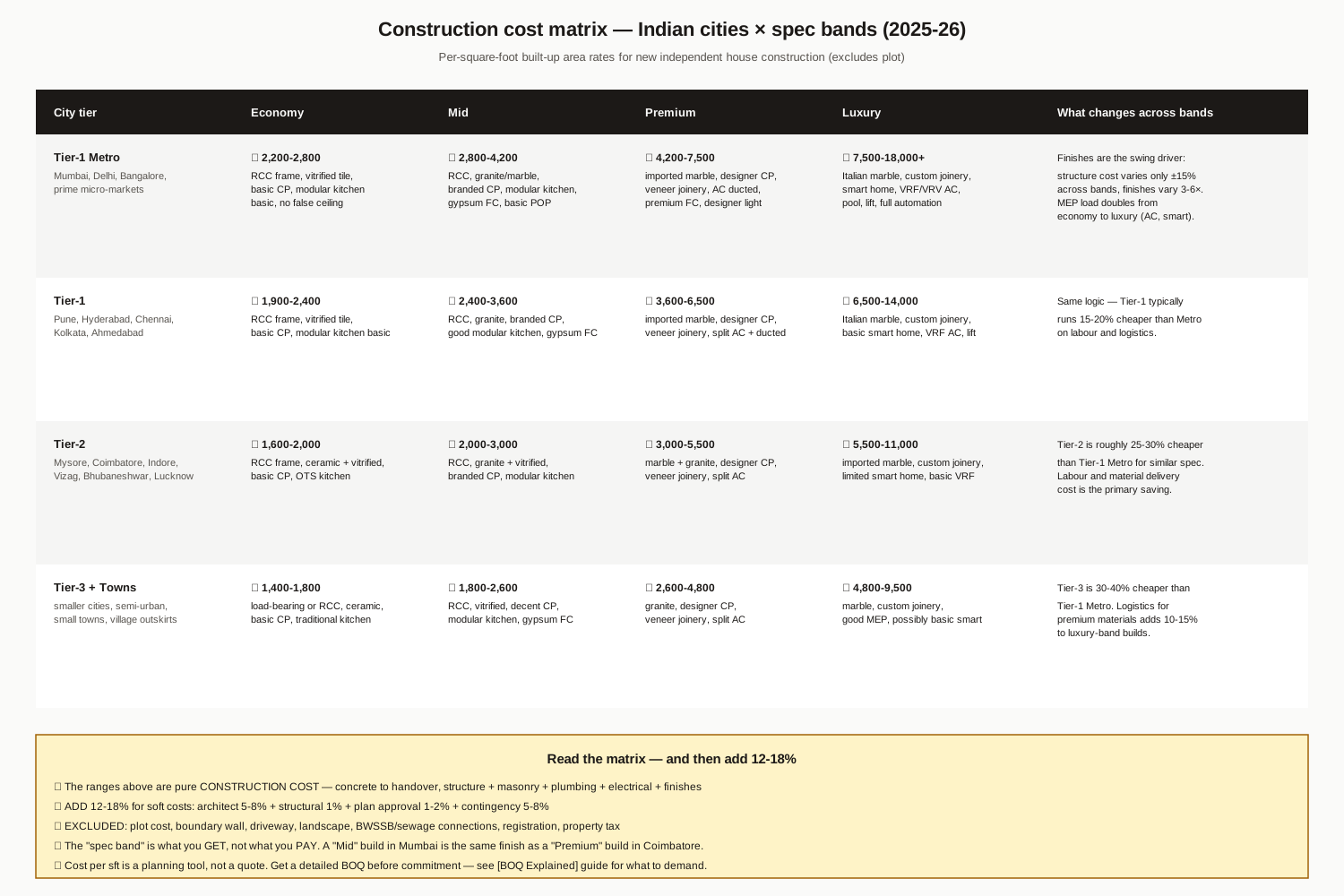
The figure above is the working construction-cost matrix. Read it as follows.
City tiers — what differs
- Tier-1 Metro (Mumbai, Delhi, Bangalore prime micro-markets): highest labour and logistics costs, dense-area site constraints, premium of 15-25% over Tier-1 baseline
- Tier-1 (Pune, Hyderabad, Chennai, Kolkata, Ahmedabad): reference baseline for our matrix
- Tier-2 (Mysore, Coimbatore, Indore, Vizag, Bhubaneshwar, Lucknow): roughly 20-30% cheaper than Tier-1 Metro on labour and material delivery
- Tier-3 + Towns (smaller cities, semi-urban, towns, village outskirts): 30-40% cheaper than Tier-1 Metro; logistics for premium materials adds 10-15% on top-band builds
Spec bands — what they describe
- Economy (₹ 1,400-2,800/sft): RCC frame, basic vitrified or ceramic tiles, basic CP fittings (Cera, Hindware basic range), OTS or basic kitchen, no false ceiling. This is the "Sintex tank + builder's choice" build — perfectly functional, no design ambition.
- Mid (₹ 1,800-4,200/sft): RCC frame, granite + premium vitrified, branded CP (Jaquar Continental, Kohler basic, American Standard), good modular kitchen (Hettich/Hafele hardware), basic gypsum false ceiling. This is the "decent contractor + light architect input" zone — most middle-class Indian houses land here.
- Premium (₹ 2,600-7,500/sft): imported marble or premium granite, designer CP (Jaquar Florentine, Grohe, Hansgrohe entry), veneer joinery, split AC + ducted, premium false ceiling, designer lighting. This is the "engaged architect + good contractor" zone.
- Luxury (₹ 4,800-18,000+/sft): Italian marble, custom solid-wood joinery, smart home automation, VRF/VRV AC, pool, lift, full home automation, premium lighting design. This is the "named architect + curated contractor + custom-everything" zone.
Reading the matrix
The four cells of "Tier-1 Metro × Mid" (₹ 2,800-4,200/sft) describe what most readers of this guide will actually build. Tighten that band by deconstructing your specific build against the eight cost drivers in the section below.
Critical caveat: The ranges above are pure construction cost — structure + masonry + plumbing + electrical + finishes, from foundation to handover. They EXCLUDE plot cost, soft costs (architect, plan approval, contingency), hidden costs (boundary wall, connections, registration), and interior decor + furniture. Always add 18-20% to the headline ₹/sft for true all-in.
Where the Money Goes — Cost Composition
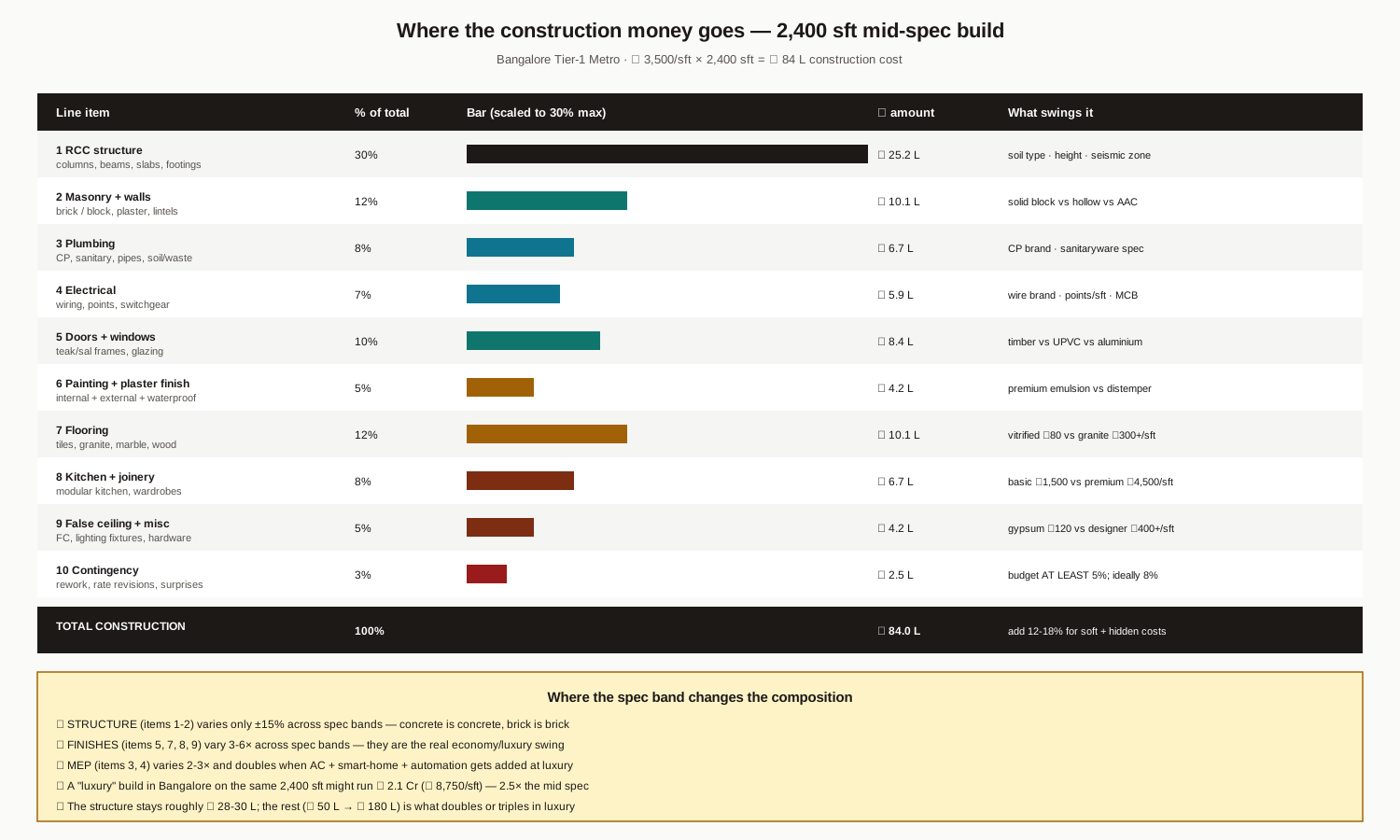
The figure above decomposes a representative ₹ 84 L Bangalore mid-spec build into the ten constituent cost lines. The pattern holds across most spec bands with small variations.
The structure-vs-finishes split
The single most important fact about construction-cost composition: structure stays roughly constant; finishes do all the swinging across spec bands.
- Structure (items 1-2): RCC + masonry. About 42% of cost. Varies only ±15% across spec bands. Concrete is concrete, brick is brick — the structural skeleton is roughly the same for an economy build or a luxury one (though luxury sometimes adds steel + complex geometry).
- Finishes (items 5, 7, 8, 9): doors + flooring + kitchen + false ceiling. About 35% of cost. Varies 3-6× across spec bands. This is where you choose: granite at ₹ 80/sft or marble at ₹ 400/sft, a ₹ 1,500/sft kitchen or a ₹ 4,500/sft one.
- MEP (items 3-4): plumbing + electrical. About 15% of cost. Varies 2-3× and doubles at luxury when AC + smart-home + automation kick in.
- Painting + contingency (items 6, 10): 8% combined. Small in percentage but contingency is often the difference between a finished house and a half-finished one.
What "₹ 84 L" actually buys
In our reference build:
- ₹ 25.2 L on RCC structure (3 months of work, the longest single phase)
- ₹ 10.1 L on flooring (granite at most, vitrified the rest)
- ₹ 10.1 L on masonry + plastering
- ₹ 8.4 L on doors + windows
- ₹ 6.7 L on kitchen + joinery
- ₹ 6.7 L on plumbing
- ₹ 5.9 L on electrical
- ₹ 4.2 L on painting + waterproofing
- ₹ 4.2 L on false ceiling + miscellaneous
- ₹ 2.5 L contingency
If you have a builder quoting "₹ 84 L all-in" without showing this breakdown, demand the breakdown. The composition is the contract. See BOQ Explained for Indian Homeowners for the line-item format every homeowner should require before signing.
The Eight Cost Drivers — What Changes ₹/sft
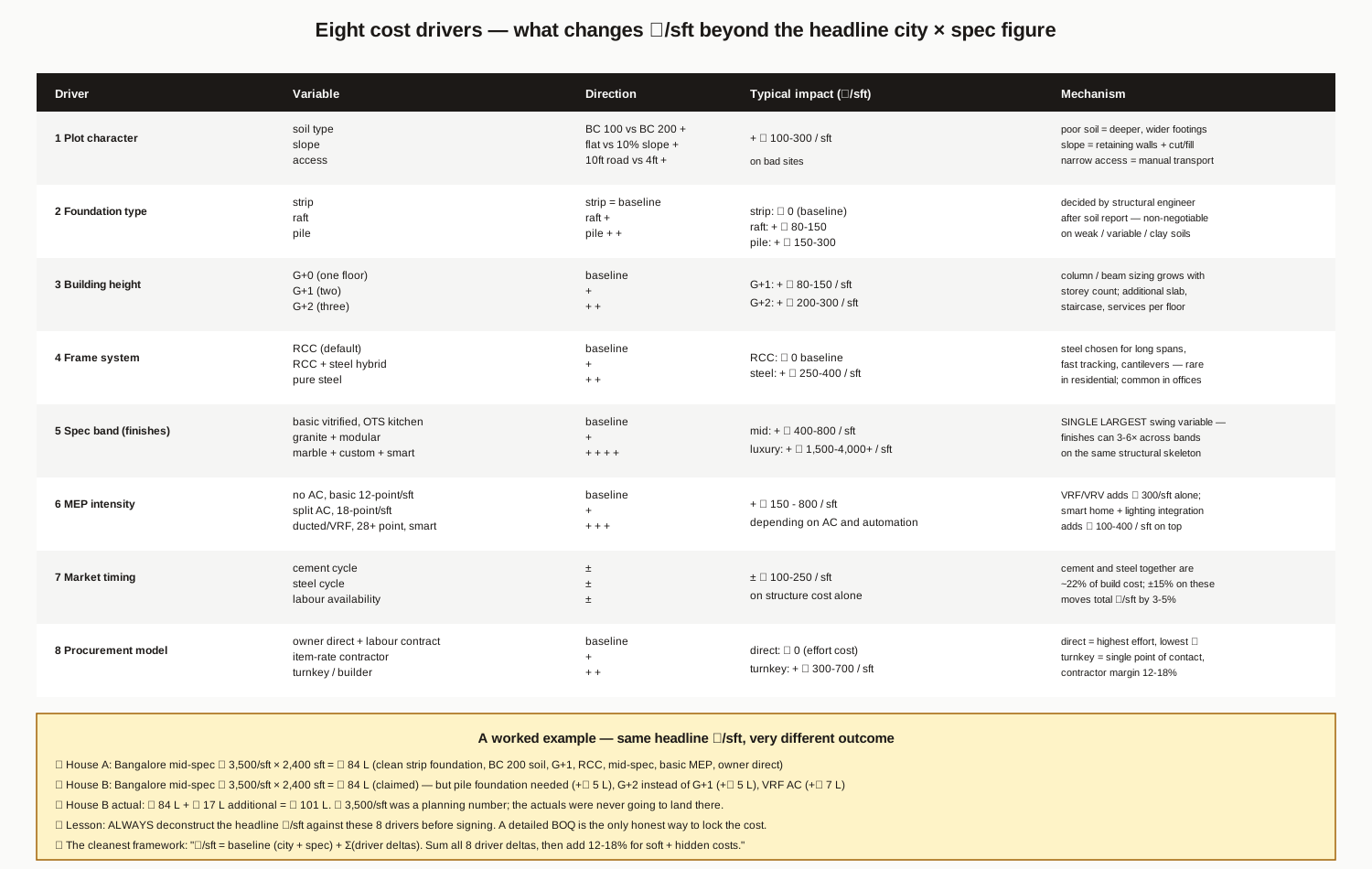
The eight drivers above are independent — each can move ₹/sft on its own. A "Bangalore mid-spec ₹ 3,500/sft" quote can land at ₹ 4,200/sft if any three of these drivers point unfavourably. Work through each one for your specific build.
1. Plot character
Soil bearing capacity, slope, access width — three plot-specific variables that move foundation and logistics costs.
- Bad soil (BC 100 kN/m² black cotton vs BC 200 firm clay): + ₹ 100-300/sft on foundation depth and width. See Soil Testing Before Construction and Soil Bearing Capacity for Indian Architects.
- Slope (10%+ gradient): + ₹ 80-200/sft on retaining walls + cut/fill earthworks
- Narrow access (4 ft entry vs 10 ft+ road): + ₹ 50-150/sft on manual material transport (no truck access means head-loading sand, cement, steel)
2. Foundation type
The structural engineer decides this after soil testing — it is not a homeowner choice but a homeowner consequence.
- Strip footing (default for BC 150+ soils, low rise): baseline
- Raft foundation (BC 100-150 soils, or G+2+): + ₹ 80-150/sft
- Pile foundation (BC < 100, variable strata, soft clays): + ₹ 150-300/sft
If you have not done a soil test before signing a "₹ 3,500/sft" quote, the foundation type is unknown and the quote is provisional. Get the test first.
3. Building height
- G+0 (one floor): baseline. Smaller foundation, no staircase complexity, single set of services
- G+1 (two floors): + ₹ 80-150/sft. Larger columns + beams + footings (compounded loads), staircase, water tank on roof, services per floor
- G+2 (three floors): + ₹ 200-300/sft. Significant structural sizing increase, lift becomes thinkable, light wells become necessary
4. Frame system
- RCC (Reinforced Cement Concrete, default for Indian residential): baseline
- RCC + steel hybrid (long spans, cantilevers, fast tracking): + ₹ 100-250/sft
- Pure steel frame (rare in residential; ground-up architectural choice): + ₹ 250-400/sft
For 95% of Indian residential builds, RCC is the answer. Steel becomes interesting only when architectural ambitions require 9 m+ clear spans or dramatic cantilevers — see Structural Design Essentials for Indian Homes.
5. Spec band (finishes)
This is the single largest swing variable. The same structural skeleton can carry:
- Basic finishes (vitrified tiles, OTS kitchen, distemper paint): baseline
- Mid finishes (granite, modular kitchen with hardware, premium emulsion paint, basic FC): + ₹ 400-800/sft
- Premium finishes (imported marble, designer kitchen, veneer joinery, designer FC): + ₹ 800-1,500/sft
- Luxury finishes (Italian marble, custom solid-wood joinery, smart-home integrated lighting): + ₹ 1,500-4,000+/sft
A "₹ 3,500/sft" build with luxury finishes is internally inconsistent — the spec doesn't match the rate. Spot this when reviewing quotes.
6. MEP intensity
Mechanical-Electrical-Plumbing scope and intensity. The default Indian build runs:
- 12 electrical points per 100 sft (lights + outlets + switches)
- 8-10 plumbing fixtures (kitchen + 2-3 bathrooms)
- No AC, or basic split AC roughed in
A premium build doubles this to 18-22 points/sft, full AC routing, possibly ducted/VRF, smart home wiring. A luxury build triples it: 28+ points/sft, VRF/VRV, automation backbone, integrated AV.
- Basic MEP: baseline
- Premium MEP (split AC routing, more points): + ₹ 150-400/sft
- Luxury MEP (VRF, automation, full smart-home): + ₹ 400-800/sft
See Residential MEP Coordination for Indian Architects for the architect-side technical reference.
7. Market timing
Cement and steel together are about 22% of build cost. Their prices move on multi-year cycles (cement: ±15%, steel: ±25%), driven by infrastructure demand, capacity additions, and commodity inputs.
- Cement boom + steel boom (worst case): + 5-8% on total ₹/sft
- Cement bust + steel bust (best case): − 4-6% on total ₹/sft
For a 12-18 month build, you absorb a full cycle. Hedge by buying steel + cement in bulk early when prices are flat; rate-lock with suppliers if possible.
8. Procurement model
- Owner-direct + labour-only contract: you buy all materials, contractor brings only labour and supervision. Lowest cost (saves contractor margin) but highest owner effort.
- Item-rate contract: contractor brings labour + materials priced at agreed rates per BOQ line. Mid effort, mid cost.
- Lump-sum / turnkey / builder: single quoted figure, contractor handles everything. Lowest effort, highest cost (contractor margin 12-18%, plus risk buffer).
The procurement choice alone moves ₹/sft by ₹ 300-700. See Turnkey Interiors in India for the same discipline applied to interior fit-out.
A Reference Build — 2,400 sft G+1 Bangalore Mid-Spec
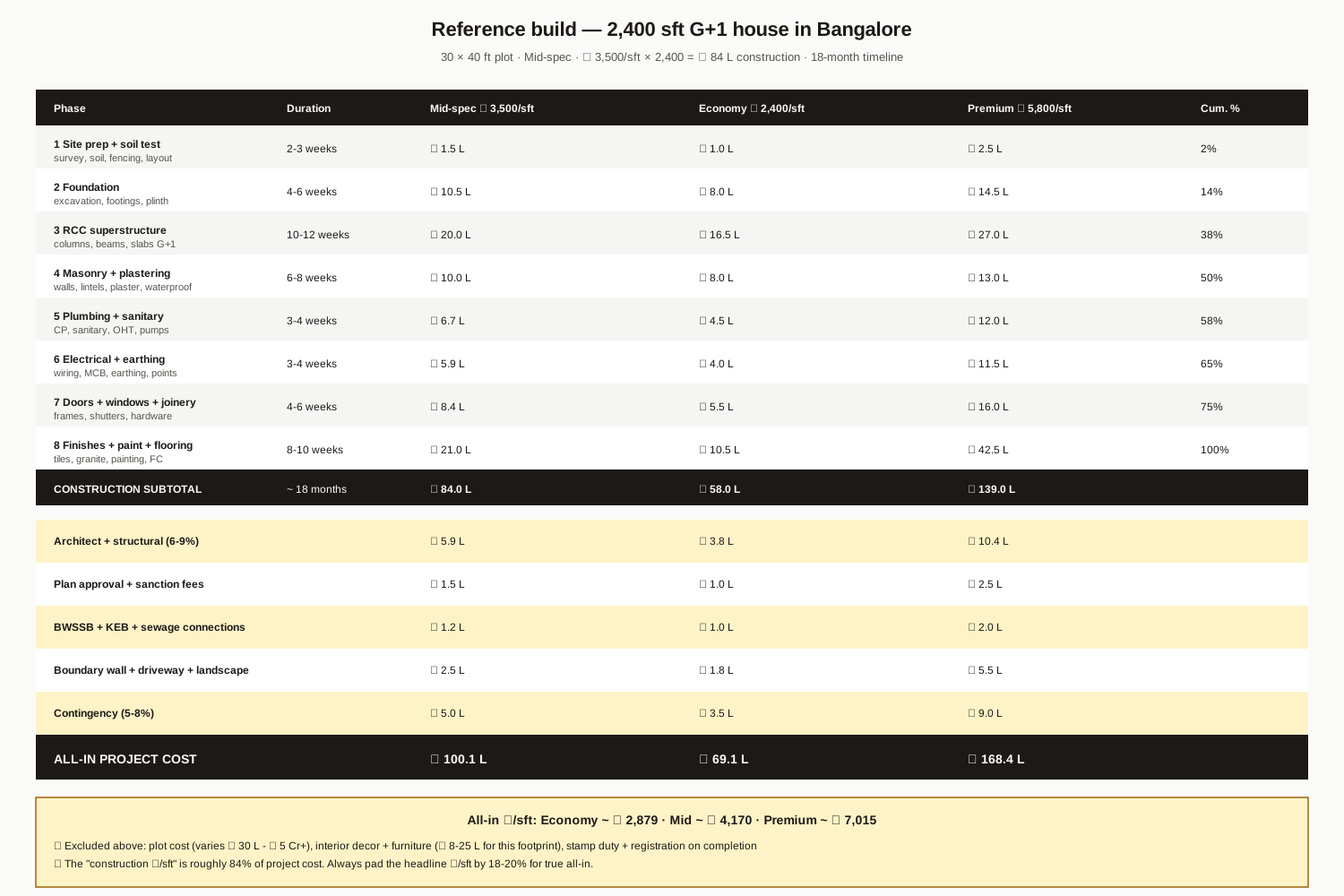
The figure above is a working budget for a 30 × 40 ft plot, 2,400 sft built-up (ground + first floor), mid-spec, Bangalore, 18-month timeline. Read it left-to-right.
Construction phase walk-through
Phase 1 — Site preparation and soil testing (2-3 weeks, ₹ 1.5 L): survey, soil report, fencing, site office, layout marking. Cheap but essential — the soil report determines foundation type, which can swing later costs by ₹ 12 L+.
Phase 2 — Foundation (4-6 weeks, ₹ 10.5 L): excavation, footings or raft, plinth beams, lift to ground floor level. For a G+1 on BC 200 soil with strip footings.
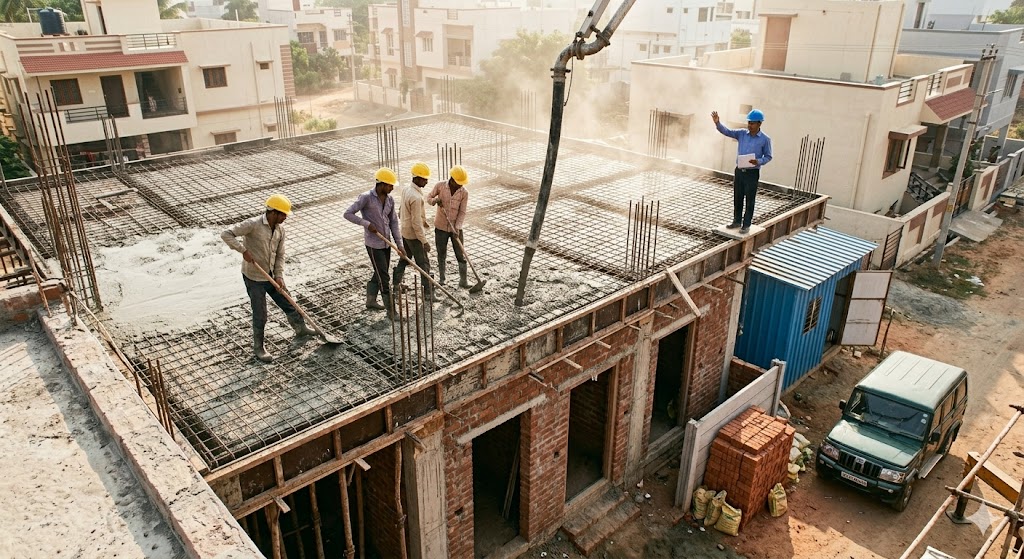
Phase 3 — RCC superstructure (10-12 weeks, ₹ 20 L): columns, beams, slabs, staircase. The longest single phase and the most weather-dependent. Monsoon delays this phase by 30-45 days routinely.
Phase 4 — Masonry and plastering (6-8 weeks, ₹ 10 L): internal + external walls, lintels, internal plaster, terrace waterproofing. Done in parallel with electrical conduit and plumbing roughing.
Phase 5 — Plumbing and sanitary (3-4 weeks active + ongoing, ₹ 6.7 L): rough-in during masonry, finish during fit-out. CP fittings + sanitaryware deferred to last (avoids damage and theft).
Phase 6 — Electrical and earthing (3-4 weeks active + ongoing, ₹ 5.9 L): rough-in conduits during masonry, switchgear + final wiring during finishing, fixtures last.
Phase 7 — Doors and windows (4-6 weeks, ₹ 8.4 L): frames installed during masonry, shutters and hardware after plaster. Teak or sal frames + UPVC windows for mid-spec.
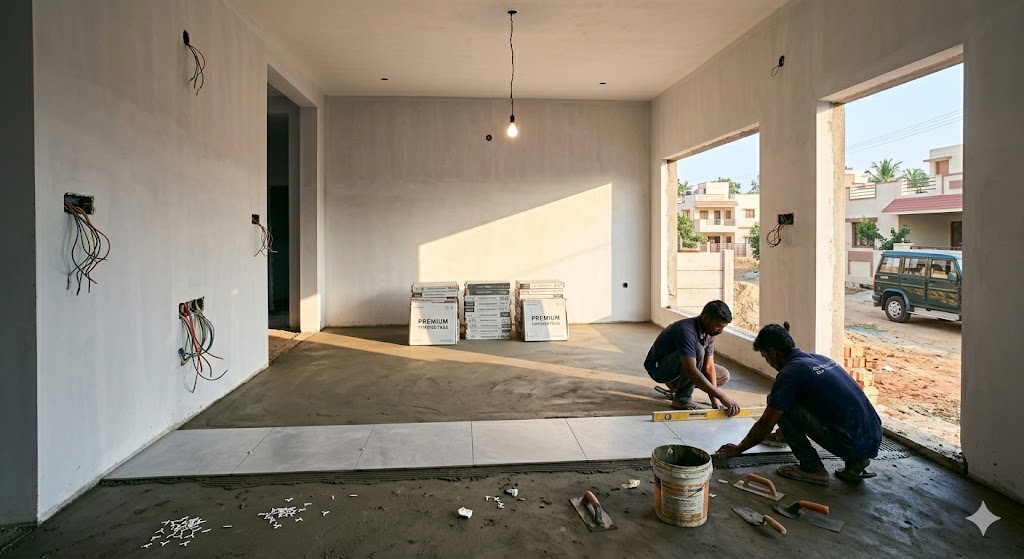
Phase 8 — Finishes (8-10 weeks, ₹ 21 L): tiles + granite + marble flooring, painting, false ceiling, kitchen installation, sanitary fitting, electrical fixtures. The most homeowner-visible phase.
Construction subtotal: ₹ 84 L over 18 months.
Adding soft and hidden costs
- Architect + structural consultant fees (6-9%): ₹ 5.9 L
- Plan approval + sanction: ₹ 1.5 L
- BWSSB + KEB + sewage connections: ₹ 1.2 L
- Boundary wall + driveway + landscape: ₹ 2.5 L
- Contingency (5-8%): ₹ 5 L
Soft + hidden subtotal: ₹ 16.1 L
All-in project cost: ₹ 100.1 L. All-in ₹/sft: ₹ 4,170.
Note that the headline construction ₹/sft was ₹ 3,500, but the all-in works out to ₹ 4,170 — a 19% padding for soft and hidden costs that the original quote did not include.
Economy vs premium comparison
The same 2,400 sft footprint and floor plan, run at economy spec (₹ 2,400/sft), lands at ₹ 58 L construction + ₹ 11 L soft = ₹ 69 L all-in. At premium spec (₹ 5,800/sft), it lands at ₹ 139 L construction + ₹ 29 L soft = ₹ 168 L all-in. The structural skeleton is the same; the finishes, MEP, and procurement model do all the lifting.
What ₹/sft Excludes — Soft and Hidden Costs
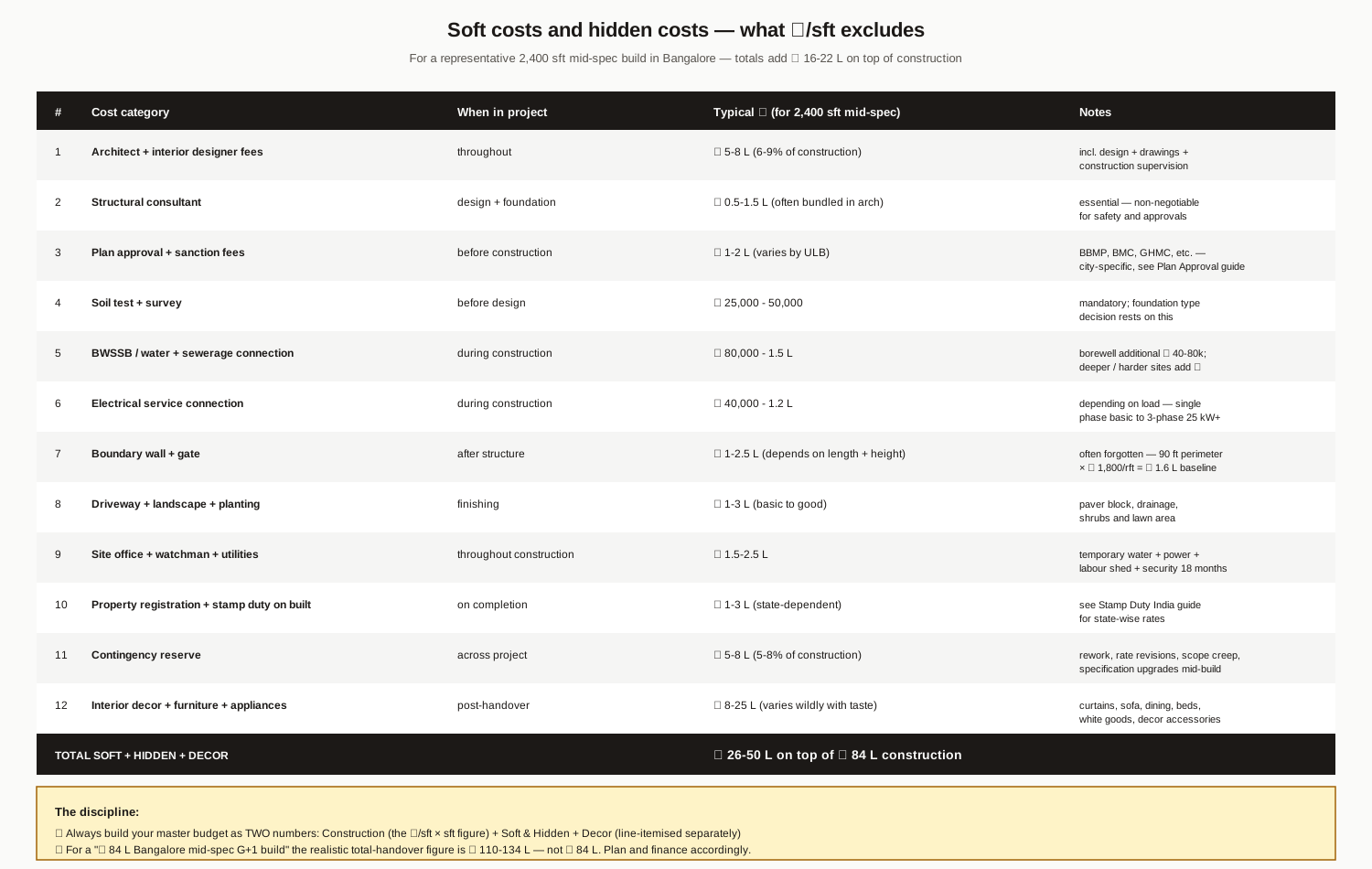
The figure above lists the twelve categories that ₹/sft excludes. For a representative 2,400 sft mid-spec Bangalore build, these add ₹ 16-22 L on top of the ₹ 84 L construction figure, plus a further ₹ 8-25 L for decor + furniture post-handover.
The four buckets
1. Soft costs — the design and approval layer (₹ 7-12 L typical)
Architect + interior designer fees (6-9% of construction), structural consultant, plan approval and sanction fees, soil test + survey.
2. Hidden infrastructure costs (₹ 4-9 L typical)
BWSSB / water + sewerage connection (deeper or harder sites add ₹), electrical service connection (load-dependent), boundary wall + gate (often forgotten — a 90 ft perimeter at ₹ 1,800/rft = ₹ 1.6 L baseline), driveway + landscape + planting, site office + watchman over 18 months.
3. Reserve and registration (₹ 6-11 L typical)
Property registration + stamp duty on built value (state-dependent — see Stamp Duty in India 2026 for state-wise rates), contingency reserve at 5-8% of construction.
4. Interior decor and furniture (₹ 8-25 L typical)
Curtains, sofa, dining set, beds, white goods (fridge, washing machine, AC if not built-in), decor accessories. The single most variable category — depends entirely on taste and brand choice.
The discipline
Always build your master budget as TWO numbers, not one:
1. Construction (the ₹/sft × sft figure — comes from the BOQ)
2. Soft + hidden + decor (line-itemised separately, with each category sized realistically)
For a "₹ 84 L Bangalore mid-spec G+1 build" the realistic total-handover figure is ₹ 110-134 L — not ₹ 84 L. Plan and finance accordingly. If your home loan is sized only on the construction figure, you will be cash-constrained at handover.
Six Cost Optimisation Strategies That Don't Sacrifice Quality
Cost optimisation is a separate discipline from cost-cutting. Cost-cutting reduces quality. Cost optimisation preserves quality while reducing rupees. Six places to actually save.
1. Owner-direct material procurement on big-ticket lines
Cement, steel, sanitaryware, CP fittings, tiles, granite — the six biggest single-item spends. Each has 10-20% margin between distributor and end-customer that a contractor captures by default.
If you buy these six categories directly (the contractor brings only labour + supervision + small materials), you save ₹ 200-400/sft without dropping spec. Effort cost: 2-3 hours per week of personal coordination over 18 months.
2. Standard module dimensions
Walls in multiples of brick size (230 mm modular). Slabs in standard column grids (3.6 m, 4.2 m, 4.8 m). Windows in standard sizes (1200, 1500, 1800 mm). Stair widths at NBC minimum (900 mm).
Standard dimensions reduce material wastage (cutting losses are 5-8% of brick, tile, and timber spend), simplify shuttering (faster site work), and lower the structural design effort. Saves ₹ 80-150/sft on a clean design.
3. Local materials for finishes
Granite from Karnataka or Andhra (₹ 80-150/sft installed) vs imported Italian marble (₹ 400-800+/sft installed). Local timber (sal, mango wood for joinery) vs imported teak (₹ 4,500-9,000/sft of joinery vs ₹ 1,500-2,800 for local). Locally fired brick vs branded AAC blocks (when soil + load conditions permit).
For Tier-2 and Tier-3 cities especially, the logistics premium on imported finishes is 10-15%. Local materials, well-specified, can deliver indistinguishable quality at 40-60% of imported cost.
4. RCC efficiency — not over-design
Indian structural engineers often over-design (safety factor 1.5 + extra steel for "good measure"). Engaging a competent structural engineer who designs to NBC + IS code minimums + adequate (not generous) safety factor saves ₹ 100-200/sft on steel + concrete consumption.
This is not unsafe — IS code factors already include 1.5× safety. Demand IS-compliant, not "more than IS." See Structural Design Essentials for Indian Homes.
5. Single-vendor for kitchen + wardrobes + joinery
Kitchen + wardrobes + interior joinery (TV unit, study, beds) all use the same hardware (Hettich, Hafele, Blum), same boards (HDHMR, BWP plywood, MDF), same finishes. Bundling all interior joinery with one vendor saves 12-18% over piecemeal sourcing.
A single-vendor joinery package for a 2,400 sft mid-spec home runs ₹ 6-9 L; piecemeal sourcing of the same items costs ₹ 7-11 L.
6. Phase the finishes — not the structure
Build the full house structure on day one (foundation + RCC + masonry + roughed-in MEP + basic plumbing/electrical) — never compromise here. Then finish the public floor (living + kitchen + master bedroom) to your full spec, and leave the upper floor at basic level for later upgrade.
This phasing lets you move in at ₹ 60-65 L instead of ₹ 84 L, then upgrade the upper floor over the next 2-3 years at your own pace. You retain the option to upgrade; the structure is already in place. Saves ₹ 15-25 L in upfront cost without compromising final outcome.
Six Common Cost Mistakes
1. Accepting a quote without a BOQ. "₹ 3,500/sft all-in" is not a contract. The BOQ is. Demand the BOQ before signing. See BOQ Explained for Indian Homeowners.
2. Not budgeting for soft + hidden costs. Quote says ₹ 84 L, you take ₹ 84 L home loan, run out of cash at month 14 of an 18-month build. Always size finance at construction + 25%.
3. Skipping the soil test. Foundation type is not optional; soil testing is the only honest way to determine it. A ₹ 35,000 soil test routinely saves ₹ 5-15 L in foundation surprises.
4. Choosing finishes after structure starts. Finishes choices change MEP routing, joinery dimensions, slab thickness (granite vs vitrified, ducted AC vs split). Make finishes choices at the design stage, before structure starts.
5. Underestimating contingency. Contingency is not optional luxury; it is project planning. Budget 5-8% of construction, not 0-3%. The most common cost overrun is "we didn't have a contingency."
6. Going turnkey without comparing direct. Turnkey adds 12-18% over direct. For some homeowners that buys real peace of mind and is worth it. For homeowners with time and willingness to coordinate, the savings are large. Get both quotes and decide knowing the delta.
Pre-Construction Budgeting Checklist
Before signing any contract, work through this checklist:
1. Soil test done? Foundation type confirmed by structural engineer.
2. Architect engaged? Drawings + structural drawings + MEP drawings + BOQ available.
3. Plan approval applied for? Sanction fees budgeted. See Building Plan Approval Process in India.
4. Construction cost = ₹/sft × built-up sft, from the BOQ. Not a verbal estimate.
5. Cost driver review — has each of the eight drivers been validated for your specific build?
6. Soft cost budget — architect 6-9%, plan approval 1-2%, structural 1%, soil test ₹ 35-50k, all explicitly allocated.
7. Hidden cost budget — BWSSB/sewage ₹ 1-2 L, electrical connection ₹ 50k-1.2 L, boundary wall ₹ 1-2.5 L, driveway + landscape ₹ 1-3 L, site office ₹ 1.5-2.5 L.
8. Registration + stamp duty budgeted at state rate. See Stamp Duty in India 2026.
9. Contingency at 5-8% of construction. Non-negotiable.
10. Decor budget at ₹ 350-1,500/sft (taste-dependent) for the post-handover period.
11. Total = construction + soft + hidden + decor + contingency. Compare to your home loan + own funds availability.
12. Cash flow — staged disbursement matched to construction phases. Most homeowners run out of cash because they treat the construction figure as the total.
For end-to-end project planning, see Complete Guide to Building a House in India.
Where to Go Next
- For interior cost specifically (which has different per-sft economics): Interior Cost per Sft in India
- For the line items the BOQ should include: BOQ Explained for Indian Homeowners
- For what hidden costs to expect in interior fit-out: Hidden Costs in Interiors
- For the turnkey vs direct decision: Turnkey Interiors in India
- For an existing house being renovated (different cost framework): Home Renovation Cost in India
- For the full end-to-end build journey: Complete Guide to Building a House in India
- For city-specific compliance and bylaws: Architect Compliance Map — Bengaluru, Architect Compliance Map — Mumbai
- For the home loan sizing question: Home Loan Affordability in India 2026
- For stamp duty on the constructed property: Stamp Duty in India 2026
References
1. CPWD Plinth Area Rates (Public Works Department), latest revision. Government of India benchmark construction rates.
2. NBC 2016, Part 7. Construction Management, Practices and Safety.
3. IS 456 (BIS 2000). Plain and Reinforced Concrete — Code of Practice. Structural design baseline.
4. CIDC Construction Cost Index, quarterly. Construction Industry Development Council India.
5. JLL India / Knight Frank / CBRE quarterly construction cost reports (2024-25). City-tier benchmarks.
6. Council of Architecture (2020). Architectural Practice Bylaws — Fee Schedule. Architect fee benchmarks.
7. State PWD Schedule of Rates (Karnataka, Maharashtra, Tamil Nadu, Telangana — latest). Government works rate references.
8. BBMP, BMC, MCGM, GHMC Building Bye-Laws. Plan approval fee schedules.
9. Cement Manufacturers Association of India (CMAI), monthly bulletin. Cement price tracking.
10. Joint Plant Committee (Ministry of Steel), monthly steel price tracking.
Author's note: The single biggest insight I want every Indian homeowner to internalise is that ₹/sft is a planning number, not a contract. A ₹ 3,500/sft Bangalore mid-spec build can land at ₹ 84 L (clean execution) or ₹ 101 L (foundation surprises, scope creep, contingency drained) — and the difference is entirely about pre-construction discipline. Do the soil test. Demand the BOQ. Deconstruct ₹/sft against the eight drivers. Budget soft + hidden separately. Size your finance at construction + 25%. These five disciplines convert a planning number into a deliverable budget. Without them, ₹/sft is just builder marketing.
Disclaimer: Cost ranges are 2025-26 indicative for Indian Tier-1, Tier-2 and Tier-3 cities and vary by micro-market, soil conditions, plot characteristics, project timing, procurement model, and specification. The reference build walk-through is illustrative for a representative 2,400 sft G+1 Bangalore mid-spec project; specific projects vary materially. State-specific stamp duty, plan approval fees, and utility connection charges should be verified against the applicable ULB and state government schedules. Architect, structural consultant, and contractor fees vary by practice and project complexity. Studio Matrx, its authors and contributors accept no liability for budget decisions made on the basis of this guide; engage a licensed architect, structural engineer, and quantity surveyor for project-specific budget development. The Council of Architecture fee schedule and PWD Schedule of Rates are the authoritative benchmarks for fee and rate validation in disputed engagements.
Interactive · Explore construction cost
1,500 sq.ft · Standard · Bengaluru → ₹33.0 L
Estimated
₹33.0 L
@ ₹2,200 / sq.ft
Standard cost at 1,500 sq.ft across cities
Indicative ₹/sq.ft rates for civil construction only (excludes land, interiors, taxes). Refer to your contractor's BOQ for binding numbers.
Export this guide
Related Guides — Deep-dive reading
The Truth About Cost Per Square Foot
Why a ₹/sqft interior quote is the most misleading number in Indian home costing — and how to convert it into a real BOQ
Cost & MoneyThe Design Decisions With the Biggest Cost Consequences
A cost-leverage map of Indian home interiors — the handful of decisions that swing your total budget the most, so you spend your attention where a single choice has an outsized rupee impact.
Cost & MoneySmart Storage Interiors — A 2026 Working Reference for Indian Homes
Inventory-driven · Floor-to-ceiling · Hardware-engineered · Zone-mapped
Room PlanningRelated Tools — Try Free
False Ceiling Cost Estimator
Live ₹/sqft across 8 ceiling types — POP, gypsum, designer, metal, PVC, wooden — with cove and spot lighting for 20 Indian cities.
Cost CalculatorProperty Tax Calculator — 10 Indian Cities
Estimate annual municipal property tax across BBMP / MCD / MCGM / GHMC / GCC / KMC / PMC / AMC / TMC / PCMC — with self-occupied, tenanted, and age-rebate adjustments.
Property TaxRainwater Tank Sizer
How big should your rainwater tank be? Computes annual harvest, recommended tank capacity in litres, water-bill savings, and payback — for 10 Indian cities.
RWH Calculator