
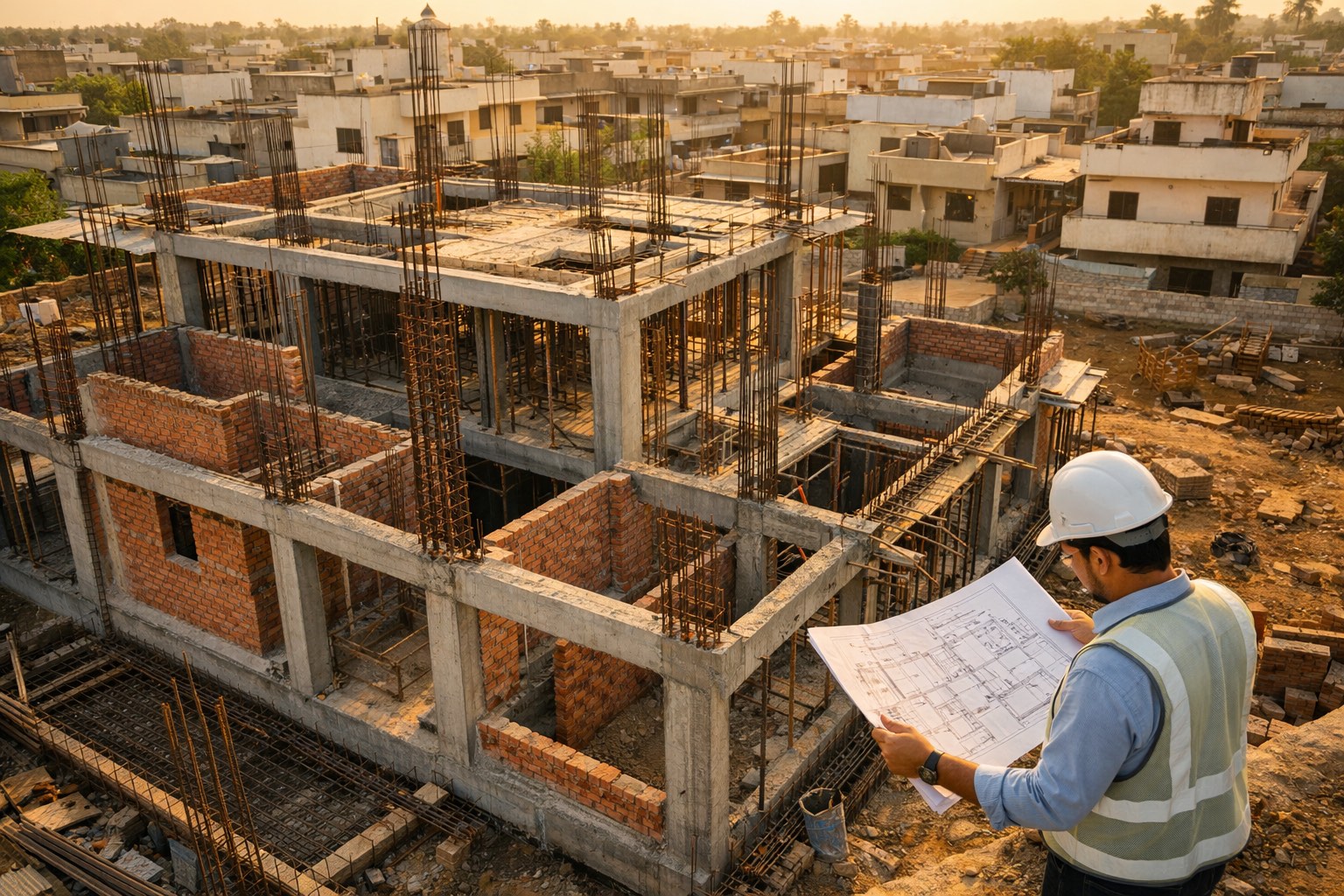
Structural Design Essentials for Indian Homes
Foundations, Load-Bearing Systems & Seismic Considerations — A Comprehensive Guide for Architects and Homeowners
Every year, India builds more homes than almost any other country on earth. By some estimates, the country will add over 300 million new housing units in the coming decades to meet the demands of urbanisation, demographic growth, and the replacement of ageing stock. Yet a troubling paradox lies at the heart of this construction surge: the majority of Indian homes are built without formal structural engineering input.
The consequences are neither abstract nor distant. India's seismic history — from the catastrophic 2001 Bhuj earthquake that killed over 20,000 people, to the 1993 Latur disaster that claimed 10,000 lives in a region then considered seismically 'safe' — has demonstrated, with painful clarity, that the single greatest determinant of earthquake survival is not geology, but the structural integrity of the buildings people live in.
This guide examines the three pillars of residential structural design in the Indian context: foundations, load-bearing and framed structural systems, and seismic design. It draws on Bureau of Indian Standards (BIS) codes, peer-reviewed research, and field experience to provide architects, engineers, and informed homeowners with the knowledge to build homes that stand — not just for decades, but through the forces that would bring them down.
"The earthquake does not kill people — buildings do." — Prof. Anand S. Arya, Former National Seismic Advisor, NDMA; Padma Shri awardee (Arya, Boen and Ishiyama, 2014)
1. India's Structural Challenge: The Numbers
The scale of structural vulnerability in India is staggering. According to the BMTPC's Vulnerability Atlas of India, approximately 59% of India's landmass falls in moderate to severe seismic zones (Zones III, IV, and V), placing hundreds of millions of people at risk (BMTPC, 2019). Yet the overwhelming majority of buildings in these zones are non-engineered — constructed by local masons using rules of thumb rather than structural calculations.
Census 2011 data reveals that roughly 42% of India's rural housing stock is constructed with mud or unburnt brick walls — materials with negligible resistance to lateral seismic forces. Post-Bhuj reconnaissance studies by Sinha and Goyal (2004) found that less than 5% of buildings in affected areas had any form of engineered seismic design. The 1993 Latur earthquake, which struck a region then classified in the lowest seismic zone, killed nearly 10,000 people — almost entirely due to the collapse of stone masonry houses with heavy mud-and-timber roofs (Jain, 2016).
The structural design of a home is not a luxury or an optional refinement. It is the single most important investment a homeowner makes — one that determines whether the building is a shelter or a hazard.
2. Understanding Indian Soils: The Foundation of Foundations
No foundation can be designed in ignorance of the soil it rests upon. India's geological diversity — from the alluvial plains of the Gangetic basin to the black cotton soils of the Deccan, the laterite of the Western Ghats, and the marine clays of the coast — presents a range of challenges that demand site-specific investigation.
IS 1892:1979 (Bureau of Indian Standards, 1979) mandates subsurface investigation as the first step in any foundation design. IS 1904:1986 (Bureau of Indian Standards, 1986) provides presumptive safe bearing capacity (SBC) values for preliminary design, though it explicitly states that site-specific geotechnical investigation per IS 6403:1981 is required for final design.
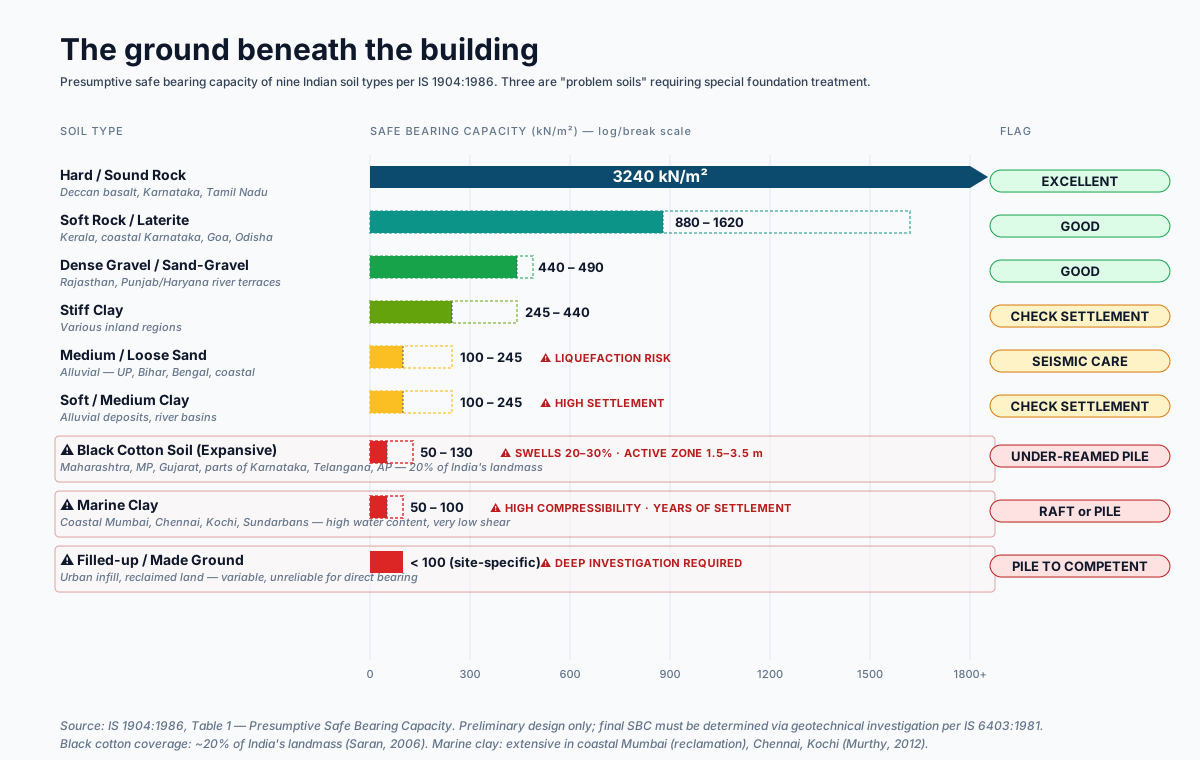
Safe Bearing Capacity of Indian Soil Types
| Soil Type | Presumptive SBC (kN/m²) | Typical Indian Regions | Key Characteristics | IS Code Reference |
|---|---|---|---|---|
| Hard / Sound Rock | 3240 | Deccan Plateau (basalt), parts of Karnataka, Tamil Nadu | No weathering, excellent bearing | IS 1904:1986, Table 1 |
| Soft Rock / Laterite | 880–1620 | Kerala, coastal Karnataka, Goa, parts of Odisha, Jharkhand | Hardens on exposure; varies with weathering grade | IS 1904:1986, Table 1 |
| Dense Gravel / Sand-Gravel | 440–490 | Parts of Rajasthan, river terraces in Punjab, Haryana | Good bearing capacity, low settlement potential | IS 1904:1986, Table 1 |
| Stiff Clay | 245–440 | Various inland regions across India | Moderate bearing, settlement to be checked | IS 1904:1986, Table 1 |
| Medium / Loose Sand | 100–245 | Alluvial plains — UP, Bihar, Bengal, coastal regions | Prone to liquefaction in seismic zones; SBC sensitive to water table | IS 1904:1986, Table 1 |
| Soft / Medium Clay | 100–245 | Alluvial deposits, river basins | High settlement potential, requires careful design | IS 1904:1986, Table 1 |
| Black Cotton Soil (Expansive) | 50–130 | Maharashtra, MP, Gujarat, parts of Karnataka, Telangana, AP | Highly expansive; free swell index >50%; active zone depth 1.5–3.5m | IS 1904:1986; IS 2911 Part III |
| Marine Clay | 50–100 | Coastal Mumbai, Chennai, Kochi, Sundarbans | Very high compressibility, low shear strength, high water content | IS 1904:1986, Table 1 |
| Filled-up / Made Ground | Site-specific (<100) | Urban areas, reclaimed land | Unreliable for direct bearing; requires deep investigation | IS 1904:1986 |
Source: IS 1904:1986, Table 1 — Presumptive Safe Bearing Capacity values. These are for preliminary design only; final SBC must be determined through site-specific geotechnical investigation per IS 6403:1981.
India's Problem Soils
Black Cotton Soil covers approximately 20% of India's land area, predominantly across the Deccan Plateau. Its defining characteristic is extreme volumetric change with moisture — swelling by 20–30% when wet, shrinking and cracking when dry. Foundations on black cotton soil must extend below the active zone (the depth to which seasonal moisture variation penetrates, typically 1.5–3.5 metres) or use under-reamed pile foundations as specified in IS 2911 Part III. The under-reamed pile — developed specifically at CSIR-CBRI Roorkee for Indian expansive soil conditions — remains one of the most effective and economical solutions for low-rise construction on black cotton soil (Saran, 2006).
Marine clay, found extensively in coastal Mumbai (particularly in reclaimed areas), Chennai, and Kochi, presents extreme compressibility and very low shear strength. Settlement in marine clay can continue for years after construction. Raft foundations or pile foundations extending to competent strata are typically required (Murthy, 2012).
Alluvial soils of the Indo-Gangetic plain, while generally offering moderate bearing capacity, are susceptible to liquefaction during earthquakes — a phenomenon where saturated loose sands lose all bearing capacity and behave as a fluid. The 1934 Bihar earthquake and the 2001 Bhuj earthquake both demonstrated devastating liquefaction effects (Jain, 2016).
"The soil beneath a building is not merely a platform — it is a participant in the structural system. Ignore it, and the finest engineering above ground becomes meaningless." — V.N.S. Murthy, Textbook of Soil Mechanics and Foundation Engineering (Murthy, 2012)
3. Foundation Types for Indian Conditions
The choice of foundation type is governed by three factors: the bearing capacity of the soil, the loads transmitted by the structure, and the environmental conditions (including seismic zone, water table, and soil expansiveness). IS 14243:1995 provides guidelines for selecting foundation types for load-bearing wall construction.
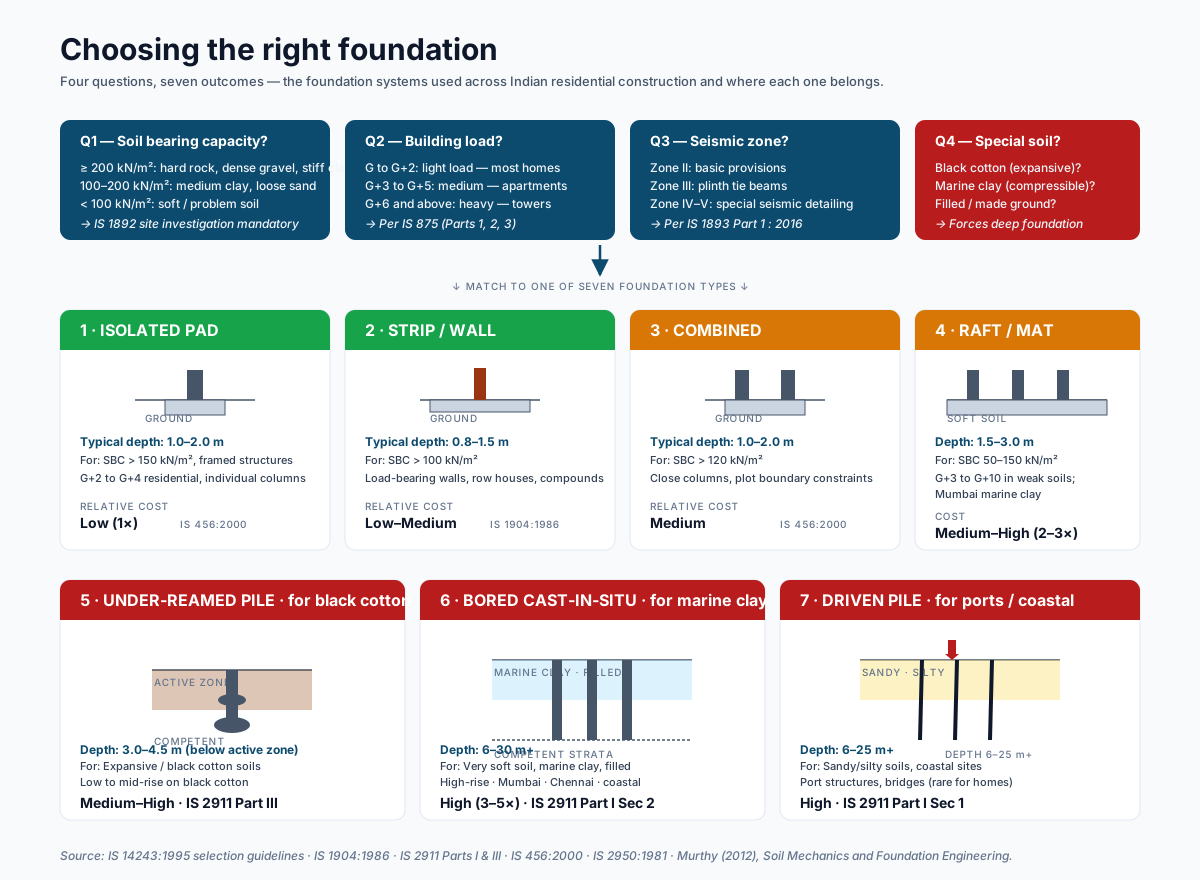
Foundation Type Comparison
| Foundation Type | Typical Depth | Suitable Soil Types | SBC Range (kN/m²) | Relative Cost | Typical Use Case in India | Key IS Code |
|---|---|---|---|---|---|---|
| Isolated (Pad) Footing | 1.0–2.0m | Medium to hard soil, rock | >150 | Low (1x baseline) | Individual columns in framed structures; G+2 to G+4 residential | IS 456:2000 |
| Strip / Wall Footing | 0.8–1.5m | Medium to stiff clay, gravel | >100 | Low–Medium | Load-bearing wall construction; row houses; compound walls | IS 1904:1986 |
| Combined Footing | 1.0–2.0m | Medium soil | >120 | Medium | Columns close together; boundary conditions limit isolated footings | IS 456:2000 |
| Raft / Mat Foundation | 1.5–3.0m | Soft clay, variable soil, low SBC | 50–150 | Medium–High (2–3x) | G+3 to G+10 in weak soils; Mumbai marine clay; reduces differential settlement | IS 2950:1981 |
| Under-Reamed Pile | 3.0–4.5m (below active zone) | Black cotton / expansive soils | Any (bypasses active zone) | Medium–High | Low to mid-rise on black cotton soil; Maharashtra, MP, Gujarat | IS 2911 Part III |
| Bored Cast-in-Situ Pile | 6–30m+ | Very soft soil, marine clay, filled ground | Any at depth | High (3–5x) | High-rise buildings; coastal construction; Chennai, Mumbai | IS 2911 Part I Sec 2 |
| Driven Pile | 6–25m+ | Sandy/silty soils, coastal | Any at depth | High | Port structures, bridges; where displacement piles are suitable | IS 2911 Part I Sec 1 |
Foundation Design Principles
Every foundation must satisfy two conditions simultaneously: bearing capacity (the soil must not fail under the applied load) and settlement (the building must not deform beyond acceptable limits). IS 1904:1986 specifies maximum permissible settlement of 25 mm for isolated footings on sand and 40 mm on clay, with differential settlement limited to 0.0015L (where L is the distance between columns) for framed structures.
In seismic zones, foundations acquire an additional responsibility: they must transmit lateral forces from the superstructure to the ground without failure. IS 1893 (Part 1):2016 requires that foundations in Zones IV and V be designed for seismic forces and connected by plinth beams or ties to prevent relative displacement.
4. Load-Bearing vs Framed Construction: The Indian Context
Indian residential construction broadly falls into two structural systems: load-bearing masonry and reinforced concrete (RC) framed construction. Each has its place, its advantages, and its limitations — and the choice between them has profound implications for structural safety, especially in seismic zones.
Load-Bearing Masonry
In load-bearing construction, the walls themselves carry the weight of the structure and transmit it to the foundation. This is the traditional and still most common system for low-rise residential construction in India. IS 1905:1987 (Bureau of Indian Standards, 1987) governs the structural use of unreinforced masonry, specifying permissible stresses, slenderness ratios, and wall thickness requirements.
Load-Bearing Wall Thickness Requirements
| Number of Storeys | External Wall Thickness (mm) | Internal Load-Bearing Wall (mm) | Seismic Zone Restrictions | Key Provision |
|---|---|---|---|---|
| Single storey (G) | 230 (one brick) | 230 (115 for non-load-bearing partitions) | Permitted in all zones with seismic bands | Slenderness ratio ≤ 27 (IS 1905, Cl. 4.6) |
| Two storey (G+1) | 230 | 230 | Permitted in all zones with seismic bands | Bottom storey walls carry cumulative loads |
| Three storey (G+2) | 345 (1.5 brick) at ground floor; 230 upper floors | 230 | Unreinforced masonry limited to 2 storeys in Zones IV–V | IS 4326:2013; ground floor walls must be thicker |
| Four storey (G+3) | 460 at ground; 345 at first; 230 upper | 230 | Only in Zone II for unreinforced masonry; confined masonry needed in Zones III–V | IS 4326:2013, Table 4 |
Source: Derived from IS 1905:1987 provisions and IS 4326:2013 seismic requirements for masonry construction.
IS 4326:2013 imposes critical restrictions on unreinforced masonry in seismic zones: it is limited to two storeys in Zone III, and prohibited entirely in Zones IV and V unless constructed as confined masonry (with RC tie-columns and bands) or reinforced masonry. The mandatory provision of horizontal seismic bands at plinth, lintel, and roof levels — as specified in IS 4326 — is perhaps the single most important structural intervention for masonry buildings in earthquake-prone regions. Studies of the 2001 Bhuj earthquake consistently found that buildings with proper band construction survived, while those without collapsed (Jain, Murty et al., 2002).
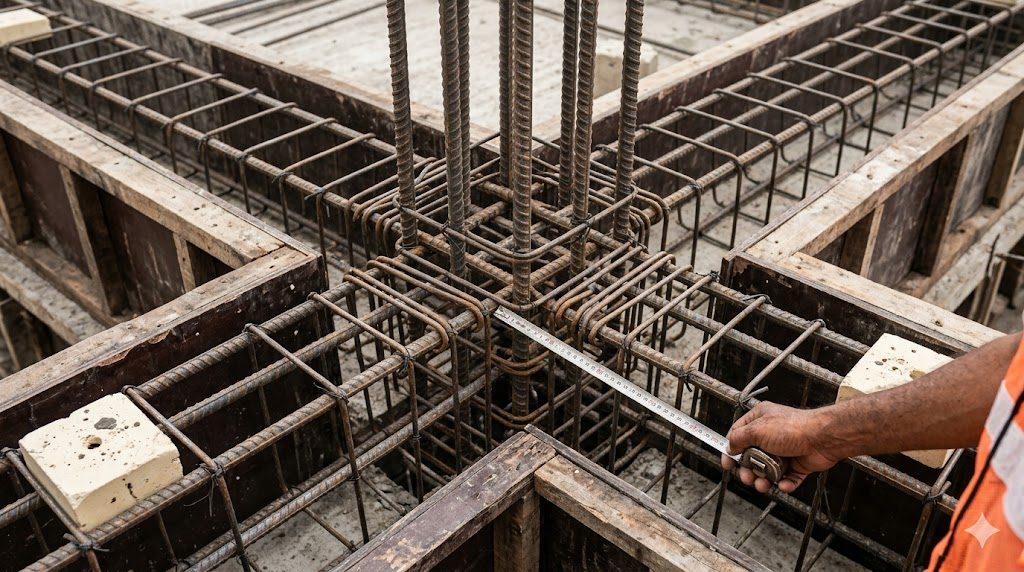
"The lintel band is to a masonry building what the spine is to the human body — without it, the structure has no mechanism to resist lateral forces." — IITK-BMTPC Earthquake Tips, Learning Earthquake Design and Construction (Jain, Murty et al., 2002)
Reinforced Concrete Framed Construction
RC framed construction — where beams, columns, and slabs carry all structural loads while masonry walls serve only as infill — has become the dominant system for urban multi-storey residential buildings in India. It offers greater flexibility in architectural planning, can accommodate larger spans, and when properly designed and detailed, provides superior seismic performance.
However, the Bhuj earthquake exposed a devastating weakness in India's RC framed buildings: the soft storey or open ground storey. In thousands of urban apartment buildings, the ground floor was left open for parking — with no infill walls to provide lateral stiffness — while the upper floors had full masonry infill. During the earthquake, the dramatic stiffness discontinuity caused the open ground storey to collapse while upper floors remained intact, pancaking downward. Over 130 multi-storey RC buildings in Ahmedabad alone — located 400 km from the epicentre — collapsed or were damaged beyond repair, almost all exhibiting soft-storey failure (Sinha and Goyal, 2004).
IS 1893 (Part 1):2016 now contains explicit provisions for soft-storey buildings, requiring either special design of the open-storey columns or the inclusion of stiff bracing elements. Yet enforcement remains uneven, and the open ground floor remains ubiquitous in Indian apartment design.
"India cannot afford to wait for the next devastating earthquake to learn lessons that are already available from past events. Every building constructed without seismic provisions is a potential death trap." — Prof. Sudhir K. Jain, Former Director, IIT Gandhinagar; lead author of IS 1893 revisions (Jain, 2016)
5. Seismic Design: India's Non-Negotiable Imperative
India's Seismic Zones
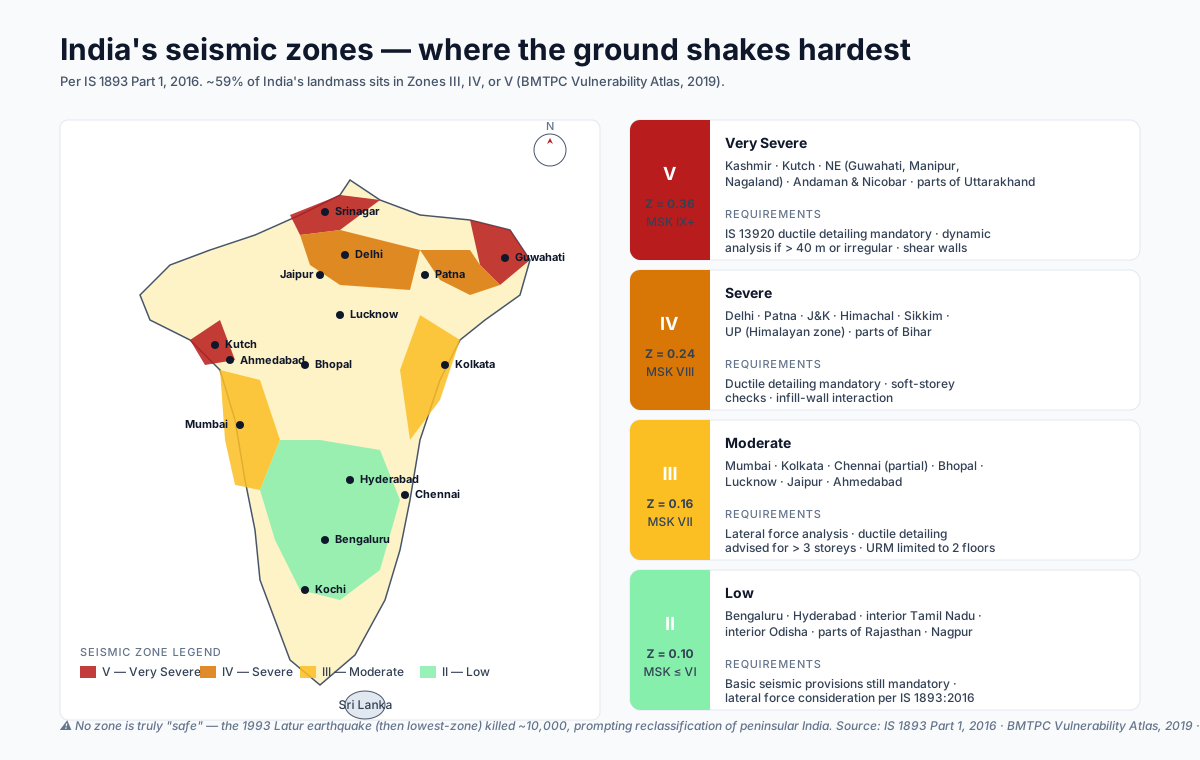
India is divided into four seismic zones (Zone I was merged into Zone II in the 2002 revision of IS 1893). The zone classification determines the zone factor (Z) — a dimensionless coefficient representing the expected peak ground acceleration — which directly governs the design seismic forces on the building.
| Zone | Zone Factor (Z) | Seismic Intensity (MSK) | Major Cities | Design Requirements |
|---|---|---|---|---|
| Zone V (Very Severe) | 0.36 | IX and above | Parts of Kashmir, Kutch (Gujarat), NE India (Guwahati, Assam, Manipur, Nagaland), parts of Uttarakhand, Andaman & Nicobar | Mandatory ductile detailing per IS 13920; RC frame or confined masonry required; dynamic analysis for buildings >40m or irregular; special shear wall provisions |
| Zone IV (Severe) | 0.24 | VIII | Delhi, Patna, parts of J&K, Himachal Pradesh, parts of UP (near Himalayas), Srinagar, Sikkim | Ductile detailing mandatory; lateral force analysis required; soft-storey provisions; infill wall interaction to be considered |
| Zone III (Moderate) | 0.16 | VII | Mumbai, Kolkata, Chennai (partially), Bhopal, Lucknow, Jaipur, Ahmedabad | Design for lateral forces; ductile detailing recommended for buildings >3 storeys; unreinforced masonry limited to 2 storeys |
| Zone II (Low) | 0.10 | VI and below | Bengaluru, Hyderabad, parts of interior Tamil Nadu, interior Odisha, parts of Rajasthan, Nagpur | Basic seismic design provisions still mandatory; lateral force consideration required per IS 1893:2016 |
Source: IS 1893 (Part 1):2016, Table 3 and Annex A (Bureau of Indian Standards, 2016).
A critical lesson from India's earthquake history is that no zone is truly 'safe'. The 1993 Latur earthquake occurred in what was then the lowest seismic zone, yet it killed 10,000 people. This event led directly to the reclassification of peninsular India into higher zones in subsequent IS 1893 revisions (Jain, 2016).
The Philosophy of Seismic Design
Seismic design is not about preventing all damage — it is about preventing collapse. IS 1893 (Part 1):2016 articulates a clear performance hierarchy: under minor earthquakes, the building should suffer no structural damage; under moderate earthquakes, limited non-structural damage is acceptable; under the design-basis earthquake, structural damage may occur but the building must not collapse and must allow safe evacuation.
This philosophy is operationalised through two key concepts: ductility and capacity design. Ductility — the ability of a structure to deform significantly without sudden failure — is achieved through proper reinforcement detailing as specified in IS 13920:2016. Capacity design ensures that if failure does occur, it happens in a controlled, ductile manner (such as flexural yielding of beams) rather than a sudden, brittle mode (such as shear failure of columns).
"Good seismic design is not about preventing cracks; it is about preventing collapse. A well-designed building may be damaged in an earthquake but should never kill its occupants." — Prof. C.V.R. Murty, IIT Madras; co-author of IS 1893:2016 revision (Jain, Murty et al., 2002)
The Design Base Shear
The fundamental seismic design calculation in IS 1893 is the design base shear — the total lateral force at the base of the building due to earthquake ground motion:
Vb = (Z/2) x (I/R) x (Sa/g) x W
Where:
- Z = Zone factor (0.10 to 0.36)
- I = Importance factor (1.0 for residential, 1.2 for schools/hospitals, 1.5 for critical facilities)
- R = Response reduction factor (depends on structural system — 5.0 for ductile RC moment frame, 3.0 for confined masonry, 1.5 for unreinforced masonry)
- Sa/g = Spectral acceleration coefficient (depends on natural period of building and soil type)
- W = Seismic weight of the building
The response reduction factor R is particularly significant: it reflects the ductility and redundancy of the structural system. A ductile RC frame (R=5) is designed for one-fifth the elastic seismic force compared to an unreinforced masonry building (R=1.5), because the RC frame can safely absorb energy through controlled deformation. This is why ductile detailing per IS 13920 is not optional — it is the mechanism that justifies the reduced design forces.
Key Seismic Detailing Requirements (IS 13920:2016)
For residential RC construction in Zones III–V, IS 13920:2016 mandates several critical detailing provisions:
- Columns: Minimum dimension 300 mm (or 15 times the largest beam bar diameter passing through); minimum 8 longitudinal bars; closely spaced hoops in the potential plastic hinge zones at column ends
- Beams: Minimum width 200 mm; longitudinal reinforcement ratio between 0.24 x sqrt(fck/fy) and 0.025; special confining reinforcement at beam-column joints
- Beam-column joints: The joint must be stronger than the members framing into it — this is the essence of capacity design
- Strong column – weak beam: Columns at any joint must have at least 1.1 times the total moment capacity of the beams framing into that joint, ensuring that plastic hinges form in beams (ductile) rather than columns (potentially catastrophic)
"If we design a building for gravity loads alone, it can only go in one direction — down. But earthquakes push buildings sideways, and that is where most buildings are weak." — Henry Degenkolb, pioneering American earthquake engineer (Paulay and Priestley, 1992)
6. Common Structural Failures in Indian Homes and How to Avoid Them
The Soft Storey
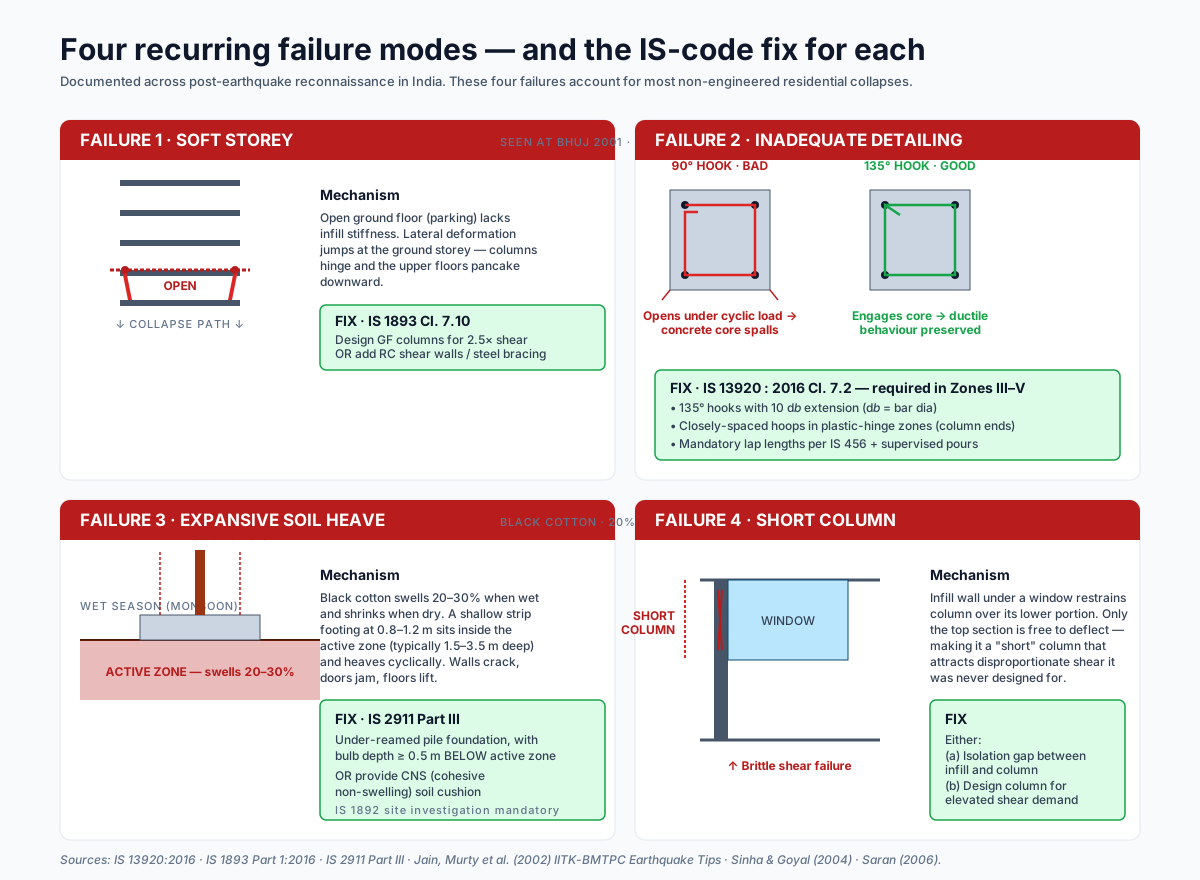
The open ground floor — ubiquitous in Indian urban apartments for parking — creates a dramatic stiffness discontinuity. The ground storey, devoid of infill walls, is many times more flexible than the upper storeys. During an earthquake, nearly all the lateral deformation concentrates in this weak storey, leading to column failure and pancake collapse. The Bhuj earthquake devastated hundreds of such buildings in Ahmedabad, a city 400 km from the epicentre (Sinha and Goyal, 2004).
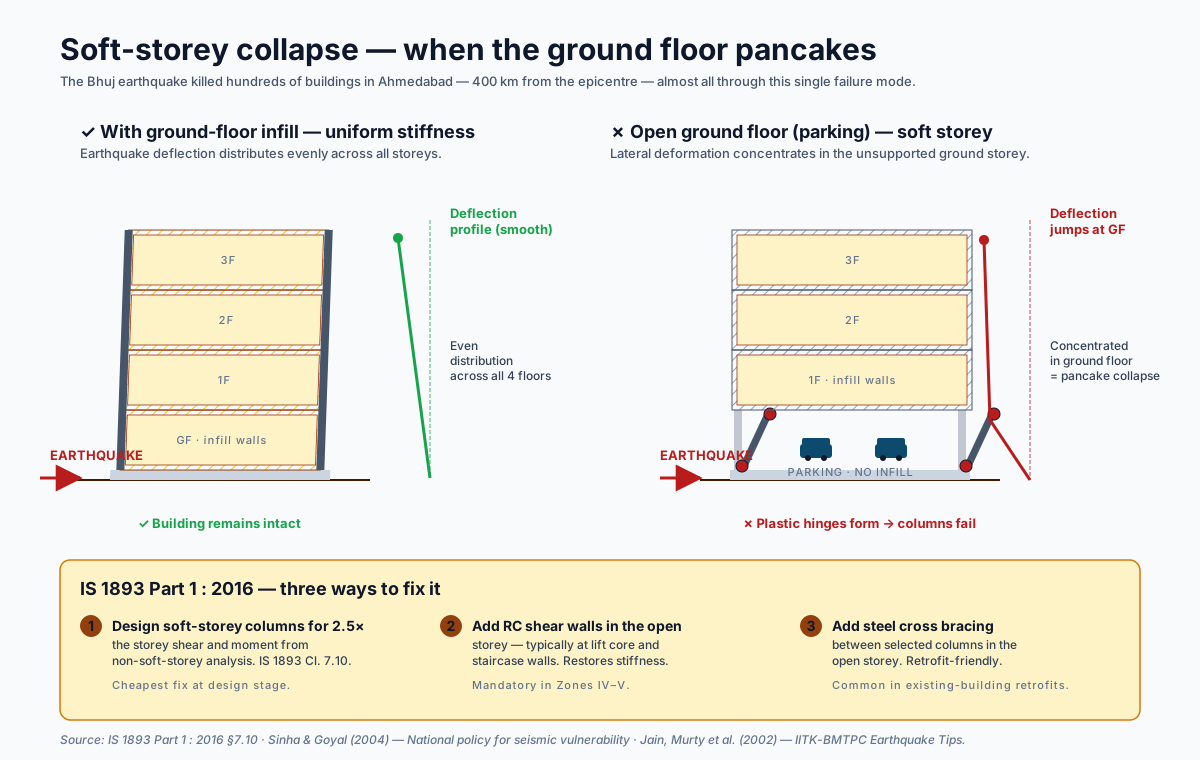
Solution: IS 1893:2016 requires that soft-storey columns be designed for 2.5 times the storey shear and moment. Alternatively, RC shear walls or steel bracing can be introduced in the open storey. Architects must treat this as a non-negotiable structural requirement, not an aesthetic choice.
Inadequate Reinforcement Detailing
Post-earthquake investigations in India consistently reveal the same catalogue of detailing failures: inadequate lap lengths in reinforcement; 90-degree hooks instead of the mandatory 135-degree hooks in column hoops; insufficient stirrup spacing in beam-column joints; and discontinuous corner reinforcement. These are not design failures — they are construction quality failures that undermine even a well-designed structure (Kaushik, Rai and Jain, 2007).
Solution: Structural drawings must specify IS 13920-compliant detailing; site supervision by a qualified structural engineer during critical pours (footings, columns, beam-column joints) is essential; bar bending schedules must be followed precisely.
Foundation Failures on Expansive Soil
In Maharashtra, Madhya Pradesh, and Gujarat, buildings founded on black cotton soil without adequate depth below the active zone experience cyclical heaving and settlement — leading to wall cracks, door-frame distortion, and in extreme cases, structural failure. The most common error is placing strip footings at conventional depths (0.8–1.2 m) in soil that has an active zone extending to 2.5–3.5 m.
Solution: Use under-reamed pile foundations per IS 2911 Part III, extending a minimum of 0.5 m below the active zone. Alternatively, provide a CNS (cohesive non-swelling) soil cushion beneath the foundation. A geotechnical investigation per IS 1892 is mandatory — not optional — in black cotton soil regions (Saran, 2006).
Short-Column Effect
When masonry infill walls have openings (windows) that partially restrain a column, the unrestricted length of the column becomes very short. This short column attracts disproportionately high shear forces during an earthquake — forces it was not designed to resist — leading to explosive shear failure. This was a common failure mode in Bhuj (Jain, Murty et al., 2002).
Solution: Provide separation between infill walls and columns using isolation gaps, or design the column for the additional shear demand. Architects must coordinate window positions with the structural engineer to avoid creating short-column conditions.
7. Indigenous Earthquake-Resistant Techniques
India possesses a rich tradition of indigenous construction techniques that have demonstrated remarkable seismic resilience. Two techniques deserve particular attention:
Dhajji-dewari (patchwork quilt wall) — traditional to Kashmir — uses a timber frame infilled with small masonry panels. The timber frame provides ductility, while the small masonry panels limit the consequences of any individual panel's failure. During the 2005 Kashmir earthquake, dhajji-dewari buildings overwhelmingly survived while modern unreinforced masonry collapsed around them (Arya, Boen and Ishiyama, 2014).

Ikra construction — traditional to Assam — uses a bamboo frame with bamboo-mat or reed infill, plastered with mud. The lightweight, flexible system performs exceptionally well in earthquakes, as its low mass generates minimal seismic forces and its ductile frame absorbs energy through deformation.
These indigenous techniques embody the principles of modern seismic engineering — light weight, ductility, redundancy, and compartmentalisation — arrived at through centuries of empirical adaptation to seismically active regions. The National Building Code of India (2016) and IS 4326:2013 now recognise and encourage the use of these techniques where appropriate.
"Earthquakes do not kill people — the collapse of man-made structures does. Every earthquake confirms that non-engineered construction remains the single largest cause of death." — Nicholas Ambraseys, Imperial College London, pioneer of earthquake engineering in developing countries (Dowrick, 2009)
8. When to Engage a Structural Engineer
Indian homeowners frequently ask: do I need a structural engineer for my home? The answer is unambiguous: yes, always — and especially under the following conditions:
- Any construction in Seismic Zones III, IV, or V (which includes Mumbai, Delhi, Kolkata, Chennai, Ahmedabad, and most of north and northeast India)
- Construction on expansive (black cotton) soil, marine clay, or filled ground
- Any building exceeding two storeys (G+1)
- Any building using RC framed construction (columns and beams, as distinct from load-bearing walls)
- Any building with architectural irregularities — open ground floor, large cantilevers, setbacks, or asymmetric plans
- Any building near a slope, water body, or in a flood-prone area
The cost of structural engineering for a residential building is typically 1–3% of the total construction cost — a negligible investment relative to the structural safety it provides. The absence of structural engineering input, by contrast, can render a building uninsurable, unsaleable, and unsafe.
"A house is a machine for living in — but a machine that must withstand forces its occupants can barely imagine. The architect gives it form; the structural engineer gives it bones." — Adapted from Le Corbusier, Towards a New Architecture (Le Corbusier, 1923)
9. The IS Code Compliance Checklist for Homeowners
For the homeowner commissioning a new home, the following IS codes form the minimum structural compliance framework:
- IS 456:2000 — Concrete design (Bureau of Indian Standards, 2000)
- IS 1893 (Part 1):2016 — Seismic design (Bureau of Indian Standards, 2016)
- IS 13920:2016 — Ductile detailing for RC structures in seismic zones (Bureau of Indian Standards, 2016)
- IS 1904:1986 — Foundation design general requirements (Bureau of Indian Standards, 1986)
- IS 1905:1987 — Structural masonry design (Bureau of Indian Standards, 1987)
- IS 4326:2013 — Earthquake-resistant construction practice (Bureau of Indian Standards, 2013)
- IS 875 (Parts 1–3) — Dead loads, imposed loads, and wind loads (Bureau of Indian Standards, 1987; Part 3 revised 2015)
- IS 2911 (relevant part) — Pile foundation design, if applicable (Bureau of Indian Standards)
- National Building Code of India 2016 — The overarching framework
Homeowners should insist on seeing the structural design report and drawings, verify that IS code references are cited, and ensure that a qualified structural engineer has signed off on the design. Municipal building plan approval processes increasingly require structural design compliance certificates — but enforcement varies widely across states and local bodies.
References
- Agarwal, P. and Shrikhande, M. (2006) Earthquake Resistant Design of Structures. New Delhi: PHI Learning.
- Arya, A.S., Boen, T. and Ishiyama, Y. (2014) Guidelines for Earthquake Resistant Non-Engineered Construction. Paris: UNESCO.
- BMTPC (2019) Vulnerability Atlas of India. 3rd edn. New Delhi: Building Materials and Technology Promotion Council, Ministry of Housing and Urban Affairs.
- Bureau of Indian Standards (1979) IS 1892:1979 — Code of Practice for Subsurface Investigation for Foundations. 1st rev. New Delhi: BIS.
- Bureau of Indian Standards (1986) IS 1904:1986 — Code of Practice for Design and Construction of Foundations in Soils: General Requirements. 3rd rev. New Delhi: BIS.
- Bureau of Indian Standards (1987) IS 1905:1987 — Code of Practice for Structural Use of Unreinforced Masonry. 3rd rev. New Delhi: BIS.
- Bureau of Indian Standards (2000) IS 456:2000 — Plain and Reinforced Concrete — Code of Practice. 4th rev. New Delhi: BIS.
- Bureau of Indian Standards (2013) IS 4326:2013 — Earthquake Resistant Design and Construction of Buildings — Code of Practice. 3rd rev. New Delhi: BIS.
- Bureau of Indian Standards (2016a) IS 1893 (Part 1):2016 — Criteria for Earthquake Resistant Design of Structures, Part 1: General Provisions and Buildings. 6th rev. New Delhi: BIS.
- Bureau of Indian Standards (2016b) IS 13920:2016 — Ductile Design and Detailing of Reinforced Concrete Structures Subjected to Seismic Forces. New Delhi: BIS.
- Dowrick, D.J. (2009) Earthquake Resistant Design and Risk Reduction. 2nd edn. Chichester: John Wiley & Sons.
- Duggal, S.K. (2013) Earthquake Resistant Design of Structures. 2nd edn. New Delhi: Oxford University Press.
- Jain, S.K. (2016) 'Earthquake safety in India: achievements, challenges and opportunities', Bulletin of Earthquake Engineering, 14(5), pp. 1337–1436.
- Jain, S.K., Murty, C.V.R. et al. (2002) IITK-BMTPC Earthquake Tips — Learning Earthquake Design and Construction. Kanpur: Indian Institute of Technology Kanpur.
- Kaushik, H.B., Rai, D.C. and Jain, S.K. (2007) 'Stress-strain characteristics of clay brick masonry under uniaxial compression', Journal of Materials in Civil Engineering, ASCE, 19(9), pp. 728–739.
- Le Corbusier (1923) Towards a New Architecture. Translated by F. Etchells (1931). London: John Rodker.
- Murthy, V.N.S. (2012) Textbook of Soil Mechanics and Foundation Engineering. New Delhi: CBS Publishers.
- National Disaster Management Authority (2011) Seismic Vulnerability Assessment of Building Types in India. New Delhi: NDMA, Government of India.
- Paulay, T. and Priestley, M.J.N. (1992) Seismic Design of Reinforced Concrete and Masonry Buildings. New York: John Wiley & Sons.
- Saran, S. (2006) Analysis and Design of Substructures: Limit State Design. 2nd edn. New Delhi: Oxford and IBH Publishing.
- Sinha, R. and Goyal, A. (2004) A National Policy for Seismic Vulnerability Assessment of Buildings and Procedure for Rapid Visual Screening of Buildings for Potential Seismic Vulnerability. Report to the Disaster Management Division, Ministry of Home Affairs, Government of India.
- Varghese, P.C. (2014) Foundation Engineering. New Delhi: PHI Learning.
Author's Note: This guide draws on published BIS codes, peer-reviewed research, and established engineering textbooks. All IS code references cite the latest revisions known at the time of writing — readers should verify current editions via the BIS website (bis.gov.in). Structural design is a regulated professional activity; this guide is intended to inform, not to substitute for the services of a qualified structural engineer. All residential construction should be designed and supervised by a licensed structural engineer in accordance with applicable IS codes and local building bye-laws.
Disclaimer: This article is for informational and educational purposes only. It does not constitute engineering advice. Structural design decisions must be made by qualified professionals based on site-specific conditions.
Export this guide
Related Guides — Deep-dive reading
Disaster-Resilient Lifeline Hospital Design in India
An Architect's Working Reference — IS 1893 Seismic with Importance Factor 1.5 · NDMA Hospital Safety Guidelines · Multi-Hazard Site Selection (Earthquake / Cyclone / Flood / Landslide / Tsunami) · Non-Structural Anchoring · Mass Casualty Surge · Critical Lifeline Redundancy · Hospital Safety Index
Healthcare ArchitectureSeismic Zones of India — A Design Guide
IS 1893 Part 1:2016, Zone Lookup, Design Base Shear, Ductile Detailing, and City-Specific Earthquake Risk — A Comprehensive Guide for Architects and Structural Engineers
ConstructionRoofing in Seismic Zones
In India’s high-earthquake belts — the Himalaya, the North-East, Kutch, the Andaman & Nicobar and parts of the Indo-Gangetic plain (BIS Seismic Zones IV–V) — the counter-intuitive rule is that a lighter roof is a safer roof, and how the roof ties to the walls matters more than what it is made of. A plain-language, India-grounded guide to how earthquakes shape roof design.
RoofingRelated Tools — Try Free
Circadian Light Meter
Patient-centric circadian lighting visualizer for Indian healthcare design — time-of-day × intensity → CCT, melanopic lux (EML / mEDI), melatonin suppression, and an alertness curve. Calibrated against WELL v2 L03 Circadian Lighting Design, CIE S 026:2018, Brainard 2001, and Lucas et al. 2014.
Circadian ToolCross-Ventilation Analyzer
Estimate airflow and air changes per hour (ACH) from room size, window areas, layout, and local wind — with NBC 2016 Part 8 compliance check.
Ventilation CalculatorStructural Modification Approval Checklist
41 items across structural assessment, society approval, municipal compliance, and safety.
Approval Checklist