
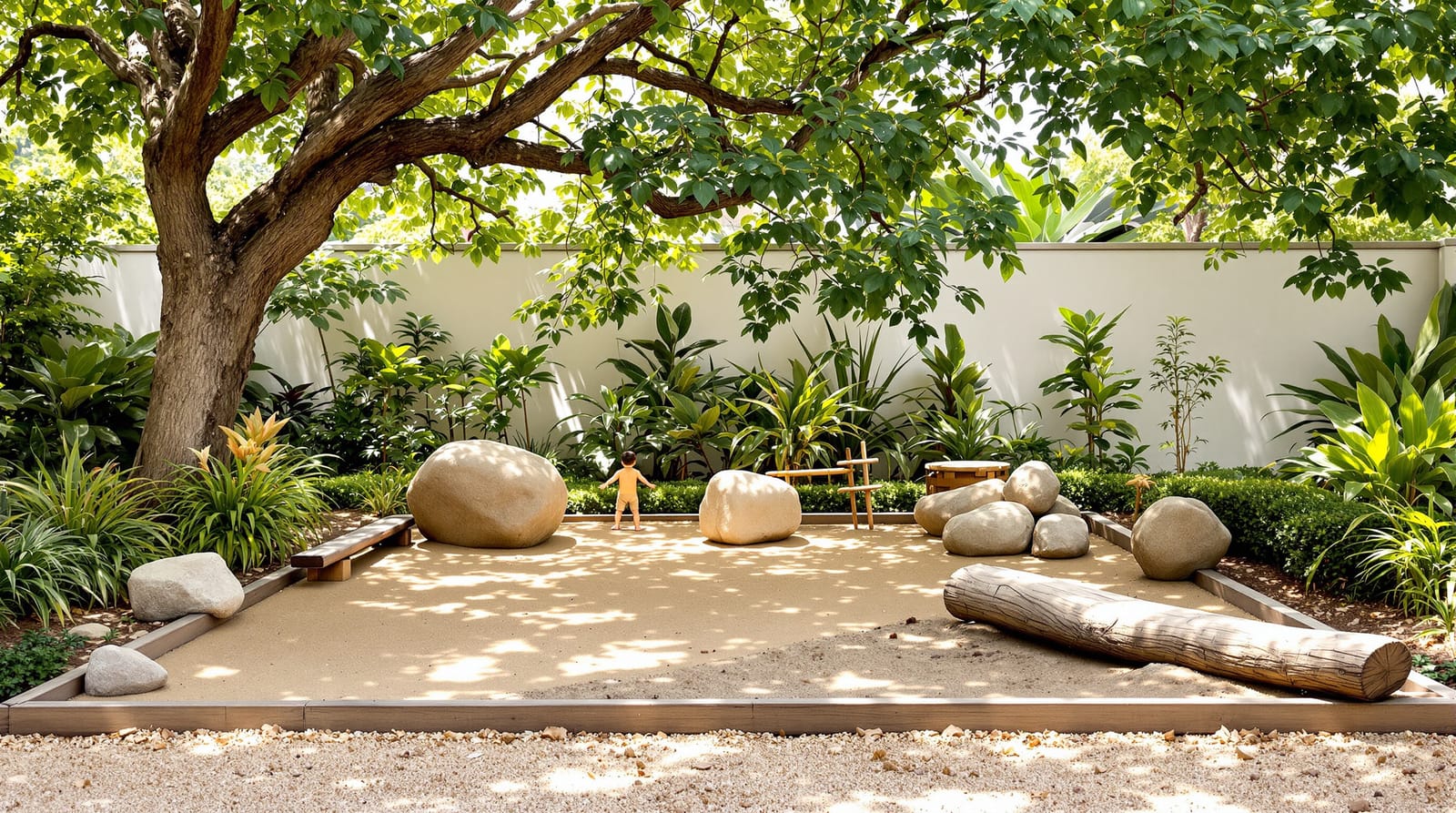
Children's Outdoor Play Environments — Designing Gardens Kids Love
Age-appropriate play zones, nature play and loose parts, sensible safety, supervision sight-lines and shade — outdoor play design for Indian homes
A great outdoor play space for an Indian child is not a swing-set bolted to a slab of concrete — it is a flexible, shaded, age-aware patch of garden where mud, sand, water and loose parts invite the kind of unstructured, self-directed play that does the real developmental work. Get the zoning, surfacing, shade and sight-lines right, and a small corner of your plot or even a balcony can grow with your child from the toddler years to pre-teen adventures — safely, without sterilising the fun.
Why outdoor play matters — and what good design gives a child
Outdoor play is not a luxury add-on to a garden; it is where children build the bodies and brains that screens and structured classes cannot. Climbing a boulder develops the vestibular system and risk-judgement. Pouring water between containers teaches volume and cause-and-effect long before a worksheet does. Digging in soil exposes children to environmental microbes increasingly linked to immune and even emotional resilience. And the freedom of an outdoor space — to be loud, messy and physical — relieves the sensory load that cooped-up apartment children carry.
The Indian context makes this both harder and more important. Many children grow up in flats with no garden, in cities where the nearest park is across a busy road and the afternoon sun is genuinely dangerous from March to June. A thoughtfully designed home play environment — even a 2-by-3-metre terrace corner — can give a child daily, low-friction access to the outdoors that a distant park never will. The design job is to make that space safe enough to allow, rich enough to hold attention, and shaded enough to use during real Indian hours.
Good play design delivers four things at once: developmental richness (varied movement, sensory input, open-ended materials), safety that adults can trust, supervision that does not require hovering, and longevity so the space adapts as the child grows. This guide is the play-specific companion to Landscape Zoning for Family Activities, which handles the whole-garden picture of carving space for different family uses.
Designing for the age
The single biggest mistake is designing for "children" as one block. A toddler and a ten-year-old need almost opposite things: the toddler needs containment, soft surfaces and a parent within arm's reach; the older child needs distance, challenge and the dignity of being unwatched. A space that serves both must be zoned — and zoned with honesty about how far you can safely be from each age.
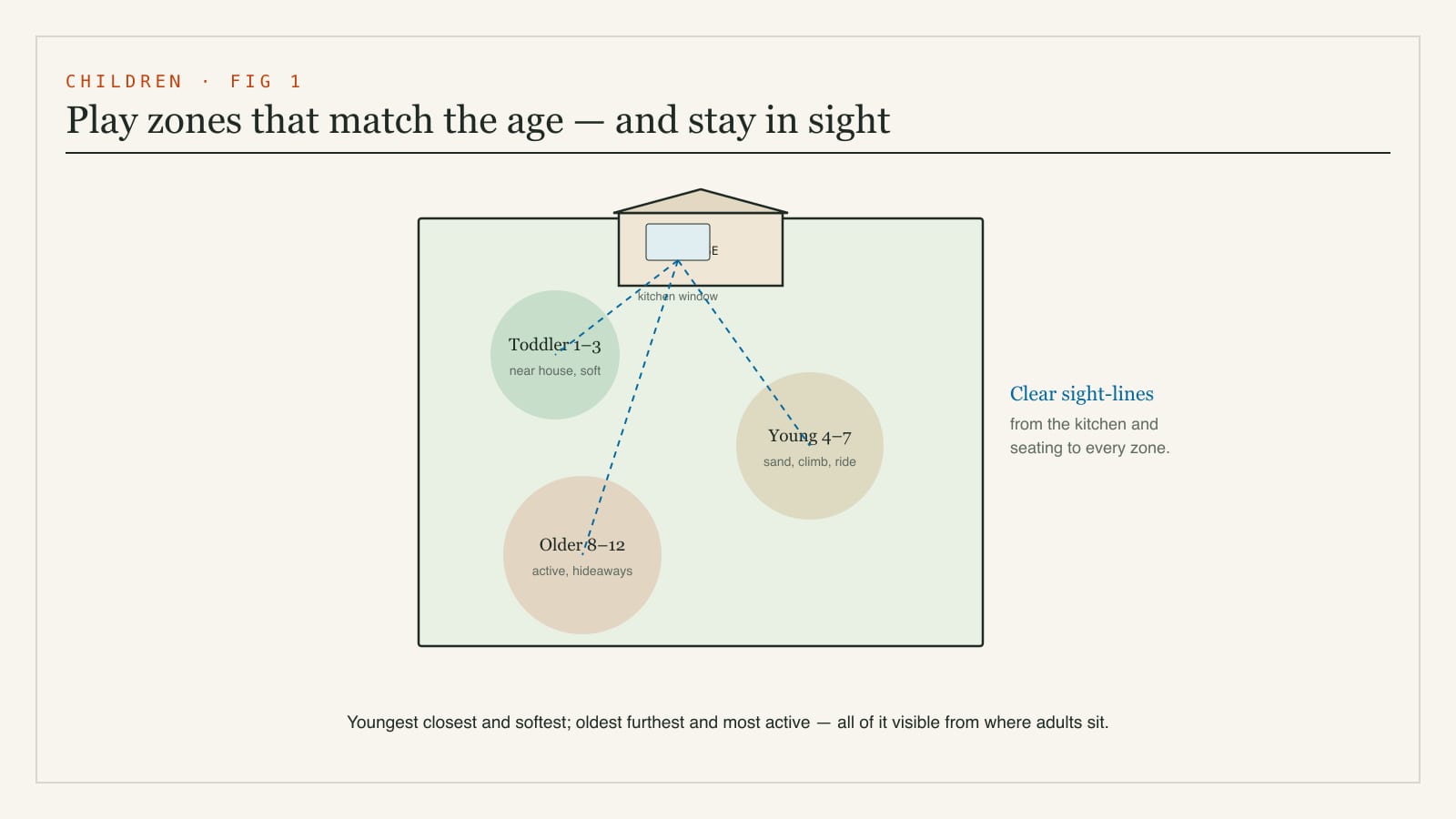
The principle is concentric: put the youngest children's zone closest to the house, where you can see and reach them while doing other things, and place the more active, higher-challenge play for older children further out. As a child matures they graduate outward — a tidy way to "grow with the child" that we return to below.
| Age band | What they need | Suitable elements | Supervision distance |
|---|---|---|---|
| Toddlers 1–3 | Containment, soft ground, gentle sensory play, near a parent | Shallow sand tray, low mounded grass, push/pull toys, very low (under 0.5 m) step or log, water in a shallow tray under watch | Within arm's reach / 1–2 m, line-of-sight always |
| Young children 4–7 | Imaginative and physical play, low risk-taking, social play | Sandpit, mud kitchen, low climbing boulders, balance logs, a cubby or den, low slide (platform under 1.2 m) | Same garden, easy line-of-sight, 5–10 m; check-ins every few minutes |
| Older children 8–12 | Real challenge, privacy, building/making, active games | Higher climbing, rope/net elements, a den they "own", space for cricket/badminton, a garden patch to dig | Periodic glances; can be out of close range if boundary is secure |
Note how supervision distance widens with age. The plan should let you stand at the kitchen window and see the toddler zone clearly, while trusting the older-child zone to a less constant gaze. This is exactly why sight-lines, covered below, drive the layout.
Nature play and loose parts vs fixed equipment
If you buy one expensive moulded-plastic combination unit, you have bought a play space with a fixed script: climb the ladder, go down the slide, repeat. Children master it in a week and abandon it. The richer — and far cheaper — approach is "loose parts" and nature play, where the materials have no fixed use and the child supplies the imagination.
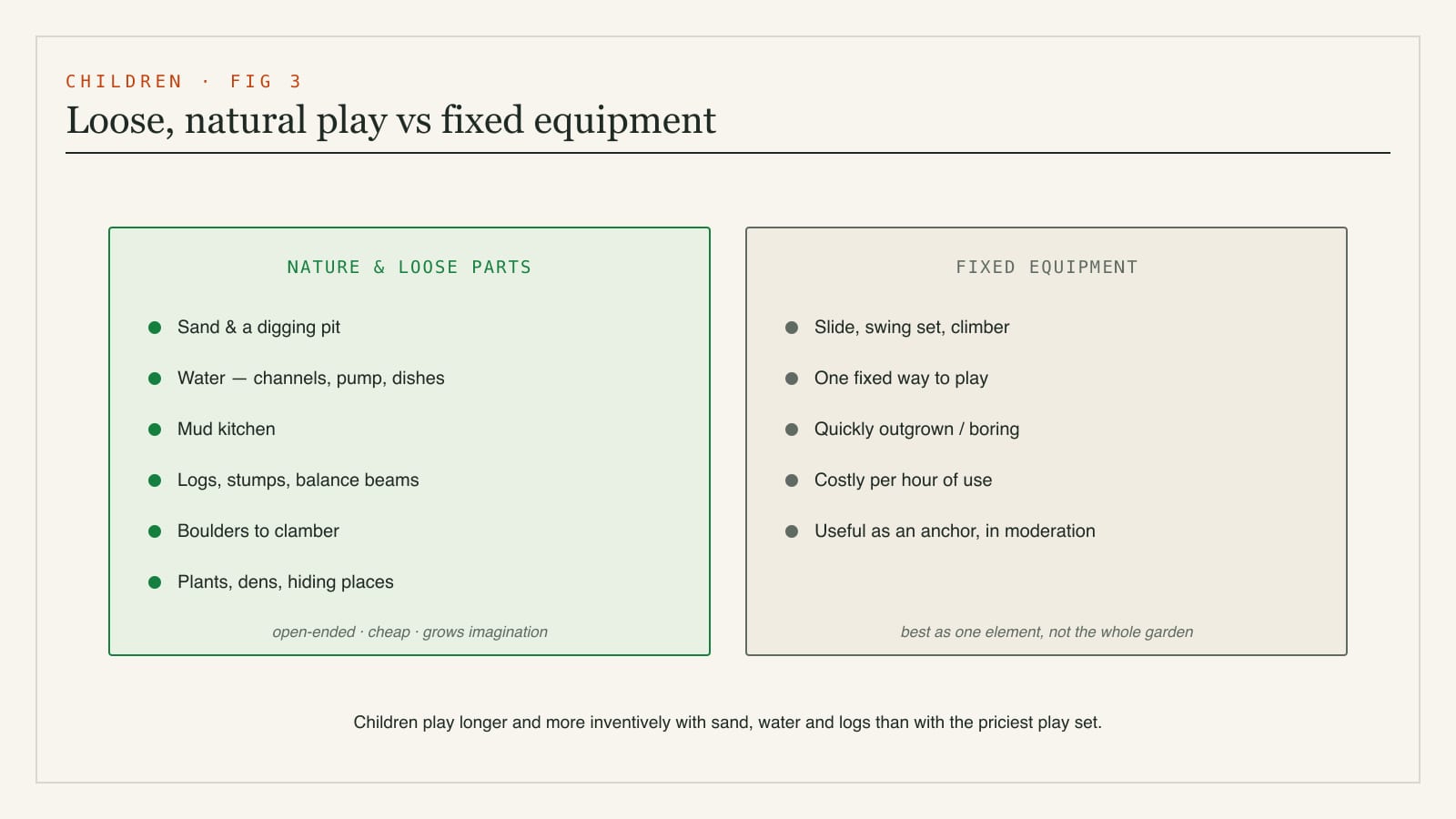
Loose parts are simply movable, open-ended objects: smooth river stones, lengths of bamboo, terracotta pots, wooden offcuts, old steel utensils for the mud kitchen, ropes, fabric, logs of varying size. A pile of these supports a hundred games — a fort, a shop, a "kitchen", a river — and rewards repeated visits because the child rebuilds the world each time. Nature play uses the garden itself: a climbable mango or jamun tree, a mound to roll down, a hedge to hide behind, a patch to dig.
This is not anti-equipment. A good swing, a rope net, or a sturdy slide built into a slope all earn their place, especially for vigorous physical development. The point is balance and value-for-money: spend on one or two robust fixed elements and lavish the rest of the budget on sand, water, soil, plants and a generous box of loose parts. A complete imaginative play setup — sandpit, mud kitchen from a reclaimed table, a crate of loose parts and a few logs — can be assembled for ₹5,000–₹15,000, against ₹40,000-plus for a single imported play structure that a child outgrows fast.
This nature-rich approach dovetails with making the garden good for birds, butterflies and small creatures — children and wildlife thrive in the same kind of layered, living landscape. See the sibling guide Wildlife-Friendly Home Landscapes for the planting side, and Biophilic Landscape Design for the broader case for nature contact at home.
Safety without sterility
The goal is not to remove all risk — children need "risky play" (heights, speed, rough-and-tumble) to learn judgement — but to remove hazards: hidden dangers a child cannot assess, like a hard surface under a climbing frame, a finger-trapping gap, or a toxic plant. The craft is keeping the thrill while engineering out the things that cause serious injury.
Fall zones, surfacing and spacing
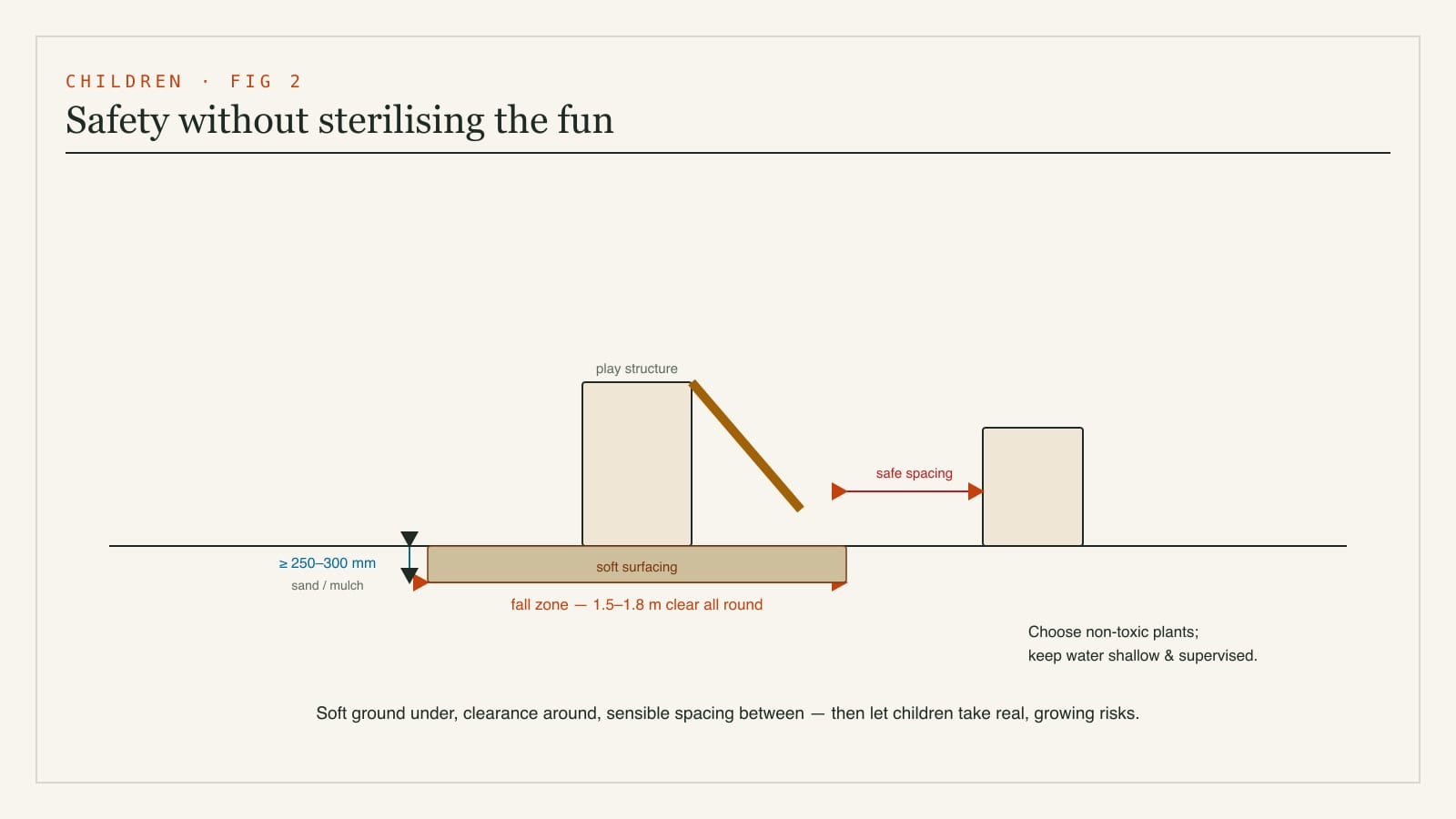
The most important safety idea is the fall zone: the area around any equipment a child can fall from, which must be free of obstacles and covered in impact-absorbing surfacing. International playground safety standards recommend a clear fall zone extending at least 1.8 m in every direction around equipment under about 1.8 m high, and softer, deeper surfacing the higher the equipment. Never place play equipment over concrete, paving, compacted soil or tile — falls onto hard surfaces cause the most serious injuries.
| Equipment fall height | Suitable loose-fill surfacing | Recommended depth |
|---|---|---|
| Up to 1 m | Sand, fine bark/wood mulch, or thick grass | ~150 mm |
| 1–1.5 m | Sand or wood mulch | ~200–250 mm |
| 1.5–2 m | Wood mulch or engineered wood fibre | ~300 mm |
| Over 2 m | Specialist surfacing — reconsider for home use | 300 mm+, professional advice |
Practical Indian notes: clean play-grade river sand is cheap and excellent; top up periodically as it scatters. Loose surfacing must be raked level and kept free of cat fouling (cover sandpits when not in use). Keep spacing generous — at least 2 m between separate play elements so a child leaving one does not collide with another, and keep swings well clear of paths and walls.
Plants — choose and avoid carefully
A play garden should be planted, but children touch, pick and taste, so plant choice is a safety decision. Avoid these common Indian garden plants in or near the play zone:
- Oleander (kaner, Nerium oleander) — highly toxic if ingested; sadly common in Indian gardens.
- Crown flower / calotropis (aak/madar) — toxic milky sap.
- Datura / thorn apple — poisonous, sometimes self-seeds.
- Castor (arandi, Ricinus) — seeds are extremely toxic.
- Yellow oleander (Cascabela thevetia), lantana berries (unripe), and euphorbias/cacti with irritant sap or spines.
Favour safe, robust, sensory-friendly plants children can interact with: tulsi (holy basil), curry leaf, mint and lemongrass (fragrant and pickable), marigold, hibiscus, sunflower, soft ornamental grasses, and sturdy fruiting trees like guava, jamun and mango that double as climbing structures. For choosing trees that give both shade and safety, see Best Trees for Indian Homes.
Water safety
Water play is wonderful but drowning can happen in very little water and in silence. Keep standing water in the play zone shallow (a tray or rill, not a pond) for under-fives, never leave buckets or tubs full and unattended, and if you have a decorative pond or a swimming pool, fence or gate it off from the toddler zone with a self-closing latch above child reach.
Supervision and sight-lines
The best safety device is an adult who can see the child without effort. Design the play zone so it is visible from where adults actually spend time — most usefully the kitchen, since that is where a parent stands while a child plays after school, and secondarily the living area and any outdoor seating. A clear, uninterrupted line of sight from the kitchen sink or window to the toddler zone is worth more than any fence.
Practical moves: keep tall, dense planting and solid walls out of the sight-line between the indoor vantage point and the youngest children's area; use low or transparent boundaries (a low hedge, a see-through railing) rather than opaque screens around the close-in zones; and position adult seating — a bench, a shaded chair — at the edge of the play space so an adult can be present without taking over. The older-child zone can be screened and tucked away precisely because those children have earned distance. This indoor-to-outdoor visual connection is part of good Residential Site Planning, which sets out how to relate the house to its grounds.
Shade and sun protection — non-negotiable in India
In most of India, an unshaded play area is unusable for the better part of the day for half the year. Surfaces in direct sun — metal slides, dark rubber, sand — can reach scalding temperatures by mid-morning in summer, and prolonged exposure between roughly 11 a.m. and 4 p.m. brings real heat and UV risk to young children. Shade is therefore the first design layer, not an afterthought.
Prioritise natural shade: a mature tree canopy is the best play shade there is — cooler than any built structure because of transpiration, plus it provides leaves, twigs and climbing. Site the main play zone under or beside an existing tree where possible; if planting new, fast-ish canopy options for play areas include neem, Indian beech (pongamia/karanj), rain tree (in large plots), and fruiting mango or jamun. Where trees are not yet grown or space is tight, add a pergola with a creeper (bougainvillea, passion fruit), shade sails, or a thatch/bamboo chhappar over the sandpit. Orient the layout so the western, hard-afternoon-sun side is the most heavily shaded. For the wider logic of designing around the Indian sun and monsoon, see Climate-Responsive Landscape Design.
Pair shade with practical heat habits: schedule outdoor play for mornings and late afternoons in summer, keep drinking water at the play space, and choose light-coloured, non-metal play surfaces that do not bake.
Sand, water and mud — the three great open-ended materials
If you do nothing else, give children sand, water and mud. These three materials carry more sustained, developmental, cross-age play value than almost any built element.
- Sandpit: a 1.2-by-1.2 m timber- or brick-edged pit of clean play sand, 250–300 mm deep, with a cover (a tarpaulin or hinged lid) to keep cats and rain out. Add a few scoops, pots and trucks.
- Water: a simple water table, a hand-pump rill, or even a shallow stone trough that you fill and empty. Combine with sand for the classic, irresistible mud-and-channel play. Drain or empty after use so it does not breed mosquitoes — important given dengue.
- Mud kitchen: a waist-height bench (a reclaimed table works) with old steel pots, a tap or water source nearby, and access to soil. It is the single most-loved, longest-lasting play installation in most family gardens, and costs almost nothing.
These get messy by design — site them where dirt does not matter, on permeable ground near a tap and a hose, and accept that mess is the evidence of good play. Linking them to a hose and letting overflow soak into a planted bed is also sound Sustainable Water Management in the Landscape.
Designing it to grow with the child
Children's needs change every couple of years, so design for change rather than for a snapshot. The concentric, zoned layout already helps: as the child grows, the close-in toddler zone can convert to a planting bed or seating, and the budget and attention shift outward to the active zone.
Build in adaptability from the start:
- Choose elements that re-script themselves — sand, mud, loose parts and a den serve a 3-year-old and a 9-year-old differently with no rebuild.
- Make fixed elements modular and demountable (bolted timber, not cast concrete) so a low platform can be raised or a sandpit converted to a raised vegetable bed later.
- Keep an open, level patch of lawn or hard-wearing turf-grass; the same space hosts a toddler's first steps, then catch, then backyard cricket.
- Avoid hyper-themed installations (the pirate ship, the fixed playhouse) that lock in an age and a story; neutral, robust structures last longer.
Small plots, terraces and balconies
Most Indian families do not have a sprawling garden, and a play environment does not need one. The principles scale down to a 2-by-2 m terrace or even a balcony.
For terraces and small courtyards: a portable sandpit or sand-and-water table, a wall-mounted chalkboard, a small climbing element rated for the load (check the slab's capacity and waterproofing first), planters of safe, sensory plants, and a shade sail or pergola against the open sky are plenty. Keep heavy loads near load-bearing walls and never compromise terrace waterproofing with permanent fixings — use freestanding, movable pieces.
For balconies: prioritise absolute safety first — railings must be high enough (around 1.2 m), with vertical balusters spaced under 100 mm so a head cannot pass through, no horizontal "ladder" rails a child can climb, and no movable furniture or planters near the railing that becomes a step. Within that safe envelope, a small sand tray, a water-play tub, soft mats, and pots of tulsi, mint and marigold turn a balcony into a daily nature contact point. Apartment dwellers should also check society/RWA rules and structural limits before adding anything fixed.
Whatever the size, the recipe is the same: zone by age, surface for safe falls, plant safely, keep it in your line of sight, shade it heavily for the Indian sun, and load it with sand, water, mud and loose parts rather than one expensive machine. Do that, and even the smallest outdoor space will give your child years of the play that genuinely builds them. For the calmer, restorative end of outdoor design that adults and children share, see Outdoor Wellness Spaces, and for larger plots, Villa Landscape Design.
References & further reading
- Indian Society of Landscape Architects (ISOLA) — professional guidance on residential and public landscape design in India.
- Ian Thompson et al., "Landscape Architecture: A Very Short Introduction" / Tim Waterman, "The Fundamentals of Landscape Architecture" — design principles for outdoor space.
- U.S. Consumer Product Safety Commission, "Public Playground Safety Handbook" — fall zones, surfacing depths and equipment spacing standards widely referenced internationally.
- Royal Horticultural Society (RHS) — guidance on family/child-friendly gardens and lists of poisonous garden plants.
- ICAR–Indian Institute of Horticultural Research (IIHR), Bengaluru — region-appropriate plant and tree selection for Indian gardens.
- Tim Gill, "No Fear: Growing Up in a Risk-Averse Society" and the work of Penny Wilson on loose-parts and adventure play — the developmental case for risk and open-ended play.
Export this guide
Related Guides — Deep-dive reading
The Best Trees for Indian Homes
A research-grade guide to choosing and placing trees around an Indian home — the real cooling and clean-air numbers, the right species for shade, flowers, fragrance and fruit, and the placement science that keeps roots out of your walls and drains.
LandscapeHow to Choose a Security System (2026): The Master Buying Guide for Indian Homes and Buildings
The mental model that ties the whole buying decision together: start from your own risk, not a product; build the layers your situation actually needs; make the big architecture choices (wired vs wireless, local vs cloud, DIY vs professional); tell real product quality from marketing; and choose a vendor you can trust.
SecurityDesigning for Views and Privacy
The site-level craft of capturing the good view while screening the neighbour's window three metres away — tuned for dense Indian plots.
Site PlanningRelated Tools — Try Free
Cross-Ventilation Analyzer
Estimate airflow and air changes per hour (ACH) from room size, window areas, layout, and local wind — with NBC 2016 Part 8 compliance check.
Ventilation CalculatorGarden Planning Toolkit
Get a tailored garden plan — planting layers, Indian species, features and a checklist — from your climate, space, sun and goals.
PlannerApartment Video Door System Planner
Enter flats, entrances, floors and guard desk for a first-pass building intercom plan — door stations, indoor monitors, guard station, the right architecture and an indicative cost band.
Building Planner