
Le Corbusier's Façade Signature: Brise-Soleil, Béton Brut and the Free Façade Explained
A façade-craft deep dive into Le Corbusier's recurring moves — the sun-breaker, raw concrete, pilotis and the free façade — and the climate-driven concrete language he gave India at Chandigarh and Ahmedabad.
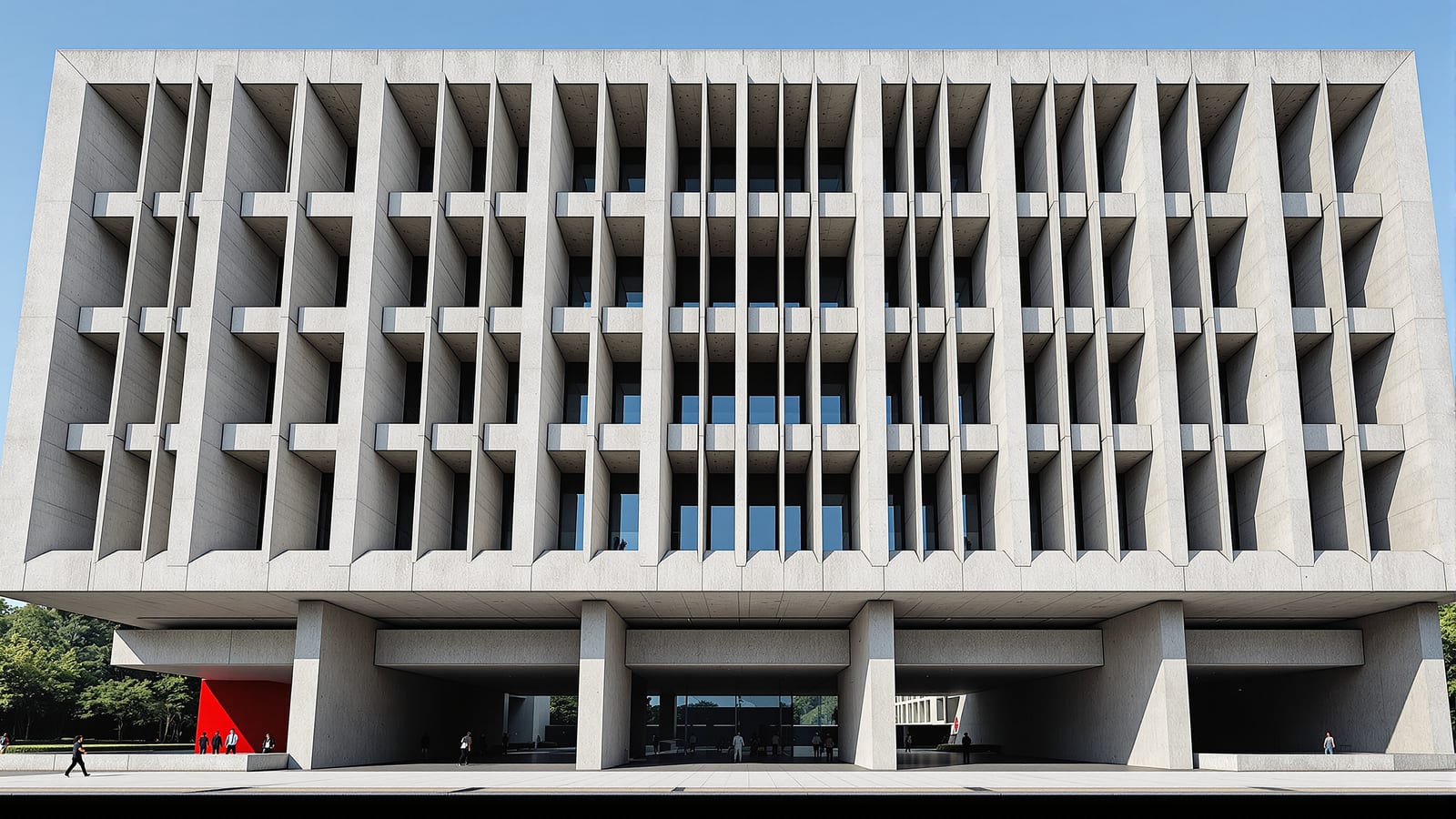
You can recognise a Le Corbusier façade from across a public square, before you know whose it is. It is almost never a flat wall with windows punched into it. Instead the wall has been pushed forward into a deep, three-dimensional grid of concrete fins and recesses — a honeycomb of shadow — and the whole heavy mass usually sits lifted off the ground on thick concrete legs, as if it were hovering. The surface is rarely painted smooth. It is raw grey concrete that still carries the grain of the wooden planks it was cast against, sometimes interrupted by a single blazing panel of red, blue or yellow buried inside the shade.
That combination — a wall turned into deep relief, a mass on stilts, raw textured concrete, and small jolts of pure colour — is a façade signature, not a style accident. Le Corbusier (1887–1965) spent forty years working out how the outer skin of a building should behave once the wall no longer had to hold the building up. His answers reshaped the modern façade everywhere, and in India specifically he handed us a concrete sun-shading language that Doshi, Correa and a whole generation built on.
This is part of our Building Façades series — specifically our Masters of the Façade set, where we study how one great architect handled the façade in particular. For the full life and ideas, read our Le Corbusier biography; this guide stays narrowly on the façade. Because so much of his Indian work is about shading, read it alongside our brise-soleil and louvre façades guide and our concrete façades guide — together they cover the craft and the maintenance reality.
1. The free façade: when the wall stopped holding the building up
Everything in Le Corbusier's façade language starts with one structural shift. Traditionally a building's outer wall was load-bearing — it carried the floors above, so its openings had to stay small and stacked over one another. Le Corbusier worked with the Dom-Ino frame, his 1914 idea of a building as a skeleton of reinforced-concrete columns and flat slabs (named after the domino-tile look of the diagram, and a pun on the Latin domus). Once columns carry the loads inside the perimeter, the outer wall carries nothing.
That liberated wall is the free façade (in French, façade libre) — the principle that the exterior skin can be composed freely, as a thin membrane, because it no longer has any structural duty. The façade becomes a design surface rather than a structural cage. Glass can run continuously, walls can be paper-thin or pushed in and out at will, and the whole composition answers to light, view and proportion instead of to gravity. This single move underwrites every other device below.
2. The brise-soleil: his most useful invention
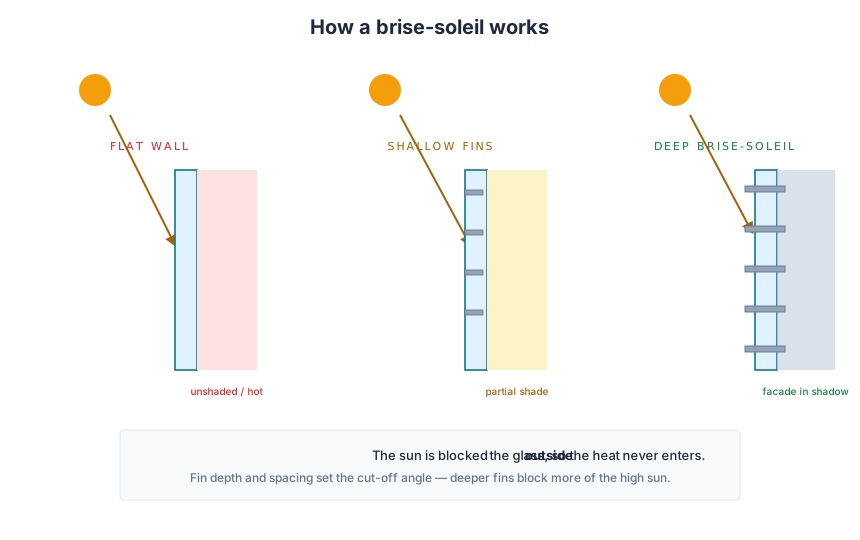
If you remember one thing about a Le Corbusier façade, remember this. The brise-soleil (French for "sun-breaker") is an architectural element — usually a deep grid or array of concrete fins, slabs or louvres — fixed in front of the glazed wall to block direct sun before it reaches the glass, while still letting in air, daylight and view. He developed it from the 1930s onward, and it became central to his work in hot climates.
The genius is that the shading is external, deep and permanent. A blind on the inside stops glare but lets the heat in through the glass first; a brise-soleil intercepts the sun outside the wall, so the heat never arrives. Sized correctly to the latitude, it blocks the high overhead summer sun while admitting the low winter sun, and on east and west faces it can be angled to cut the brutal low morning and evening sun. It turns the façade into a passive climate device — and it turns a flat wall into deep, sculptural shadow, which is why his late buildings look so heavy and carved. For hot, sunny India, this was exactly the right idea, and it remains his single most useful gift to our façade design.
3. Pilotis: lifting the façade off the ground
The pilotis are the reinforced-concrete columns (pillars or stilts) that lift the body of the building clear of the ground, leaving the ground plane open beneath. On the façade, pilotis do something specific: they detach the mass from the earth so the building reads as a floating volume rather than a block planted in the soil. The ground floor becomes shaded open space — for circulation, breeze, parking or a garden — and the "real" façade begins one storey up. In hot climates this raised, shaded undercroft is also a practical cooling and flood-sense move.
4. The ribbon window: light from edge to edge
Because the free façade carries no load, a window no longer has to be a small punched hole. Le Corbusier ran his windows horizontally in continuous bands — the ribbon window (in French, fenêtre en longueur, literally "window in length"): a long horizontal strip of glazing that runs across the façade uninterrupted by structure. It floods the interior with even daylight from one side wall to the other, frames the landscape as a panoramic horizontal slot, and visually stretches the building sideways. The ribbon window is the most visible proof on the elevation that the wall has been freed from structure.
5. Béton brut and board-marked concrete: the honest, raw surface
After the war, working in scarce, rough conditions, Le Corbusier embraced béton brut — French for "raw concrete," meaning structural concrete left exposed exactly as it came out of the formwork, with no plaster, render or polish over it. He cast it against rough sawn timber planks, so the cured surface keeps the imprint of the wood grain and the joints between boards: this is board-marked concrete (or board-formed concrete), where the texture and lines of the shuttering boards become the finish.
Smooth exposed concrete had existed for decades; what was new was the deliberate coarseness — treating the rawness, the formwork seams, even the casting imperfections, as the honest expression of the material rather than flaws to hide. This raw concrete surface gave the English critics the name Brutalism (from béton brut), and it defines the texture of his late façades. It is heroic and tactile up close. It is also, as we will be honest about below, the part of his language that ages worst in a wet tropical climate.
6. The Modulor and polychromy: proportion and colour on the wall
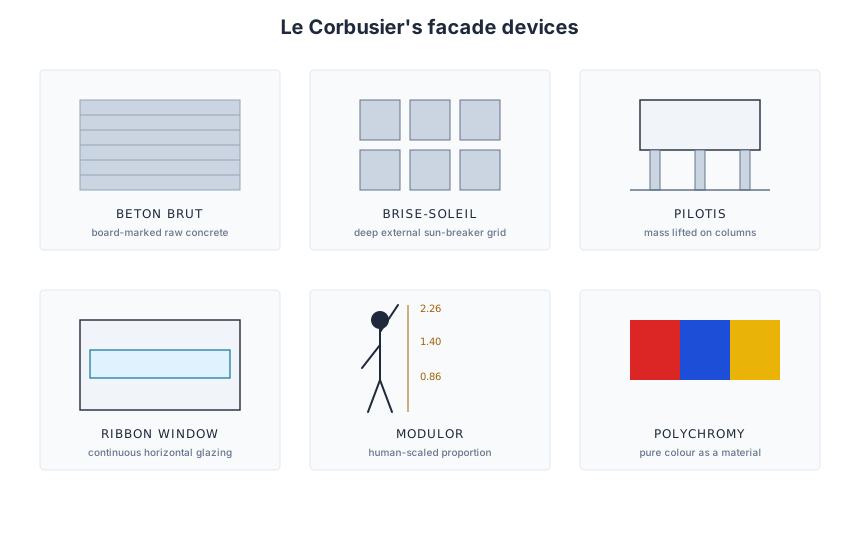
Le Corbusier did not size his façade openings by eye. He used the Modulor, his proportioning system (codified around 1945) based on the human body and the golden ratio: a standard figure 1.83 m tall, 2.26 m to the raised hand, generating a cascading series of measurements (2.26, 1.40, 0.86, 0.53 m and so on) tuned to human scale. He set the spacing and size of his brise-soleil bays, panels and openings to these harmonious dimensions, which is part of why his façades feel ordered even when they look rough.
The second softening device is polychromy — his deliberate use of strong, pure colour (his signature reds, blues, yellows and greens, drawn from his own paintings) on selected façade planes. At the Unité d'Habitation the deep loggias of the brise-soleil are painted in these primaries, so the grey concrete grid is punctuated by jolts of saturated colour hiding in the shadow. Colour, for him, was a façade material like any other. (A related, more technical glazing device is the ondulatoire — an irregular, musically spaced rhythm of vertical glazing mullions, paired with the aérateur, a narrow full-height ventilation flap — which he used to give a glass wall a varied, rhythmic beat instead of a monotonous grid.)
The Five Points and the façade
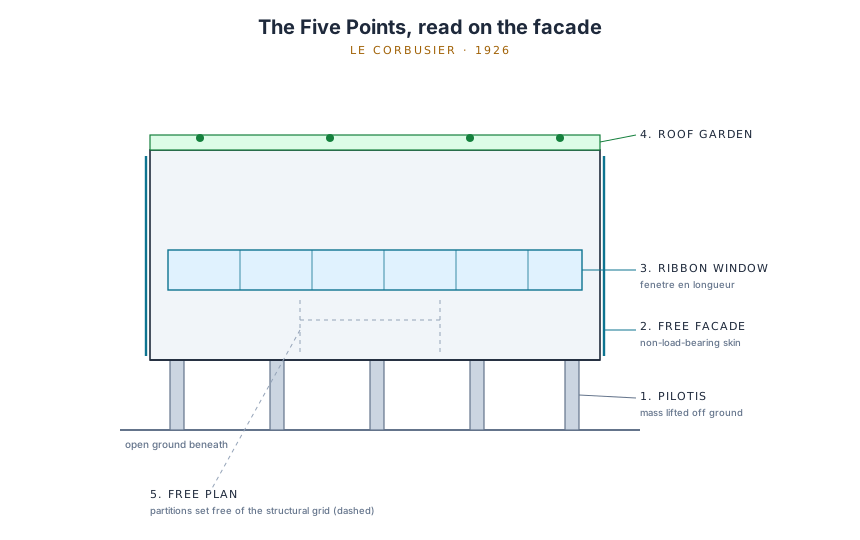
In 1926 Le Corbusier published his Five Points of Architecture (Cinq points de l'architecture moderne) — pilotis, the roof garden, the free plan, the free façade and the ribbon window. Three of the five are directly about the outside skin, and together they describe how the concrete frame changes the façade:
- Pilotis lift the mass and start the façade one floor up, over open ground.
- The free façade liberates the skin from structure, so the elevation can be composed freely.
- The ribbon window runs glazing horizontally in a continuous band, impossible in a load-bearing wall.
(The other two — the roof garden, which reclaims the lost ground on top, and the free plan, which frees the interior partitions — shape the building behind the façade.) Read as a set, the Five Points are essentially a manifesto for the modern façade: stop letting the wall do structural work, and use the freedom to compose light, shade and proportion.
The signature façade devices at a glance
| Device | What it is | Why he used it | Where to see it | India relevance |
|---|---|---|---|---|
| Brise-soleil | Deep external grid of concrete fins/louvres in front of the glass | Block direct sun outside the wall; admit air, light and view | Mill Owners' Association; Chandigarh Capitol; Unité loggias | His core hot-climate gift; sized to Ahmedabad/Chandigarh latitude |
| Béton brut + board-marking | Raw exposed concrete cast against rough timber, left untreated | Honest material expression; texture; post-war economy | Unité d'Habitation; Chandigarh; Sanskar Kendra | Defined Indian concrete modernism, but streaks in monsoon |
| Pilotis | Reinforced-concrete columns lifting the mass off the ground | Float the volume; open, shaded ground plane | Villa Savoye; Unité; Secretariat | Shaded undercroft aids breeze and flood-sense in our climate |
| Free façade (façade libre) | Non-load-bearing skin freed by the concrete frame | Compose the elevation freely; thin membrane wall | Villa Savoye; throughout | Made deep brise-soleil screens and big openings possible |
| Ribbon window (fenêtre en longueur) | Continuous horizontal band of glazing | Even daylight edge-to-edge; panoramic view | Villa Savoye | Needs the brise-soleil over it to work in Indian sun |
| Modulor proportion | Human/golden-ratio measurement series | Order the size and spacing of openings and bays | Unité; Chandigarh | Why the rough façades still feel scaled to people |
| Polychromy | Strong pure colour on selected façade planes | Relieve the grey; colour as a façade material | Unité loggias; Villa Sarabhai interiors | A way to humanise heavy concrete |
Real buildings, not renders
Villa Savoye, Poissy, France (1928–31). The canonical demonstration of the Five Points on a façade. A white box lifted on slender pilotis over an open ground floor, wrapped by a continuous ribbon window that runs unbroken around all four sides — only possible because the free façade carries no load. Here the wall is a thin, weightless membrane and the window is a horizontal slot in it; this is the freed façade in its purest, lightest form, before concrete went raw and heavy.
Unité d'Habitation, Marseille, France (1947–52). The pivot to béton brut. A long, tall slab raised on massive sculptural pilotis, cast in raw board-marked concrete, with deep brise-soleil loggias punched into the long east and west faces. Inside those shaded recesses the concrete is painted in his polychromy — reds, blues, yellows, greens — so the grey façade carries hidden colour. The bays are set out to the Modulor. This is the proto-Brutalist façade and the template for his Indian work.
Mill Owners' Association Building, Ahmedabad, India (1951–54). A façade-design masterclass for a hot climate. Le Corbusier covered the east and west faces — the worst low-sun directions — with deep concrete brise-soleil grilles, and crucially angled them: on the west face the fins are set diagonally to cut the low evening sun and screen the street while still letting indirect light and air through, while the river side is set more openly to draw the breeze through the shaded depth. The building is, in effect, a porous concrete cube wearing a sun-breaker on its hottest sides.
Chandigarh Capitol Complex, India (1950s). His Indian climate-façade language at civic scale, across the Palace of Assembly, the Secretariat and the High Court. The faces are continuous rows of deep concrete brise-soleil with small square openings behind, giving the huge blocks a carved, rhythmic shadow pattern; combined with double-skin roofs and reflecting pools, the façade works as a passive climate regulator. Listed by UNESCO in 2016 (see Sources). Note honestly: these are heroic but the deep concrete sun-shades also collect dirt and streak in the monsoon, and the interiors are not always comfortable.
Notre-Dame du Haut, Ronchamp, France (1950–55). The opposite extreme, included to show the same hand thinking sculpturally. Here there is no grid at all: a thick, curved, sculptural concrete wall — swelling from a point to roughly three metres thick — pierced by deep, irregularly placed, splayed window openings that funnel coloured light. It proves the façade for Le Corbusier could be a solid, plastic, light-modulating mass, not only a screen.
What Indian architects took from him
Le Corbusier's Ahmedabad and Chandigarh work landed on fertile ground, and a clear Indian concrete-façade lineage grew out of it. B. V. Doshi worked in Le Corbusier's office and supervised the Indian projects, then spent a career adapting raw concrete and deep shading to Indian life; Charles Correa took the climate logic — shade, the open shaded undercroft, the section that breathes — and pushed it toward a more open, courtyard-and-terrace tropical modernism. The common inheritance is simple and correct: in our sun, the right move is deep external shading, and the brise-soleil is the device that delivers it.
But the lineage also learned the limits. Raw exposed concrete in a monsoon climate weather-streaks badly: dirt, algae and water-runoff stain the grey surface, and the deep brise-soleil ledges that make such beautiful shadow also catch grime and become hard to clean and maintain. The honest Indian descendants kept the principle — shade, honesty of material, human proportion — while learning to detail the surface for our rain.
The honest reckoning
Le Corbusier's façade language is not something to copy wholesale, and pretending otherwise does a homeowner no favours.
The brise-soleil is his enduring, transferable gift: external solar shading, sized to your latitude and your worst sun directions, is simply the correct way to keep an Indian façade cool, and you can do it in any material. That principle is timeless.
Béton brut is the hard part. Raw, board-marked concrete is heroic in a museum photograph and harsh in real life. In tropical damp it ages poorly — it streaks black and green within a few monsoons, the deep brise-soleil shelves trap water and dirt, and the material is unforgiving to repair. Some of his buildings are uncomfortable inside and several have leaked. And good béton brut is genuinely hard to execute today: it demands exceptional formwork, a single continuous pour, and skilled labour, because every flaw is permanently on show with nothing to hide it. Our concrete façades guide covers the waterproofing, drip-detailing and maintenance reality in depth — if you are tempted by raw concrete, read it first.
So the honest summary: borrow his principles, not his literal harshness. Take the deep shade, the honesty, the human proportion. Leave the unrelieved raw grey to the masters and the heritage listings.
What this means for you
For a homeowner or architect designing a façade in India, three things from Le Corbusier are worth borrowing directly:
- Shade the glass from outside, deeply. A brise-soleil, a louvre screen, a deep fin or an overhang sized to your sun does more for comfort and energy than any tinted glass or internal blind. This is the single highest-value lesson.
- Be honest about materials, but detail them for rain. Exposed, true materials read as confident and timeless — but in our climate they need drip edges, slopes and a maintenance plan so they weather gracefully instead of streaking. Honesty plus good detailing, not honesty alone.
- Proportion your openings. You do not need the Modulor, but you do need a consistent measuring logic. Openings, fins and bays that share a proportional family feel calm and considered, even on a rough surface.
Do all three and you get the good of a Corbusier façade — climate-smart, ordered, dignified — without the grey harshness that does not survive our monsoons.
Sources
- Fondation Le Corbusier — official catalogue of works (Mill Owners' Association Building, Ahmedabad, 1951; Villa Sarabhai, Ahmedabad, 1951–56), fondationlecorbusier.fr
- UNESCO World Heritage Centre — "The Architectural Work of Le Corbusier, an Outstanding Contribution to the Modern Movement," 17 sites across 7 countries inscribed 2016, including the Chandigarh Capitol Complex
- Le Corbusier, Vers une architecture (1923) and the "Five Points of a New Architecture" (1926)
- Le Corbusier, Le Modulor (1948/1955) — the proportioning system based on human scale and the golden ratio
- Encyclopaedia Britannica and standard architectural references on béton brut, Brutalism, the brise-soleil and the Dom-Ino system
- ArchDaily / ArchEyes architecture-classics records for Villa Savoye, Unité d'Habitation de Marseille, Mill Owners' Association Building, the Palace of Assembly (Chandigarh) and Notre-Dame du Haut, Ronchamp
- Studio Matrx in-house: Le Corbusier biography, brise-soleil and louvre façades, concrete façades
Export this guide
Related Guides — Deep-dive reading
Tadao Ando's Façade Signature: Silky Off-Form Concrete and the Tie-Hole Grid
How Tadao Ando turned exposed concrete into the world's most disciplined façade language — the tatami-proportioned formwork panel, the rhythmic six-hole grid, and walls that frame light, water and sky instead of opening to the street.
Building FacadesCharles Correa's Façade Signature: How India's Master Made the Climate-Correct Wall
How Charles Correa eroded the flat sealed wall into deep, shaded, porous layers — verandahs, terraces, pergolas and open-to-sky courts — so the Indian façade filters sun and drives air instead of sealing it out.
Building FacadesEnergy-Efficient Facades in India: How the Building Skin Cuts Your Cooling, Heating & Lighting Bills
How a building facade drives cooling, heating and lighting energy in India, the three levers of solar-heat-gain control, insulation and daylighting, U-value, SHGC, VLT and WWR in plain terms, ECBC and Eco-Niwas expectations, and real Indian green buildings.
Building FacadesRelated Tools — Try Free
Brise-Soleil Visualizer
Interactive horizontal-louvre cut-off angle calculator — sun altitude, louvre depth, and spacing inputs with a live shadow preview. Computes θ = arctan(spacing/depth) for façade shading, ECBC envelope compliance, hospital daylight design, and tropical sun-control detailing.
Sun Shading ToolCross-Ventilation Analyzer
Estimate airflow and air changes per hour (ACH) from room size, window areas, layout, and local wind — with NBC 2016 Part 8 compliance check.
Ventilation CalculatorMonsoon-Readiness Checklist
Pre-rain home audit across 9 categories — terrace, drains, waterproofing, electrical, HVAC, pest, vehicles, documents.
Seasonal Audit