

CCTV Optical vs Digital Zoom (India 2026): Which Actually Sees Detail
Optical zoom uses a real lens to add genuine detail; digital zoom just crops and interpolates pixels you already have. Why big digital-zoom numbers on the box are marketing, and when a varifocal or PTZ optical lens is worth paying for.
Two cameras both say "zoom" on the box. One quietly lists 4x optical; the other shouts 16x digital zoom in big letters. The louder number is almost always the weaker camera. Understanding cctv optical vs digital zoom is the difference between footage that reads a face or a number plate at the gate and footage that dissolves into coloured blocks the moment you try to enlarge it.
This guide sits in the Image Quality & Optics part of Studio Matrx's CCTV hub. It stays in one lane: what the two kinds of "zoom" actually do to your picture, why the marketing favours the useless one, and when paying for a real optical lens is worth it. For the pixels the zoom is working with, pair it with the CCTV resolution guide; for the lens that makes optical zoom possible, the varifocal vs fixed lens guide.
Scope & safety. This guide helps you choose a spec and brief an installer — nothing more. Mounting at height, cabling and any mains-electrical work belong to licensed professionals. And a plain truth about zoom: the closer and sharper you can pull a face, the more identifiable the footage, which means more privacy duty under the Digital Personal Data Protection Act, 2023 — not less. Cameras belong on your own property and shared areas only, never bathrooms, bedrooms or changing areas, and aimed to respect neighbours.
The one idea that explains everything
There is a single distinction to hold onto, and every buying decision follows from it:
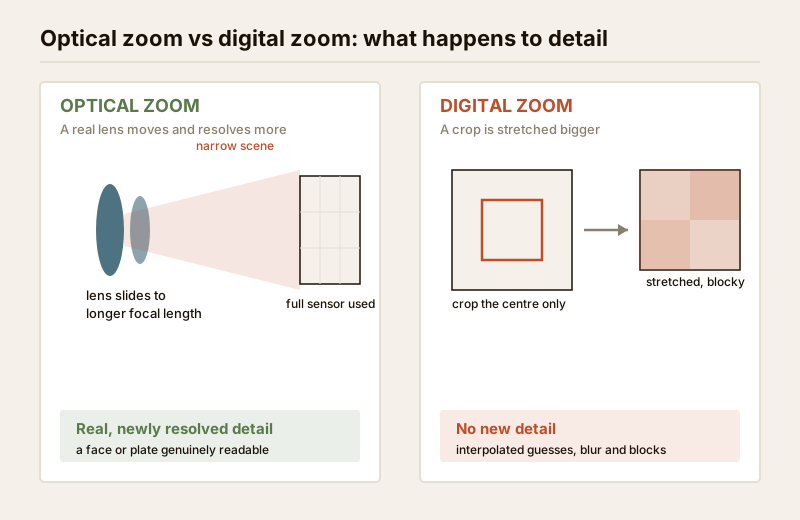
- Optical zoom moves real glass. The lens physically changes its focal length, gathering light from a narrower slice of the scene and spreading it across the whole sensor. The distant gate now fills the frame using all the camera's pixels. That is genuine, newly resolved detail.
- Digital zoom moves nothing. The camera (or the app, or you on the recorder) simply takes the pixels it already captured, crops out the middle, and stretches that small patch back up to full size — inventing in-between pixels by interpolation. No new detail exists to reveal. You are enlarging a photo, not looking closer.
Put bluntly: optical zoom sees more; digital zoom just shows the same thing bigger and blurrier. A camera can even combine them — for example "4x optical, 16x total" — but only the optical portion adds anything real. Anything beyond the optical figure is cropping dressed up as a feature.
Why "16x digital zoom" is on the box (and optical is not)
Digital zoom is essentially free. It is a line of software; it costs the manufacturer nothing to print "16x digital zoom" and it lets a cheap fixed-lens camera claim a big, impressive-sounding number. Optical zoom, by contrast, needs a motorised multi-element lens — real glass, a focus motor, precise assembly — which adds genuine cost to the camera.
So the marketing incentive is exactly backwards from your interest. The camera that trumpets a huge digital-zoom figure is usually a basic fixed-lens unit with nothing optical inside. When you read a spec sheet, the honest number is the optical one, often written as a focal-length range like 2.8–12 mm (a varifocal or motorised-zoom lens) or a plain "Nx optical zoom." If a camera lists only a big digital or "total" zoom and no optical figure, treat its zoom as 1x — because that is what it really is.
| On the box it says | What it usually means | How much real reach |
|---|---|---|
| "16x digital zoom", no optical figure | Fixed-lens camera, software crop only | None — 1x of real detail |
| "4x optical, 16x total zoom" | Real 4x lens + software beyond it | 4x is real; the rest is crop |
| "2.8–12 mm varifocal" | Adjustable lens, set once on install | ~4.3x optical range, real |
| "5–50 mm motorised / PTZ" | Motor-driven optical zoom, remote | 10x optical, real |
| "digital zoom supported" | A crop tool in the app/NVR | Convenience only, not detail |
What digital zoom does to detail
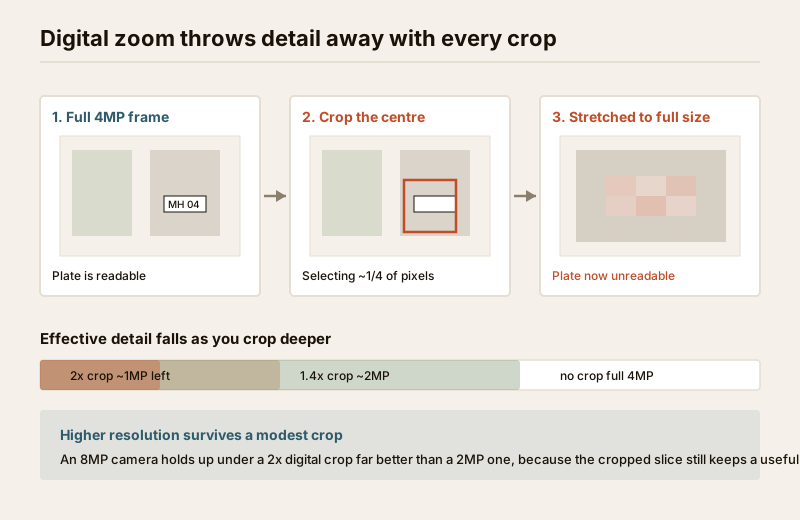
Every camera captures a fixed number of pixels — that is its resolution. Digital zoom cannot create pixels it never recorded. When you crop to the centre quarter of a 4MP image and blow it back up to full screen, you are viewing roughly a 1MP slice stretched over a 4MP frame. The camera's processor fills the gaps by guessing, and guessing looks like blur, blockiness and smeared edges — precisely on the small, high-value details you were zooming for: a face, a number plate, a hand at a lock.
This is why zoom and resolution are joined at the hip. A higher-resolution sensor gives digital zoom more to crop into before it falls apart — an 8MP camera survives a modest 2x digital crop far better than a 2MP one, because even the cropped quarter still holds a useful pixel count. In that narrow sense, buying resolution is the homeowner's alternative to optical zoom: capture the whole scene in enough detail and you can crop into the recording afterwards without a motor. The trade is storage and light, both covered in the resolution guide; size the recording cost with the storage & bitrate calculator.
When optical zoom is genuinely worth paying for
Most Indian homes do not need a motorised optical zoom on every camera. But there are specific situations where real optical reach earns its higher price, and a couple where it is overkill.
Worth it:
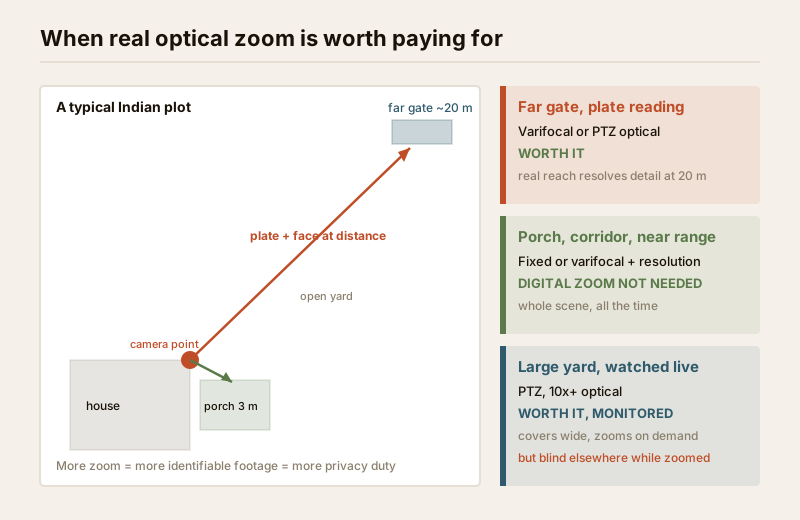
- A long, fixed line you must read at distance. A camera at the house corner that has to capture faces or number plates at the far gate, 15–25 metres away, is exactly where optical reach pays. Here a varifocal camera — an adjustable lens you dial in once on install — lets the installer set the precise reach and framing for that one view, without buying a motorised PTZ.
- A large plot or commercial yard patrolled from one point. Where one camera must watch a wide area and zoom in on demand, a PTZ (pan-tilt-zoom) with 10x–30x optical genuinely earns it — but only as an active, monitored camera, since a PTZ zoomed onto one corner is blind everywhere else. See the PTZ CCTV guide for where that fits and where it does not.
- Number-plate and face capture at a chokepoint. A single gate or till where identification is the whole point justifies a lens matched to the distance — set once, framed tight.
Usually not worth it:
- General home coverage. For a porch, a compound corner, a corridor, a well-chosen fixed or varifocal lens plus enough resolution beats an expensive motorised zoom. You want the whole scene, all the time, not a narrow tube.
- "Just in case I want to zoom later." Buy resolution for that. A 4MP–8MP camera lets you crop into a recording after the fact; a motorised zoom only helps if someone is driving it live at the moment it matters.
Matching zoom to the job — a quick table
Zoom is not a standalone spec; it is a way of putting your pixels where the detail matters. Use this to sanity-check what a view actually needs before you pay for a lens you will not use.
| Where the camera looks | Distance | Sensible zoom choice | Why |
|---|---|---|---|
| Porch, front door, doorbell view | 1–4 m | Fixed wide lens, no zoom | Whole scene close up; digital crop rarely needed |
| Compound corner, side wall | 4–10 m | Varifocal, set once | Frame the exact strip; no motor needed |
| Far gate / driveway, plate + face | 12–25 m | Varifocal (longer end) or PTZ | Real optical reach to resolve detail at distance |
| Large yard / society ground, live watch | 20 m+ | PTZ, 10x+ optical | One camera covers wide, zooms on demand — but blind elsewhere while zoomed |
| "Might zoom the recording later" | any | Buy resolution, not zoom | Higher MP survives a modest crop; no live driver needed |
For choosing the actual focal length and angle-of-view for a given spot, the varifocal vs fixed lens guide and the lens field-of-view calculator do the geometry. To place cameras across a whole plot, use the camera coverage calculator and the CCTV camera type selector.
The India realities that blunt zoom
A zoom number on a datasheet meets some hard local truths:
- Zoom in, light out. Pushing an optical lens to its long end usually narrows the aperture, so less light reaches the sensor. On a poorly lit Indian street at night, a long-zoom shot can be darker and noisier than a wide one. Overall image quality — sensor size, aperture, low-light behaviour — often matters more than raw zoom; that is the domain of the image quality guide and the low-light CCTV guide.
- Heat, dust and monsoon on moving parts. A motorised zoom and PTZ mechanism has moving parts that dust, heat and monsoon humidity wear on — a fixed or varifocal lens, set once, has nothing to fail. Weatherproofing (IP66+) matters more, not less, on a zoom camera.
- More reach, more storage and upload. A tighter, more detailed view is only useful if it is recorded and retrievable. Resolution and frame rate drive storage and your Jio/Airtel upload if it is cloud-backed; balance it with the storage & bitrate calculator and, for the cloud-vs-local cost, the local storage guide.
- Power cuts. A PTZ that resets its position or loses power in an evening outage is watching the wrong corner when it matters. Put the camera, recorder and network on a UPS as part of the wider plan in the building security systems guide.
Price bands (indicative)
Prices move with brand, sensor, lens quality and season — treat these as ballparks to sanity-check a quote, not fixed rates. Camera-only, installed-order estimates.
| Camera type | Typical range (₹) | Zoom reality |
|---|---|---|
| Fixed-lens 2MP–4MP ("16x digital zoom") | ₹1,200 – ₹4,000 | Digital only; treat as 1x real |
| Varifocal 4MP (2.8–12 mm) | ₹4,000 – ₹9,000 | ~4x real optical, set on install |
| Motorised varifocal / auto-focus 4MP–8MP | ₹7,000 – ₹16,000 | Real optical, remote-adjustable |
| PTZ 2MP–4MP, 10x–25x optical | ₹12,000 – ₹45,000+ | Real long optical; monitored use |
| NVR/recorder digital-zoom playback | included | Convenience crop, no added detail |
When to bring in a professional
Decide the views, distances and zoom type yourself using this guide — then hand the rest over. An installer sets a varifocal or motorised lens to the exact framing for each distance, mounts a PTZ where its sweep is unobstructed, and pulls cabling to the recorder. Mounting at height, cable terminations and any work at the mains board are licensed-professional tasks — see the electrical hub. A varifocal camera framed correctly by someone who checked the shot on site is worth far more than a pricey PTZ bolted up in the wrong spot. For the whole-system picture, start at the complete guide to CCTV systems.
Key takeaways
- Optical zoom = real detail (a lens physically resolving a narrower scene across the full sensor). Digital zoom = a crop stretched bigger (interpolated pixels, no new detail).
- Big "10x/16x digital zoom" claims are marketing on cheap fixed-lens cameras — read the optical figure or the focal-length range; if there is no optical number, the real zoom is 1x.
- Zoom lives or dies with resolution: higher MP survives a modest digital crop, which is the homeowner's alternative to a motor — at the cost of light and storage.
- Optical zoom is worth paying for on long fixed lines (a far gate — use varifocal) and large monitored areas (a PTZ), but is overkill for porches, corridors and general home coverage.
- More zoom means more identifiable footage and more privacy duty, and it meets Indian realities — less light at the long end, moving parts in dust and monsoon, more storage and upload. Check each view with the camera type selector and route mounting, cabling and mains work to a licensed professional.
References
- Digital Personal Data Protection Act, 2023 — higher-resolution, zoomed footage is more identifiable personal data; cover only your own property and shared areas with a legitimate purpose and avoid capturing neighbours' private spaces.
- Ingress Protection (IP) ratings — verify weatherproofing (IP66 or higher for outdoors, and especially for motorised/PTZ cameras) on the manufacturer's specification sheet before ordering.
- National Building Code of India (SP 7), Bureau of Indian Standards, and local municipal bye-laws for any structural, electrical or life-safety aspect of an install; verify the current edition via the BIS catalogue: https://www.services.bis.gov.in/
This is an educational overview. Mounting at height, cabling and any electrical work are qualified professional tasks — engage licensed installers and verify any standard's current status via the BIS catalogue before relying on it.
Export this guide
Related Guides — Deep-dive reading
CCTV Varifocal vs Fixed Lens (India 2026): Choosing the Right Angle of View
Focal length sets how wide and how far a camera sees. What a fixed 2.8mm or 3.6mm lens gives you, when an adjustable varifocal earns its higher price, manual versus motorised, and how to pick the right angle for each spot on an Indian plot.
SecurityHow to Choose a CCTV Camera (2026): The Homeowner's Decision Guide for India
Cut through the spec-sheet noise and choose the right CCTV camera for each spot around an Indian home. What actually matters — sensor and low-light performance, lens and field of view, form factor, IP and IK ratings, honest smart features — and the marketing claims to ignore.
SecurityPTZ Cameras: When One Moving Camera Is Worth It in India
What a PTZ (pan-tilt-zoom) camera really does, the blind-spot catch every homeowner must understand, and where a motorised zoom camera earns its keep versus plain fixed cameras.
SecurityRelated Tools — Try Free
CCTV Camera Coverage & Count Calculator
Estimate how many CCTV cameras you need, the NVR channels, storage in TB for your retention period, and an indicative all-in cost with GST.
CCTV CalculatorCCTV Cloud vs Local Cost Calculator
Compare cloud CCTV subscription against a local NVR + HDD — upfront, 5-year total, monthly fee and break-even.
Cloud vs LocalCCTV Lens & Field-of-View Calculator
Focal length, sensor and resolution to field-of-view angle, scene width and DORI detect/observe/recognise/identify distances.
Lens & FoV