
BLDC Fans: The Efficient Upgrade to the Ceiling Fan
The quiet revolution in the most-used appliance in an Indian home — how a BLDC ceiling fan uses roughly half the power of an ordinary fan, runs cooler and quieter with remote and speed control, whether the higher price pays back, and what to check when buying.
The ceiling fan is the most-used electrical appliance in most Indian homes — running many hours a day, for much of the year. So an upgrade that halves a fan's power use adds up fast across a home. That upgrade is the BLDC fan — one built with a brushless DC motor instead of the traditional induction motor. It uses roughly half the power for the same airflow, runs cooler and quieter, and comes with a remote and fine speed control. This guide explains BLDC fans, whether the higher price pays back, and what to check.
It is an efficiency deep-dive in the Electrical Knowledge Hub, part of the sustainable and energy management story.
The safety line. A like-for-like fan replacement can look simple, but fan wiring, the fan box and the ceiling fixing are a licensed electrician's job (a falling fan is dangerous). Buy an ISI-marked fan to IS 374.
What makes a BLDC fan different
The difference is the motor:
- An ordinary ceiling fan uses an induction motor — reliable, but it wastes more energy as heat and runs at a fixed efficiency.
- A BLDC fan uses a brushless DC motor with electronic control — significantly more efficient at turning electricity into airflow.
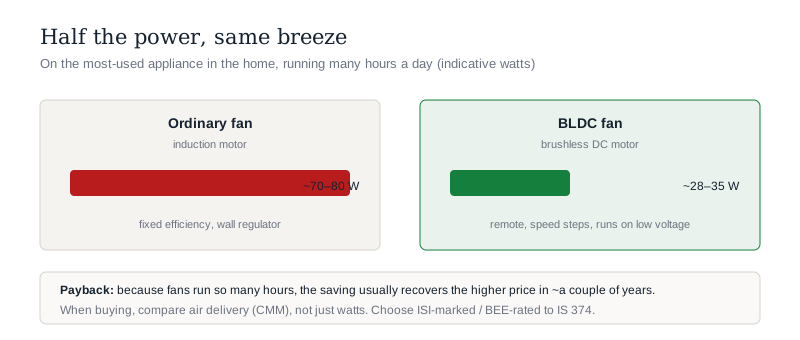
- For the same air delivery, a BLDC fan typically draws around half the power of a conventional fan — often roughly 28–35 W versus 70–80 W (indicative; varies by model).
That efficiency, on an appliance that runs for hours daily, is the whole point.
The benefits beyond efficiency
BLDC fans bring more than lower power:
- Big energy saving — roughly half the running cost, multiplied across every fan and every hour.
- Remote control & speed steps — fine speed control, timers, and modes, from a handset (electronic control makes this easy).
- Cooler, quieter running — less wasted heat, often quieter operation.
- Better low-voltage performance — many keep running smoothly even when the mains sags, where an ordinary fan slows.
- Efficiency ratings — look for BEE star-rated / high-efficiency models.
Does the higher price pay back?
The honest maths:
- BLDC fans cost more upfront than ordinary fans — the main barrier.
- They pay it back through running-cost savings — because a fan runs so many hours, the electricity saved typically recovers the price premium within a couple of years or so, then keeps saving for the fan's life (indicative — depends on hours, tariff and price).
- The more you run your fans (long summers, many fans), the faster the payback — making BLDC especially worthwhile in most of India.
- Estimate it with the appliance running cost calculator using the two wattages.
- The verdict: for fans that run a lot, BLDC is usually worth it — one of the easier efficiency wins after LED lighting.
What to check when buying
- Air delivery (CMM) — ensure it moves enough air for the room (efficiency is pointless if it doesn't cool); compare air delivery, not just watts.
- Power (watts) and BEE rating — lower watts for the same air delivery, and a good star rating.
- ISI mark / IS 374 — a quality, safe, ISI-marked fan.
- Sweep size — matched to the room (larger rooms need larger sweep).
- Warranty and reputable brand — BLDC electronics benefit from a solid warranty.
- Professional installation — proper fan box, fixing and wiring by a licensed electrician.
The one-line answer
A BLDC ceiling fan swaps the traditional induction motor for a brushless DC motor with electronic control, using roughly half the power for the same airflow (often ~28–35 W vs ~70–80 W) — a big saving on the most-used appliance in an Indian home, plus a remote, fine speed control, cooler quieter running and better performance when the voltage sags. It costs more upfront, but because fans run so many hours, the running-cost saving usually pays back the premium within a couple of years, then keeps saving — so for fans that run a lot (most of India), BLDC is one of the easiest efficiency wins after LED lighting. When buying, compare air delivery (CMM) and watts, choose an ISI-marked, BEE-rated model to IS 374 sized to the room, and have it installed by a licensed electrician.
Where to go next
- The efficiency strategy: Sustainable Home Electrical Guide · Home Energy Management Guide.
- The other easy win: LED vs CFL vs Incandescent Guide.
- Work out the saving: Appliance Running Cost Calculator.
- Buy quality: Buying Electrical Materials Guide.
References
- IS 374 : 2019, Electric Ceiling Type Fans — Specification, Bureau of Indian Standards.
- Bureau of Energy Efficiency (BEE) — Standards & Labelling (ceiling fans star rating): https://beeindia.gov.in/
- IS 732 : 2019, Code of Practice for Electrical Wiring Installations, BIS: https://www.bis.gov.in/
Power figures and payback are indicative and vary by model, air delivery, hours of use and tariff; compare air delivery (CMM), not watts alone. Installation is a licensed electrician's work. Verify any standard's status via the BIS catalogue before relying on it.
Export this guide
Related Guides — Deep-dive reading
Smart Air Purifiers for Indian Homes: Beating PM2.5
Across Delhi-NCR winters and year-round urban haze, indoor air is often worse than the street. This guide explains what actually makes a purifier smart, how CADR and room sizing work, what HEPA and activated carbon really remove, honest running costs on filters and power, and which brands earn their price in Indian conditions.
Smart HomeSmart Ceiling Fans in India: BLDC, Remote & Voice Control
The ceiling fan is the hardest-working appliance in an Indian home — running eight months a year, often all night. A smart BLDC fan cuts its power draw by two-thirds, adds a remote and app, and answers to Alexa and Google. Here is what actually matters when you buy one.
Smart HomeInverter vs Non-Inverter AC: Why the Compressor Type Matters Most
The single most important AC choice, explained — how an inverter's variable-speed compressor differs from a fixed-speed one, why it saves energy, runs quieter and copes with low voltage, whether the higher price pays back, and the rare case for a fixed-speed unit.
HVAC & CoolingRelated Tools — Try Free
False Ceiling Cost Estimator
Live ₹/sqft across 8 ceiling types — POP, gypsum, designer, metal, PVC, wooden — with cove and spot lighting for 20 Indian cities.
Cost CalculatorElectrical Safety & Load Audit
Home electrical audit — 10 categories, 65+ checkpoints across earthing, RCCB, MCB, wiring, switchboards, appliance circuits, DG/inverter backup.
Safety AuditRoom Lighting Calculator
Estimate the target lux, total lumens and number of LED fixtures a room needs, from its type and size — a general-illumination planning guide.
Lighting