

How to Hire a Good Electrician in India: Licences, Vetting & Working With the Pro
The single most important electrical decision a homeowner makes — choosing the person who does the work. How to check a licence, vet an electrician or contractor, spot the red flags, agree a clear scope and estimate, and get quality workmanship on a safety-critical job.
Because this is a domain where the honest answer is almost always "call a licensed electrician", the most important electrical decision you make is which electrician. Good work is invisible and safe for decades; bad work is a shock or fire risk hiding in the walls. Yet electricians are usually chosen on price and availability alone. This guide is how to choose well — how to check a licence, vet the person, agree a clear scope, and get genuine quality on a safety-critical job.
It is the "who does the work" guide of the Electrical Knowledge Hub, the natural companion to every guide that ends with "leave this to a professional".
The safety line. This guide is about choosing and working with the professional, not doing the work. Electrical work in India should be carried out by a licensed electrician / electrical contractor competent to the relevant standards — hiring the right one is exactly how you stay safe.
Why this matters more than the materials
You can specify the best ISI-marked materials in the world, but they're only as safe as the workmanship that installs them. Most electrical failures — loose connections, poor earthing, undersized cables, missing protection — are installation failures, not material failures. The person is the biggest variable in whether your home is safe. That's why choosing well is worth real effort.
Licences and competence
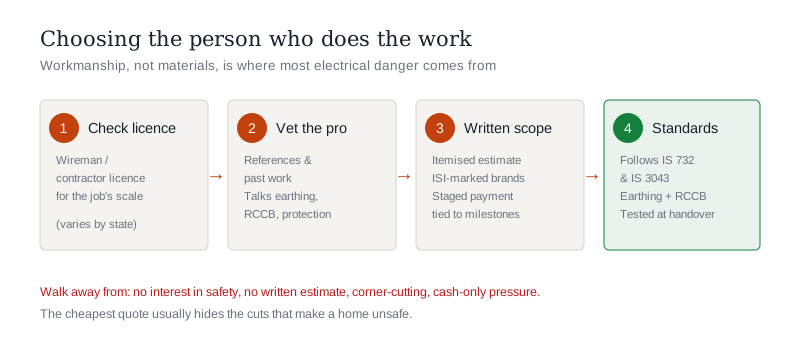
Electrical work in India is a licensed trade. Depending on the state and the scope, the relevant credentials include a wireman/electrician licence and, for contracting, an electrical contractor licence issued by the state's licensing board or electrical inspectorate. For a significant job (new home wiring, a full rewire, a load enhancement), it's reasonable to:
- Ask whether they hold the relevant licence for the work's scale, and for larger jobs use a licensed electrical contractor.
- Understand that licence requirements vary by state and by job size — a small repair and a full house wiring are different regulatory situations.
- Prefer competence you can verify over the cheapest quote — this is not where to bargain-hunt.
How to vet an electrician
Beyond the licence, judge the person:
- References and past work — ask for recent jobs and, ideally, see one or speak to a past client.
- Reputation — word of mouth, your architect/builder's recommendation, and reviews.
- How they answer — a good electrician talks about earthing, RCCBs, cable sizing and protection unprompted, and is comfortable explaining. Vagueness or dismissiveness about safety is a red flag.
- Quality of their own tools and habits — switching off before work, testing, tidy terminations.
- Willingness to give a written scope and estimate — professionals do; "trust me" pricing is a warning sign.
Red flags to walk away from
- No interest in earthing, RCCBs or protection, or calling them unnecessary.
- Refusal to give a written estimate or itemised scope.
- Suggesting corner-cuts — undersized cables "to save cost", skipping the RCCB, no earthing, reusing dubious old wiring.
- Cash-only, no accountability, no traceability if something goes wrong.
- Pressure and rush on what is a safety-critical job.
- Unwillingness to use ISI-marked materials or pushing suspiciously cheap unbranded ones.
Agreeing scope, estimate and quality
Set the job up to succeed:
- Write down the scope — what work, which rooms/circuits, what materials (brands/specs), what protection. Use your electrical plan as the brief.
- Get an itemised estimate — labour and materials separated; understand what drives the cost.
- Specify ISI-marked materials and, ideally, agree the brands (see buying materials).
- Agree the standards — the work follows IS 732 and IS 3043 (see standards); earthing and an RCCB are non-negotiable.
- Payment in stages tied to milestones, not all upfront.
- Ask about testing and handover — a good job ends with testing and, for a big job, a completion/test record.
Getting a fair price without cutting corners
Price matters, but the cheapest quote often hides the corner-cuts that make a home unsafe. Get a few itemised quotes, compare like for like (same materials, same protection), and treat a quote that's far below the rest as a warning, not a bargain. Use the house wiring cost guide and the wiring cost estimator to know roughly what the job should cost, so you can tell a fair price from a false economy.
The one-line answer
The most important electrical decision is which electrician — because workmanship, not materials, is where most electrical danger comes from. Choose a licensed electrician (or contractor for larger jobs) whose credentials you verify, vet them on references, reputation and how seriously they take earthing, RCCBs and protection, and walk away from red flags (no interest in safety, no written estimate, corner-cutting, cash-only pressure). Agree a written scope, itemised estimate, ISI-marked materials and standards compliance, pay in milestones, and expect testing at handover. Never bargain-hunt on a safety-critical job — the cheapest quote usually hides the cuts that make a home unsafe.
Where to go next
- Know what to insist on: Home Electrical Safety Guide.
- Specify the materials: Buying Electrical Materials Guide.
- Know what it should cost: House Wiring Cost Guide · Wiring Cost Estimator.
- Hand over a clear brief: Home Electrical Planning Guide.
References
- Central Electricity Authority (Measures relating to Safety and Electric Supply) Regulations, 2010 (as amended) — licensing and competence of electrical persons (state-specific): https://cea.nic.in/
- IS 732 : 2019, Code of Practice for Electrical Wiring Installations; IS 3043 : 2018, Code of Practice for Earthing, Bureau of Indian Standards.
- State electrical licensing boards / electrical inspectorates — wireman and electrical contractor licensing (state-specific).
Licensing requirements and processes vary by state and by job scale, and evolve; verify current licence requirements with your state's electrical inspectorate. All electrical work must be carried out by a competent licensed professional. Verify any standard's status via the BIS catalogue.
Export this guide
Related Guides — Deep-dive reading
Residential Electrical Systems: The Complete Guide for Indian Homes
How the electricity in an Indian home actually works — from the utility supply and meter through the distribution board, circuits, wiring, earthing and protection, to lighting, safety, energy efficiency, smart controls, solar and backup — written so a homeowner can understand, plan and judge it, and know exactly where a licensed electrician must take over.
Electrical & WiringElectrical Fire Safety in India (2026): Overloads, Wiring and the Right Protection
Why electrical faults cause so many Indian building fires, and the fix: correct cable sizing and a properly designed board by a licensed electrician, MCB plus RCCB protection, no overloading, and never water on a live fire.
SecurityContractor Red Flags: Warning Signs When Hiring in India (2026)
A homeowner's plain-language guide to the warning signs before you sign and while work is on site - and the practical safeguard for each. Even-handed: most contractors are honest, and these habits protect you against the minority who are not.
Hiring ProfessionalsRelated Tools — Try Free
Electrical Safety & Load Audit
Home electrical audit — 10 categories, 65+ checkpoints across earthing, RCCB, MCB, wiring, switchboards, appliance circuits, DG/inverter backup.
Safety AuditContract Studio
AI generates professional architecture service agreements with milestones and scope.
ArchitectAIWire Size Calculator
Find the minimum copper or aluminium cable size for a circuit that satisfies both current-carrying capacity and voltage drop over the run length.
Electrical