
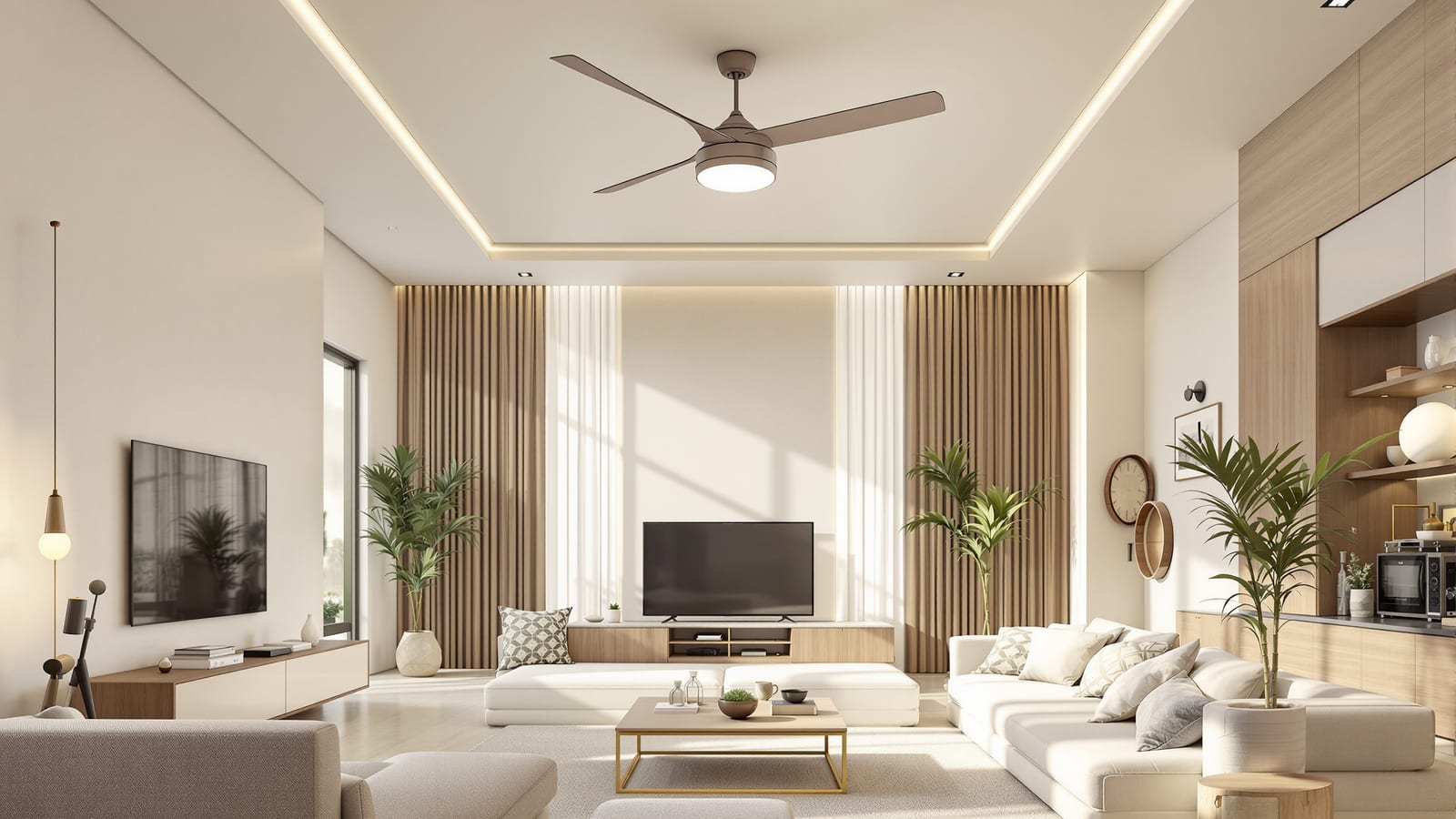
Smart Ceiling Fans in India: BLDC, Remote & Voice Control
The ceiling fan is the hardest-working appliance in an Indian home — running eight months a year, often all night. A smart BLDC fan cuts its power draw by two-thirds, adds a remote and app, and answers to Alexa and Google. Here is what actually matters when you buy one.
Walk into almost any Indian home and count the ceiling fans. Two, three, five — one in every room, often more than one in the hall. For eight months of the year they run for ten, twelve, sometimes eighteen hours a day; through the summer they run all night in the bedroom. No other appliance in the house works so hard for so long. And for decades every one of those fans was built around the same 1970s technology: a single-phase induction motor that quietly wastes power as heat every second it spins. The smart ceiling fan changes two things at once — it swaps that old motor for a modern BLDC one that sips a third of the electricity, and it adds a remote, an app, voice control and scheduling on top.
A ceiling fan is the one appliance you leave running for hours without thinking about it. That is exactly why upgrading it pays back faster than almost any other smart-home purchase in India — the savings compound every single hour.
This is a companion to our ultimate guide to smart homes in India. If you are thinking about the bigger picture of cutting bills, read it alongside our smart home energy management guide; for the wider comfort story of cooling an Indian home, see the smart HVAC and climate control guide.
The heart of the matter: BLDC vs induction
Before you worry about apps and voice, understand the motor — because that is where nearly all the value sits. A conventional ceiling fan uses an induction motor. It is cheap and reliable, but it draws roughly 70–80 watts even at full speed, and worse, at lower speeds it barely saves power because it wastes energy as heat in the windings. A BLDC (Brushless Direct Current) fan replaces this with an electronically commutated motor and a small driver circuit. The result: the same airflow for about 28–35 watts, and genuine proportional savings when you slow it down.
The airflow is not compromised. A good BLDC fan delivers 220–260 cubic metres per minute of air delivery — the same as, or better than, the induction fan it replaces. What you lose is only the waste heat. BLDC fans also start smoother, run quieter, hold a steadier speed when voltage dips (a real advantage in small towns and villages where the grid sags in the evening), and many keep spinning on an inverter for far longer because they draw so little.
| Feature | Induction fan | BLDC fan |
|---|---|---|
| Power at full speed | 70–80 W | 26–35 W |
| Power at low speed | ~45 W | ~6–10 W |
| Speed control | Regulator (wastes heat) | Electronic, proportional |
| Voltage-dip tolerance | Slows / hums | Holds speed |
| Inverter runtime | Short | 2–3x longer |
| Typical noise | Moderate hum | Very quiet |
| Price (India) | ₹1,200–₹2,500 | ₹2,800–₹6,500 |
| Smart features | Rare | Common |
What actually makes a fan "smart"
"Smart" is a word manufacturers stretch. Strictly, a BLDC fan with just a remote is efficient but not really connected. A genuinely smart fan usually stacks four or five of these layers:
- A BLDC motor — the efficiency foundation.
- A remote control — IR or RF, for speed, boost and off-timer without the wall regulator.
- Wi-Fi / IoT connectivity — so the fan appears in an app.
- An app — for control from your phone anywhere, plus firmware updates.
- Voice control — through Alexa or Google Assistant.
- Scheduling and sensors — timers, sleep-mode ramp-down, and on some models occupancy or temperature sensors.
Not every buyer needs all six. The honest order of value for most Indian homes is: BLDC motor first (this is where the money comes back), remote second (genuine daily convenience), then app and voice if you are building a wider connected home. Scheduling matters most in bedrooms and for people who forget to switch the fan off when they leave.
Smart fan or retrofit controller?
You have two roads to a controllable fan, and the right one depends on whether you are replacing the fan anyway.
Buy a smart BLDC fan if the existing fan is old, noisy or inefficient. You get the big energy saving plus the remote, app and voice in one purchase. This is the better long-term choice for a fan that runs all day.
Fit a retrofit smart controller if the fan is newish and you only want app or voice control without changing the fixture. A device like an inline Wi-Fi fan controller or a smart fan regulator (Wipro, Havells, Anchor and others sell these, roughly ₹1,200–₹3,000) sits behind the switchboard or in the canopy and adds connectivity to an ordinary induction fan. But note the trap: a retrofit controller on an induction fan gives you the smarts without the efficiency. You are still burning 75 watts. For a fan that runs a few hours a week this is fine; for a bedroom fan it is a false economy.
| Situation | Best choice | Why |
|---|---|---|
| Old induction fan, runs many hours | New smart BLDC fan | Efficiency + smarts together |
| Recent fan, want only voice/app | Retrofit smart controller | Cheaper, no fixture change |
| Rented home | Retrofit controller or plug | Take it with you when you leave |
| New construction / renovation | Smart BLDC fan | Wire once, done right |
If you rent, the retrofit route also keeps you flexible — see our thinking on that in the wider energy management guide.
IR vs RF vs Wi-Fi: how the fan listens
Three different signals reach a smart fan, and mixing them up leads to disappointment.
- IR (infrared) is line-of-sight, like an old TV remote. Cheap, but you must point it at the fan and it will not work from the next room. Fine as a basic remote, useless for automation.
- RF (radio frequency) passes through walls within a room's range. Most bundled fan remotes today are RF — you can control the fan from the bed without aiming. This is the sweet spot for everyday use.
- Wi-Fi connects the fan to your home router and the internet. This is what enables the app, remote control from outside the house, scheduling and voice assistants. It uses more standby power (a small but real 1–2 watts) and depends on your router being up.
Most true smart fans give you both an RF remote for instant local control and Wi-Fi for the app and voice. That combination is ideal: the remote works even if the internet is down, and Wi-Fi adds the clever features on top. A few premium models also speak the Matter standard for cross-ecosystem compatibility.
Integrating with Alexa and Google
Once a fan is on Wi-Fi and linked in its own app (Atomberg's app, Havells Sync, Crompton, and so on), you connect that app as a "skill" or "service" inside Alexa or Google Home. From then on you can say "Alexa, set the bedroom fan to speed three" or "Hey Google, turn off all fans." Grouping fans into rooms lets one command sweep the whole floor. If you are still choosing your voice ecosystem, our voice assistants for the smart home guide and the head-to-head in Alexa vs Google vs Apple in India will help. One caveat: Apple HomeKit support for Indian smart fans is still rare, so iPhone-first households should check compatibility carefully before buying.
The energy savings math
This is the part that turns a purchase into an investment. Take a single fan that runs an average of 12 hours a day across the year — conservative for a bedroom or hall in most of India.
| Induction (75 W) | BLDC (30 W) | |
|---|---|---|
| Hours per day | 12 | 12 |
| Units per day (kWh) | 0.90 | 0.36 |
| Units per year | 329 | 131 |
| Cost per year at ₹8/unit | ₹2,628 | ₹1,051 |
| Annual saving per fan | — | ₹1,577 |
Over a four-fan home the saving is roughly ₹5,000–₹6,000 a year, and BLDC fans typically carry a longer motor warranty. A ₹3,500 BLDC fan replacing an induction fan pays for itself in well under three years, and often inside two, after which the saving is pure. Run the numbers for your own tariff and usage with our smart home cost calculator. Note that BEE (Bureau of Energy Efficiency) now rates ceiling fans on a star scale based on their "service value" (air delivery per watt); a 5-star fan is the efficiency benchmark to look for on the box.
Noise, air delivery and the things buyers forget
Efficiency is not the only thing that matters at 2 a.m. Check three specs beyond wattage:
- Air delivery (CMM): aim for 220+ cubic metres per minute for a standard 1200 mm fan. Efficiency with weak airflow is a hollow saving.
- Noise: premium BLDC fans (Orient Aeroquiet, Crompton Silent Pro) are engineered for near-silent running — worth it in a bedroom.
- Sweep size: 1200 mm suits most rooms; larger halls need 1400 mm; small kitchens or balconies may take 900 mm.
Also confirm the fan handles India's voltage swings — good BLDC drivers work from about 140 V to 285 V, which matters wherever the grid is unstable.
Brands and prices in India
The Indian BLDC smart-fan market matured fast. A snapshot of popular models and street prices:
| Brand / model | Type | Approx. price | Notes |
|---|---|---|---|
| Atomberg Renesa / Studio+ | BLDC, RF remote, some Wi-Fi | ₹3,200–₹4,500 | Category pioneer, strong app on smart models |
| Havells Stealth / Efficiencia | BLDC, remote, Wi-Fi variants | ₹3,500–₹6,000 | Wide range, good build |
| Crompton Silent Pro / Energion | BLDC, remote | ₹3,000–₹5,500 | Silent Pro focuses on low noise |
| Orient Aeroquiet / Ecotech | BLDC, remote | ₹3,200–₹5,000 | Aeroquiet very quiet |
| Superfan Super X / V1 | BLDC, remote | ₹3,500–₹5,500 | Long-standing BLDC specialist |
Prices move with sales and capacity; the smart Wi-Fi versions sit at the top of each range, while the remote-only BLDC versions save you ₹500–₹1,000 if you do not need voice or app. For a full connected home, pair the fans with the wider planning in the ultimate smart home guide and the media side in our smart home entertainment guide.
The honest bottom line
If you buy only one smart upgrade for an Indian home, a BLDC ceiling fan for the room that runs longest is the highest-return choice — the saving is real, measurable and repeats every hour. Add the remote for daily comfort. Add Wi-Fi and voice only if you are building a connected home or genuinely want to say "turn off all fans" from the door. Skip the retrofit-controller-on-induction-fan combination for any fan that runs long hours; it gives you the gadget without the saving. Buy for airflow and quiet, not just wattage, and check the BEE star rating on the box before you pay.
References
- Bureau of Energy Efficiency — Star Rating for Ceiling Fans — official BEE star-rating scheme and criteria for ceiling fans in India.
- Bureau of Indian Standards — IS 374: Electric Ceiling Type Fans — the Indian standard governing ceiling-fan safety and performance.
- Atomberg — Smart BLDC Fan Range — manufacturer specifications, wattage and app/voice compatibility.
- Havells — Ceiling Fans — model range, BLDC options and smart-fan documentation.
- Crompton — Energion / Silent Pro Fans — efficiency and low-noise BLDC fan specifications.
- BEE — Standards & Labelling Programme — background on India's appliance efficiency labelling.
Export this guide
Related Guides — Deep-dive reading
BLDC Fans: The Efficient Upgrade to the Ceiling Fan
The quiet revolution in the most-used appliance in an Indian home — how a BLDC ceiling fan uses roughly half the power of an ordinary fan, runs cooler and quieter with remote and speed control, whether the higher price pays back, and what to check when buying.
Electrical & WiringSmart Geysers & Water Heaters in India: The Biggest Energy Saver in Your Home
The water heater is one of the largest single loads on an Indian electricity bill — and the easiest to tame. This guide covers what makes a geyser smart, why scheduling saves the most, the 16A smart-plug retrofit and its caveat, storage vs instant, BEE star ratings, hard-water descaling, safety, real energy-savings math, and brands with prices.
Smart HomeSmart Air Purifiers for Indian Homes: Beating PM2.5
Across Delhi-NCR winters and year-round urban haze, indoor air is often worse than the street. This guide explains what actually makes a purifier smart, how CADR and room sizing work, what HEPA and activated carbon really remove, honest running costs on filters and power, and which brands earn their price in Indian conditions.
Smart HomeRelated Tools — Try Free
Smart Home Cost Calculator
13 device categories across 5 ecosystems (Apple HomeKit, Alexa, Google Home, Mi, Wipro). Live floor-plan that lights up as you add devices, per-room and per-category breakdown.
Smart Home CalculatorSmart Curtain Compatibility Checker
Check whether a motorised curtain will work with Alexa, Google, Apple Home, SmartThings or Home Assistant — and what you need.
CheckerCross-Ventilation Analyzer
Estimate airflow and air changes per hour (ACH) from room size, window areas, layout, and local wind — with NBC 2016 Part 8 compliance check.
Ventilation Calculator