
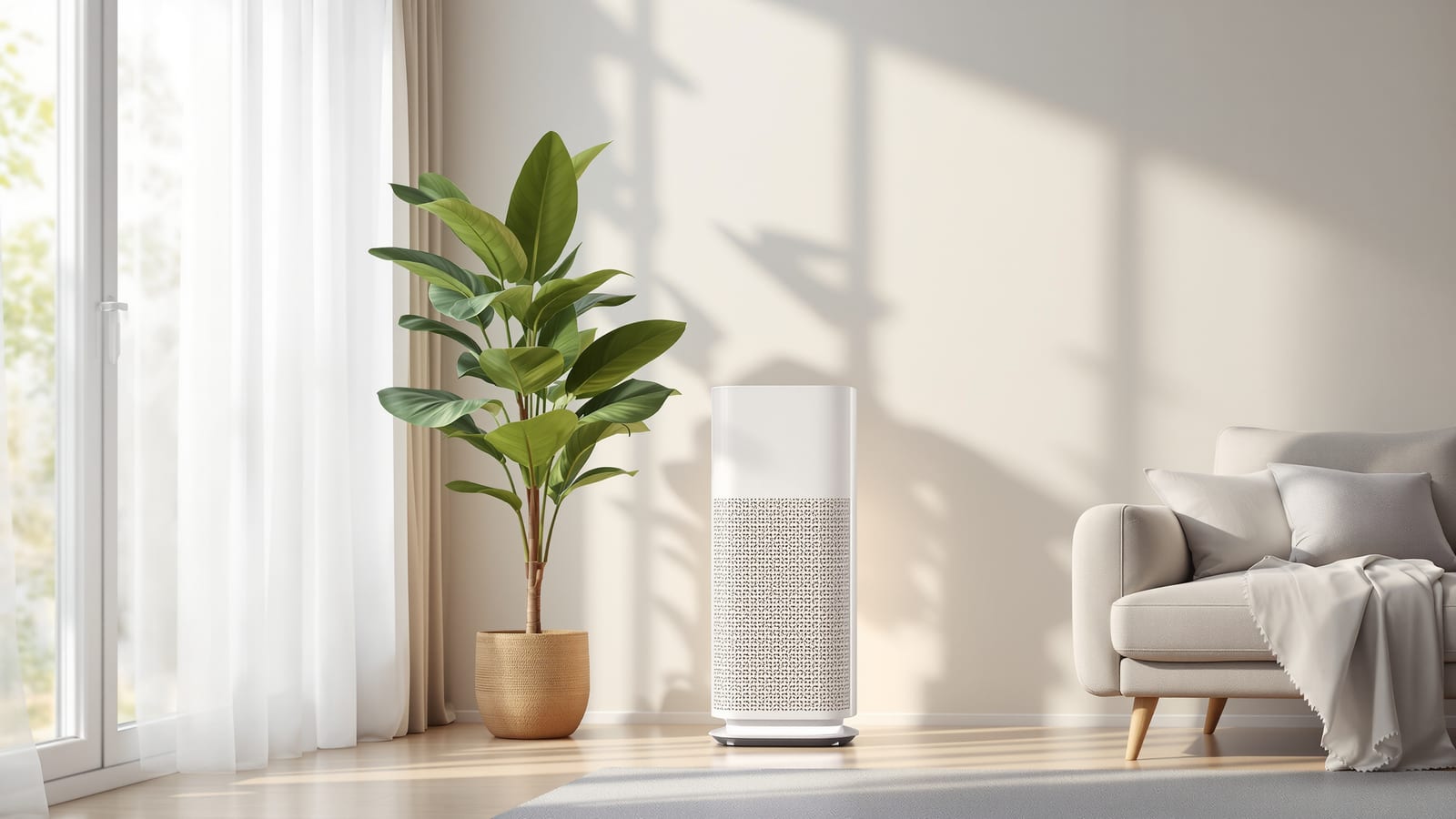
Smart Air Purifiers for Indian Homes: Beating PM2.5
Across Delhi-NCR winters and year-round urban haze, indoor air is often worse than the street. This guide explains what actually makes a purifier smart, how CADR and room sizing work, what HEPA and activated carbon really remove, honest running costs on filters and power, and which brands earn their price in Indian conditions.
Ask anyone in Delhi, Gurugram, Noida, Kanpur or Ghaziabad what winter smells like and the honest answer is smoke. Every October the Air Quality Index climbs past 300, 400, sometimes 500, and the fine particles that do the damage do not stop at the front door. Indoor PM2.5 in an unfiltered urban home often tracks 60 to 80 percent of the outdoor level, and cooking, incense and dust push it higher still. An air purifier is one of the few appliances that treats a genuine health problem rather than a comfort one, which is exactly why it deserves a clear-eyed guide rather than a marketing brochure.
This guide goes deep on smart air purifiers for Indian homes. We cover what actually makes a purifier "smart" versus what is just a Wi-Fi badge, how HEPA and activated carbon each work, the single most important number to size a machine (CADR) and how to match it to your room, what PM2.5, PM10 and VOC really mean, honest running costs on filters and electricity, when a household truly needs a purifier, and brands with real Indian prices. It sits alongside the smart HVAC and climate guide and the home health monitoring guide, and slots into the wider smart homes pillar guide. To budget the whole system, use the smart home cost calculator.
A purifier does not clean the air of a room once. It has to keep cleaning it, because the room keeps leaking dirty air back in. That is why size and airflow matter far more than any app feature on the box.
What actually makes an air purifier "smart"
Almost every mid-range purifier sold in India now carries a "smart" label, but the word covers a wide range of usefulness. Some features genuinely change how well the machine protects you; others are convenience. Here is the honest breakdown.
Auto mode driven by a real PM sensor is the feature that matters most. A laser particle sensor reads the PM2.5 in the room several times a minute and ramps fan speed up when the air worsens and down when it clears. Done well, this means the machine runs hard during your evening cooking or when someone opens a door on a bad-AQI night, and idles quietly otherwise, protecting you without you having to think about it. Done badly, on a cheap sensor, auto mode either never spins up or roars all night.
An on-device air-quality display with a live PM2.5 number and a colour ring turns an invisible problem into something you can see. Watching the number jump from 15 to 180 the moment you light a mosquito coil teaches a household more about its own air than any article can.
App control and scheduling let you pre-clean the bedroom before bedtime, check the reading from work, and set the machine to run harder during the 6 to 10 pm pollution peak. Voice control through Alexa or Google Assistant adds hands-free convenience. Filter-life alerts track the hours the fan has run and warn you before the filter is saturated, which in Indian conditions is genuinely useful because filters clog far faster here than the manuals assume.
| Smart feature | What it does | How much it matters in India |
|---|---|---|
| Auto mode on PM sensor | Ramps fan to real air quality | Essential — the core value |
| On-device AQI display | Shows live PM2.5 number | High — makes the invisible visible |
| App control and scheduling | Remote start, pre-clean, peak-hour boost | Medium-high |
| Voice control | Hands-free on or off | Nice to have |
| Filter-life alert | Warns before filter saturates | High — filters clog fast here |
| Wi-Fi with no auto mode | Just remote on and off | Low — a badge, not a benefit |
The takeaway: a purifier with a good sensor and honest auto mode but no app beats a Wi-Fi machine with no real sensor every time. Buy the sensing, not the badge.
HEPA and activated carbon: what each actually removes
Two different filters do two different jobs, and Indian air needs both.
A True HEPA filter (look for H13 grade) is a dense mat of fibres that traps 99.97 percent of particles at 0.3 microns — the hardest size to catch — and even more of the larger and smaller ones. This is what removes PM2.5, PM10, dust, pollen, smoke particles and much of the particulate that makes AQI numbers spike. The word "True" matters: some cheaper machines use "HEPA-type" or "HEPA-like" media that is not certified and lets far more through.
An activated carbon filter is a bed of porous carbon that adsorbs gases and odours — the volatile organic compounds (VOCs) from paint, furniture and cleaning products, plus cooking smells, smoke gases and the sharp odour of traffic. Carbon does nothing for particles, and HEPA does nothing for gases, so a purifier meant for Indian urban air should have both. The amount of carbon matters: a thin coated screen does little, while a thick granular bed measured in hundreds of grams actually holds odours for months.
Ignore the marketing add-ons unless the core two are strong. Ionisers can produce trace ozone and add little; "plasma", "photocatalytic" and UV stages are usually marketing gloss on top of the HEPA and carbon that do the real work. A machine that is honest about grams of carbon and H13 HEPA is worth more than one boasting seven stages.
| Pollutant | Measured as | Removed by | Common Indian source |
|---|---|---|---|
| Fine particles | PM2.5 | True HEPA | Vehicle exhaust, crop burning, smoke |
| Coarse particles | PM10 | True HEPA | Road dust, construction |
| Gases and odours | VOC / TVOC | Activated carbon | Paint, cooking, incense, traffic |
| Pollen and dust mites | Particulate | True HEPA | Seasonal, bedding |
| Cooking smells | Odour | Activated carbon | Kitchen |
CADR and room sizing: the number that actually matters
The single most important specification is CADR — Clean Air Delivery Rate — measured in cubic metres per hour (m³/h). It tells you how much clean air the machine actually produces, combining fan power and filter efficiency. A big filter behind a weak fan has a low CADR and cleans slowly; CADR is the honest measure of both together.
The goal is roughly five air changes per hour (ACH) for a room where someone with asthma or a young child sleeps, and at least three ACH for general use. To size it, take the room's floor area and ceiling height to get its volume, multiply by your target air changes, and match to a machine whose CADR meets or beats that. A rough shortcut that works for standard 3-metre ceilings: your CADR should be about ten to fifteen times the room's floor area in square metres for a healthy five air changes.
The most common Indian mistake is buying one mid-size purifier for a large open living-dining and expecting bedroom-grade air. It cannot happen: the CADR is too low for the volume, so the machine runs flat out and still only manages one or two air changes. Either buy a machine sized for the true volume or accept that the purifier protects one closed room well rather than the whole floor poorly. Closing the bedroom door and cleaning that one space to five air changes is far better protection than an under-sized unit fighting the whole flat.
Be sceptical of the "coverage area" printed on the box. Many brands quote the area at just two air changes per hour, which is fine for a lightly polluted city but nowhere near enough on a 400-AQI Delhi night. Halve the claimed coverage to get a realistic five-air-change figure.
Auto-purify: the sensor-to-action loop
A smart purifier is really a small control loop. A sensor reads the air, the controller compares it to a target, the fan acts, and the cleaner air feeds back to the sensor. Understanding the loop explains why sensor quality and placement decide how well the machine protects you.
Two practical lessons fall out of the loop. First, keep the machine in open air, not tucked behind a sofa or curtain, or the sensor reads a stale pocket and the fan never ramps. Second, a purifier only cleans the room it is in — the loop cannot reach through a closed door, which is exactly why bedroom protection means a bedroom machine. Pair it with a standalone AQI sensor if you want an independent second reading, and let it work with your smart HVAC setup so the AC recirculates rather than pulling in outside air on bad nights.
Running costs: filters and power, honestly
The purchase price is only the start. In Indian conditions the running cost is real and worth planning for.
Power is modest. A typical purifier draws 30 to 60 watts on medium and up to 90 on turbo. Running one for the polluted eight-hour night for the four worst months, plus lighter year-round use, adds perhaps ₹150 to ₹350 a month to the bill — genuinely small.
Filters are the real cost, and India is harsh on them. Because our air is so loaded, a HEPA filter rated for a year in a clean European city often clogs in six to eight months here, and the pre-filter needs vacuuming every few weeks. A replacement HEPA-plus-carbon set costs anywhere from ₹1,500 for budget machines to ₹6,000 or more for premium ones. Over three years the filters can quietly cost as much as the machine did.
| Cost item | Typical range | Notes |
|---|---|---|
| Electricity | ₹150–₹350 per month (season) | 30–90 W depending on speed |
| HEPA + carbon replacement | ₹1,500–₹6,000 per set | Every 6–12 months in Indian air |
| Pre-filter | Washable on most | Vacuum every 2–4 weeks |
| 3-year filter total | ₹4,500–₹18,000 | Often near the purchase price |
Two honest tips cut this. Wash or vacuum the pre-filter regularly so coarse dust never reaches the expensive HEPA, extending its life. And be wary of machines with proprietary, hard-to-find or overpriced filters — check replacement price and availability before you buy, because a cheap machine with expensive filters is a bad deal. Model the full system spend in the smart home cost calculator, and treat purifier running cost as part of your home energy management plan.
When you actually need one
An air purifier is not decoration and not universally necessary. Be honest about your situation.
You have a strong case if anyone in the home has asthma, allergies, COPD or frequent respiratory infection; if there is a baby, young child or elderly parent; if you live in the Indo-Gangetic plain where winter AQI routinely exceeds 200; or if your flat faces a busy road, construction or open burning. In these homes a purifier is a health tool, and a bedroom unit running through the night is the highest-value place to start.
The case is weaker if you live in a coastal or hill city with generally good AQI, keep windows open to fresh air most of the year, and have no vulnerable family members. There, opening windows on good-air days, keeping the kitchen well-ventilated, and running a purifier only on the occasional bad-air day may be all you need. Do not let AQI panic sell you three machines you will not maintain — one well-sized, well-filtered unit in the bedroom beats a houseful of neglected ones.
Brands and prices in India
| Brand | Typical models | Price band | Notes |
|---|---|---|---|
| Xiaomi / Mi | Smart Air Purifier 4 series | ₹9,000–₹18,000 | Strong value, good app, real sensor, cheap filters |
| Philips | 800 to 3000 series | ₹10,000–₹40,000 | Reliable, high CADR options, wide service |
| Coway | Storm, Sleek, Airmega | ₹15,000–₹45,000 | Excellent filtration, quiet, premium build |
| Honeywell | Air Touch series | ₹9,000–₹30,000 | Widely available, solid mid-market |
| Dyson | Purifier Cool, Hot+Cool | ₹35,000–₹65,000 | Fan and purifier in one, strong app, pricey filters |
| Atomberg | Smart purifier range | ₹9,000–₹18,000 | Indian brand, energy-efficient, growing lineup |
Prices move with CADR, filter size and features, so treat these as bands. Two honest routes. If your budget is tight and your need is real, a well-reviewed Xiaomi, Atomberg or Honeywell unit sized correctly for one bedroom captures nearly all the health benefit for under ₹15,000. If you want premium filtration, quiet running and a machine that doubles as a fan for the whole living room, Coway, Philips and Dyson earn their price — provided you size the CADR for the true room volume and budget for the filters. Either way, buy for CADR and honest filtration first, and let the smart features be the bonus, not the reason. From here, extend clean-air thinking across the home with the home health monitoring guide and the smart HVAC and climate guide.
References
- Central Pollution Control Board — National Air Quality Index and city data
- World Health Organization — Ambient air pollution and health guidelines
- Bureau of Energy Efficiency — appliance energy efficiency programme
- Bureau of Indian Standards — air purifier and filtration standards
- Philips India — air purifier range and CADR specifications
- Coway India — air purifier lineup and filtration technology
Export this guide
Related Guides — Deep-dive reading
Smart Ceiling Fans in India: BLDC, Remote & Voice Control
The ceiling fan is the hardest-working appliance in an Indian home — running eight months a year, often all night. A smart BLDC fan cuts its power draw by two-thirds, adds a remote and app, and answers to Alexa and Google. Here is what actually matters when you buy one.
Smart HomeSmart Kitchen Guide for Indian Homes: Appliances Worth It (and Not)
An honest, device-by-device walk through smart chimneys, refrigerators, ovens, dishwashers, purifiers, plugs, gas and leak sensors and voice control — with real Indian brands, rupee costs and a clear verdict on what is genuinely useful versus a marketing gimmick.
Smart HomeSecurity for People Living Alone in India (2026): Calm, Practical Habits When There Is No Second Person to Notice
Living alone is an ordinary and growing part of Indian life - the student in a new city, the working single, the elder whose children are abroad, the person after a separation. It does not call for fear. It calls for a few deliberate habits, because there is no second person in the home to notice trouble, raise the alarm, or catch an accident. This is calm self-reliance, layer by layer.
SecurityRelated Tools — Try Free
Cross-Ventilation Analyzer
Estimate airflow and air changes per hour (ACH) from room size, window areas, layout, and local wind — with NBC 2016 Part 8 compliance check.
Ventilation CalculatorApartment Furniture Size Chart
Standard furniture dimensions for Indian apartments — sofas, beds, tables, dining, storage.
Reference ChartFull-Room BOQ — Living, Bedroom, Kitchen, Bath
Room-wise BOQ across living, bedrooms, kitchen, utility, and bathrooms with line-item pricing.
Full-Room BOQ