
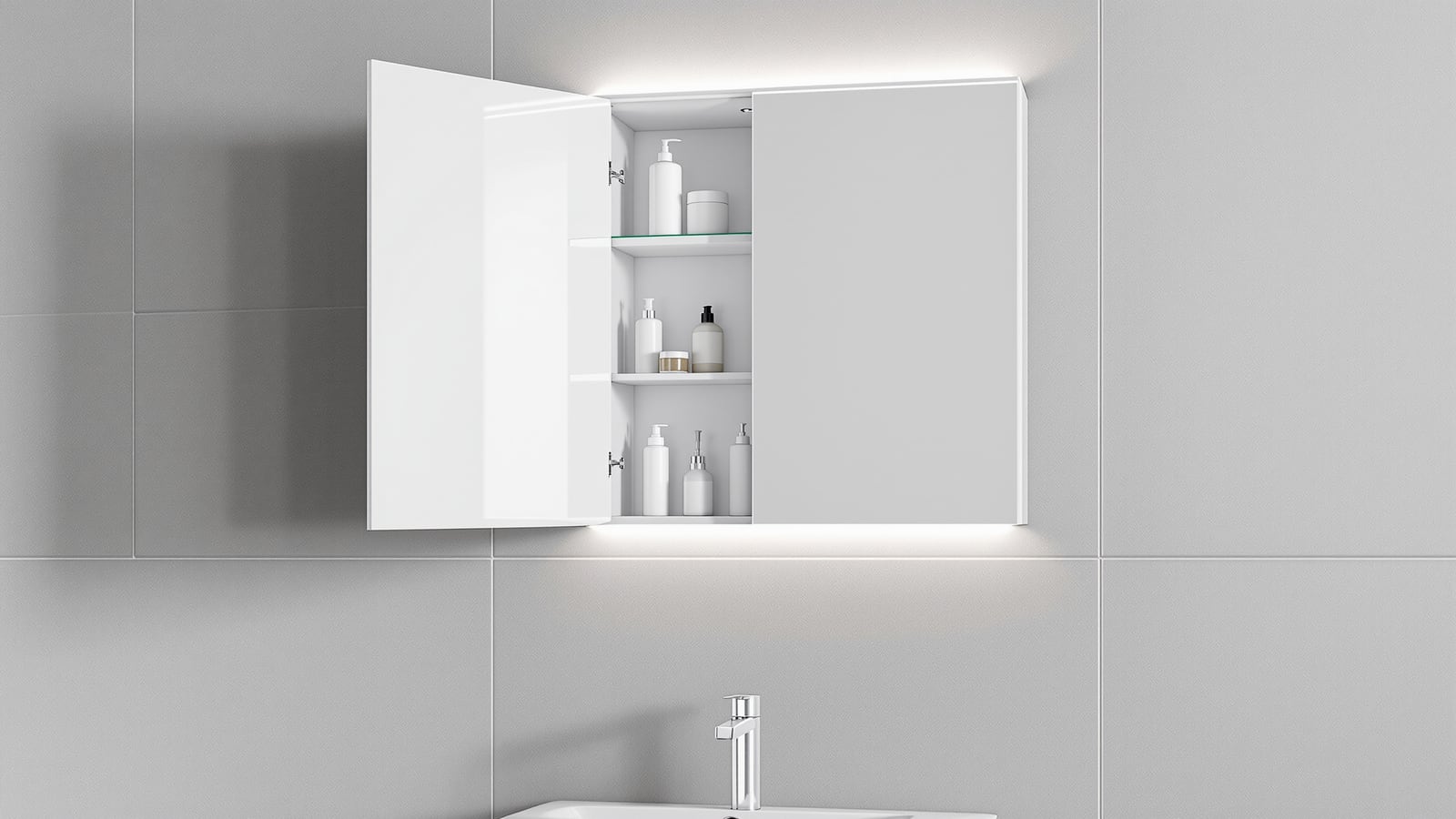
Bathroom Mirror Cabinet India: Medicine Cabinets, LED, Sizes & Cost (2026)
The mirror-fronted storage box above the basin that hides the messy shelf — surface-mounted vs recessed, single vs double door, LED and demister options, steam-proof materials, correct mounting height, lockable medicine storage, and honest rupee ranges.
A mirror cabinet is the hardest-working square metre in any bathroom: it is the mirror you use every morning and, behind that mirror, the storage that swallows the toothpaste, medicines, razors and half-used tubes that otherwise colonise the basin rim. Also sold as a "medicine cabinet", it does in one fitting what a bare mirror plus an open shelf do in two — and it hides the clutter instead of displaying it. This guide is India-first and practical: how to choose surface-mounted or recessed, single or double door, whether LED and a demister are worth it, which materials survive our steam and hard water, the right height to hang it, and what it all costs in 2026.
Read it alongside the bathroom vanity guide for India, which plans the storage below the basin, so cabinet and vanity work as a pair. If you want a purely reflective, back-lit surface with no box behind it, compare an LED bathroom mirror; and if you would rather show a few things than hide everything, weigh bathroom open shelving for the display pieces while the cabinet takes the rest.
A mirror cabinet is the one piece of storage that costs you no floor space and no wall space you weren't already giving to the mirror. That is why, in a small Indian bathroom, it is almost always the highest-value fitting rupee-for-rupee.
Mirror cabinet or medicine cabinet — same box, two jobs
The terms describe the same product: a shallow cupboard with a mirrored door (or doors) that hangs above the basin. "Mirror cabinet" emphasises the reflective front; "medicine cabinet" emphasises what goes inside. In practice you want both jobs from one unit:
- The mirror job — a full-height reflective front at the right height for shaving, grooming and make-up, ideally lit.
- The storage job — three to four adjustable shelves behind the door for daily toiletries, plus, ideally, one shelf you can lock for medicines and blades away from children.
Because the depth sits mostly inside or on the wall rather than projecting into the room, the cabinet is the natural answer to India's small, wet bathrooms where a floor cabinet would be in the splash zone.
Surface-mounted vs recessed — the first real decision
Every mirror cabinet is either bolted onto the finished wall (surface-mounted) or sunk into a niche in the wall (recessed). This choice is driven by your wall build-up, not by taste alone.
- Surface-mounted. The cabinet box hangs on the tile face like a shallow cupboard, projecting 100–150 mm into the room. It fits any wall — brick, block, RCC or drywall — and is the safe retrofit choice because you never open up the wall. The trade-off is that the box is visible from the side and can feel bulky in a narrow bathroom.
- Recessed (built-in). The box sits inside a pocket cut into the masonry, so only the mirror door is flush with the tiles — the sleekest look, and it reclaims the projection depth. But it demands a non-load-bearing wall thick enough to lose 100–120 mm without hitting a structural member, a plumbing riser, or the concealed cistern of a wall-hung WC. It must be planned before plastering and tiling, and the pocket must be waterproofed.
| Factor | Surface-mounted | Recessed |
|---|---|---|
| Wall needed | Any wall | Thick non-load-bearing wall only |
| Plan when | Any time — retrofit friendly | Before plastering / tiling |
| Projection into room | 100–150 mm | Flush — none |
| Storage depth | Full box depth | Limited by wall thickness |
| Look | Cupboard on wall | Seamless, built-in |
| Risk | Low | Hitting pipes / studs / cistern |
| Relative cost | Lower | Higher (carpentry + waterproofing) |
Single, double or triple door — and hiding the messy shelf
Door count follows cabinet width and how you use the mirror.
- Single door. Widths around 400–500 mm, one hinged mirrored door. Cheapest and fine for a powder room or a slim wall, but the mirror is narrow and you cannot see two faces at once.
- Double door. The Indian workhorse at 600–800 mm wide. Two doors give a broad mirror, and — a real bonus — an open door angled against a second mirror lets you see the side and back of your head.
- Triple / bi-fold. Wide vanities (900 mm+) and his-and-hers basins. A three-panel front can give a near-3D view for grooming.
The point of any of them is the same: the mirror hides the mess. Everything that used to sit on the basin rim — tubes, bottles, strips of tablets — goes behind the door and disappears the moment you close it. Keep the daily-use items on the middle shelf at eye level, bulk refills up high, and reserve one shelf, ideally a lockable one, for medicines and razor blades so a child cannot reach them. A small mirror-backed interior and a couple of shallow bins turn the cabinet from a jumble into real organisation.
LED lighting and the demister — worth it in India?
The two upgrades that separate a basic cabinet from a good one are integrated lighting and a demister.
- LED lighting. Front-of-mirror or edge-lit LEDs throw shadow-free light straight onto your face — far better for shaving and make-up than a ceiling light that back-lights you. Choose a neutral 4000K tone for true skin colour; warm 2700K flatters but distorts. Look for an IP-rated driver and, given India's supply, a unit that simply switches on and off cleanly through voltage dips. Sensor or touch switches are common but the switch and any socket must sit outside the wet zone and be on an RCD/ELCB-protected circuit — see the smart bathroom guide for wiring the extras safely.
- Demister (anti-fog) pad. A thin heating film bonded behind the mirror keeps a patch clear of condensation after a hot shower — genuinely useful in humid coastal and monsoon conditions, and in closed bathrooms with poor ventilation. It draws little power but does need a wired supply.
- Extras. Some units add a shaver socket, a magnifying spot mirror, or a USB point. Each is a convenience, but each is also another electrical item in a wet room — insist every one is properly earthed and RCD-protected under IS 732.
| Feature | What it does | Worth it when |
|---|---|---|
| LED front/edge light | Shadow-free face lighting | Grooming, make-up, dim bathrooms |
| Demister pad | Keeps mirror clear of fog | Humid/coastal, poor ventilation |
| Sensor / touch switch | Hands-free on-off | Convenience — needs safe wiring |
| Magnifier spot | Close-up detail | Shaving, contact lenses, brows |
| Shaver socket / USB | Charge on the wall | Only if RCD-protected |
Materials that survive steam and hard water
A bathroom cabinet lives in a warm, wet, splashing environment with hard water and a health-faucet jet nearby. The carcass material decides whether it lasts five years or fifteen.
- Anodised / powder-coated aluminium. The best all-round choice for India — rustproof, light, and unbothered by steam. Slim profiles suit modern bathrooms and it shrugs off splashes.
- 304 stainless steel. Premium and effectively corrosion-proof; heavier and dearer, but a lifetime fitting.
- Glass with metal frame / frameless. Toughened glass shelves inside an aluminium or steel box look clean and are easy to wipe.
- Marine-grade (BWR/BWP) plywood or WPC. If you want a warm, joinery-matched cabinet to tie into a bathroom vanity, insist on boiling-water-resistant ply or WPC with fully sealed edges and a laminate or PU finish. Ordinary MDF or commercial ply will swell and delaminate.
- Avoid plain MDF, particle board, and mild steel with only paint — all fail fast in a wet Indian bathroom.
Whatever the carcass, look for a copper-free silvered mirror (or a modern equivalent) so the reflective layer does not "black-edge" and corrode where water tracks in — a hard-water problem you will see on cheap mirrors within a couple of monsoons.
Sizes, mounting height and clearances
Sizing is about matching the cabinet to the basin below and the eyes in front of it.
- Width: roughly match or sit just inside the vanity/basin width — 450 mm for a single, 600–800 mm for a double, 900 mm+ for wide vanities.
- Height of unit: 600–900 mm tall is common; taller gives more shelves.
- Depth: 100–150 mm — deep enough for bottles, shallow enough not to hit your head.
- Mounting height: centre the mirror on the users' eye line. As a rule, set the top of the cabinet around 1900–2000 mm and the bottom clear of the basin/tap by at least 250–300 mm so splashing and the spout do not foul the door. Practically the cabinet body lands in the 1300–1900 mm off-FFL band, with the mirror centred near 1500–1650 mm.
- Lighting height: if the cabinet is LED, that height doubles as your task light — another reason to centre it on the face, not the wall.
Cost in India (2026)
| Item | Typical India range (2026) | Note |
|---|---|---|
| Basic single-door mirror cabinet | ₹2,500–₹6,000 | Aluminium/PVC, no light |
| Double-door mirror cabinet | ₹5,000–₹14,000 | 600–800 mm, aluminium |
| LED mirror cabinet | ₹9,000–₹28,000 | With edge/front LED + switch |
| LED + demister + sensor | ₹18,000–₹45,000+ | Premium feature set |
| Recessed / built-in (carpentry) | ₹12,000–₹40,000+ | Niche, waterproofing, custom box |
| Custom BWP ply / WPC to match vanity | ₹8,000–₹30,000+ | Joinery-matched, sealed edges |
| Installation labour | ₹800–₹2,500 | More for recessed / electrical |
Prices are brand-neutral; Jaquar, Hindware, Cera and Kohler sit at the branded end, while local aluminium fabricators cover the budget end.
Buying and installation checklist
- Decide surface-mounted or recessed early — recessed must be planned before tiling and clear of pipes, studs and any WC cistern.
- Choose a rustproof carcass (anodised aluminium, 304 steel, or sealed BWP ply/WPC) — never plain MDF.
- Size the width to the basin; keep the door 250–300 mm clear of the tap and splashing.
- Centre the mirror on eye height (~1500–1650 mm); top around 1900–2000 mm off FFL.
- For LED/demister/sensor units, insist on an RCD/ELCB-protected, earthed circuit with switches outside the wet zone (IS 732).
- Fix into solid masonry with proper anchors, or a backer in drywall — the loaded cabinet plus contents is heavy.
- Keep one lockable shelf for medicines and blades if there are children in the home.
- Specify a copper-free silvered mirror to resist hard-water edge corrosion.
References
- National Building Code of India (NBC 2016) — Part 8 (Building Services) and Part 9 (Plumbing services), for bathroom fittings, ventilation and clearances.
- IS 732 — Code of practice for electrical wiring installations, governing RCD/ELCB protection and earthing for LED, demister and socket-fitted cabinets in wet areas.
- IS 3548 — Code of practice for glazing, and mirror/silvered-glass quality guidance for reflective surfaces.
- IS 2556 — Vitreous sanitary appliances, for the basin the cabinet is mounted above and its rim height reference.
- Manufacturer fixing and electrical instructions (Jaquar, Hindware, Cera, Kohler as examples) — follow the specified anchor type, load rating and IP-rated wiring for each unit.
Export this guide
Related Guides — Deep-dive reading
LED Bathroom Mirror India: Backlit vs Front-Lit, Colour Temperature, Cost & The Point Behind the Glass
A practical India-first guide to LED and backlit bathroom mirrors — integrated shadow-free face lighting, 2700K-6500K colour temperature and tunable white, halo backlight versus sandblasted front strips, plus the concealed electrical point, IP rating, demister and driver access you must plan behind the mirror before you tile.
BathroomsSmart Bathroom Mirror India: Touch Display, Voice, Defogger, Cost & Is It Worth It
A practical India-first guide to smart bathroom mirrors — the embedded touch display showing time, weather and news, the Bluetooth speaker, voice assistant, mood-lighting scenes and defogger — plus the power and optional data point behind the glass, the IP and electrical safety it demands, how hard water and monsoon humidity decide whether it lasts, and whether it is really worth the money over a good LED mirror.
BathroomsBathroom Mirror India: Plain vs LED vs Backlit vs Smart, Size, Height & Cost (2026)
The complete India-first guide to bathroom mirrors — plain, LED, backlit, smart, anti-fog and magnifying types; the right size and mounting height over a basin; copper-free silvered glass that resists black-edge corrosion in humid bathrooms; fixing to tile, lighting a mirror the right way, demister pads and rupee costs.
BathroomsRelated Tools — Try Free
Electrical Safety & Load Audit
Home electrical audit — 10 categories, 65+ checkpoints across earthing, RCCB, MCB, wiring, switchboards, appliance circuits, DG/inverter backup.
Safety AuditAluminium Door Cost Calculator
Estimate an aluminium door cost by opening size, profile grade, finish, glazing and type, with fitting and GST.
Door CalculatorDoor Material Comparison Tool
Compare 2–4 door materials on cost, durability, maintenance, security and moisture resistance.
Comparison Tool