
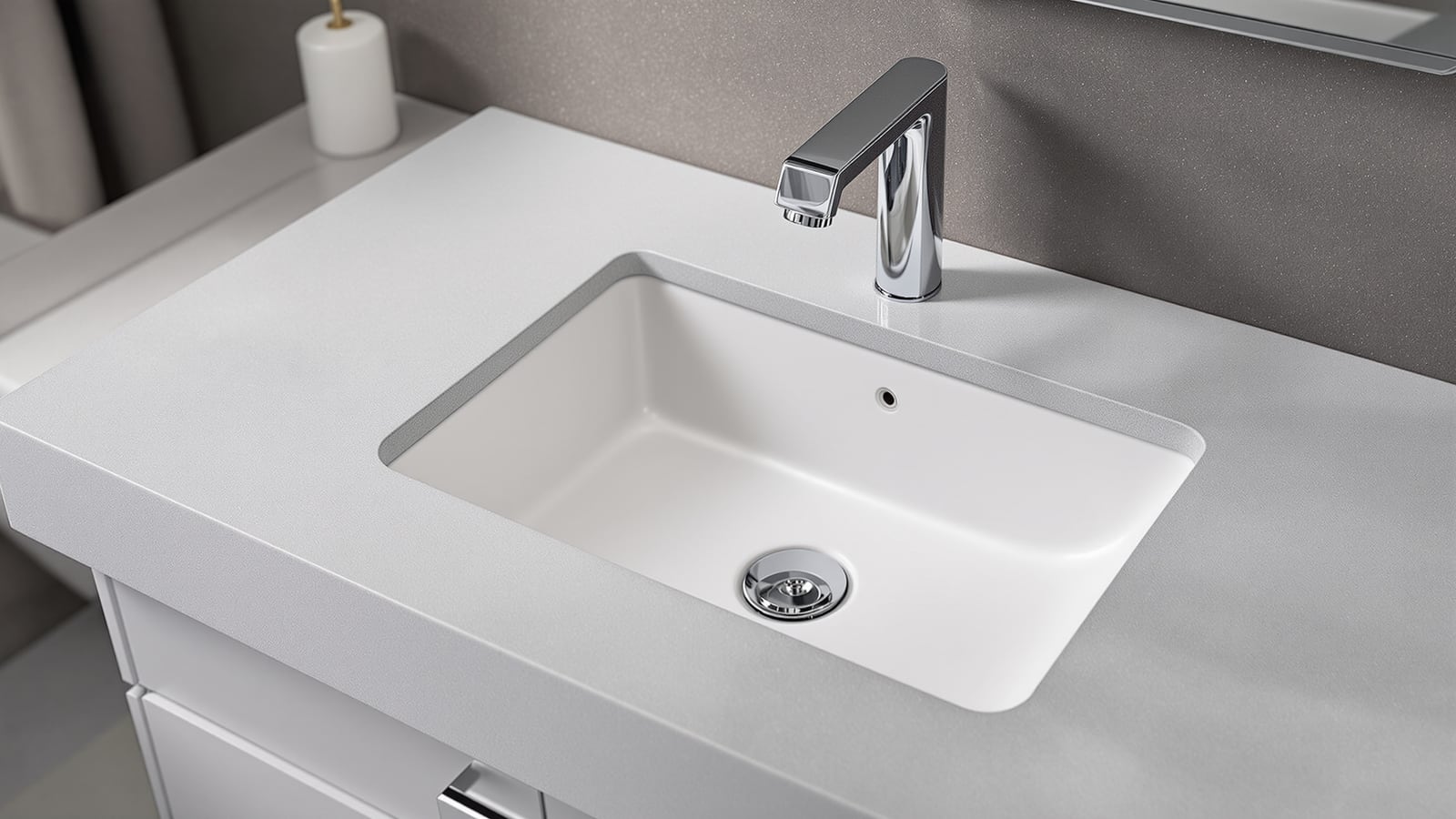
Under Counter Wash Basin India: Undermount Basins, Cut-outs & Sealing
A practical, India-first guide to under-counter (undermount) wash basins fixed below a granite or quartz vanity top — the clean wipe-down counter, the deck-mounted tap, the cut-out and rim seal that keeps water out, and honest ₹ costs versus a countertop basin.
An under-counter basin is the quiet luxury of a well-made vanity. Instead of a bowl perched on top of the counter, the basin is fixed underneath the stone, so the vanity top reads as one continuous surface with a hole in it — and you can sweep water, toothpaste and hard-water splash straight into the bowl with a single wipe. There is no rim to catch grime, no join to grow black mould, no ceramic foot to scrub around. For an Indian bathroom, where hard water and a busy family counter are the daily reality, that wipe-down cleanliness is the single strongest reason to choose an undermount over a fashionable countertop bowl.
But the look only works if the fabrication is right. An under-counter basin lives or dies on the counter it is cut into, the way the cut-out edge is finished, and the seal at the rim where the ceramic meets stone. Get those wrong and you get a rocking basin, a dripping cabinet and a stained edge within a season. This is a materials-and-components guide in the Studio Matrx bathroom hub. Read it alongside the bathroom wash basin guide for India for the full picture of basin types; the companion countertop basin guide for the vessel-bowl alternative that sits on top; the quartz vanity top guide and bathroom stone cladding guide for the surfaces this basin fixes into; and the master bathroom design guide for how a twin-vanity undermount scheme fits a premium room.
An under-counter basin is a fabrication decision as much as a fixture choice. The bowl is the cheap part; the stone cut-out, the sealed rim and the support clips are what you are actually buying.
What "under counter" actually means
An under-counter (or undermount) basin is a bowl mounted to the underside of a solid vanity top so that the top's material — granite, quartz, marble or solid surface — forms the visible deck around and up to the water. The tap does not sit on the basin; it is deck-mounted on the counter behind the bowl, or wall-mounted above it. This is the opposite of a countertop (vessel) basin, which sits fully on top of the counter like a bowl on a table.
Three edge treatments exist where the ceramic meets the stone, and they define the look and the cleanability:
- Negative reveal — the stone overhangs the bowl by 3–6 mm. Cleanest wipe, but a small ceramic lip is left exposed to catch grime; hardest to fabricate.
- Positive reveal — the ceramic rim projects past the stone cut. Easiest to seal but leaves a ridge you have to wipe around.
- Flush (zero reveal) — stone and ceramic finish in the same plane. The premium look, and the fussiest to cut, so it costs the most.
For most Indian homes a small negative reveal is the sweet spot: it keeps the wipe-into-the-bowl advantage and is forgiving of the millimetre tolerances of a hand-finished ceramic bowl.
Under-counter vs countertop basin — the honest comparison
The two are not just styles; they behave differently in daily use, and the choice should follow how the bathroom is actually used.
| Factor | Under-counter (undermount) | Countertop (vessel) |
|---|---|---|
| Counter cleaning | Best — wipe straight into the bowl, no rim | Poorer — must clean around a raised bowl foot |
| Usable counter space | Full deck area usable | Bowl occupies the deck |
| Tap | Deck-mounted or wall-mounted | Tall pillar tap or wall spout needed |
| Fabrication cost | Higher — precise cut-out + support | Lower — simple hole for the drain |
| Replacement / swap | Harder — bonded under stone | Easy — lift the bowl off |
| Water on the floor | Splash contained low in the bowl | Higher splash from a raised bowl |
| Hard-water scale | Less visible, easy to wipe | Shows on the exposed bowl exterior |
| Look | Clean, seamless, understated | Statement, sculptural, boutique |
- Choose undermount for a family bathroom, a busy master, or anywhere the counter earns its keep and gets wiped daily. It is the low-maintenance choice.
- Choose a countertop bowl for a powder room or guest bath where drama beats daily practicality — see the countertop basin guide.
Basin, counter and tap: getting the combination right
An under-counter basin is only ever half the assembly. The other half is the top and the tap, and they must be specified together.
- Basin material. Vitreous china / ceramic to IS 2556 is the workhorse — dense, non-porous, easy to clean, and available from every Indian sanitaryware brand. Stainless steel and stone-composite undermount bowls exist but are niche in bathrooms.
- Counter material. Granite is the default in India — dense, cheap per sq ft, and very tolerant of water and a deck tap's constant splash. Engineered quartz gives a uniform, low-porosity, near-stain-proof top (read the quartz vanity top guide). Marble looks beautiful but etches with acidic cleaners and needs sealing. Solid surface (acrylic composite) allows a seamless, glued-in undermount with no visible joint at all — the easiest to keep hygienic.
- Counter thickness. 18–20 mm stone is standard; a mitred edge can fake a 40 mm chunky look. The thicker the deck, the deeper the tap hole and the more the basin's clips must reach.
- The tap. A deck-mounted single-lever mixer or 3-hole basin mixer sits in a drilled hole on the counter behind the bowl. Confirm the spout reach and height land water into the bowl, not onto the rim, and leave 40–50 mm behind the bowl for the tap body. A wall-mounted spout keeps the deck completely clear — the cleanest look of all — but must be roughed-in during plumbing, so decide early.
The cut-out, the support and the seal
This is the part a plumber cannot improvise on site. The cut-out and the fixing are fabricated by the stone/quartz workshop, and the sealing is the difference between a dry cabinet and a rotting one.
The cut-out. The bowl comes with a paper or acrylic template. The fabricator traces the internal outline onto the underside of the stone, then wet-cuts and polishes the exposed edge — the raw edge of a granite or quartz cut-out will show through the water, so it must be ground and polished, not left rough. On a negative reveal the cut is a few millimetres inside the bowl line so the stone oversails; on a flush detail it follows the bowl exactly.
The support. The bowl must never hang on the sealant. Its weight — a full ceramic basin plus water can be 15–25 kg — is carried by mechanical support: undermount clips and threaded rods anchored into the underside of the stone, a plywood or metal cradle, or a batten frame inside the vanity carcass. Solid-surface tops are the exception: the bowl is chemically welded to the underside and the joint disappears.
The seal. A continuous bead of neutral-cure (non-acetic) silicone sealant runs the full rim between ceramic and stone. Acetic ("vinegar smell") silicone can corrode fittings and feeds mould; use neutral-cure sanitary silicone with a fungicide. Tool the bead smooth, and re-seal every few years — a hard, cracked or lifting bead is the number-one route for water to creep behind the bowl and into the cabinet.
| Fabrication check | Why it matters |
|---|---|
| Cut-out edge ground & polished | Raw stone edge stains and looks unfinished through the water |
| Mechanical clips / cradle fitted | Sealant must never carry the bowl's weight |
| Neutral-cure sanitary silicone | Acetic silicone corrodes brass and grows mould |
| Fall to the waste checked | Standing water at the rim breeds scale and stain |
| Overhang consistent all round | Uneven reveal reads as a fabrication defect |
Sealing against water ingress — the failure most people meet
Because the rim seal is horizontal and constantly wetted, it is the weak point of every under-counter installation. Water that gets past it does not evaporate — it wicks into the chipboard or ply carcass and swells, delaminates and smells within months.
- Seal the cut-out edge itself. On natural stone and especially marble, brush a penetrating sealer onto the raw polished cut edge before the bowl is fitted, so the exposed granite/quartz around the water does not drink it in.
- Choose a moisture-proof carcass. Under-counter basins belong on BWR/BWP marine-grade ply or a WPC/PVC-board vanity, never bare MDF. Read how a wall-hung vanity keeps the cabinet off a wet floor.
- Ventilate the cabinet. A closed cabinet under a basin traps humidity; a couple of vents or a louvred door lets it dry.
- Watch the tap holes too. The deck-mounted tap's drilled hole is a second ingress point — bed the tap base and any escutcheon on silicone so splash cannot run down the thread into the cabinet.
Ninety per cent of under-counter basin problems are water in the cabinet, not the bowl. Marine-ply carcass, neutral silicone at the rim, sealed stone edge, ventilated box — do those four and the basin outlives the bathroom.
What it costs in India
Budget the assembly, not just the bowl. The basin is often the smallest line item.
| Item | Indicative ₹ range |
|---|---|
| Ceramic under-counter basin (mid-market brand) | ₹2,500–8,000 |
| Premium / designer undermount bowl | ₹8,000–25,000+ |
| Granite vanity top (supplied + polished) | ₹250–700 / sq ft |
| Engineered quartz top | ₹450–1,200 / sq ft |
| Undermount cut-out, edge polish & clip fixing | ₹1,500–4,000 per bowl |
| Deck-mounted single-lever basin mixer | ₹3,000–15,000+ |
| Neutral-cure silicone + marine-ply carcass | included in vanity cost |
The fabrication surcharge — the cut-out, the polished internal edge and the support clips — is what separates an undermount from a cheaper countertop bowl. It is money well spent: it buys the seamless wipe-down surface that is the whole point of going under-counter.
Living with it: hard water and daily care
- Squeegee or wipe the deck dry after use; standing hard-water droplets on stone leave chalky scale that dulls a polished granite or marble edge.
- Use pH-neutral cleaner on marble and quartz — never acidic descalers, CIF or lemon on stone, which etch marble and can haze some quartz.
- Re-tool the silicone bead every 2–3 years, or sooner if it lifts, discolours or grows a black line — that black line is mould in a failing seal.
- Clear the pop-up and bottle trap periodically; a slow-draining undermount leaves water pooling at the rim exactly where scale forms.
- Check the cabinet floor twice a year for any damp smell or swelling — the earliest sign of a rim-seal or tap-hole leak, caught before it wrecks the carcass.
References
- NBC 2016 (National Building Code of India) — Part 9 Plumbing Services; sanitary appliances, fixture setting-out and water-supply provisions.
- IS 2556 (Vitreous sanitary appliances / wash basins) — specification for ceramic wash basins including under-counter types.
- IS 2963 (Copper alloy fittings) and IS 8931 (basin mixers/faucets) — deck-mounted tap and waste fitting standards.
- IS 1172 (Basic requirements for water supply, drainage and sanitation) — fixture provision and drainage practice.
- CPHEEO Manual on Water Supply and Sanitation / CPWD Specifications — sanitary appliance fixing and vanity fabrication schedules.
- BIS product certification — confirm sanitaryware and faucets carry the relevant IS marking.
Export this guide
Related Guides — Deep-dive reading
How to Choose a Wash Basin in India: Mount Type, Size, Tap Holes & Budget (2026 Buyer's Guide)
A buyer's decision guide to picking the right wash basin — matching the mount type to your vanity and space, sizing it to the room, getting the tap-hole config right for your faucet, judging material and durability, checking what's in the box, good/better/best rupee tiers, the IS 2556 vitreous-china mark, and how to spot seconds, hairline cracks and warranty traps.
BathroomsBathroom Vanity India: Floor-Standing vs Wall-Hung Units, Materials & Cost
The complete India-first guide to bathroom vanity units — floor-standing versus wall-hung (floating), the carcass materials that actually survive Indian bathroom humidity, counter tops and basin fixing, sizes, heights and honest ₹ costs.
BathroomsBathroom Wash Basin India: Types, Sizes, Height, Materials & Cost (2026)
The complete India-first guide to choosing a bathroom wash basin — wall-hung, countertop, under-counter, pedestal and semi-recessed mounting; ceramic, stone, solid-surface and glass materials under IS 2556; ergonomic heights, tap-hole options, waste and bottle-trap fittings, rupee costs and how to match a basin to your bathroom.
BathroomsRelated Tools — Try Free
Before vs After — Cost Reality Check
Compare what you expected to pay vs what you actually paid, category by category.
Reality CheckMaterial Compare — Side by Side
Compare materials side-by-side: granite vs quartz vs marble, laminate vs acrylic vs PU, and more.
ComparisonDoor Material Comparison Tool
Compare 2–4 door materials on cost, durability, maintenance, security and moisture resistance.
Comparison Tool