
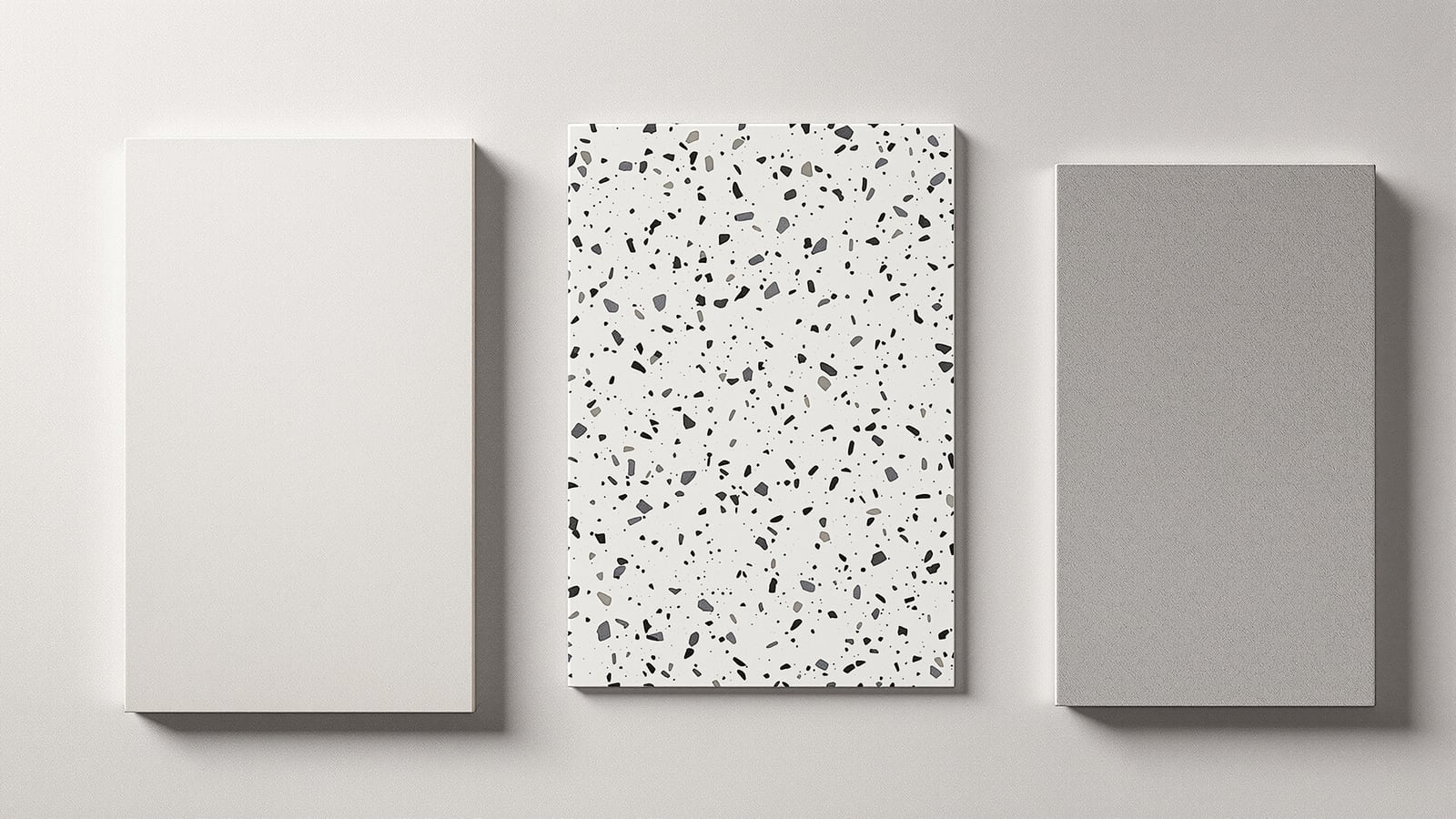
Composite Bathroom Materials India: WPC, HDHMR, Engineered Stone, Resin & FRP Guide
The India-first guide to engineered composite materials for bathrooms — WPC and HDHMR boards for waterproof vanities, engineered stone and terrazzo for basins and counters, resin and mineral composites, FRP and SMC panels — why they beat natural wood and plywood in humidity, where each fits and what they cost.
A bathroom is the most hostile room in an Indian home for any natural material. It is warm, splashed, mopped, sprayed by the health faucet, and — for a third of the year — soaked in monsoon humidity that never fully dries out. Solid timber swells and cracks, plywood delaminates at every unsealed edge, and even good marble stains and etches. This is exactly the problem that engineered composite bathroom materials in india were designed to solve: take the raw ingredients — wood fibre, plastic, mineral powder, stone chips, resin, glass fibre — bind them into a dense, uniform, water-stable board or slab, and you get a surface that behaves the same on its wet edge as it does on its dry face.
This is a materials guide in the Studio Matrx bathroom hub. Read it alongside the bathroom vanity guide for India for how these boards go into a cabinet, and the material-specific deep dives on solid-surface bathrooms, terrazzo bathrooms and WPC wall panels for bathrooms. For the wider picture see the bathroom design guide for India and the waterproofing guide.
A composite is a made material, engineered on purpose. Its whole point in a bathroom is uniformity — the same density and water resistance right through, so there is no weak natural edge for humidity to attack. Buy the composite that matches the job, not the one that looks like something else.
What "composite" actually means here
A composite is two or more materials combined so the mixture performs better than any one ingredient alone — a binder (plastic or resin) holding a filler (wood fibre, stone chips, mineral powder or glass fibre). For bathrooms they fall into four practical families:
- Board composites — WPC, HDHMR and foam PVC. These replace plywood in the vanity carcass, shutters and wall panelling.
- Stone composites — engineered quartz and engineered terrazzo. Crushed stone bound in resin or cement, cut into slabs for counters, basins and floors.
- Resin and mineral composites — solid surface (acrylic or polyester mineral composite) and cast mineral basins. Cast into seamless, repairable, integrated shapes.
- Reinforced composites — FRP and SMC. Glass-fibre-reinforced plastic moulded into shower trays, prefab cubicles and one-piece wall panels.
Board composites: the moisture-proof toolkit for cabinetry
This is where composites most directly beat natural wood and plywood. Ordinary MDF drinks water at any cut edge and swells irreversibly; commercial MR-grade ply is only moisture-resistant and delaminates in a wet room. The engineered boards below are the fix.
- WPC (wood-plastic composite) is wood flour blended with PVC and foaming agents into a board that is effectively waterproof through its whole section. It will not rot, swell or host termites even standing in water, which makes it ideal for the plinth and lower carcass of a floor-standing vanity — the exact zone that gets wet. Its weakness is screw-holding on long unsupported spans, so it is often paired with ply where the cabinet takes load.
- HDHMR (High-Density High Moisture Resistance board) is a dense, uniform fibre board that machines cleanly for routed and membrane-pressed shutters, resisting moisture far better than plain MDF. It is the go-to for modern flat-front and profiled vanity fronts.
- Foam PVC board is a lightweight, fully closed-cell plastic sheet — waterproof and easy to fabricate, good for light shutters and panelling, though softer and less rigid than WPC.
For the full carcass-versus-shutter breakdown, the bathroom vanity guide is the companion read; WPC wall panels covers the same family used on walls instead of cabinets.
Stone composites: engineered quartz and terrazzo
Where a natural stone slab would go — the vanity counter, a floor, a shower threshold — an engineered stone composite often does the same job with fewer weaknesses. Engineered quartz is roughly 90–94% crushed quartz bound in about 6–10% polymer resin, vibro-compacted into slabs. Because the resin fills every pore, it is far less porous than granite or marble, so it resists staining and etching from soap, toothpaste and hard-water salts, and its colour and pattern are consistent slab to slab. Engineered terrazzo sets marble or granite chips into a cement or resin matrix, ground and polished flat; the resin-based version is dense enough for wet floors and counters. The terrazzo bathroom guide covers this family in depth.
The India-first caveat: engineered quartz is superb on counters but should be kept out of direct, prolonged sunlight (a sunny window sill), because the resin can yellow over years. For a shaded vanity top it is close to ideal.
Resin and mineral composites: seamless solid surface
Solid surface is a mineral-filled acrylic or polyester composite — a non-porous, homogeneous material that can be thermoformed, joined with invisible seams and repaired by sanding. Its killer bathroom feature is the integrated basin: the bowl is fused into the counter so there is no rim joint, no silicone line and nowhere for water or grime to sit — the single most hygienic vanity top you can specify. Because it is solid all the way through, a scratch or a cigarette burn sands out rather than exposing a different layer. See the solid-surface bathroom guide for the full treatment. Cast mineral (mineral-cast) basins use a similar resin-and-mineral mix poured into moulds for a warm, smooth, low-conductivity bowl.
Reinforced composites: FRP and SMC
FRP (fibre-reinforced plastic / GRP) is glass fibre set in resin — light, strong, fully waterproof and mouldable into complex shapes. In Indian bathrooms it turns up as one-piece shower trays, prefabricated cubicles, ready-made wall linings and even complete modular toilet pods for towers and site accommodation. SMC (sheet moulding compound) is a compression-moulded FRP variant used for rigid, dimensionally accurate one-piece panels and shower bases. Both give a seamless, non-absorbent surface with almost no joints to fail — their trade-off is a more industrial, less "natural" look and a surface that can scratch and dull over time.
The diagram below shows how the families stack up in a single floating vanity — each composite doing the job it is best at, from the waterproof board in the wet zone to the seamless top on show.
Composites versus natural wood, ply and stone
| Property | Solid wood / ply | Natural marble/granite | Composite (WPC / quartz / solid surface) |
|---|---|---|---|
| Water resistance | Poor–moderate; edges fail | Good but porous, needs sealing | Excellent, uniform through section |
| Uniformity | Natural variation, knots | Slab-to-slab variation | Consistent colour and density |
| Termite / rot | Vulnerable | Immune | Immune (board composites) |
| Seams / hygiene | Visible joints | Rim joints at basin | Seamless integrated options |
| Repairability | Refinish surface only | Professional polishing | Sands out (solid surface) |
| Cost predictability | Variable | Variable, wastage | Standardised sheets/slabs |
| Recyclability | Low (glued boards) | Inert, reusable as aggregate | WPC/PVC and quartz offcuts recyclable |
The recyclability line matters more than it looks. WPC and foam-PVC offcuts can be reground and re-extruded, and quartz and terrazzo offcuts crush back into aggregate — so a composite bathroom generates less true landfill waste than glued MDF or laminated ply, which are effectively unrecyclable once bonded. For IGBC and GRIHA credit-seeking projects, that recycled-content and low-waste story is worth documenting.
Indicative India costs
| Material | Typical bathroom use | Indicative ₹ range |
|---|---|---|
| WPC board (18 mm) | Vanity carcass / plinth | ₹120–200 per sq ft |
| HDHMR board (18 mm) | Vanity shutters | ₹90–150 per sq ft |
| Foam PVC board | Light shutters, panels | ₹80–140 per sq ft |
| Engineered quartz slab | Vanity counter | ₹250–650 per sq ft |
| Resin terrazzo (cast/precast) | Floor / counter | ₹300–800 per sq ft |
| Solid surface (with integrated basin) | Seamless counter-basin | ₹550–1,400 per sq ft |
| FRP / SMC shower tray or panel | Shower base / lining | ₹8,000–40,000 per unit |
Prices are material-and-fabrication indications for 2026 and swing with brand, thickness, colour and city. Treat them as planning figures, not quotes.
Where each composite fits — a quick selector
- Vanity carcass and plinth in the wet zone — WPC (waterproof through section), or marine ply with WPC on the lowest run.
- Vanity shutters and fronts — HDHMR for routed and membrane finishes; foam PVC for the lightest, cheapest fronts.
- The counter top — engineered quartz for a hard, low-stain surface; solid surface if you want a seamless integrated basin.
- Floor and threshold — resin terrazzo composite for a monolithic, low-joint wet floor.
- Shower enclosure / prefab — FRP or SMC one-piece trays and panels where speed and zero joints beat a natural look.
Match the composite to the exposure and the job. Used that way, the engineered-materials toolkit gives an Indian bathroom something natural wood and ply can never manage: the same behaviour on every wet edge as on the dry face, season after season.
References
- National Building Code of India (NBC) 2016 — Part 9 Plumbing Services; guidance on sanitary appliances and bathroom finishes, Bureau of Indian Standards.
- IS 710 — Marine plywood, and IS 303 — Plywood for general purposes, BIS (the natural-board benchmarks composites are measured against).
- IS 2556 — Vitreous sanitary appliances (specification), BIS.
- IS 15825 / relevant WPC and PVC building-board specifications, BIS.
- IGBC Green Homes and GRIHA rating manuals — recycled content, low-VOC and material-reuse credits relevant to composite selection.
- CPHEEO Manual on Water Supply and Sanitation, Ministry of Housing and Urban Affairs — material durability in wet service.
Export this guide
Related Guides — Deep-dive reading
Bathroom Vanity India: Floor-Standing vs Wall-Hung Units, Materials & Cost
The complete India-first guide to bathroom vanity units — floor-standing versus wall-hung (floating), the carcass materials that actually survive Indian bathroom humidity, counter tops and basin fixing, sizes, heights and honest ₹ costs.
BathroomsQuartz Bathroom Countertop India: Engineered Quartz Vanity Tops, Cost & vs Granite/Marble
A practical, India-first guide to engineered quartz vanity tops for bathrooms — why the non-porous, no-seal surface beats granite and marble on a wet counter, plus thickness, seams, heat caution, brand quality and honest ₹ per sq ft costs.
BathroomsSolid Surface Bathroom India: Seamless Corian-Type Basins, Counters & Wet-Room Seats (2026)
How solid surface (Corian-type acrylic-mineral composite) makes a seamless integrated basin-and-counter with no joint to leak or harbour grime, why it thermoforms into curves, its non-porous hygiene and sandable repairability, the real heat caution, and honest 2026 rupee costs against quartz and granite.
BathroomsRelated Tools — Try Free
Cross-Ventilation Analyzer
Estimate airflow and air changes per hour (ACH) from room size, window areas, layout, and local wind — with NBC 2016 Part 8 compliance check.
Ventilation CalculatorMaterial Compare — Side by Side
Compare materials side-by-side: granite vs quartz vs marble, laminate vs acrylic vs PU, and more.
ComparisonWindow Material Comparison Tool
Compare uPVC, aluminium, wood, steel and composite windows on cost, life, upkeep and insulation.
Compare