
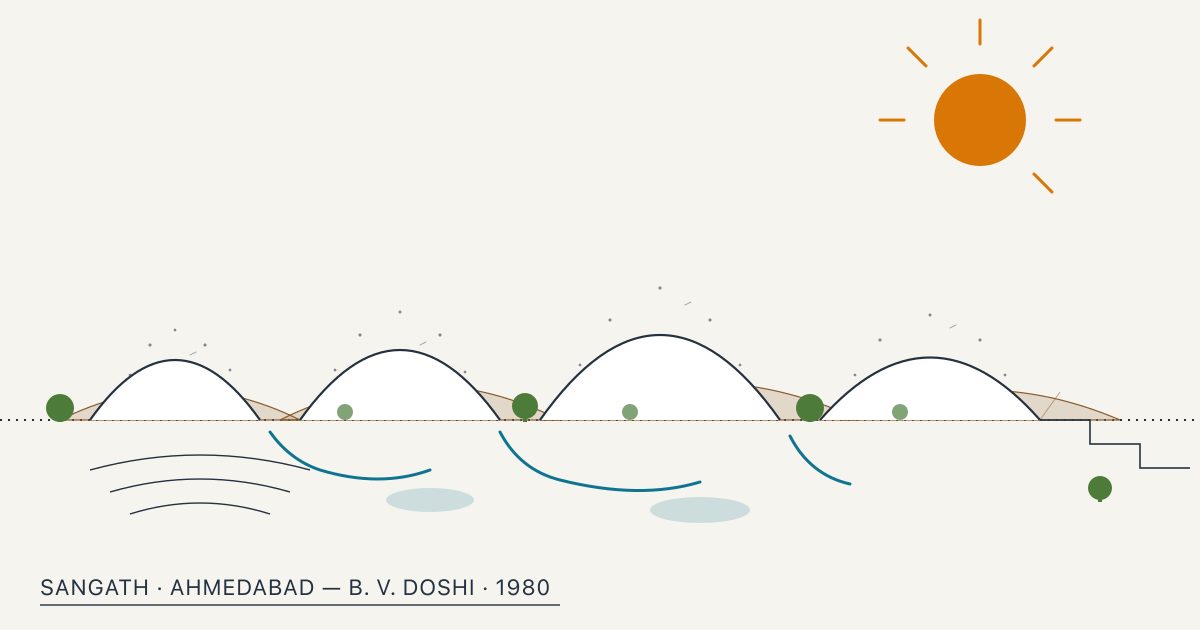
Sangath, Ahmedabad — Doshi's Half-Buried Vaults That Beat the Heat
B. V. Doshi's own studio sinks china-mosaic vaults into the earth and threads water through the gardens — a Pritzker laureate's masterclass in hot-dry, low-energy building.
You do not so much enter Sangath as descend into it. There is no grand portico, no glazed lobby announcing itself to the street. Instead you arrive at the edge of a low cluster of pale, gleaming vaults that seem to grow out of the ground, half-sunk into the earth and stitched together by steps, terraces, channels of water and the soft green of planting. This is the studio that the architect Balkrishna Doshi built for himself in Ahmedabad, completed in 1980, and it is among the most loved works of modern Indian architecture. Its name, Sangath, means roughly moving together, or moving together through participation, and the building lives up to it: it is not a single object but a small landscape of rooms, gardens and passages designed to be moved through, worked in, and quietly enjoyed.
Arriving: a landscape that happens to be a building
The first lesson of Sangath is that it refuses the usual hierarchy between building and ground. Most architecture sits on the land; Sangath settles into it. The vaults are bermed with earth on their flanks, so the structure appears to hunker down into the site, its curved white backs barely rising above the surrounding gardens. The effect is deliberately modest and almost geological, as if the studio had been there long enough for the earth to fold around it.
That impression is heightened by what surrounds the vaults. Rather than a forecourt of parking and paving, you find terraced gardens, broad steps that double as seating, a small outdoor amphitheatre, and water that runs in channels and pools across the site. Movement is choreographed. You go up a few steps, turn, catch a glimpse of a sunken courtyard, hear water somewhere below, and only then arrive at a working room. Doshi understood arrival as a sequence rather than a threshold, and he treated the whole site as the project. Sangath is often described, accurately, as a landscape as much as a building.
Doshi liked to speak of architecture as something close to everyday ritual, even the spiritual. Sangath was his daily place of work, and the slow, deliberate passage through its gardens and steps turns the ordinary act of arriving at the office into something closer to a procession.
The buried vaults: form, earth and a mosaic skin
The signature image of Sangath is its cluster of low, half-buried barrel vaults. The choice is not merely sculptural. In Ahmedabad's hot, dry climate, where summer temperatures are punishing and the sun is relentless for much of the year, the vault is a remarkably intelligent piece of climate engineering, and Doshi pushed it on several fronts at once.
Begin with the earth. By sinking the vaults partly into the ground and banking soil against their sides, Doshi wrapped the building in a thick blanket of thermal mass. Earth is slow to heat and slow to cool; it buffers the wild daily swing between scorching afternoon and cooler night, so the interior temperature drifts gently rather than spiking with the outdoor air. The berming also insulates the lower walls and reduces the area of building exposed to direct sun. The studio floor itself is set below grade, where the ground stays cooler, so the working spaces draw coolth from the earth they sit within.
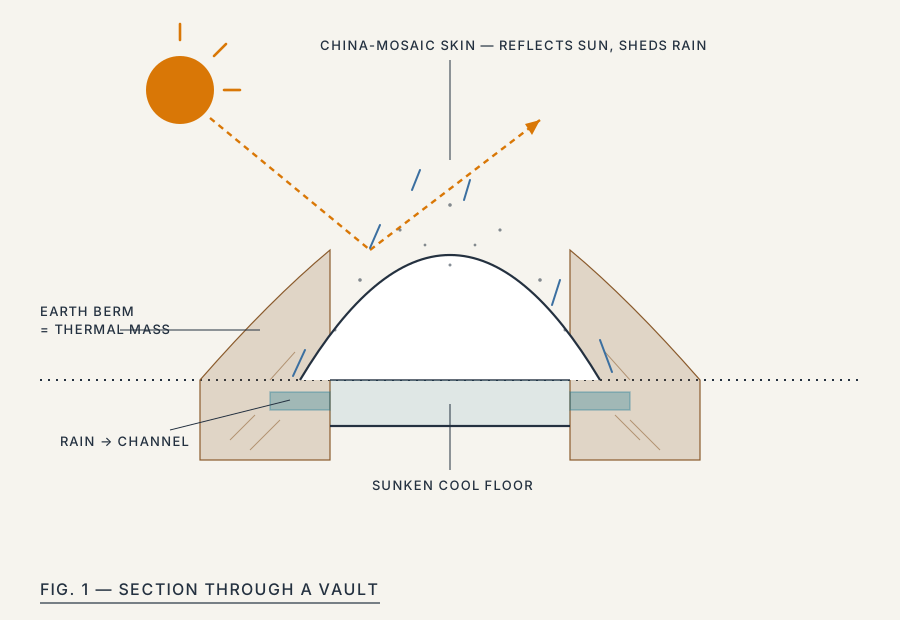
Then there is the geometry of the vault itself. A curved roof is partly self-shading: at any given moment, much of its surface is angled away from the sun, and the curvature spreads incoming heat across a larger area rather than concentrating it on a flat slab. The interior volume that a vault creates is generous and tall, allowing hot air to rise and stratify well above the heads of the people working below.
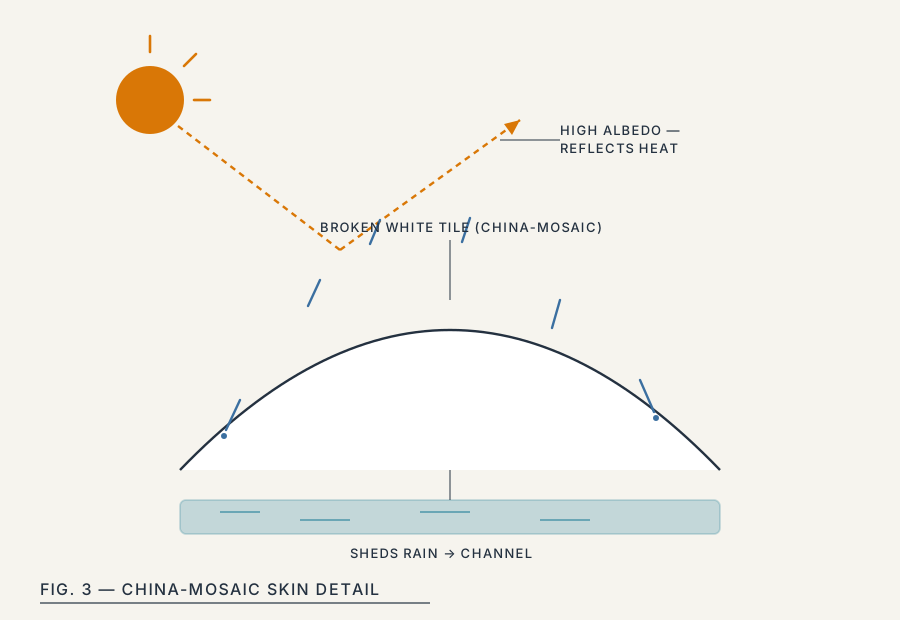
Finally, the skin. The vaults are clad in broken white china-mosaic, fragments of porcelain and ceramic tile pressed into the curved surface. This humble, almost folk technique does serious work. The bright white finish reflects a large share of the harsh solar radiation before it can be absorbed into the structure, keeping the roof and the rooms beneath it cooler. The hard, glazed, slightly faceted surface also sheds the heavy monsoon rain efficiently, sending water running down the curves of the vaults and into the channels below rather than letting it pool and seep. One material, doing the work of sun-reflection and rain-management at once.
| Passive strategy | How it works | The climatic payoff |
|---|---|---|
| Earth berming around the vaults | Banked soil wraps the lower structure in thermal mass | Slows heat gain, buffers day-night temperature swings |
| Sunken floor below grade | Working level sits in cooler ground | Draws coolth from the earth; lower base temperature |
| Barrel-vault geometry | Curved roof is partly self-shading; tall volume lets hot air rise | Less concentrated solar load; cooler occupied zone below |
| White china-mosaic skin | Bright, reflective broken-tile finish | Reflects harsh sun; keeps roof and rooms cooler |
| Mosaic as rain shield | Hard glazed curves shed water | Sheds monsoon rain into channels; protects the structure |
Water and movement: cooling, delight and ritual
If the earth and the mosaic handle the sun, water handles both comfort and pleasure. Doshi threaded the site with channels, small pools and a modest cascade, so that water moves through the landscape much as people do. In a hot-dry climate this is more than decoration. Moving and standing water cools the air around it by evaporation, and a breeze passing over a pool or channel arrives at the body noticeably cooler and softer than the dry, dusty air beyond. The microclimate of the gardens is gently conditioned by the water that runs through them.
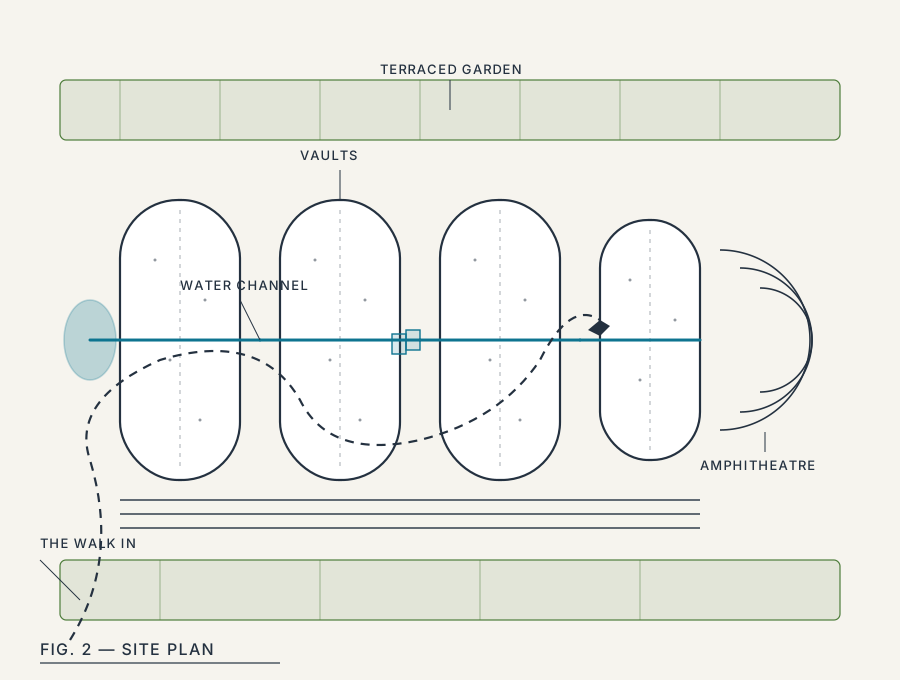
There is also the matter of the monsoon. The same china-mosaic vaults that reflect the summer sun become, in the rains, gleaming catchment surfaces. Water runs down their curves and is led into the channels and courses below, so the building's response to the two extremes of Ahmedabad's year — searing dry heat and sudden heavy rain — is handled by a single, continuous logic of curved surfaces and water paths.
And then there is delight. The sound of the cascade, the glint of light off a pool, the cool that lingers near the water: these turn a working day into something sensory and slow. Movement through Sangath is choreographed precisely so that you encounter these moments — a turn that reveals a channel, a flight of steps beside a pool, the amphitheatre opening below. Comfort and pleasure are not separate from the architecture; they are produced by the same gestures that keep the place cool.
The lineage: Corbusier, Kahn and the Indian vernacular
Sangath did not appear from nowhere. Early in his career, Doshi worked in Paris with Le Corbusier, absorbing modernism's confident form-making, its sculptural handling of concrete and its belief that architecture could shape a way of living. Back in India, he was closely involved as Louis Kahn worked on the Indian Institute of Management in Ahmedabad, an experience that deepened his feeling for monumental geometry, for light, and for buildings that carry a sense of weight and permanence.
But Sangath is not a transplant of European or American modernism onto Indian soil. What makes it remarkable is the synthesis. Doshi took the modernist's freedom of form and married it to the accumulated climate wisdom of Indian vernacular building: the courtyard, the sunken cool room, the thick earthen wall, the reflective surface, the choreography of shade and water that traditional Indian settlements had refined over centuries. The vault is at once a Corbusian gesture and a deeply local, climate-driven form. The china-mosaic is a humble Gujarati craft put to high purpose.
The synthesis is the point. Doshi did not choose between the international and the Indian; he let each correct the other. The result feels modern and rooted at the same time — confident in form, but obedient to sun, earth and rain.
What Sangath teaches
For students, professionals and homeowners alike, Sangath is a working catalogue of hot-dry climate strategies, and most of them scale down to an ordinary house. You do not need vaults or mosaic to learn from it; you need the underlying logic of working with the climate rather than fighting it with machines.
| What you can borrow for a hot-dry home | The Sangath idea behind it | How to apply it modestly |
|---|---|---|
| Use thermal mass | Earth-bermed, heavy structure buffers heat | Thick masonry walls, earth or stone where you can; avoid thin, lightweight skins facing the sun |
| Go light and reflective on the roof | White china-mosaic reflects solar gain | Light-coloured, reflective roof finishes; high-albedo terraces |
| Bring the floor down | Sunken studio stays cool | Lower or shaded living zones; cool, earth-coupled floors |
| Shade yourself with form | Curved, self-shading vaults | Deep overhangs, curved or sloped roofs, self-shading massing |
| Let water cool the air | Channels and pools cool by evaporation | A small water body or channel in a shaded court; planting near openings |
| Design the path, not just the room | Movement is choreographed for comfort and delight | Sequence shaded and open spaces; lead people past cool, planted, watered zones |
The deeper lesson is one of attitude. Sangath treats comfort as something to be designed into the building's form, materials and landscape, rather than bolted on afterwards with energy-hungry equipment. The roof that keeps you cool is the roof that sheds the rain that feeds the water that cools the garden you walk through to reach your desk. Each move does several jobs. That integration — of structure, climate, craft and pleasure — is what makes the building feel inevitable rather than merely clever. Anyone planning a home in a hot, dry region can study these moves; readers exploring our guides and house plans will find many of the same principles applied at domestic scale.
A reflection: Doshi and the Pritzker
In 2018, Balkrishna Doshi became the first Indian architect to receive the Pritzker Prize, the field's highest international honour. The recognition came late in a long career, and it acknowledged not a single monument but a lifetime of building thoughtfully for India — housing, institutions, campuses and studios that took climate, craft and community seriously. Doshi died in 2023, at the age of ninety-five.
Of all his works, Sangath holds a special place, because it was his own. This was the studio where he came to work each day, the landscape he refined over years, the place that distilled his beliefs into built form. It is fitting that his most personal building is also one of his most instructive: a small, half-buried cluster of mosaic vaults that quietly demonstrates how architecture can be cool in the heat, generous in the rain, rooted in its craft and joyful to move through. Sangath is, in the end, an argument made in earth, water and broken white tile — that building well and building kindly to the climate can be the same thing.
References & further reading
- The Pritzker Architecture Prize — 2018 Laureate citation and biography for Balkrishna Doshi.
- Vastushilpa Foundation / Vastushilpa Sangath — on Doshi's practice and the Sangath studio.
- ArchDaily — feature article on Sangath, B. V. Doshi's Ahmedabad studio.
- Balkrishna Doshi, Paths Uncharted — Doshi's own writings and reflections on his work and philosophy.
- William J. R. Curtis — writings on Balkrishna Doshi and modern Indian architecture.
Export this guide
Related Guides — Deep-dive reading
Sangath: How B.V. Doshi Buried a Studio in the Ground to Cool It
Balkrishna Doshi's own Ahmedabad studio, completed around 1980, sinks its china-mosaic vaults into the earth and lets water, shade and convection do the work of air-conditioning. It is a low-tech manifesto for a climate-responsive, place-rooted modernism — and a preview of where sustainable architecture is quietly heading.
The Future of ArchitectureBalkrishna Doshi's Façade Signature: Earth Berms, China Mosaic Vaults and the Building as Landscape
How India's first Pritzker laureate turned the façade into a continuous earth-sheltered skin — half-buried, white broken-tile vaults that reflect the sun, deep shaded layers, and open frameworks ordinary families complete themselves.
Building FacadesLouis Kahn's Façade Signature: Wrapping Ruins, Brick Arches, and Monumental Light
How Louis Kahn shaded the glass behind giant geometric screen walls, asked the brick to be an arch, and built monumental façades of fair-faced concrete and light — and what that hot-climate logic teaches Indian builders today.
Building FacadesRelated Tools — Try Free
Brise-Soleil Visualizer
Interactive horizontal-louvre cut-off angle calculator — sun altitude, louvre depth, and spacing inputs with a live shadow preview. Computes θ = arctan(spacing/depth) for façade shading, ECBC envelope compliance, hospital daylight design, and tropical sun-control detailing.
Sun Shading ToolDesign Style Finder Quiz
Answer 10 visual questions to discover your Indian interior style profile with materials and colours.
Interactive QuizGarden Planning Toolkit
Get a tailored garden plan — planting layers, Indian species, features and a checklist — from your climate, space, sun and goals.
Planner