
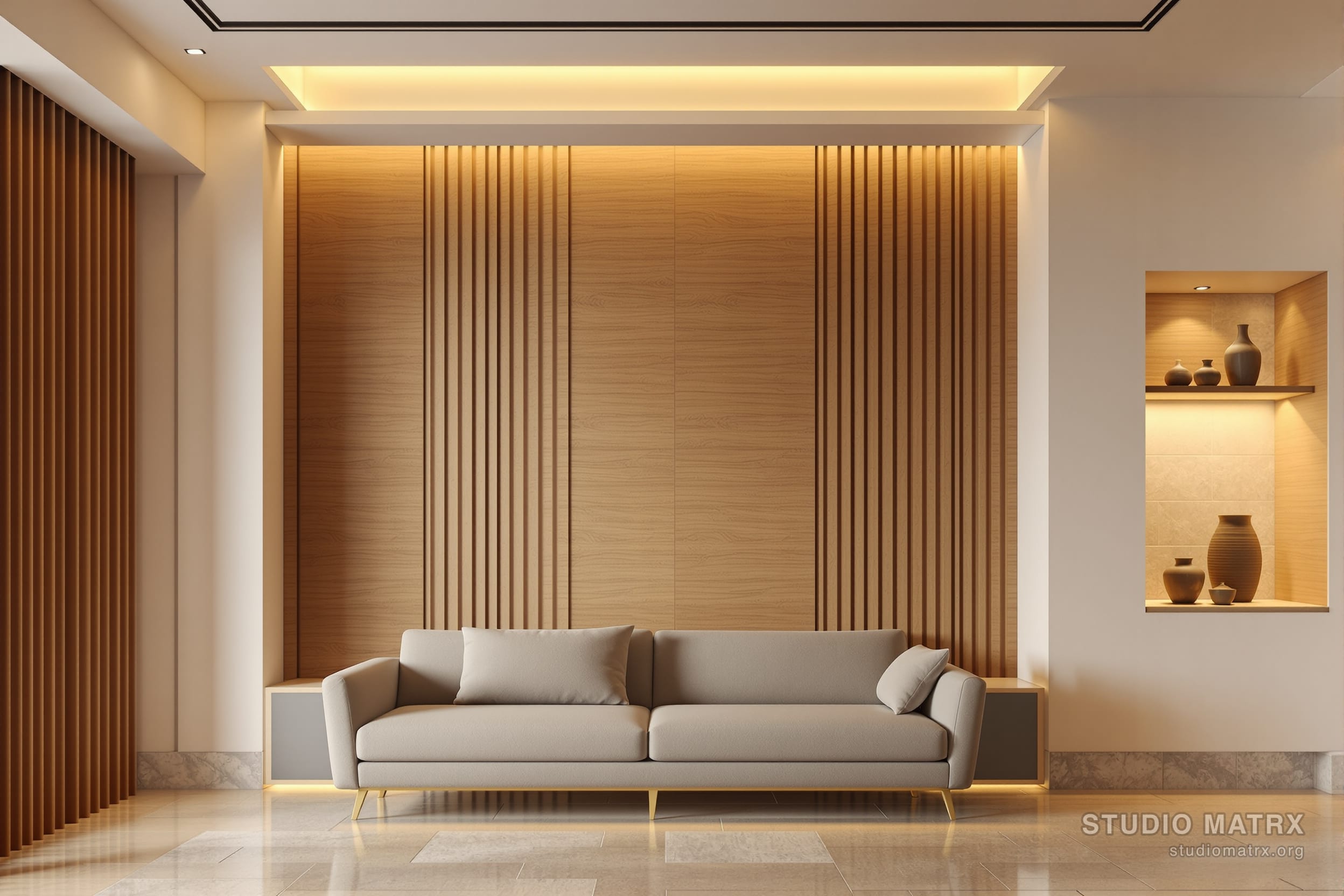
Architectural Decorative Elements — 9 Built-In Features for Indian Homes
Paneling · Fluted · Jaali · Slat Walls · Feature Ceilings · Niches · Courtyards · Fireplaces · Accent Walls
Walk into a well-resolved Indian home and the things that make it feel "designed" are rarely the cushions or the vases. They are the surfaces and the structure: a fluted wall behind the TV, a cove of light folded into the ceiling, a carved jaali filtering the afternoon sun, a niche that turns a blank corner into a small shrine of light. These are architectural decorative elements — decor that is built in, permanent, and becomes part of the interior itself rather than sitting on top of it.
That permanence is the whole point. A movable lamp can be returned; a coffered ceiling cannot. Architectural elements are detailed into the carpentry, the gypsum, the masonry and the electricals, so they cost more, take longer, and are harder to undo — but they also read as quality, photograph beautifully, and genuinely lift resale value because a buyer sees a finished home, not a blank box. The trade-off is the opposite of the Decoration Ideas approach, which is about movable, swappable, low-commitment styling. Most good Indian homes use both: built-in bones, movable skin.
This guide covers the nine architectural decorative elements that show up most often in Indian homes in 2026 — what each one is, where it works, honest installed-cost bands in rupees, the detailing pitfalls that ruin them, and the Vastu, climate and heritage logic that makes some of them genuinely Indian rather than imported. The principle running through all of it: choose one or two hero elements per room and let everything else stay quiet.
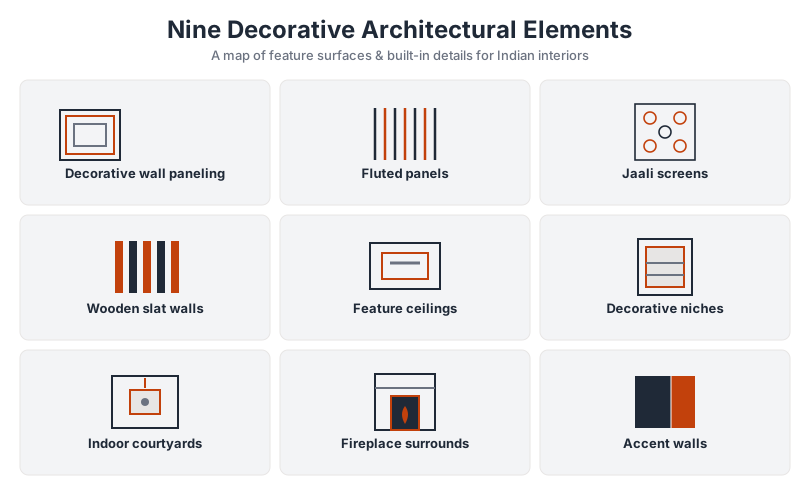
How to choose: architectural vs movable
Before spending on built-ins, sort your wish list into two buckets. Architectural elements are permanent, are fixed to the building, change the geometry or surface of a space, and are expensive to remove — paneling, ceilings, niches, courtyards. Movable decoration — art, rugs, lamps, plants — is cheap, reversible and seasonal. A simple test: if you would have to call a carpenter, electrician or mason to undo it, it is architectural and deserves architectural-level thought.
Spend architectural money where you live and where guests gather first: the living and dining room, the main bedroom headboard wall, the entrance foyer. Spend movable money everywhere else. And decide built-ins early — paneling, niches and feature ceilings all need to be coordinated with wiring, AC drops and false-ceiling levels before plaster and POP go up. Retrofitting them later means breaking finished work.
1. Decorative wall paneling
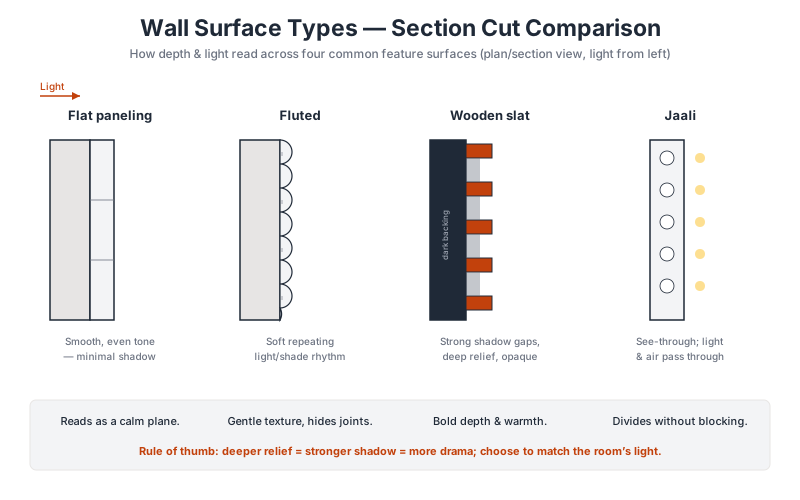
Wall paneling is any applied surface treatment that turns a flat painted wall into a composed plane — flat rectangular panels with reveal joints, beaded/Shaker frames, leather-look upholstered panels, PVC/WPC panels, or laminate-faced ply panels. It is the workhorse of Indian interiors because it hides patchy plaster, conceals wiring, and instantly signals that a wall was "done."
Where it works: living-room TV walls, the headboard wall in a bedroom, dining feature walls, and entrance foyers. Full-height paneling makes ceilings feel taller; wainscot (lower-third) paneling suits dining rooms and staircases.
Materials and cost (2026, installed): WPC/PVC ready panels run roughly ₹250 to ₹600 per sq ft; laminate-faced 18 mm ply with hardware-grade carpentry ₹650 to ₹1,400 per sq ft; veneer or fabric/leatherette upholstered panels ₹1,200 to ₹3,000+ per sq ft. A single 10 x 9 ft TV-wall therefore lands anywhere from ₹25,000 to well over ₹2 lakh depending on material.
Detailing tips: keep reveal-joint gaps consistent (a 6 to 10 mm shadow gap reads cleaner than a tight butt joint that telegraphs every misalignment). Use moisture-resistant (BWR/BWP, IS 303 grade) ply on any wall sharing a side with a bathroom or external face, and demand factory edge-banding so laminate edges do not peel — see Best laminate finishes for picking the right finish and texture. For a fuller catalogue of layouts, browse Wall Panelling design ideas.
India angle: humidity and pest load are the real enemies. Insist on borer-treated ply and avoid MDF on ground-floor or coastal walls — it swells the first monsoon.
2. Fluted panels
Fluted panels are vertical (or horizontal) ribbed surfaces — a run of half-round or rectangular grooves that catch light and throw soft shadow lines. They are the defining texture of late-2020s Indian interiors because they add rhythm and depth without colour or clutter, and they read as premium even in MDF.
Where it works: TV/console backdrops, behind-the-bed headboard walls, reception desks, pillar cladding, and as a soft room divider. Vertical flutes make a wall feel taller; they are perfect for hiding service doors and AC return grilles.
Materials and cost (2026, installed): ready PVC/WPC fluted boards ₹150 to ₹450 per sq ft; polyurethane (PU) charcoal/MDF fluted with laminate or veneer ₹450 to ₹900 per sq ft; solid-wood or backlit fluted feature walls ₹900 to ₹2,000+ per sq ft.
Detailing tips: the most common failure is mismatched flute pitch where two boards meet — plan the wall so a full flute lands at each end and joints fall inside a groove, not on a peak. If you backlight flutes, run a warm 2700 to 3000 K LED strip in a recessed channel so you see glow, not dots. For the full deep-dive on profiles, spacing and lighting, read the dedicated Fluted Panel Design guide.
India angle: PVC fluted is the budget hero for rental and quick flips; for a Vastu-conscious or longevity-first home, PU/wood on the north or east living wall ages far better than plastic in our heat.
3. Jaali screens
A jaali is a perforated screen — a lattice of repeated openings cut into stone, wood, metal, terracotta or GFRC. It is the most genuinely Indian element on this list, drawn straight from Mughal and Rajasthani architecture, where jaalis cooled rooms, gave privacy without blackout, and dissolved harsh sun into patterned light. In a modern home it does the same job and doubles as sculpture.
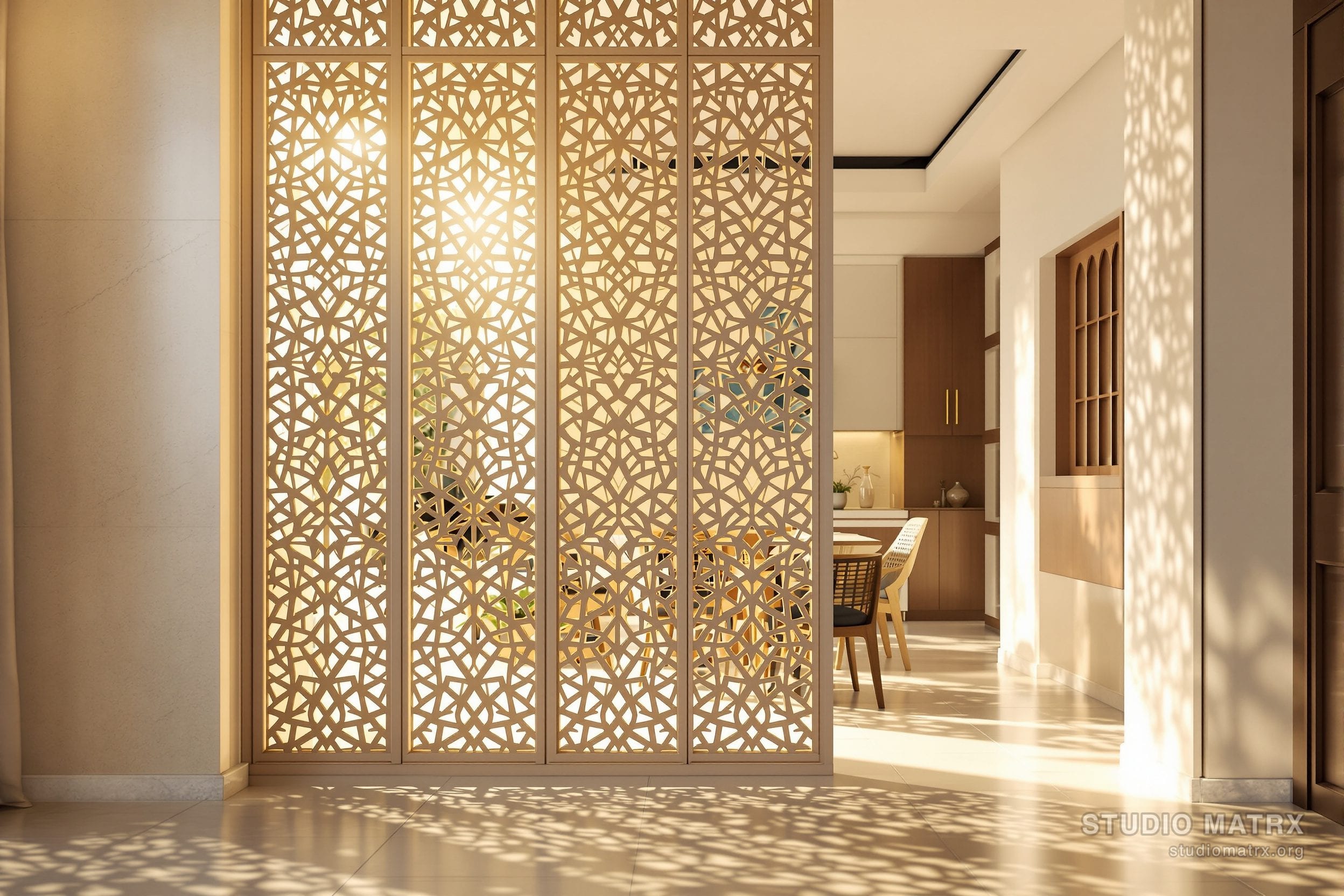
Where it works: as a partition between living and dining, a pooja-room screen, a staircase guard, a balcony privacy screen, or a foyer divider that hides the kitchen while letting light through.
Materials and cost (2026, installed): laser-cut MDF/acrylic jaali ₹350 to ₹800 per sq ft; powder-coated CNC-cut MS or aluminium ₹700 to ₹1,800 per sq ft; carved natural stone (sandstone, marble) or solid teak ₹2,500 to ₹8,000+ per sq ft depending on carving depth.
Detailing tips: scale the perforation to the function — a fine, dense pattern gives privacy but cuts airflow; an open geometric pattern moves air but reveals silhouettes. For floor-to-ceiling jaali partitions, frame the panel in a concealed MS sub-frame so it does not bow over time, and finish metal jaali with a rust-inhibiting primer before powder-coat in coastal cities.
India angle: the jaali is climate-responsive vernacular, not decoration borrowed from abroad — see Indian Vernacular Architecture. A west-facing jaali on a hot-climate facade cuts solar gain the way a curtain never can.
4. Wooden slat walls
A slat wall is a run of evenly spaced timber (or timber-look) battens fixed to a backing — first cousin to the fluted panel, but with real gaps between members and a chunkier, warmer, more Scandinavian feel. The shadow gaps give acoustic softening and a calm, linear rhythm.
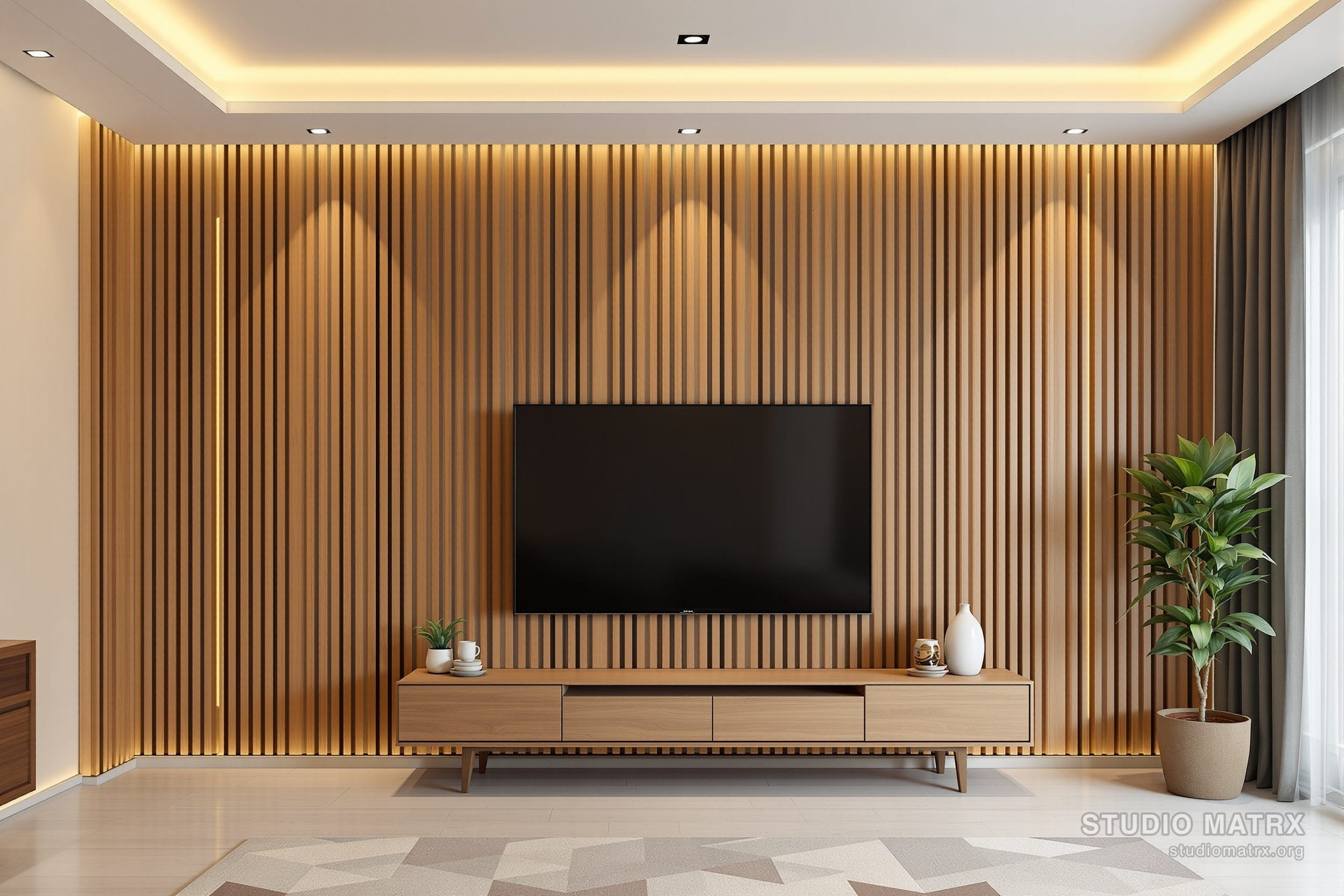
Where it works: living-room feature walls, behind-the-bed walls, home-office backdrops (great for video calls), and as semi-open partitions where you want air and sightlines to pass through.
Materials and cost (2026, installed): WPC/PVC slat-and-felt acoustic panels ₹250 to ₹550 per sq ft; laminate or veneered MDF battens on ply backing ₹500 to ₹1,000 per sq ft; solid teak/ash/walnut slats ₹1,200 to ₹2,500+ per sq ft.
Detailing tips: acoustic felt-backed slat panels genuinely tame echo in tiled Indian living rooms — specify them where reverberation is a problem. Keep the slat-to-gap ratio consistent (a common, pleasing rhythm is around a 40 to 50 mm slat with a 20 to 30 mm gap), and seal solid-wood slats on all four faces so they do not cup in dry north-Indian winters.
India angle: slat walls are the signature of warm-minimal and Japandi interiors that suit Indian apartments well — the Japandi apartment guide shows how to keep them from looking cold.
5. Feature ceilings
The ceiling is the largest uninterrupted surface in any room and the most under-used. A feature ceiling — cove (peripheral concealed lighting), tray (a recessed central pocket), coffered (a grid of recessed boxes), or wooden-batten — adds the fifth wall and is where a room's lighting layer really lives.
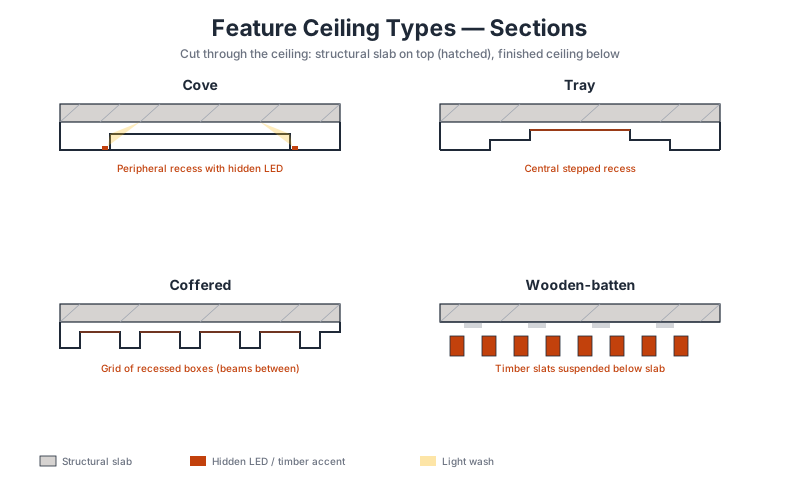
Where it works: living and dining rooms first, then the main bedroom. Avoid heavy multi-level POP in rooms under about 9.5 to 10 ft floor-to-slab height — every drop steals headroom.
Materials and cost (2026, installed): plain gypsum board false ceiling ₹70 to ₹130 per sq ft; POP with cove/tray detailing and concealed LED ₹130 to ₹250 per sq ft; coffered or wooden-batten/grid ceilings ₹250 to ₹600+ per sq ft.
Detailing tips: the single biggest mistake is a cove that lights the ceiling unevenly — keep the LED strip 75 to 100 mm below the cove lip and at least 150 mm clear of the ceiling face so the wash is smooth, not scalloped. Coordinate AC duct drops, sprinklers and speaker cut-outs before the grid goes up. For the full system — frames, board grades, and waterproofing near balconies — read the False Ceiling Design guide, price your own room with the False-ceiling cost estimator, and browse layouts in False-ceiling design ideas.
India angle: keep at least one Vastu-favoured zone (often the centre, the Brahmasthan) visually light and unburdened — a flat, calm centre with detailing pushed to the periphery reads better and respects the convention.
6. Decorative niches
A niche is a recessed pocket built into a wall — a deliberate void, usually backlit, that frames objects, a deity, books or a single sculpture. Because it is carved into the wall rather than projecting from it, a niche adds richness without stealing floor space, which makes it ideal for tight Indian apartments.
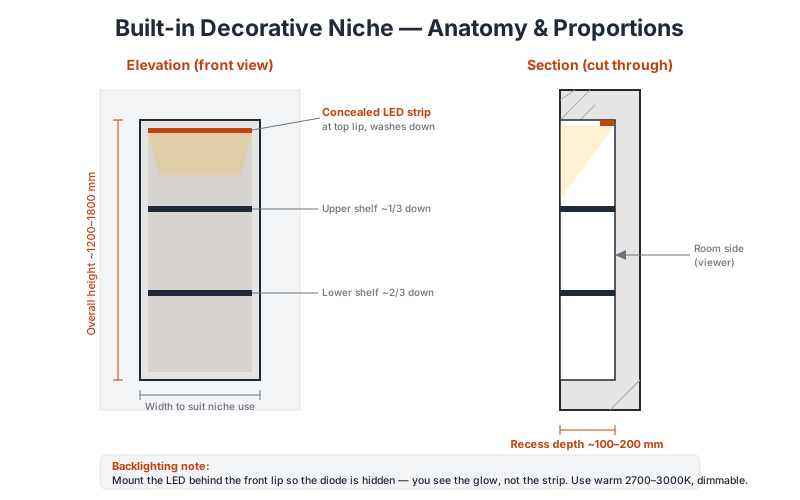
Where it works: entrance foyers, living-room flank walls, headboard walls, dining areas, and most meaningfully as a pooja niche. Vertical stacked niches suit narrow walls; a single wide niche anchors a console.
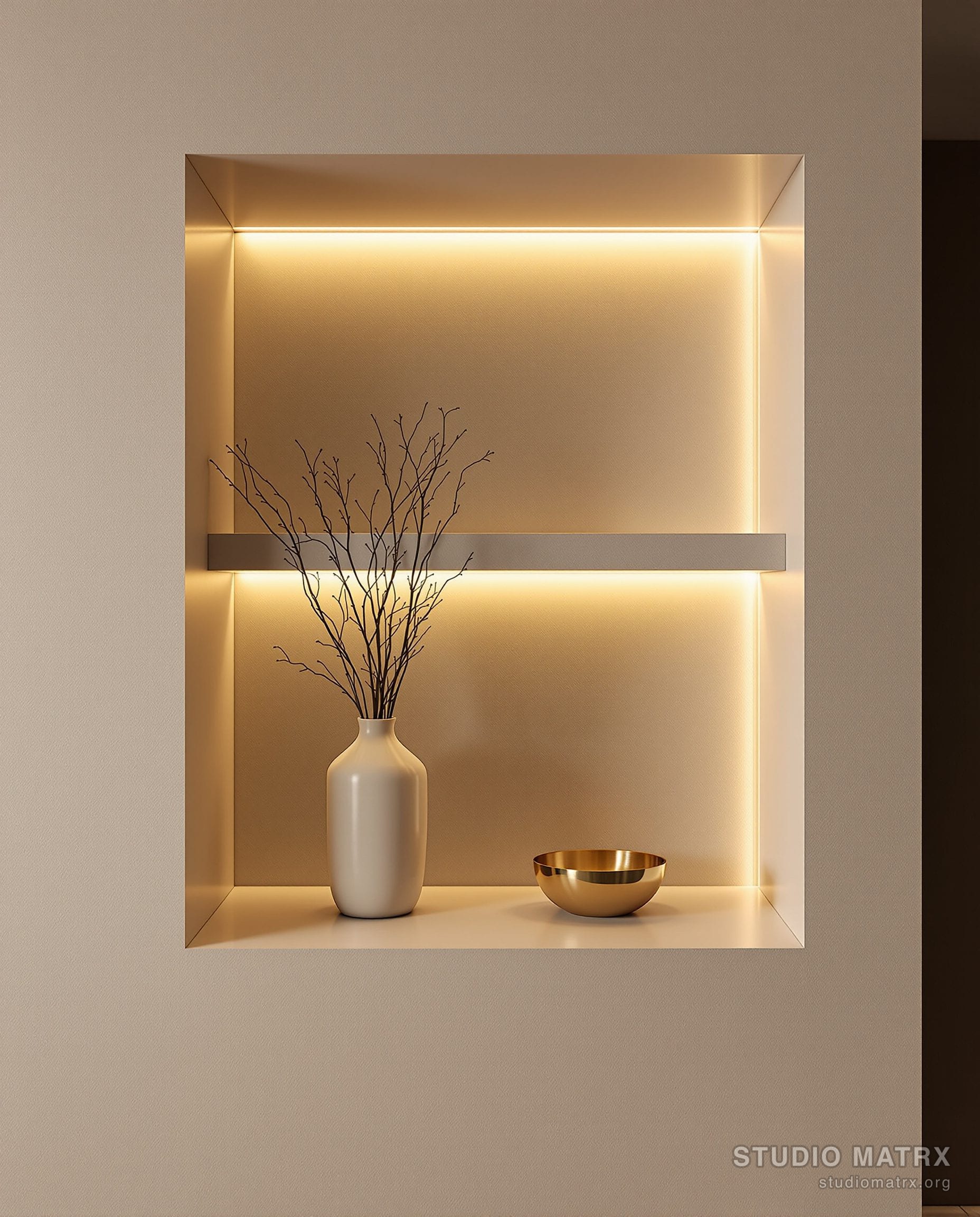
Materials and cost (2026, installed): drywall/gypsum niche with LED strip ₹4,000 to ₹12,000 each; ply-and-laminate or veneer-lined niche ₹8,000 to ₹25,000 each; stone/marble-clad or backlit-onyx niche ₹25,000 to ₹60,000+ each.
Detailing tips: light from the top edge with a recessed warm strip (a concealed channel hidden behind a lip), never a visible downlight that glares. Give the niche a clear proportion — roughly a 1:1.6 height-to-width feels resolved — and a contrasting back surface (a darker laminate or textured plaster) so objects pop.
India angle: the niche is the natural home of the devta — a built-in pooja niche keeps the shrine off the floor and respects orientation conventions (north-east is the favoured corner). For a full treatment of placement, lighting and materials, see Pooja room design.
7. Indoor courtyards
The courtyard — the aangan or chowk — is the oldest organising idea in Indian domestic architecture: an open-to-sky or skylit void at the heart of the plan that pulls daylight and ventilation deep into the house. In a modern home it returns as a double-height light well, a skylit indoor garden, or a small green court off the living room.
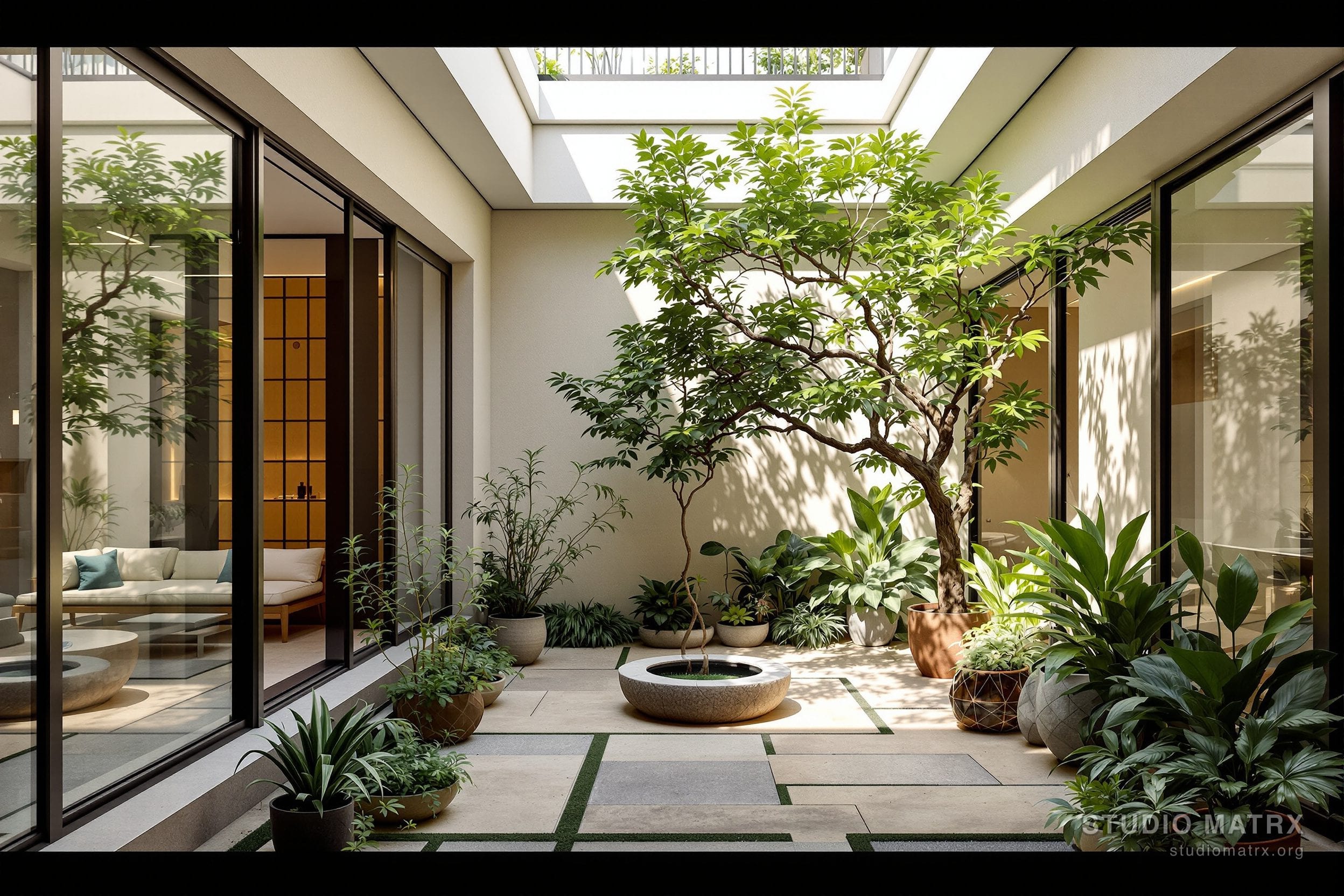
Where it works: in independent houses, villas and ground-floor plots — anywhere you control the roof. In apartments it scales down to a skylit dry-garden niche or a planted light shaft. It is the one element on this list that is genuinely architectural, not just decorative, and must be designed at the structural stage.
Materials and cost (2026, installed): a modest skylit indoor planter court with stone flooring, drainage and a polycarbonate/glass skylight runs roughly ₹1.5 to ₹6 lakh; a full double-height courtyard with pergola/operable skylight, waterproofing and landscaping can run ₹8 lakh and well upward.
Detailing tips: waterproofing and drainage are everything — an open court needs a sunken, well-graded slab and a planned overflow, or the first heavy monsoon floods the adjoining rooms. If you skylight it, use a heat-cutting glazing or a deep louvre, because an unshaded glass court becomes a greenhouse by April.
India angle: the courtyard is the original passive-cooling device — it drives stack ventilation and shades itself through the day. See Climate-responsive courtyard homes for the climate logic and Indian Vernacular Architecture for the heritage lineage. In Vastu, the central open space aligns neatly with the Brahmasthan, the sacred core kept open and unbuilt.
8. Fireplace surrounds
A fireplace is rare in the Indian plains but genuinely useful in hill homes — Shimla, Manali, Mussoorie, Ooty, Munnar, Gangtok, Darjeeling. Even where you do not need the heat, a fireplace surround — the framed, clad face around a real, gas, ethanol or electric firebox — works as a powerful living-room focal point.
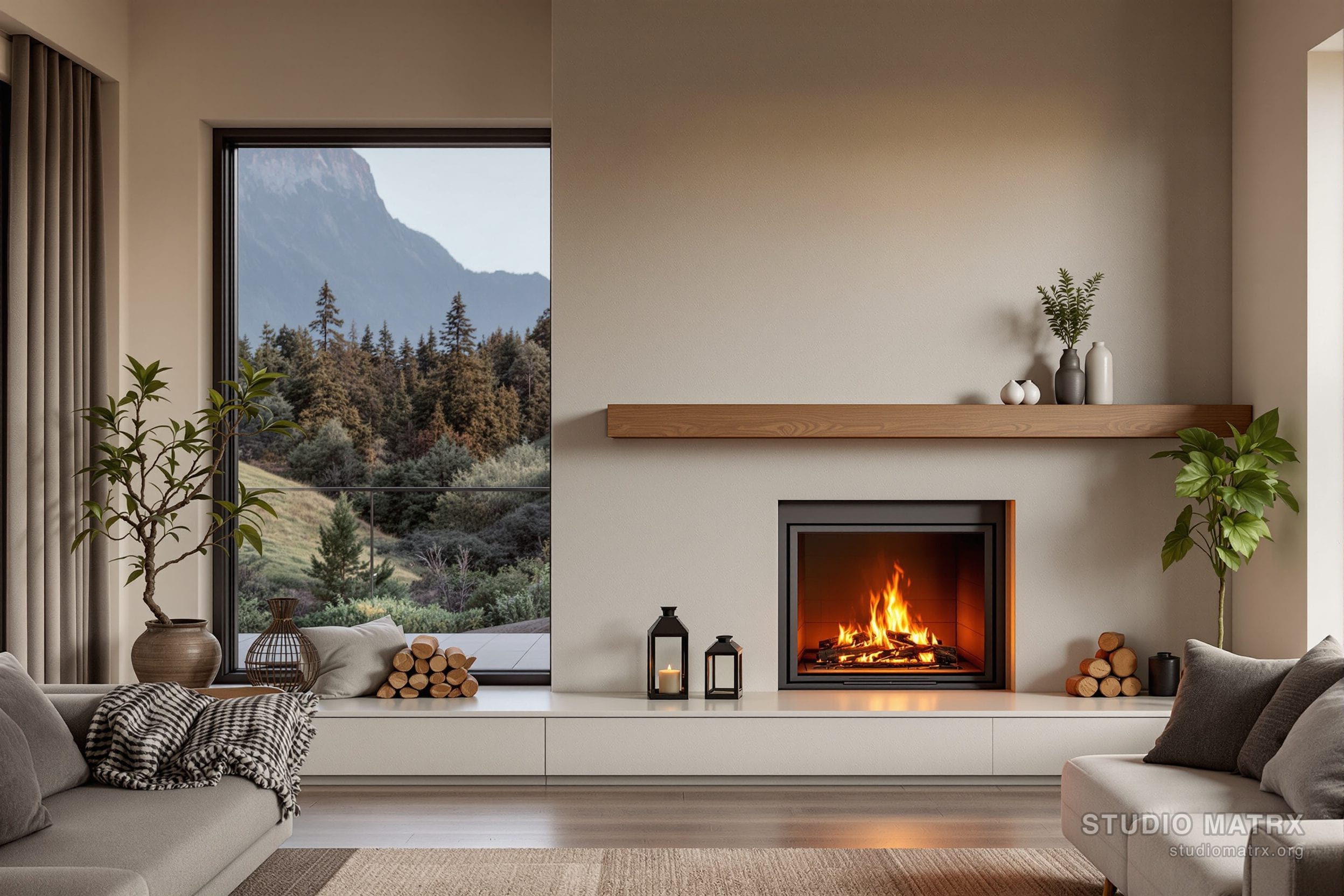
Where it works: the main living wall in hill-station homes (wood-burning or gas), and as a decorative electric/ethanol feature in plains apartments where it is purely a focal element, not a heat source.
Materials and cost (2026, installed): an electric or ethanol insert with a clad surround ₹40,000 to ₹1.5 lakh; a gas fireplace with stone/tile surround ₹1.5 to ₹4 lakh; a built masonry wood-burning fireplace with a proper flue and stone surround ₹3 to ₹10 lakh+.
Detailing tips: for any real-combustion fireplace, the flue, hearth clearances and non-combustible surround are a safety matter, not a style choice — keep timber and fabric well clear of the firebox and use stone, tile, concrete or steel for the immediate surround. For electric/ethanol units in apartments, ensure ventilation for ethanol and a dedicated circuit for electric.
India angle: in heritage hill bungalows the original masonry fireplace and chimney are often the most characterful feature in the house — restore rather than rip out where the flue is sound.
9. Accent walls
The accent wall is the lowest-commitment architectural move: a single wall treated differently from the other three — through colour, texture (lime/Venetian plaster, microcement), a stone or brick cladding, large-format tile, or wallpaper. It anchors a room and directs the eye without rebuilding anything.
Where it works: behind the sofa or TV, the headboard wall, the dining wall, and the wall you see first on entering. The rule is one accent wall per room — usually the one without windows or doors interrupting it.
Materials and cost (2026, installed): premium paint or textured paint ₹40 to ₹120 per sq ft; designer wallpaper ₹120 to ₹400 per sq ft installed; Venetian/lime plaster or microcement ₹250 to ₹700 per sq ft; natural stone, brick or large-format tile cladding ₹350 to ₹1,200+ per sq ft.
Detailing tips: choose the accent wall by architecture, not whim — the wall the eye lands on naturally. Coordinate the accent colour or material with the rest of the palette before committing; the Colour palette generator helps test combinations against your flooring and furniture. For applied panel options on an accent wall, Wall Panelling design ideas and Best laminate finishes are the right starting points.
India angle: for movable, seasonal accent treatments — festive colours, removable styling — the reversible counterpart is Decoration Ideas rather than a permanent clad wall.
How to combine them without overdoing it
The single rule that separates designed homes from busy ones: one or two hero elements per room, everything else quiet. A living room can carry a fluted accent wall plus a cove-lit feature ceiling — that is two heroes, and it is enough. Add a slat wall, a jaali partition, a stone fireplace and a coffered ceiling to the same room and each element fights the others; nothing reads.
Practical guardrails:
- Pick one texture hero per surface. If the wall is fluted, keep the ceiling calm. If the ceiling is coffered, keep the walls plain.
- Repeat materials, do not multiply them. Echo the same teak in the slat wall and the niche lining rather than introducing a third wood.
- Let the floor and ceiling stay backgrounds unless one of them is deliberately the hero.
- Match commitment to room importance — heroes in the living, dining and main bedroom; plain paint and movable decor in secondary rooms and passages.
Cost and materials comparison
| Element | Typical materials | Installed cost band (₹) | Best room |
|---|---|---|---|
| Decorative wall paneling | WPC/PVC, laminate-faced ply, veneer, upholstered | ₹250 to ₹3,000 / sq ft | Living / bedroom |
| Fluted panels | PVC/WPC, PU/MDF, solid wood | ₹150 to ₹2,000 / sq ft | Living / TV wall |
| Jaali screens | Laser-cut MDF, CNC metal, carved stone/teak | ₹350 to ₹8,000 / sq ft | Partition / pooja / foyer |
| Wooden slat walls | WPC acoustic, veneered MDF, solid timber | ₹250 to ₹2,500 / sq ft | Living / home office |
| Feature ceilings | Gypsum, POP, coffered, wooden batten | ₹70 to ₹600 / sq ft | Living / dining |
| Decorative niches | Drywall+LED, laminate/veneer, stone/onyx | ₹4,000 to ₹60,000 each | Foyer / pooja / headboard |
| Indoor courtyards | Stone floor, skylight, drainage, planting | ₹1.5 to ₹8 lakh+ | Villa / ground floor |
| Fireplace surrounds | Electric/ethanol, gas, masonry + stone/tile | ₹40,000 to ₹10 lakh+ | Hill-home living room |
| Accent walls | Paint, wallpaper, microcement, stone/tile | ₹40 to ₹1,200 / sq ft | Any (one per room) |
Cost bands are 2026 metro estimates for supply-and-install; tier-2 cities run lower, premium imported materials and bespoke carving run higher.
Vastu and Indian context
Three of these elements — the jaali, the courtyard and the pooja niche — are not borrowed trends but native Indian solutions, and they sit comfortably with both climate and Vastu logic. The courtyard aligns with the Brahmasthan, the sacred open core of a plan that Vastu asks to keep light and unbuilt. The pooja niche favours the north-east (Ishanya) corner. Heavy ceiling detailing is best pushed to the periphery so the centre of a room stays visually open, echoing the same idea. Jaalis and courtyards earn their place on performance, not superstition — they cool, ventilate and shade in ways imported decoration cannot. Treat Vastu here as a useful design discipline about orientation, openness and light rather than a rule to follow blindly.
Common mistakes
- Too many heroes in one room — three or more feature elements competing until nothing reads.
- Skipping moisture-grade material — ordinary MDF/ply on bathroom-adjacent or coastal walls that swells the first monsoon.
- Visible LED dots or scalloping — strips placed too close to the surface in coves, flutes and niches instead of recessed in a channel.
- Mismatched flute or slat pitch at joints — not setting out the wall so full members land at the ends.
- Retrofitting built-ins late — niches and feature ceilings added after wiring and plaster, forcing finished work to be broken.
- Unshaded glass courtyards or skylights that turn into greenhouses by summer, with no drainage planned for the monsoon.
- Heavy multi-level ceilings in low rooms that crush already-tight apartment headroom.
References
- Bureau of Indian Standards, IS 303: 2024 — Plywood for general purposes (specifies BWR/BWP moisture-resistant grades referenced for paneling and joinery).
- Bureau of Indian Standards, IS 2095 / IS 2547 — Gypsum plaster boards and gypsum building plasters (relevant to false and feature ceilings).
- National Building Code of India 2016 (NBC), Bureau of Indian Standards — fire safety, ventilation and material provisions relevant to courtyards and fireplaces.
- Charles Correa, "A Place in the Shade: The New Landscape and Other Essays" (Penguin/Hatje Cantz) — the courtyard, the open-to-sky space and climate-responsive Indian planning.
- Laurie Baker, "Houses: How to Reduce Building Costs" (COSTFORD) — jaali, ventilation and frugal, climate-aware Indian detailing.
- Sarbjit Bahga & Surinder Bahga, "Modern Architecture in India" — documentation of contemporary Indian architectural detailing and materials.
This guide refreshes every 12 months. Last verified: June 2026 · Next verify: June 2027.
Export this guide
Related Guides — Deep-dive reading
Decorative Mirrors — A 2026 Guide for Indian Homes
Space, light and a focal point in one move · Full-height to Venetian · Where to place them and why
Design StylesOrientation, Light & Views: Designing With Your Space, Not Against It
How reading your plot's sun, breeze and views — and placing each room on the right face — gives an Indian home that is cooler, brighter and quietly right, instead of one that fights its site forever.
Design PrinciplesDesigning a Naturally Energy-Efficient Indian Home
Comfort first, gadgets last — passive design, orientation, insulation, ventilation and the climate wisdom that cuts Indian energy bills
SustainabilityRelated Tools — Try Free
Cross-Ventilation Analyzer
Estimate airflow and air changes per hour (ACH) from room size, window areas, layout, and local wind — with NBC 2016 Part 8 compliance check.
Ventilation CalculatorFalse Ceiling Cost Estimator
Live ₹/sqft across 8 ceiling types — POP, gypsum, designer, metal, PVC, wooden — with cove and spot lighting for 20 Indian cities.
Cost CalculatorBrise-Soleil Visualizer
Interactive horizontal-louvre cut-off angle calculator — sun altitude, louvre depth, and spacing inputs with a live shadow preview. Computes θ = arctan(spacing/depth) for façade shading, ECBC envelope compliance, hospital daylight design, and tropical sun-control detailing.
Sun Shading Tool