
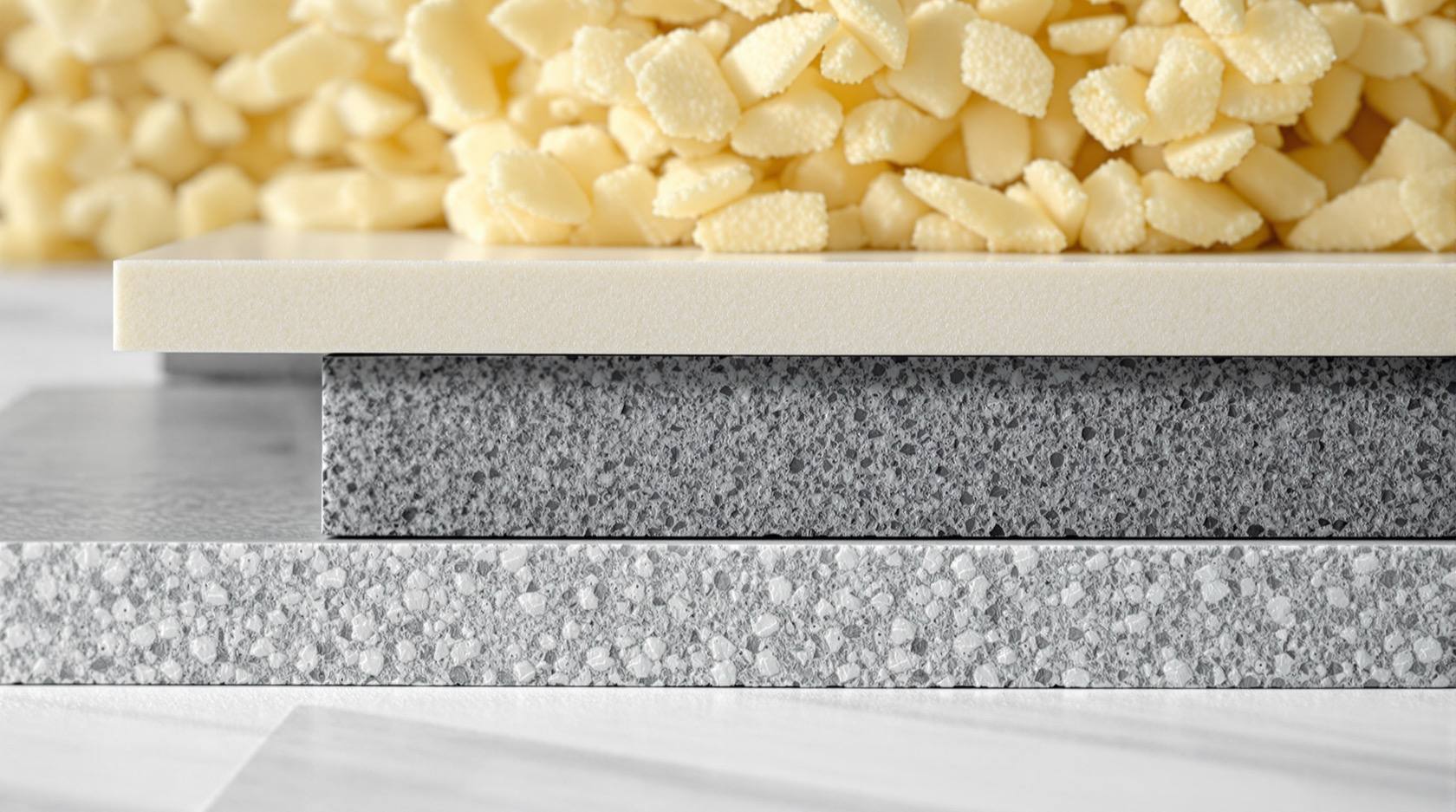
Acoustic Insulation Materials in India: Soundproofing Products Explained (2026)
The materials that quiet a room and block noise between rooms - mineral wool, acoustic gypsum, mass-loaded vinyl, resilient channels, damping compound and seals. What each does, where it goes, indicative cost, and why soundproofing is always a system, not a single product.
Ask ten showrooms for "soundproofing material" and you will be handed ten different things - egg-crate foam, a heavy black sheet, a fluffy grey slab, a tube of goo. Each is real, each does something, and none of them on its own will turn a noisy bedroom into a quiet one. Sound control is a system: several materials, each doing one job, working together inside a well-built wall or floor.
This guide helps you choose and specify the materials that go into quiet spaces - a home theatre, a bedroom facing a busy road, a party wall between two flats, a small studio. It does not design the room for you: acoustic design, target ratings and on-site testing belong to an acoustic consultant. What follows is the shopping knowledge that lets you brief that professional well and buy the right things.
Scope and honesty note: This is a material selection guide. Ratings, thicknesses and prices here are indicative only - they move with brand, construction and region, so get local quotes and the manufacturer's tested data. Real acoustic performance depends on the whole assembly and the quality of the build, not on any single product, and a genuine STC/Rw target should be set and verified by an acoustic consultant. Be sceptical of any product sold as a one-step "soundproof" fix - the big claims are usually oversold. Structural changes, floating floors and studio design are professional work.
Two different problems: absorption vs insulation
Almost every soundproofing mistake starts by confusing two completely different jobs.
Sound absorption reduces the echo and reverberation inside a room. Hard bare surfaces bounce sound around so a room feels loud, boomy and harsh. Soft, porous materials - foam, fabric, porous panels, exposed mineral wool - soak up that reflected energy and make the room sound calmer and clearer. Absorption is measured by the Noise Reduction Coefficient (NRC), from 0 (fully reflective) to about 1 (fully absorptive). Absorption does not stop sound leaving the room - a wall of foam will make a recording sound cleaner but your neighbour will still hear the drums.
Sound insulation (also called transmission loss) stops airborne sound passing from one room to another through a wall, floor or ceiling. This is what you want when the problem is traffic outside, a TV next door, or a snoring flatmate. It is rated by STC (Sound Transmission Class, the North American index) or Rw (the ISO/European index) - both single numbers where higher is better. A flimsy single-layer partition might rate STC 30 to 35; a well-built acoustic party wall reaches STC 55 to 60-plus.
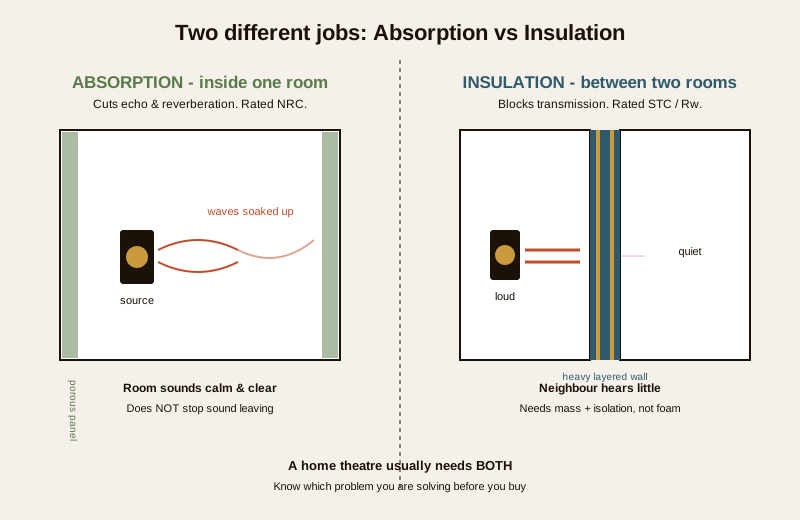
The two overlap - some materials help a little with both - but you must know which problem you are solving. A home theatre usually needs both: absorption so the room sounds good, and insulation so the film's explosions do not travel to the bedrooms.
The five principles that actually block sound
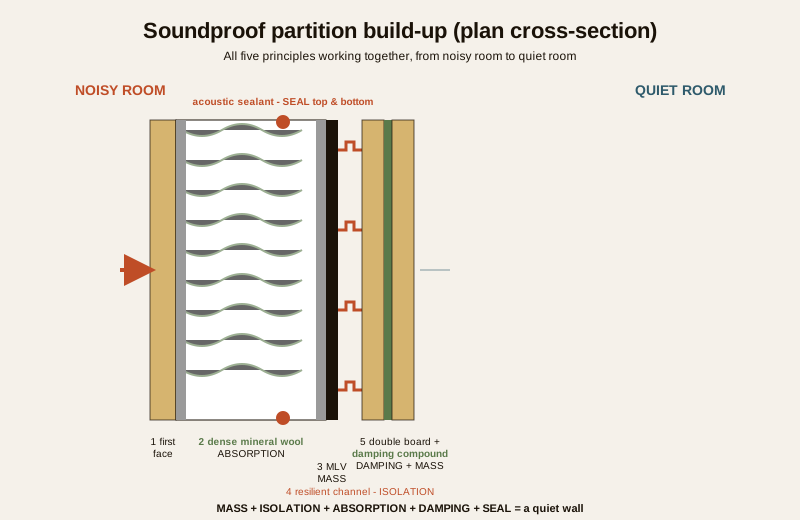
Insulation - the harder problem - obeys five simple physical principles. Every good soundproofing material is just one of these principles in a bag.
- Mass. Heavy, dense barriers are harder for sound to shake. Doubling the mass of a wall gives a worthwhile improvement. This is why a thick masonry wall already outperforms a thin drywall - and why adding dense layers helps.
- Isolation (decoupling). If the two faces of a wall are physically connected, vibration passes straight through. Break that path - with resilient channels, isolation clips or a double stud frame - and sound has to jump a gap, which it does poorly.
- Absorption. A soft, porous fill inside the wall cavity (mineral wool) soaks up the sound energy rattling around inside the void, so less of it reaches the far face.
- Damping. A visco-elastic layer sandwiched between two rigid boards converts vibration into a tiny amount of heat, killing the "ringing" resonance of the panel.
- Seal the gaps. Sound is like water - it pours through any unsealed gap, crack, socket or door edge. A wall that is 99 percent built but has open perimeter joints can leak enough sound to waste everything else. Sealing is the cheapest, highest-value step.
Remember them as mass, isolation, absorption, damping, seal. A serious quiet wall uses all five, and no single product delivers all five - which is exactly why soundproofing is a system.
The materials, one by one
Mineral wool and glass wool - the cavity workhorse
Dense rock (mineral) wool or glass wool slabs packed into the stud cavity are the absorption layer of almost every acoustic wall, floor and ceiling in the country. They are cheap, non-combustible and highly effective at soaking up sound inside the void. For acoustics you want a reasonably dense slab (commonly 48 to 100 kg/m3) rather than the lightest thermal batt. This is the single most cost-effective acoustic material you will buy. See our dedicated guides on rock wool insulation and glass wool insulation, and the wider building insulation materials guide.
Acoustic-grade gypsum and high-density board - the mass
Extra layers of gypsum board add the mass that blocks sound. Standard board works, but heavier "acoustic-grade" high-density gypsum boards deliver more transmission loss per layer, and two staggered layers beat one thick one. Fibre-cement and calcium-silicate boards also add useful mass. Our gypsum boards guide, cement boards and fibre-cement and calcium silicate boards cover the board options.
Mass-loaded vinyl (MLV) - a limp heavy barrier
MLV is a thin, dense, flexible sheet (often around 5 to 8 kg/m2) made from vinyl loaded with heavy mineral fillers. Because it is limp and heavy, it adds mass without stiffness - ideal as a barrier layer inside a wall, over a ceiling, or wrapped around a noisy pipe or duct. It is one of the more expensive materials per sq ft and is a barrier, not an absorber - it does nothing for room echo. Use it where you need mass but cannot add another rigid board.
Resilient channels and isolation clips - decoupling
These are the isolation principle in metal form. Resilient channels are springy metal strips fixed across the studs; the board screws to the channel, not the stud, so vibration is broken. Isolation (sound) clips with a rubber element, carrying furring channel, do the same job better. Both decouple the wall's two faces and can add several STC points - but only if installed exactly right (a single screw touching the stud "short-circuits" the whole thing). This is precisely the kind of detail to leave to a trained installer following the tested system.
Damping compound (Green Glue type)
A visco-elastic damping compound spread between two boards before screwing them together turns the sandwich into a constrained-layer damper, killing panel resonance. It is applied wet from a tube like a thick adhesive, and needs a curing period to reach full effect. Cheap, easy to add during a double-board build, and a genuine performer - one of the few "add-on" products that earns its place.
Acoustic sealant - seal the gaps
A permanently flexible acoustic sealant seals the perimeter of the wall, board joints, and around sockets and penetrations, so sound cannot leak through gaps. It stays soft (unlike rigid caulk) so the joint keeps sealing as the building moves. It is cheap and unglamorous but skipping it undoes everything else. See our sealants guide for the wider sealant landscape.
Foam and PET absorber panels - in-room absorption only
Open-cell acoustic foam and moulded PET (polyester) panels are absorbers for the inside of the room - they cut echo and tame reverberation. They do not block sound between rooms, despite how they are often marketed. For finished wall-mounted absorbers that also look considered, see our acoustic wall panels guide - this present guide is about the materials inside the build-up, that one is about the panels you see on the wall.
Acoustic underlay - for floors
Under tile, timber or laminate, a resilient acoustic underlay (rubber, cork, foam or engineered mat) reduces impact noise - footsteps and dragged chairs heard in the flat below. Impact noise is rated separately (by an impact index), and underlay plus a proper floating detail is the usual fix.
Acoustic door and window seals
A room is only as quiet as its weakest element, and that is almost always the door. A standard hollow-core door and its gaps can leak more sound than the whole wall around it. Acoustic seals (perimeter gaskets plus an automatic drop-down bottom seal) and a solid-core or purpose-built acoustic door make a large difference. For glazing, laminated and double glazing cut outside noise - see the windows hub and glass and glazing hub.
A material-by-material comparison
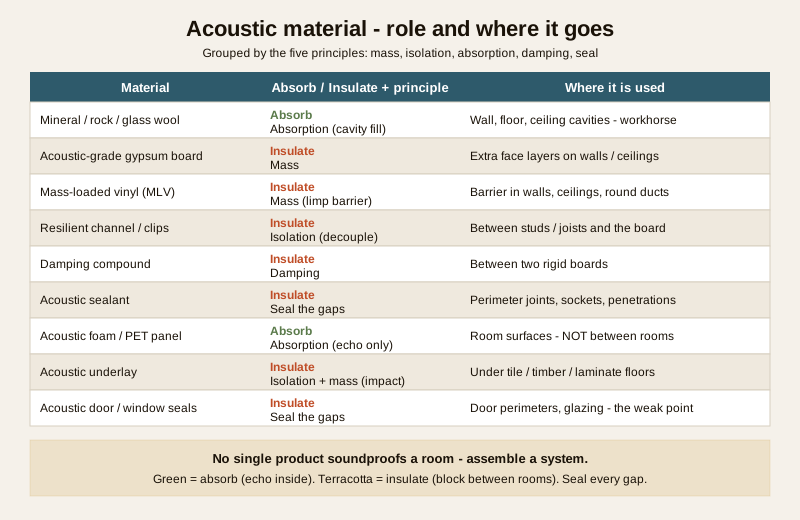
Which principle does each material serve, and where does it go? Use this to assemble a system rather than buy a single "magic" product.
| Material | Absorb or insulate | Principle it serves | Where it is used |
|---|---|---|---|
| Mineral / rock / glass wool slab | Both (mostly cavity absorption) | Absorption | Wall, floor and ceiling cavities - the workhorse fill |
| Acoustic-grade gypsum / dense board | Insulate | Mass | Extra face layers on walls and ceilings |
| Mass-loaded vinyl (MLV) | Insulate | Mass (limp barrier) | Barrier layer in walls, ceilings, around ducts and pipes |
| Resilient channels / isolation clips | Insulate | Isolation (decoupling) | Between studs/joists and the board |
| Damping compound (Green Glue type) | Insulate | Damping | Between two rigid boards |
| Acoustic sealant | Insulate | Seal the gaps | Perimeter joints, board edges, penetrations |
| Acoustic foam / PET panels | Absorb | Absorption | Room surfaces - echo control only |
| Acoustic underlay | Insulate (impact) | Isolation + mass | Under floor finishes |
| Acoustic door / window seals | Insulate | Seal the gaps | Door perimeters, glazing |
Indian applications - what a real system looks like
The right combination depends on the problem. These are indicative starting points to discuss with an acoustic consultant, not finished designs.
| Situation | The problem | A sensible material system |
|---|---|---|
| Home theatre | Both echo inside and sound leaking out | Dense wool cavity, double acoustic gypsum with damping compound, resilient channels, sealed perimeter, plus in-room absorber panels; acoustic door |
| Bedroom facing a busy road | Traffic noise entering through wall and window | Laminated or double glazing with good seals, an added mass layer or MLV on the wall, sealed gaps; the window is usually the weak point |
| Party wall between two flats | Neighbour TV and voices | Independent double-stud or decoupled wall, dense wool fill, double board, damping compound, fully sealed - a masonry-plus-lining system |
| Small home studio | Clean recordings and no leakage | Decoupled, well-sealed shell with dense wool, mass and damping; heavy in-room absorption and bass traps; specialist acoustic design |
Notice what every system shares: mass, a decoupled or heavy structure, cavity absorption, and obsessive sealing. The exotic add-ons help at the margin; the heavy, well-sealed construction does most of the work.
The honest part - why big claims are oversold
A few truths worth more than any product brochure:
- No single product soundproofs anything. A sheet of MLV, a box of foam, or one tube of compound cannot turn a thin wall into a quiet one. Sound control is always a system.
- Heavy construction and isolation matter most. A solid masonry wall or a properly decoupled double-stud wall does more than any bolt-on layer. Get the structure right first.
- Foam is not soundproofing. The most common mistake in India is covering a wall in acoustic foam expecting to block noise. Foam absorbs echo inside a room; it does almost nothing for transmission between rooms.
- Sealing is the cheapest big win. Unsealed gaps, sockets and door edges leak more than people expect. Acoustic sealant and door seals give the best return per rupee.
- Low frequencies are hardest. Bass and traffic rumble pass through walls far more easily than voices. Beating them needs serious mass and isolation - and honest expectations.
- Diminishing returns are real. Going from a bad wall to a good wall is cheap; the last few STC points are expensive. Set a realistic target with a consultant rather than chasing "silence".
Specify the materials with confidence; hand the acoustic design, the target rating and the on-site testing to a professional. The build quality - especially the sealing and the decoupling - decides whether the money you spend on materials is actually heard as quiet.
Standards and testing
Airborne sound insulation is expressed as STC (ASTM method) or Rw (ISO method), and impact sound by a separate impact index; product absorption is given as NRC. In India the National Building Code (SP 7:2026) carries acoustic and habitability provisions, and Bureau of Indian Standards documents cover acoustic measurement and building acoustics generally (named generally here - verify the current editions). Crucially, a lab rating for a wall assembly is achieved only if the wall is built exactly as tested; field performance is always a little lower. Always rely on the manufacturer's tested data for a specific product and an acoustic consultant's design for a specific room, not on generic tables.
Key takeaways
- Absorption (NRC) calms echo inside a room; insulation (STC/Rw) blocks sound between rooms - they are different jobs needing different materials.
- Insulation obeys five principles: mass, isolation (decoupling), absorption, damping, and sealing gaps - a serious quiet wall uses all five.
- The materials map to those principles: mineral/glass wool (cavity absorption), dense gypsum and MLV (mass), resilient channels/clips (isolation), damping compound (damping), acoustic sealant and door seals (sealing), foam/PET panels (in-room echo only).
- Real spaces - home theatre, road-facing bedroom, party wall, studio - need a system, and heavy, well-sealed, decoupled construction does most of the work.
- No single product soundproofs a room; be sceptical of big claims, seal every gap, and hand the acoustic design and testing to a specialist.
References
- National Building Code of India (SP 7:2026) - acoustic, habitability and life-safety provisions relevant to walls, floors and openings.
- Bureau of Indian Standards - standards covering acoustic measurement, building acoustics and mineral wool insulation; consult the current editions.
- ASTM and ISO acoustic methods - STC (transmission class), Rw (weighted sound reduction index), NRC (absorption) and impact-sound indices; refer to the current standards for definitions and test conditions.
- Manufacturer technical data sheets - the authoritative source for a specific product's tested acoustic ratings, density and thickness.
- Studio Matrx guides: rock wool insulation, glass wool insulation, building insulation materials guide, gypsum boards guide, sealants guide, acoustic wall panels and the complete building materials guide.
Export this guide
Related Guides — Deep-dive reading
Soundproof Doors in India: How Doors Leak Sound, STC Ratings, Seals & Real Costs
A door is the weakest acoustic link in any wall - and it usually leaks through the gaps, not the panel - so here is how to actually quieten a bedroom, home theatre or street-facing room, from a 1,500-rupee seal kit to a proper acoustic door.
Home Doors & EntrancesFire-Resistant Building Materials in India: A Specify-and-Select Guide (2026)
The difference between how a material reacts to fire and how long a rated assembly resists it, then the materials that deliver passive fire protection - non-combustible structure, mineral wool, fire-rated boards, intumescent coatings, spray fireproofing and fire-stopping - with a material-to-role selection table.
Building MaterialsDoor Sound Insulation: Improve It Step by Step (India 2026)
The physics of mass, sealing and decoupling — and how to upgrade an ordinary Indian door to genuinely cut the noise coming through it.
Home Doors & EntrancesRelated Tools — Try Free
Acoustic Privacy (STC) Visualizer
Indian healthcare acoustic visualizer — compare wall assemblies and noise sources, see received SPL after STC attenuation, and check FGI 2018 / IS 1950 / NABH speech-privacy compliance with live dual-canvas waveform.
Acoustic ToolAcoustic Window Calculator
Estimate how much outside noise a window blocks and the resulting indoor dB level and comfort.
Window ToolMaterial Schedule Generator
Generate a room-wise finish schedule — walls, floors, ceilings, trim, and joinery by location.
Material Schedule