
Door Sound Insulation: Improve It Step by Step (India 2026)
The physics of mass, sealing and decoupling — and how to upgrade an ordinary Indian door to genuinely cut the noise coming through it.
Most noise complaints in Indian homes — the TV bleeding into a study, traffic into a street-side bedroom, a snoring partner — come through the door, not the wall. A 230mm brick wall blocks sound easily; a hollow flush door and the 5–10mm gaps around it do not. The good news is that door sound insulation is one of the cheapest acoustic upgrades you can make, because four physical levers — mass, damping, sealing and decoupling — are all things you can add to an existing door without rebuilding a wall. This guide is the hands-on how to improve it companion: if you want the product round-up see soundproof doors, and if you want to understand the rating number itself read door STC ratings.
The four levers: how sound actually gets blocked
Sound is airborne energy. A door stops it through four mechanisms, and a good upgrade uses all four together — chasing just one (usually only mass) is the classic mistake.
- Mass. Heavier leaves vibrate less for the same sound energy. This is the single biggest lever: the mass law says doubling the weight of a panel adds roughly 5–6 dB. A 9kg hollow flush door and a 35kg solid-core door are not in the same league.
- Damping. A constrained-damping layer (a viscoelastic compound sandwiched between two boards) converts vibration into tiny amounts of heat, killing the resonance frequencies where a stiff panel "rings" and leaks sound.
- Sealing. This is the one homeowners forget. An unsealed 3mm perimeter gap can leak as much sound as a hole the size of your palm — a door that is acoustically a 35 on paper performs like a 25 if air whistles around it. Air-tight equals sound-tight.
- Decoupling. If the leaf and frame are rigidly coupled, vibration crosses the junction as flanking sound. Resilient perimeter gaskets and a separated stop break that bridge.
What "good" sounds like in real decibels
We describe door performance with STC (Sound Transmission Class) or the metric Rw; higher is better, and roughly every 10 points halves perceived loudness. Be honest about expectations — numbers below are achievable, real-world bands, not lab marketing claims.
| Door build | Typical STC / Rw | What you'll hear |
|---|---|---|
| Hollow flush door, unsealed | 18–22 | Speech intelligible through it |
| Solid-core door, unsealed | 28–32 | Loud speech audible, muffled |
| Solid-core + full perimeter seals + drop seal | 33–38 | Normal speech inaudible, loud TV faint |
| Engineered acoustic door + seals + threshold | 38–45 | Only heavy bass/impact gets through |
| Acoustic door-set, double-leaf or airlock lobby | 45–55 | Home-theatre / studio territory |
Notice the jump from line 1 to line 3: most of it comes from sealing, which costs a few thousand rupees, not from buying a fancier leaf. Sealing is always the best rupee-per-decibel you can spend. For the measurement theory behind these numbers see door acoustic performance.
Upgrading an existing door, in order of value
Work down this list and stop when the room is quiet enough — you rarely need all of it.
1. Seal the perimeter and the bottom gap first
Fit compression seals (silicone or EPDM gaskets, or a kerf-in acoustic gasket) into the frame rebate on the head and both jambs so the closed leaf squeezes against them. Then close the bottom gap — the worst offender — with either a brush/wipe seal or, far better, an automatic drop-down bottom seal that lowers a gasket onto the floor as the door shuts and lifts when it opens (so it clears rugs). This is the detailing covered in depth in acoustic door seals, and it overlaps with door draught proofing performance — the same air-tightness that keeps noise out keeps your AC in.
2. Add mass to the leaf
If the leaf is hollow, the cheapest real gain is to replace it with a solid-core leaf (particleboard-core or solid timber). If replacement isn't possible, bond a layer of mass-loaded vinyl (MLV) or a dense MDF/cement-board skin to the face and finish over it — this raises weight and adds a damping interface. Remember to check your hinges and frame can carry the extra load; a 35kg door needs three good hinges, not the two flimsy ones on a hollow door.
3. Add a damping / decoupling sandwich for the last few decibels
For a home theatre, build the leaf as two boards with a constrained-damping compound between them, and isolate the frame from the wall with a resilient sealant bead rather than rigid mortar. This is where you move from "quiet bedroom" to "studio", and it is the most expensive and least DIY-friendly step.
Detailing the door-in-frame
A brilliant leaf in a sloppy frame is wasted money. The acoustic performance of the door-set — leaf, frame, seals and threshold as a system — is what you actually experience.
| Element | Weak detail | Acoustic detail |
|---|---|---|
| Frame fixing | Foam-only gaps, hollow voids behind jamb | Frame packed solid (acoustic sealant / mortar), no air paths around it |
| Stop / rebate | Flat stop, leaf rattles | Deep rebate with compression gasket the leaf seats into |
| Bottom of leaf | Open undercut over hard floor | Automatic drop seal onto a sealed threshold strip |
| Hardware | Through-holes for handles/locks | Gaskets behind escutcheons; avoid letterbox/ventilation cut-outs |
| Glazing (if any) | Single pane | Laminated or double glazing with an air gap |
Key principle: there must be no air path that bypasses the seals. Keyholes, gaps behind a loose frame, an undercut over tiles, or a ventilation grille will each defeat an otherwise excellent door. Treat the assembly the way you would a window — it only performs as well as its leakiest point.
Room-specific targets
Don't over-specify — a guest WC doesn't need a recording-studio door. Match the upgrade to the room.
- Bedroom (privacy from a passage or living room): solid-core leaf + full perimeter seals + drop seal. Target STC ~33–38. A few thousand rupees; the highest-value upgrade in most homes.
- Study / WFH room (calls and concentration): same as bedroom, and seal any AC sleeve or grille that bypasses the door.
- Home theatre / music room: acoustic door-set, ideally a heavy engineered leaf, decoupled frame, drop seal onto a solid threshold — or an airlock lobby with two doors for serious bass. Target STC ~40–50.
- Apartment main door (corridor noise + security): a solid leaf you likely already have for security; add a kerf gasket and drop seal. Coordinate with fire-rating rules — don't fit anything that voids a required fire door.
Because the same mass-and-seal physics governs heat and draughts, an acoustic upgrade usually improves comfort too; see how this ties into the building envelope in the cluster's complete door guide and the door acoustic performance pillar.
What it costs, as a rule of thumb
As an indicative guide (₹, before 18% GST, materials plus fitting, varying by city and brand):
| Upgrade | Indicative cost | dB gain you can expect |
|---|---|---|
| Perimeter compression seals (DIY-able) | ₹800–2,500 | +3 to +6 |
| Automatic drop-down bottom seal | ₹1,500–4,500 | +3 to +6 |
| Swap hollow leaf for solid-core | ₹4,000–12,000 | +8 to +12 |
| MLV / dense-skin mass layer on existing leaf | ₹3,000–8,000 | +4 to +8 |
| Full engineered acoustic door-set | ₹18,000–60,000+ | reaches STC 40–50 |
The pattern is clear: the first ₹3,000–5,000 (seals + drop seal) buys the most decibels per rupee, and you only climb the expensive steps for theatres and studios. Estimate the heat-and-air side of the same upgrade with the door air leakage calculator, and weigh the energy-comfort case with the door energy savings calculator.
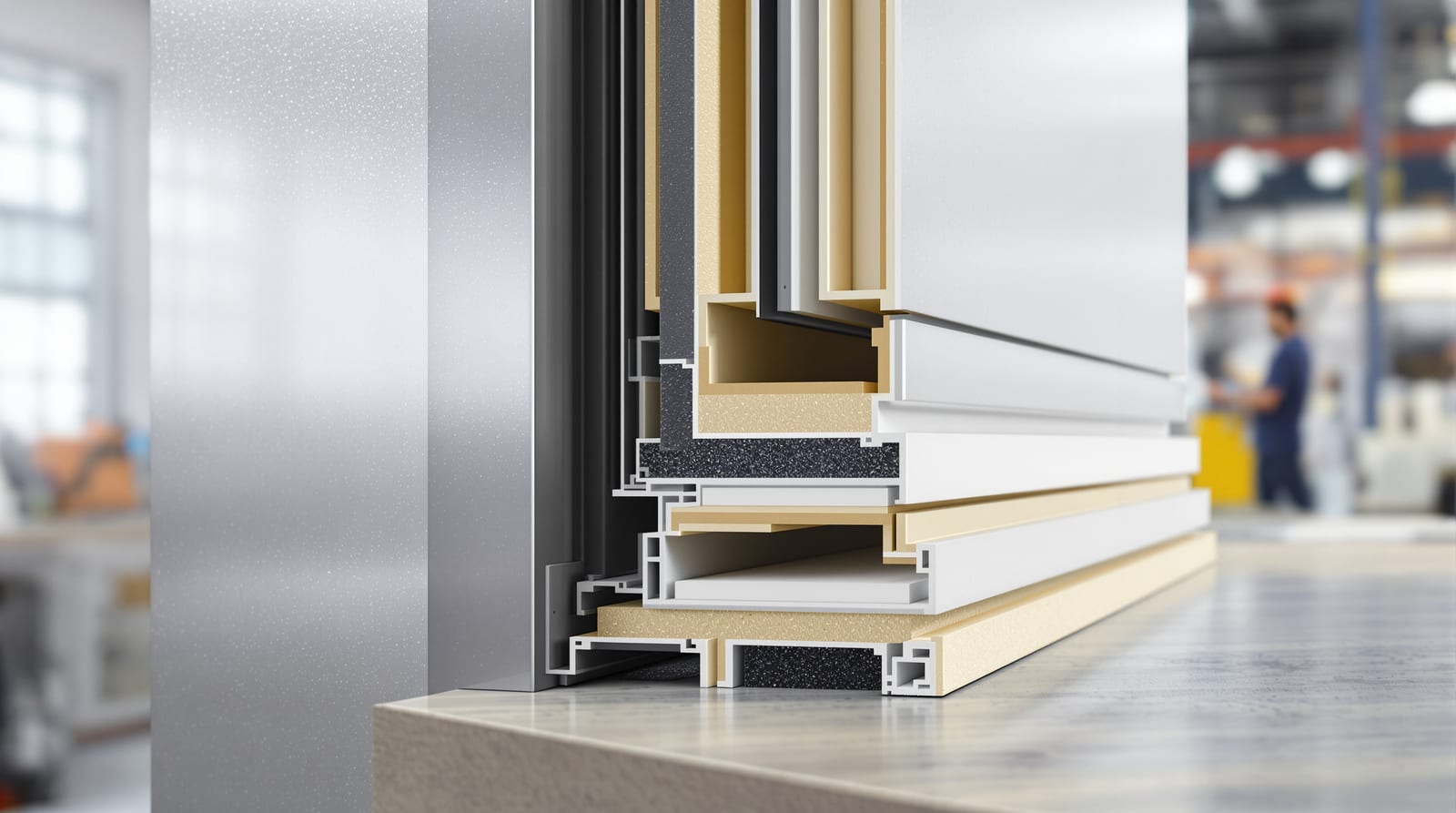
The sound-insulation layers, illustrated
Honest limits
Three truths keep expectations realistic. First, you cannot make a door better than the wall around it — if the partition is a thin block wall or has open AC sleeves, fix those too or the door won't help. Second, low-frequency bass (a home theatre, a sub-woofer) is the hardest to stop and needs mass plus an airlock, not just seals. Third, fire-rated doors have rules: never modify a required fire door in a way that voids its certification. Get the basics — mass and a sealed perimeter — right first; they deliver the overwhelming majority of the benefit at a fraction of the cost.
Frequently asked questions
What's the single cheapest way to make a door quieter?
Seal the gaps. A set of perimeter compression seals plus an automatic drop-down bottom seal costs a few thousand rupees and typically adds 5–10 dB — more decibels per rupee than any other step, because unsealed gaps leak sound out of proportion to their size.
Will a solid-core door alone solve my noise problem?
It helps a lot (an unsealed hollow door at STC ~20 versus a solid-core at ~30), but an unsealed solid door still leaks through the perimeter. Always pair the heavier leaf with full seals — mass and sealing together, not either alone.
How much sound reduction can I realistically expect?
A bedroom upgrade (solid-core + seals + drop seal) reaches roughly STC 33–38, which makes normal speech inaudible and a TV faint. Home-theatre levels (STC 40–50) need an engineered acoustic door-set or a two-door airlock and cost much more.
Does MLV (mass-loaded vinyl) actually work on a door?
Yes, as added mass and a damping interface bonded to an existing leaf — it can add a few decibels without replacing the door. But check your hinges and frame can carry the extra weight, and it is less effective than simply fitting a proper solid-core leaf.
Why is bass from my neighbour's music so hard to block?
Low frequencies carry more energy and are governed even more strongly by the mass law, so they need heavy leaves, decoupled frames and ideally an airlock lobby. Seals alone barely touch deep bass; only added mass and decoupling do.
Can I soundproof a fire-rated apartment door?
Only with care. Never make a modification that voids the fire certification. You can usually fit compatible intumescent-and-acoustic seals and a certified drop seal, but use products rated for fire doors and confirm with the door manufacturer rather than improvising.
Export this guide
Related Guides — Deep-dive reading
Soundproof Doors in India: How Doors Leak Sound, STC Ratings, Seals & Real Costs
A door is the weakest acoustic link in any wall - and it usually leaks through the gaps, not the panel - so here is how to actually quieten a bedroom, home theatre or street-facing room, from a 1,500-rupee seal kit to a proper acoustic door.
Home Doors & EntrancesDoor Acoustic Performance: STC & Sound Control (India 2026)
How sound travels through and around a door, what STC ratings really mean, and what makes a door genuinely quiet in an Indian home.
Home Doors & EntrancesHome Theatre Door in India: Acoustic Sealing, STC Ratings and Costs (2026)
Why a normal door ruins a media room - and how to spec a heavy solid-core acoustic door with full perimeter seals, a drop-down bottom seal, light-tight finish and (for serious rooms) a double-door airlock.
Home Doors & EntrancesRelated Tools — Try Free
Acoustic Privacy (STC) Visualizer
Indian healthcare acoustic visualizer — compare wall assemblies and noise sources, see received SPL after STC attenuation, and check FGI 2018 / IS 1950 / NABH speech-privacy compliance with live dual-canvas waveform.
Acoustic ToolWindow Hardware Cost Calculator
Estimate window hardware cost — hinges, handles, locks, rollers and multipoint gears.
Window CalculatorAcoustic Window Calculator
Estimate how much outside noise a window blocks and the resulting indoor dB level and comfort.
Window Tool