
Zaha Hadid's Façade Signature: The Seamless Parametric Skin (And What It Teaches India)
How Zaha Hadid turned façades into single flowing surfaces built from thousands of unique GFRC panels — a spectacular, mega-budget, climate-poor icon whose real gift to India is the parametric method, not the smooth swooping look.
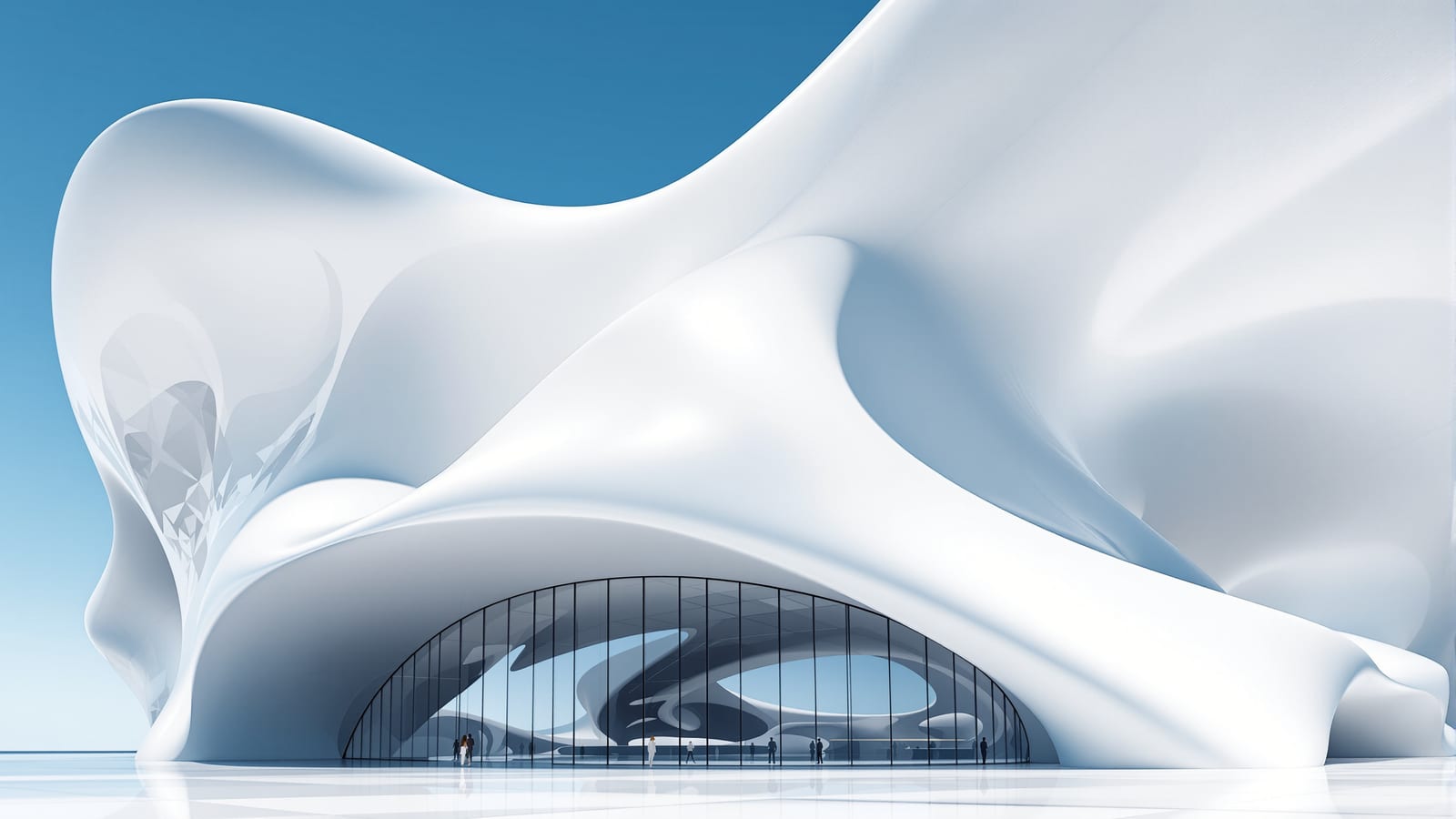
Most buildings have walls, then a roof, then windows — three different things, meeting at corners. Zaha Hadid spent a career erasing those corners. In her work the wall does not stop and hand over to the roof; it curves up, becomes the roof, folds back down, lifts off the ground and dives back into it — one continuous skin, flowing like poured liquid that froze mid-motion. Stand in front of the Heydar Aliyev Center in Baku and you genuinely cannot point to where the ground ends and the building begins. That is the signature: not a shape, but the abolition of the join.
It looks impossibly smooth — a single white sheet draped over a city block. It is not. That seamless skin is an illusion assembled from thousands of individually-shaped panels, each one slightly different from its neighbour, hung on a fiendishly complex steel sub-frame, with the joints hidden so well your eye reads it as one surface. To design and build something where every panel is unique, Hadid's office leaned on a method as important as the look itself: parametricism — letting algorithms, not a draughtsman's hand, generate and control the geometry. That method is the real story, and as we will argue, it is the only part of her signature India should actually copy.
This is part of our Building Façades series — specifically our Masters of the Façade set, where we study how one great architect treated the building's skin. Zaha Hadid is the master of the fluid, seamless, parametric façade. To place her ideas in an Indian context, read this alongside our guide to smart, kinetic and parametric façades, the Morphogenesis façade signature (which uses the very same parametric tools but points them at climate, the right way), our concrete façades guide (the GFRC that makes the curves), the glass curtain-wall façades guide, and the energy-efficient façades guide. We will be honest throughout: Hadid's skin is breathtaking and the wrong thing to literally copy in Indian heat.
1. The seamless continuous skin: a façade with no corners
The first and biggest idea is the seamless continuous skin — a façade conceived as one uninterrupted surface in which wall, roof and floor merge into each other. There are no obvious "elevations" (front, side, rear) the way a conventional building has; there is just a single morphing envelope that you walk around and under.
Hadid described the Heydar Aliyev Center as a fluid form that "emerges by the folding of the landscape's natural topography." That is the whole move: the ground plane lifts, peels and wraps to become the building, then settles back. The corner — architecture's most basic, most honest joint, where two planes meet at an angle — is treated as something to be dissolved. A double-curved surface (a surface that curves in two directions at once, like a saddle or a hill, not a simple barrel) is the geometric tool that makes this possible. You cannot flow without double curvature; a flat or singly-curved surface always reveals an edge.
The effect is sculptural and, frankly, magnificent. It is also the source of every cost and climate problem we will get to, because a smooth continuous surface is wonderful for drama and terrible for shade.
2. Parametricism: the façade generated by parameters, not drawn by hand
Parametricism / parametric design is the design philosophy underpinning all of it — theorised most loudly by Hadid's long-time partner Patrik Schumacher, who in 2008 declared it the great new style after Modernism. In parametric design, the form is not drawn directly. Instead the designer sets up parameters and rules — curvature, panel size, the way a surface responds to a point of attraction — and the software generates the geometry. Change a parameter and the whole façade re-computes.
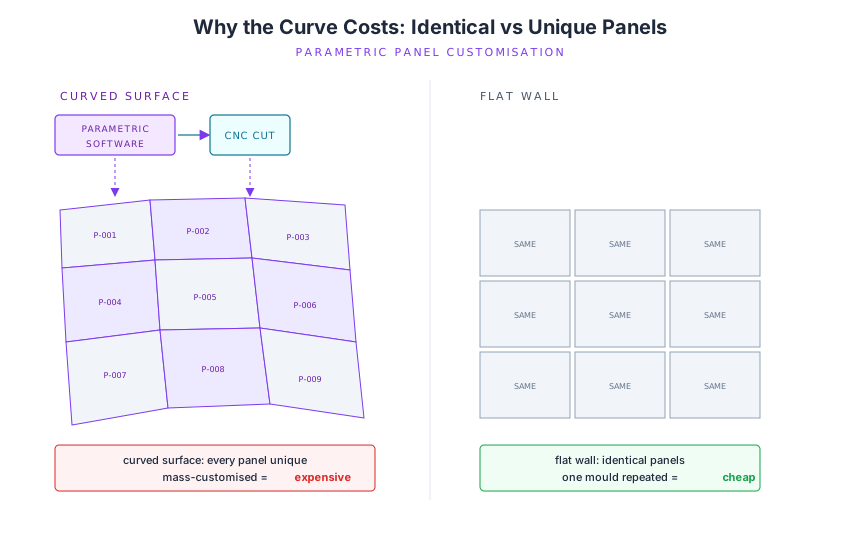
Why does this matter for a façade specifically? Because a smooth double-curved skin contains thousands of panels, and on a curved surface no two panels are the same shape. A human cannot draw 45,000 different panels by hand and keep them coordinated. An algorithm can. Parametricism is what makes a differentiated façade — one where every element varies smoothly across the surface — buildable at all. It is a genuinely powerful idea, and it is the idea India should take.
3. Frozen motion and fluidity: the painting roots
Hadid trained her eye on the Russian avant-garde. Her famous student thesis, "Malevich's Tektonik," reworked the Suprematist painter Kazimir Malevich into architecture, and her early career was full of explosive, fragmented, motion-filled paintings before she could ever build them. When the technology finally caught up, those paintings became buildings.
That history is why her façades read as frozen motion / fluidity — they look like they are flowing, accelerating, liquefying, caught and held mid-movement. The Galaxy SOHO in Beijing reads as four smooth, tiered mountains melting into one another with no straight line in sight. This is not decoration applied to a box; the movement is the building. It is the emotional core of her signature, and it is real and worth admiring even if you would never build it in Chennai.
4. GFRC, fibre-composite and panelised double-curved cladding: what actually makes the curve
Here is the part renders never show you. A flowing white skin is built from one of a small family of materials that can be cast or moulded into smooth curves:
- GFRC / GRC (glass-fibre-reinforced concrete) — concrete reinforced with glass fibres instead of steel bars, so it can be cast thin (a few centimetres) and into complex shapes. This is the classic Hadid "white skin" material, used widely on the Heydar Aliyev Center. See our concrete façades guide.
- Fibre-composite GRP / GFRP panels — glass-reinforced polymer (fibreglass), lighter still, mouldable into deep double curves, used where weight matters.
- Cold-bent / curved glazing — flat glass bent (cold-bent on site, or heat-curved in the factory) to follow a curving frame, so the glass can flow with the solid panels.
Each panel sits on the sub-frame (secondary structure) — a dense, bespoke web of steel members behind the skin whose only job is to hold each unique panel at exactly the right point in space. The smooth surface you see is a thin skin; behind it is a forest of steel. This is why these buildings are expensive: you are not just buying cladding, you are buying a one-off structural geometry behind it.
The seamless skin and parametricism: how a flowing façade is really built
Put the pieces together and the magic trick is visible. A double-curved digital surface is generated parametrically. Software then "rationalises" it — divides the smooth surface into a buildable grid of panels and works out the exact shape of every single one. Because the surface curves in two directions, almost every panel is a mass-customised piece: a unique shape, made individually.
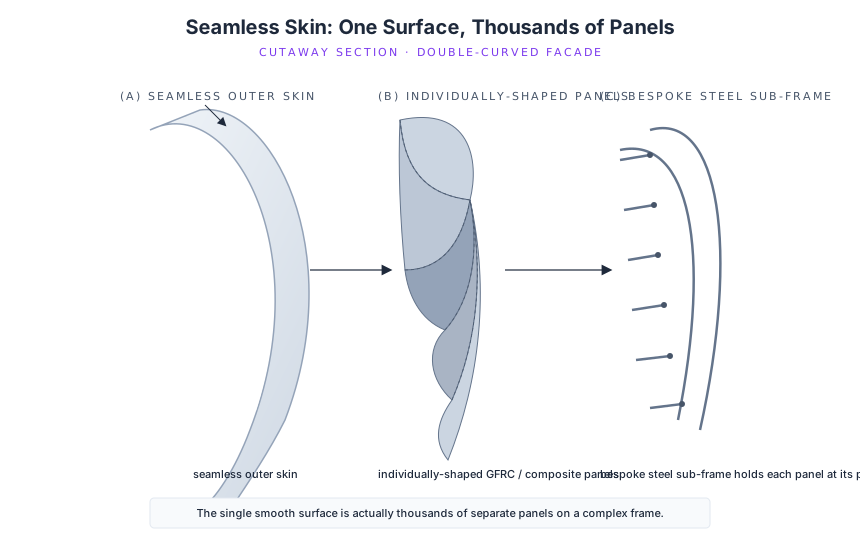
Then comes digital fabrication / CNC — computer-controlled machines cut moulds and panels straight from the digital model, so each unique GFRC or composite panel can actually be produced. Every panel carries an ID; the model tells the crew exactly where each one goes. The joints between panels are detailed to be as thin and shadow-free as possible so the eye blends them into one continuous skin.
The Dongdaemun Design Plaza in Seoul is the textbook case: its envelope is clad in roughly 45,000 aluminium panels, a large share of them uniquely shaped, coordinated through BIM and a space-frame structure and produced with digital fabrication. The Heydar Aliyev Center achieves its even smoother, whiter seamlessness with a GFRC-and-glass skin over a vast bespoke space frame. Both are extraordinary. Both also tell you, plainly, what this costs: thousands of one-off panels, a one-off steel geometry, years of computation and fabrication. There is no cheap version of a seamless skin.
5. The diagrid and exoskeleton on curved towers
On her towers, Hadid often pulls the structure to the outside as the diagrid / exoskeleton — a diagonal lattice of structural members wrapping the building's skin, doing the structural job and becoming the façade's pattern at the same time. The Morpheus Hotel in Macau is the clearest example: a free-form block with two voids punched through it, held up by an external woven exoskeleton that is unmistakably the face of the building. One Thousand Museum in Miami wears a curving white exoskeleton; the Leeza SOHO in Beijing twists a soaring atrium. The lesson: structure and skin need not be separate layers — sometimes the structure is the façade.
6. Interior-exterior continuity: the skin folds inside
Because the envelope is one continuous surface, it frequently does not stop at the door. The skin folds through the glazing and continues inside as floors, ramps, ceilings and walls, so the flowing language of the outside becomes the flowing language of the lobby. This is why a Hadid interior feels like being inside the same object you saw from the street. It is a beautiful idea — and it deepens the cost, because now the bespoke geometry has to be detailed indoors too.
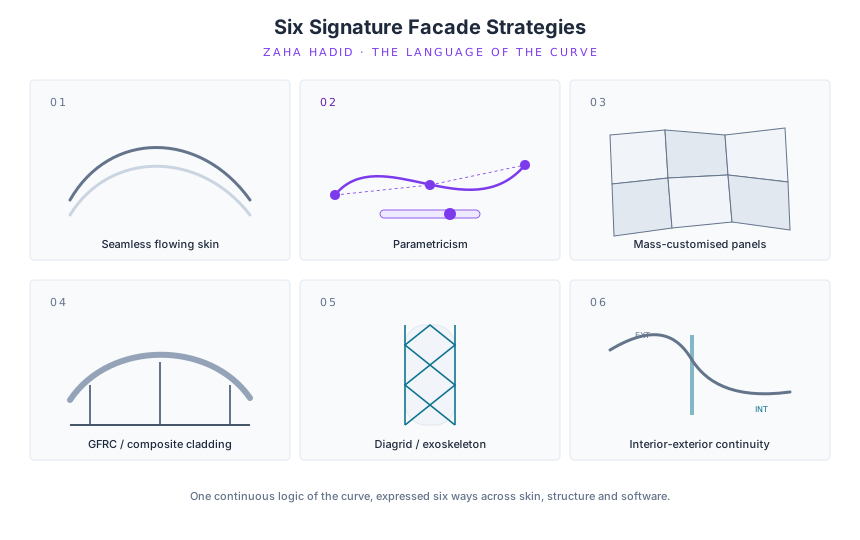
7. Signature strategies at a glance
| Strategy | What it is | Building | Why she did it | Honest India verdict |
|---|---|---|---|---|
| Seamless continuous skin | Wall, roof, ground merge into one double-curved surface; no corners | Heydar Aliyev Center, Baku | Dissolve the building into the landscape; pure fluidity | Spectacular but climate-poor — a smooth curved surface self-shades almost nothing; bakes in Indian sun |
| Parametricism | Form and panels generated and controlled by algorithms | Across the studio | Make differentiated, complex geometry buildable | The genuinely transferable gift — borrow the method, point it at shade |
| Mass-customised panels | Every panel a unique shape, CNC-fabricated | Dongdaemun Design Plaza (~45,000 panels) | Tile a curved surface where no two panels match | Extremely expensive and slow; a bespoke, mega-budget proposition |
| GFRC / composite cladding | Thin glass-fibre concrete or fibreglass cast into curves on a sub-frame | Heydar Aliyev Center | The only way to get a smooth white double-curved skin | Workable material, but the bespoke moulds + sub-frame are costly; dust and monsoon make a white seamless skin hard to maintain |
| Curved / cold-bent glazing | Flat glass bent to follow the curve | Galaxy SOHO, Guangzhou Opera House | Let glass flow with the solid skin | Curved glass with little shading is a solar oven in India |
| Diagrid / exoskeleton | External structural lattice as the façade | Morpheus Hotel, Macau | Structure becomes the skin's expression | Interesting and adaptable; the diagonal lattice can itself be a shading device if designed for sun |
Real buildings, not renders
Heydar Aliyev Center, Baku (Zaha Hadid Architects, completed 2012; Design of the Year 2014). The purest seamless skin she built — a white GFRC-and-glass surface that rises out of the plaza, swoops over the building and dives back to the ground as one continuous fold, carried on an enormous bespoke space frame. There is genuinely no readable corner. It is also a masterclass in expense.
Dongdaemun Design Plaza, Seoul (Zaha Hadid + Samoo, opened 2014). A smooth, silvery, mushroom-like mass clad in roughly 45,000 aluminium panels, a large proportion of them uniquely shaped, coordinated through BIM with a mega-truss and space-frame structure and produced by digital fabrication. The flagship demonstration of mass-customised panelisation.
Galaxy SOHO, Beijing (completed 2012). Four flowing, tiered, rounded volumes melting into one another with smooth bridges, all curves and no corners — frozen motion at urban scale, in white aluminium and curved glass.
Guangzhou Opera House, China (completed 2010). Her "twin boulders" or "double pebble" — two organic stone-and-glass masses conceived as rocks washed smooth by the Pearl River. The façade pairs exposed granite with glass-clad steel framing, a more grounded, geological version of the fluid language.
Morpheus Hotel, Macau (completed 2018, posthumous). A free-form block with sculpted voids, held and expressed by an external woven exoskeleton — the diagrid strategy at full volume, structure and façade fused into one.
What it teaches India
Be very clear-eyed here. Zaha Hadid's fluid, seamless, parametric façade is one of the genuine wonders of contemporary architecture, and her influence on the whole profession is enormous. But almost everything about the literal look is wrong for India.
A smooth continuous double-curved surface has, by definition, very little self-shading — there are no deep reveals, no overhangs, no fins, nothing to throw a shadow on the wall. Curved and cold-bent glazing, beautiful as it is, lets the sun straight in; in a hot-dry or warm-humid Indian climate that is a cooling-load disaster (see our glass curtain-wall façades and energy-efficient façades guides). The seamless skin is built from thousands of unique bespoke GFRC or composite panels on a one-off steel sub-frame — extremely expensive to design, fabricate and erect, and a real maintenance burden once Indian dust films a pristine white surface and the monsoon tests every concealed joint. Her work is, frankly, icon architecture on a mega-budget. The "parametric curvy building" copied onto an Indian site is, almost every time, costly climate-poor spectacle.
So separate the two halves of her signature. The look — the smooth swooping icon — leave it. The method — parametricism, the computational design workflow — take it, and point it somewhere useful. This is exactly what our own Morphogenesis façade signature shows: the same parametric and computational tools Hadid championed, used not to make a smooth icon but to compute a façade for performance — to optimise shading, sun angles, daylight and views, and to generate a performative jaali whose every aperture is sized by the sun it faces. That is the right way to be parametric in India. If you want the wow of complex, differentiated geometry, aim the algorithm at climate — let the computation earn its keep by keeping the building cool — rather than at a continuous shape that bakes.
Borrow the tool, not the look. Use parametric software to make a shaded, breathing, view-aware façade — a smart screen, a deep brise-soleil, a computed jaali, the strategies in our smart, kinetic and parametric façades guide — and you have taken the most valuable thing Zaha Hadid ever gave architecture without taking the heat, the cost and the maintenance headache that come with the smooth white skin.
What this means for you
If you are a homeowner or developer who loves the Hadid look, understand what you are buying before you brief an architect for a "parametric" or "flowing" building: thousands of unique panels, a bespoke steel geometry, big money, and a façade that — in Indian sun — will need serious extra shading and serious cleaning. Ask your architect the honest question: is the curve doing any climate work, or is it pure spectacle you will pay to cool forever?
If you are an architect or student, fall in love with the method, not the mannerism. Learn the parametric and computational tools — they are the future and they are genuinely powerful — and then do the harder, better thing: use them to optimise a façade for the Indian sun. Compute a jaali. Size every shading fin to its orientation. Make the complexity perform. That is the Hadid legacy worth inheriting. The smooth white skin is a photograph; a computed, climate-responsive façade is a building that works.
Sources
- Encyclopaedia and project records, "Zaha Hadid" — born 1950 Baghdad, died 2016; first woman to win the Pritzker Architecture Prize (2004); first woman individually awarded the RIBA Royal Gold Medal (2016); thesis "Malevich's Tektonik," Suprematist influence.
- "Heydar Aliyev Center" — Zaha Hadid Architects, completed 2012; fluid folded-landscape form; GFRC-and-glass skin; Design Museum Design of the Year 2014.
- "Dongdaemun Design Plaza" — Zaha Hadid with Samoo Architects & Engineers, opened 2014; BIM, mega-truss and space-frame structure; aluminium envelope of roughly 45,000 panels per Zaha Hadid Architects project documentation.
- "Guangzhou Opera House" — Zaha Hadid, completed 2010; "double pebble" concept; granite and glass-clad steel.
- Patrik Schumacher, "Parametricism: A New Global Style for Architecture and Urban Design" (2008) — definition of parametricism.
- Zaha Hadid Architects project pages — Galaxy SOHO (2012), Morpheus Hotel Macau (2018), One Thousand Museum (2019), Leeza SOHO (2019); GFRC/composite cladding and exoskeleton descriptions.
- Studio Matrx in-house: smart, kinetic and parametric façades, Morphogenesis façade signature, concrete façades.
Export this guide
Related Guides — Deep-dive reading
Heydar Aliyev Center: How Zaha Hadid Dissolved the Wall into a Wave
Zaha Hadid Architects' cultural centre in Baku turns a city plaza into a single continuous surface that folds up into a building — the definitive case study in parametricism, its column-free structure, its 40,000 m² of computer-cut skin, and the politics the fluid form cannot quite smooth over.
The Future of ArchitectureGuangzhou Opera House: Zaha Hadid's Twin Boulders and the Gap Between the Smooth Dream and the Faceted Reality
Zaha Hadid Architects' first completed building in China casts the opera house as two river-worn stones on the bank of the Pearl River. This deep study reads its landscape metaphor, the faceted granite skin that translated a smooth digital surface into flat panels on a steel frame, the constellation-lit auditorium tuned by Marshall Day, and the cracks that appeared within a year of opening.
The Future of ArchitectureLouis Kahn's Façade Signature: Wrapping Ruins, Brick Arches, and Monumental Light
How Louis Kahn shaded the glass behind giant geometric screen walls, asked the brick to be an arch, and built monumental façades of fair-faced concrete and light — and what that hot-climate logic teaches Indian builders today.
Building FacadesRelated Tools — Try Free
Brise-Soleil Visualizer
Interactive horizontal-louvre cut-off angle calculator — sun altitude, louvre depth, and spacing inputs with a live shadow preview. Computes θ = arctan(spacing/depth) for façade shading, ECBC envelope compliance, hospital daylight design, and tropical sun-control detailing.
Sun Shading ToolCross-Ventilation Analyzer
Estimate airflow and air changes per hour (ACH) from room size, window areas, layout, and local wind — with NBC 2016 Part 8 compliance check.
Ventilation CalculatorWindow Cleaning Cost Calculator
Estimate professional window cleaning cost per visit and per year by access and frequency.
Window Calculator