
Solar Heat Gain and Windows in India: The Science of SHGC
How sunlight enters through glass, why west windows are the worst, and how SHGC, sun-path and Low-E coatings actually work
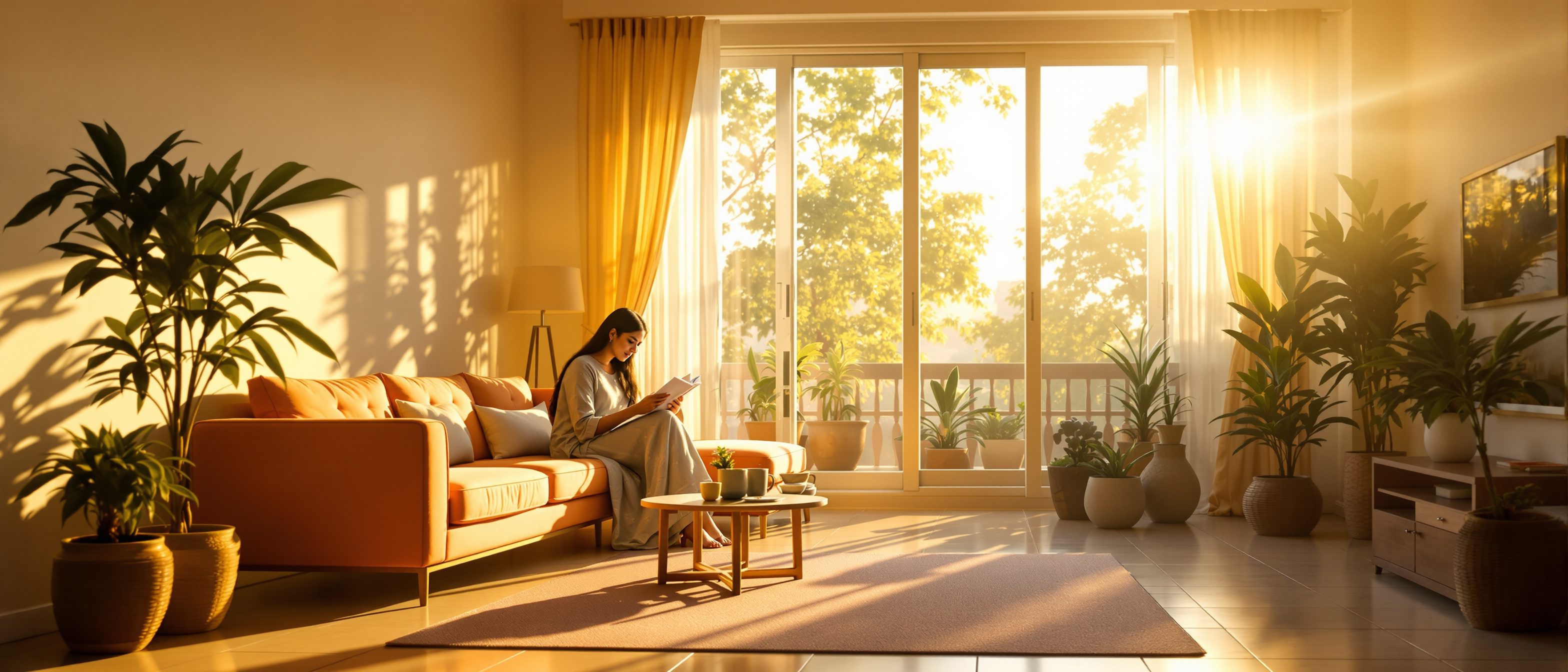
In hot India, the single biggest reason a room overheats is not poor insulation. It is sunlight pouring straight through the glass and turning into trapped heat inside. Understanding how that happens, the science of solar heat gain, is what lets you choose glass and shading that actually work, instead of guessing. This guide explains the WHY. For the WHAT-TO-DO, we point you to the practical guides at every step.
In a 45 degrees C Indian summer, the sun through your glass usually delivers far more heat than conduction through the wall around it. Master solar gain and you have mastered the largest lever in the room.
What SHGC actually measures
SHGC (Solar Heat Gain Coefficient) is a number from 0 to 1. It is the fraction of the sun's energy striking the glass that ends up as heat inside the room. An SHGC of 0.70 means 70 per cent of the incoming solar energy becomes interior heat; 0.25 means only a quarter does.
Crucially, SHGC counts heat by TWO paths added together:
- Directly transmitted solar radiation, the sunlight that passes straight through the pane.
- Re-radiated and convected heat: energy the glass itself absorbs, warms up, and then releases inward.
So a dark tinted glass that "blocks the view of the sun" can still have a mediocre SHGC, because it absorbs heat, gets hot, and re-radiates a good share of it inward. SHGC captures the whole story; how dark the glass looks does not.
The mini greenhouse effect
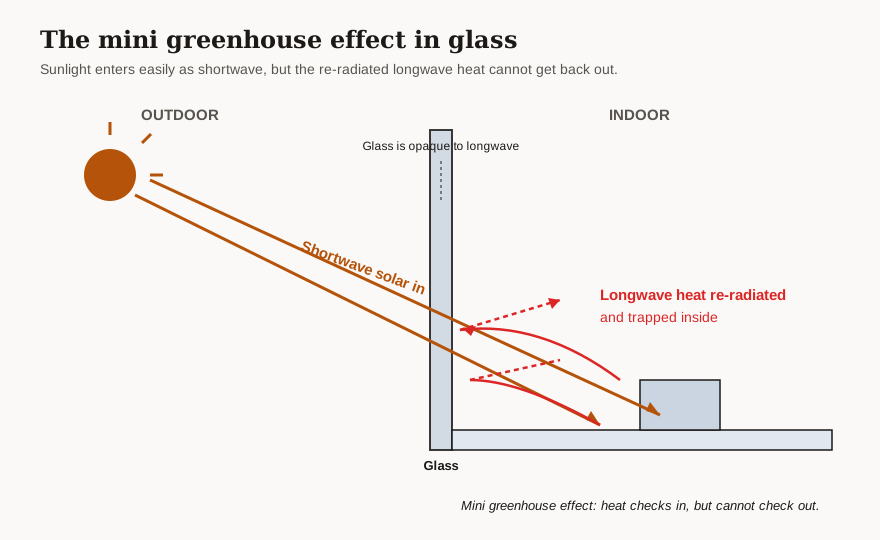
Sunlight arrives as shortwave radiation, which clear glass lets through easily. It strikes your floor, sofa and walls, which warm up and re-emit that energy as longwave (far-infrared) radiation. Ordinary glass is largely opaque to longwave, so that heat cannot escape back out the way it came in. It is trapped. This is the same physics that warms a parked car, a small greenhouse effect happening in every sunlit room. A Low-E coating is engineered to reflect that longwave radiation, which is the heart of how it works.
Why orientation decides everything
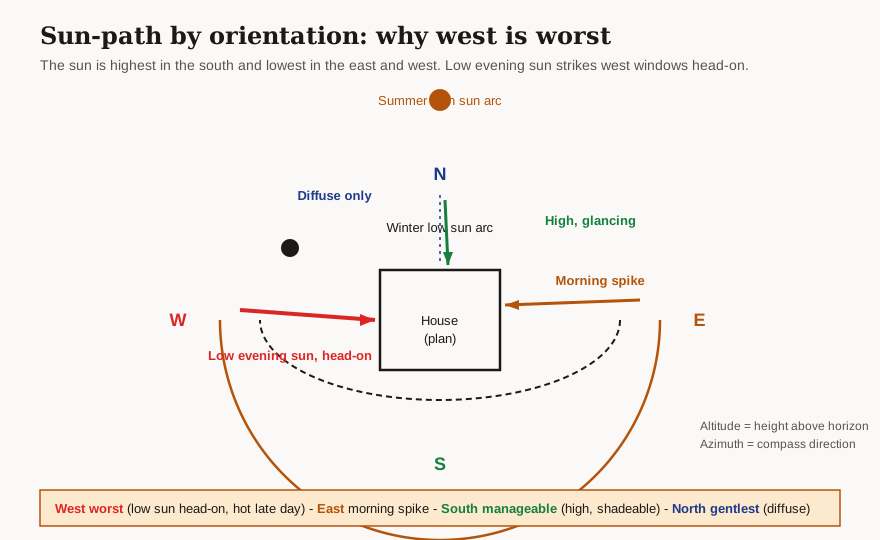
The sun is not a fixed lamp. Its altitude (angle above the horizon) and azimuth (compass direction) change through the day and the year. A vertical pane of glass collects the most heat when the sun's rays hit it most directly, head-on rather than glancing.
This is why orientation, not just glass type, governs heat gain:
- West is the worst. In the late afternoon the sun is LOW in the sky and still fierce. Its near-horizontal rays strike a vertical west window almost head-on, at the hottest part of the day, when the building has already soaked up heat. A horizontal chajja cannot block a low sun. West glass is the prime suspect in an overheating Indian room.
- East is a morning spike. The same low-angle, head-on geometry as west, but in the cooler morning, so the consequences are milder, though bedrooms can still bake by 9 am.
- South is manageable. In summer the midday sun rides HIGH overhead, so its rays hit a south window at a steep, glancing angle and a modest horizontal overhang shades most of it. In winter the lower south sun is welcome warmth. South is the orientation a horizontal chajja was made for.
- North is gentlest. It receives mostly soft, diffuse sky light and very little direct beam (a little at the height of summer), so it stays coolest and gives the steadiest daylight.
Rule of thumb for hot India: protect WEST first, EAST second, then SOUTH. North glass can be generous, it is your friend for daylight.
The device-by-device fix, overhang depths, vertical fins for east and west, jaali and louvers, belongs to our window shading strategies guide. This guide explains why each orientation behaves the way it does.
Incidence angle, beam and diffuse
Two more pieces of the science complete the picture.
Incidence angle. The more head-on the sun strikes the glass, the more it transmits; the more glancing the angle, the more it reflects away. This is why the published SHGC (measured at normal, head-on incidence) is a worst-case figure, and why a high overhead sun on a south wall is partly self-defeating, the glass reflects more of it.
Beam versus diffuse radiation. Total solar energy has two parts: beam (direct) radiation straight from the sun's disc, which is intense and directional, and diffuse radiation scattered by the sky, haze and clouds, which arrives from all over the dome. North windows live mostly on diffuse light. On a hazy or monsoon-overcast day, beam drops but diffuse can still be significant, which is why a room can feel warm even with no visible sunbeam.
SHGC by glass type
SHGC is set mainly by the glass and its coating. Here is where common Indian assemblies land. Treat these as indicative; always ask your fabricator for the tested SHGC.
| Glass assembly | Typical SHGC | Typical VLT | Notes |
|---|---|---|---|
| Clear single glazing | ~0.82 | ~0.88 | Worst for hot sun-facing walls |
| Clear double glazing (DGU, air) | ~0.70 | ~0.78 | Insulates better, still high gain |
| Body-tinted (bronze/grey) | ~0.50 to 0.60 | lower | Absorbs heat, dims daylight |
| Spectrally selective Low-E DGU | ~0.25 to 0.40 | ~0.50 to 0.70 | The hot-India sweet spot |
| Aggressive solar-control / reflective | ~0.18 to 0.27 | lower | Big west and south glass |
For comparison: GRIHA requires SHGC less than or equal to 0.25, and IGBC Green Homes v3 requires less than or equal to 0.45. So a good spectrally selective Low-E DGU can satisfy the toughest residential rating.
Cutting SHGC without going dark: LSG
The naive way to cut solar gain is to make glass darker, but that also kills your daylight (low VLT) and forces the lights on. The clever way is spectral selectivity: a Low-E coating that reflects the invisible near-infrared part of sunlight (which is pure heat, about half the sun's energy) while passing the visible part you actually want.
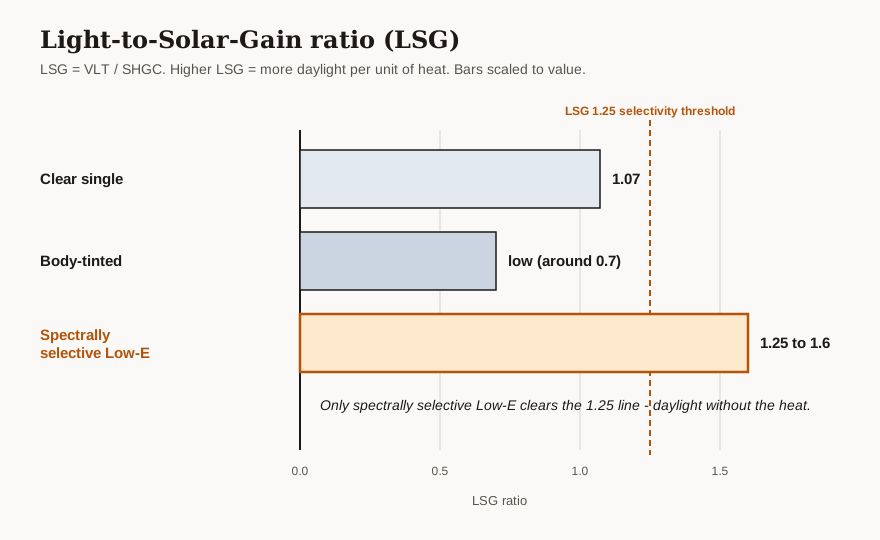
We measure this with LSG (Light-to-Solar-Gain) = VLT divided by SHGC. A higher LSG means more daylight per unit of heat admitted.
- Clear single glass: LSG roughly 0.88 / 0.82, about 1.07, no selectivity.
- A good spectrally selective Low-E: LSG greater than or equal to 1.25, often 1.4 to 1.6.
That is the whole magic of modern solar-control glass: bright rooms, cooler rooms, at the same time. The product guides go deeper, see solar control glass for India and Low-E glass for India. This guide tells you the physics those products exploit.
How SHGC is measured and why you should ask for it
SHGC is determined by standardised testing, the NFRC method internationally and equivalent EN procedures, on the WHOLE window or the glazing, under a defined sun and reference conditions, then reported on a label or test report. In India there is no consumer star-sticker on windows yet, so in practice you ask the manufacturer for the NFRC or EN tested SHGC of the exact assembly. The data sheet figure is what you specify against GRIHA, IGBC or Eco-Niwas Samhita.
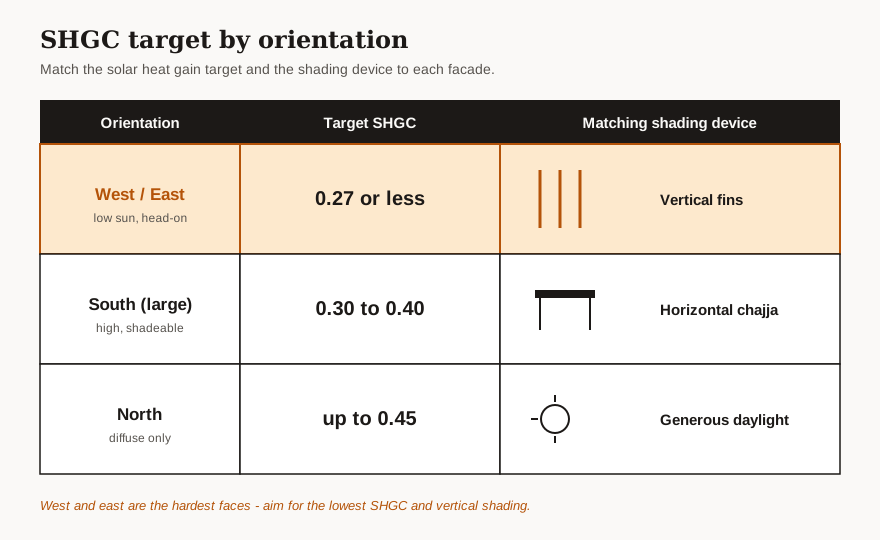
| If the window faces | And it is | Target SHGC | Pair it with |
|---|---|---|---|
| West or east | Any size | less than or equal to 0.27 | Vertical fins or movable shading |
| South | Large | ~0.30 to 0.40 | A horizontal chajja or overhang |
| North | Any size | up to ~0.45 | Generous daylight, light shading |
Where this fits, and what to read next
Solar heat gain is the largest of the four ways heat moves through a window (the others, conduction, air leakage and the frame thermal bridge, are covered in the thermal-performance guides). In hot India it usually dwarfs conduction, which is why chasing a cold-climate sub-1.0 U-value matters far less here than getting SHGC and shading right.
This guide is the science, the WHY. To act on it:
- For the ranked, rupee-aware playbook of cuts, read reducing heat gain through windows in India.
- For the catalogue of shading devices by orientation, read window shading strategies for India.
- For the glass products that deliver low SHGC, read solar control glass and Low-E glass.
- For the whole-system view, start at the pillar, energy efficient windows explained for India, and the glass overview, types of glass for windows in India.
Get SHGC and orientation right, and external shading does the rest. That ordering, not a third pane of glass, is how Indian homes stay cool.
References
- Eco-Niwas Samhita 2018 (BEE/ECBC): https://ecbc.in/econiwas.html
- Low-E glass and energy efficiency (Guardian Glass): https://www.guardianglass.com/eu/en/our-glass/glass-types/low-e-glass
- Low-E glass rating, U-factor, SHGC and VT explained: https://www.mannleecw.com/what-is-low-e-glass-rating/
- Glass and window solutions for homes (Saint-Gobain India): https://in.saint-gobain-glass.com/knowledge-center/glass-and-windows
- Types of Low-E and solar control glass (FG Glass India): https://fgglass.com/blogs-details/types-of-low-e-glass
Export this guide
Related Guides — Deep-dive reading
Energy Efficient Windows Explained: The Whole-System Guide for Indian Homes
Treat the window as an energy device — frame, glass, seals, shading, install and rating — and learn why low SHGC and shading beat chasing a cold-climate U-value in hot India.
Windows & GlazingFloor-to-Ceiling Windows (India): Maximum Light, and the Heat Trade-Off
Full-height glazing for Indian homes — how to win the daylight and view without losing the energy code, comfort or safety.
Windows & GlazingEnergy-Efficient Facades in India: How the Building Skin Cuts Your Cooling, Heating & Lighting Bills
How a building facade drives cooling, heating and lighting energy in India, the three levers of solar-heat-gain control, insulation and daylighting, U-value, SHGC, VLT and WWR in plain terms, ECBC and Eco-Niwas expectations, and real Indian green buildings.
Building FacadesRelated Tools — Try Free
Brise-Soleil Visualizer
Interactive horizontal-louvre cut-off angle calculator — sun altitude, louvre depth, and spacing inputs with a live shadow preview. Computes θ = arctan(spacing/depth) for façade shading, ECBC envelope compliance, hospital daylight design, and tropical sun-control detailing.
Sun Shading ToolCross-Ventilation Analyzer
Estimate airflow and air changes per hour (ACH) from room size, window areas, layout, and local wind — with NBC 2016 Part 8 compliance check.
Ventilation CalculatorWindow Orientation Planner
Pick the best window type, glass and shading by wall direction — north, east, south and west.
Window Tool