

Why Building Rules Exist in India: A Homeowner's Guide
What setbacks, FAR, height limits and certificates quietly protect — and why following them pays you back
When you build or buy a home in India, you quickly run into words like "setback," "FAR," "occupancy certificate" and "bye-laws." To most of us they feel like obstacles — extra paperwork between you and your dream home, or fees you would rather not pay. It is tempting to see building rules as red tape invented to slow you down.
This guide takes the opposite view, and tries to convince you of it honestly. Building rules are not arbitrary. Almost every one of them is the scar tissue of a past disaster — a fire that could not be reached, a building that collapsed in a tremor, a colony that ran out of water because too many flats were packed onto too little land. The rule is the city's memory of what went wrong, written down so it does not happen to your family. Once you understand what each rule is quietly protecting, the whole system stops looking like punishment and starts looking like a shared contract between you and everyone who lives around you.
A fair warning before we begin: in India there is no single national rulebook you can memorise. Rules vary from city to city and change over the years. Throughout this guide, wherever a number matters, treat it as a typical range and verify it against your own local municipal bye-law.
1. What "building regulation" actually means
Building regulation is simply a set of agreed rules about what you may build, where, how big, and how safely. Some of these rules are technical (how strong the columns must be), and some are about neighbourliness (how far your wall must sit from your neighbour's window). Together they answer one question: how do millions of people build private homes on private land without making the shared city unliveable or unsafe?
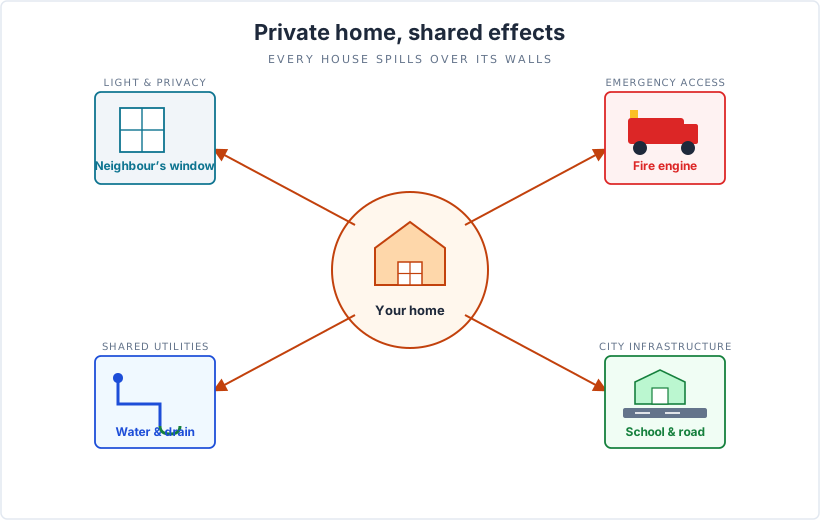
The key idea is that your house is never fully private in its effects. The smoke from a fire in your home travels to the flat above. The water your building draws comes from the same pipe as your neighbour's. The lane in front of your gate has to be wide enough for an ambulance whether or not you ever call one. Building regulation is the way a society manages all these spillovers between private decisions and shared consequences.
2. The problem rules solve: what happens when they are absent
The clearest way to see the value of a rule is to look at where rules are missing or ignored. India has large amounts of informal construction — homes built without sanctioned plans, without engineered structures, without inspection. The consequences are sadly familiar from news reports: buildings that pancake in moderate earthquakes because no seismic detailing was followed; multi-storey structures added floor by floor on foundations never designed for the load, collapsing without warning; tightly packed lanes where a fire engine simply cannot reach a burning home; and colonies that grew faster than the water and sewage lines could ever serve, leaving residents on tankers and overflowing drains.
None of these outcomes happen because people are careless. They happen because, building by building, individual choices that each seemed reasonable added up to a collective disaster. That is precisely the gap regulation fills. It sets a floor of safety and fairness that no single builder can quietly fall below, because everyone is held to the same line.
3. What each major rule quietly protects
Most homeowners meet the rules one at a time and never see the logic behind them. Here is what each of the big ones is actually doing for you.
| Rule you will hear about | What it controls | What it quietly protects |
|---|---|---|
| Setbacks | The open gap you must leave between your building and the plot boundary | Daylight and fresh air into rooms, privacy from neighbours, and space for a fire engine or ambulance to reach you |
| FAR / FSI | How much total floor area you may build relative to plot size | The balance between how many people live in an area and what the water, sewage, roads and schools can actually carry |
| Height limits | The maximum height of your building | Whether fire-fighting ladders can reach upper floors, structural and wind safety, and clear approach paths near airports |
| Ground coverage | How much of the plot footprint the building may occupy | Open ground for rainwater to soak in, light, and breathing space between structures |
| Parking norms | Off-street parking you must provide | Keeping cars off the public road so lanes stay clear for traffic and emergencies |
| Structural codes | How the building must be designed and built | That your home stays standing in an earthquake, storm or flood |
| Occupancy / completion certificate | Final sign-off before you move in | Confirmation that what was built matches the sanctioned, safe plan |
Look closely and a pattern appears. Setbacks, height limits and ground coverage are all really about the same precious things — light, air and the ability to reach you in an emergency. FAR and parking are about not overloading the shared infrastructure. Structural codes and the final certificate are about the building physically not hurting you. None of it is decoration.
4. Setbacks, height and FAR — the quiet trio, explained simply
Three rules cause the most confusion, so they are worth slowing down on.
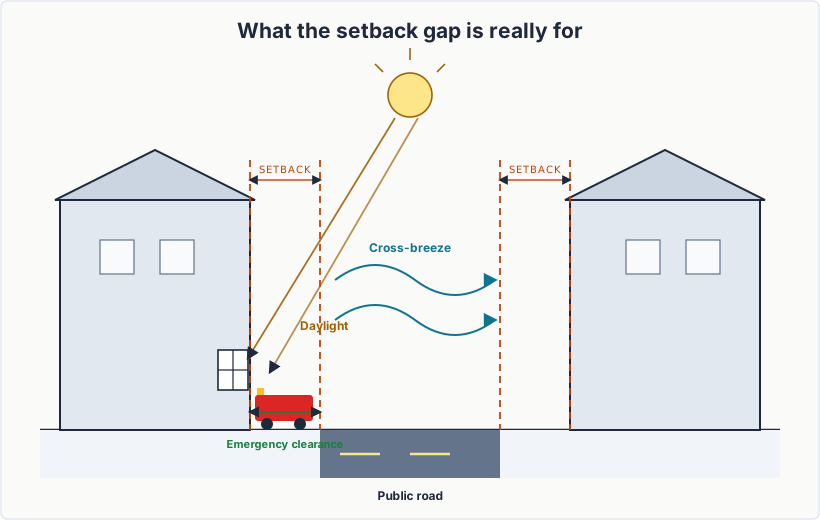
A setback is the empty strip you must leave between your building and the edge of your plot. If your neighbour and you both leave a gap, the two gaps add up to a real open lane — and that lane is what carries daylight to your windows, lets cross-breeze through, gives privacy so your window does not stare straight into theirs, and most importantly, gives an emergency vehicle somewhere to go. Front setbacks in Indian bye-laws commonly fall somewhere in the range of about 1.5 to 6 metres and side and rear setbacks roughly 0.9 to 4 metres, growing with plot size and building height — but the exact figure is set by your city, so verify against your local municipal bye-law.
Height limits exist partly because a fire ladder can only reach so high, partly because tall buildings face more wind and earthquake force and need stricter engineering, and partly to protect flight paths near airports and the agreed character of an area.
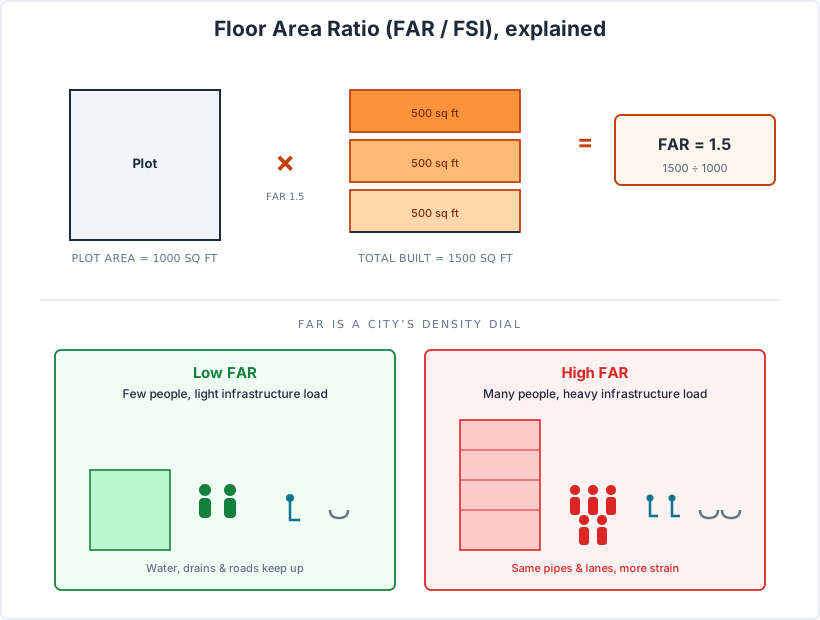
FAR (Floor Area Ratio), also called FSI (Floor Space Index), is the single most important density dial a city has. It is the ratio of total built-up floor area to plot area. An FAR of 1.5 on a 1,000 square-foot plot means you may build about 1,500 square feet of floor across all storeys. The reason a city does not simply allow everyone to build as high as they like is that every extra flat adds another family drawing water, flushing into the sewer, putting children into the local school and cars onto the road. FAR is how a city keeps the number of people roughly in step with the infrastructure that has to serve them. If you want to understand exactly how it is computed and why it varies so much, see how FSI/FAR is computed.
5. The certificates that say your home is safe to live in
Two pieces of paper matter enormously and are often misunderstood. The completion certificate is issued by the local authority after construction is finished, certifying that the building was actually built according to the sanctioned plan and the applicable safety norms. The occupancy certificate (OC) goes one step further and confirms the building is fit and safe for people to move in — services connected, fire safety provisions in place.
These are not bureaucratic souvenirs. Under the Real Estate (Regulation and Development) Act, 2016 — usually called RERA — a builder generally cannot hand over legal possession of a flat without the occupancy certificate. Authorities also commonly insist on the OC before granting permanent water and electricity connections, and most banks will hesitate to sanction a home loan against a property that lacks one. So the certificate is, in plain terms, the system's promise to you that the home was built as approved and is safe to occupy — and the document that protects your money, your loan and your resale value later.
6. Structural codes: the rules that save lives in seconds
Some rules you will never see and never have to file, but they may matter more than all the others combined. India sits across several seismic zones, and much of the country is exposed to earthquakes, cyclones and floods. Structural codes are the engineering rules that decide whether a building merely stands on a calm day or survives a bad one.
The key Indian Standards (IS codes), published by the Bureau of Indian Standards, include IS 1893 for earthquake-resistant design, IS 456 for reinforced concrete, IS 800 for steel structures, and IS 875 for the loads a building must withstand (its own weight, occupants, wind and so on). These are folded into the National Building Code so that a properly sanctioned and supervised building carries the seismic detailing and load capacity to protect the people inside it. This is the single strongest reason to insist on a qualified structural engineer and a sanctioned design rather than a "the contractor knows how to build" approach.
7. How building rules are actually made in India
Here is the part that confuses almost everyone, including many homeowners who assume there is one government rulebook. There is not.
At the national level, the Bureau of Indian Standards (BIS) publishes the National Building Code of India, 2016, issued as SP 7 — its document reference. The NBC was first brought out in 1970, revised in 1983, and comprehensively revised again in 2016. But the NBC is a model code: a recommended, expert-prepared template. It does not, by itself, become enforceable law in your city.
Separately, the Ministry of Housing and Urban Affairs (MoHUA), through its Town and Country Planning Organisation, issued the Model Building Bye-Laws, 2016 — a guiding document offered to state governments and union territories to help them frame their own rules.
What actually governs your plot is the local instrument: your state's development control regulations and your municipal or development authority's building bye-laws. Each state and city takes the national model, then adapts the numbers — setbacks, FAR, heights, parking — to its own land, water, climate and politics. That is why Delhi, Mumbai, Bengaluru and a small town in between can all have genuinely different rules for the same kind of house. Two other national laws sit alongside these: the Architects Act, 1972, which governs who may call themselves an architect, and RERA, 2016, which governs how housing is sold.
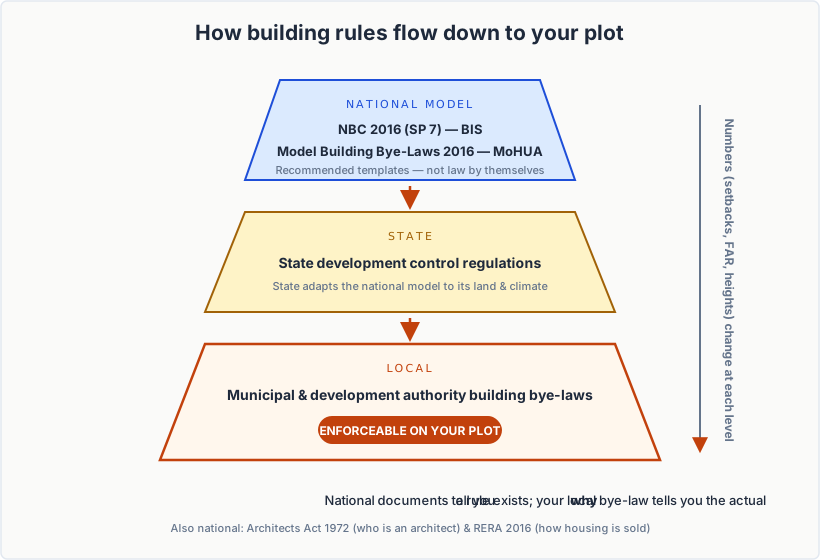
The practical takeaway is liberating once you accept it: never assume a figure you read online applies to you. The national documents tell you why a rule exists; your local bye-law tells you the actual number. For a city-by-city view, the Studio Matrx India Regulatory Atlas gathers local rules in one place.
8. Rules as a shared contract, not red tape
It helps to reframe the whole thing. When you follow the rules, you are not surrendering to the government — you are keeping your side of a bargain in which everyone else keeps theirs. You leave your setback so your neighbour's child gets daylight; in return their setback gives daylight to yours. You provide parking so the lane stays clear; in return the lane is clear when you need it. You build to code so your wall does not fall on the house next door; in return their wall will not fall on yours. The rule only works because it binds everyone equally. That is what makes a street feel like a neighbourhood rather than a gamble.
Seen this way, the person who quietly breaks the rule — the extra unsanctioned floor, the setback eaten up by a room — is not getting away with something clever. They are spending everyone else's safety to save themselves a little money or space.
9. What this means for you
If you are about to build or buy, the rules are working in your favour more than against you. Here is how following them pays you back, concretely.
- Safety. A sanctioned, code-built home is far more likely to protect your family in an earthquake, fire or flood. This is the return you hope never to need but cannot replace.
- Clean title and resale value. A home with a sanctioned plan and an occupancy certificate sells faster and at a better price. An unauthorised one carries a permanent discount and the risk of demolition or penalty.
- Loans and insurance. Banks lend, and insurers cover, much more readily against a regularly approved property with its certificates in order.
- Peace of mind. No fear of a sealing notice, a stop-work order or a neighbour's complaint that turns into a court case years later.
When you are planning, the most useful next step is to understand the approval journey itself — what to file, in what order, and who signs off. Read our companion guide on the building plan approval process, and ask your architect for the specific bye-law that governs your plot in writing before any design is finalised.
For the bigger picture, three sibling guides in this series go deeper: understanding building bye-laws breaks down the local rulebook line by line, how urban regulations shape cities shows what these rules do to the skyline and streets you live in, and the evolution of building regulations in India traces how we arrived at today's system. Together they turn a wall of jargon into something you can actually use to protect your home.
Sources
- Bureau of Indian Standards — National Building Code of India 2016 (SP 7), overview and history. https://www.bis.gov.in/standards/technical-department/national-building-code/
- National Building Code of India 2016, Volume 1 (Internet Archive copy of the BIS publication). https://archive.org/details/nationalbuilding01
- Ministry of Housing and Urban Affairs / Town and Country Planning Organisation — Model Building Bye-Laws (draft and adoption guidance). https://mohua.gov.in/upload/uploadfiles/files/Draft%20MBBL-2015.pdf
- Press Information Bureau — Model Building Byelaws 2016 amendment note. https://www.pib.gov.in/Pressreleaseshare.aspx?PRID=1564744®=3&lang=2
- IS 1893 (Part 1): 2016 — Criteria for Earthquake Resistant Design of Structures, Bureau of Indian Standards (Internet Archive). https://archive.org/details/gov.in.is.1893.1.2016
- Brigade Group — Occupancy Certificate vs Completion Certificate explainer. https://www.brigadegroup.com/blog/residential/occupancy-certificate-vs-completion-certificate
- Puravankara — Regulatory 101 for home buyers: RERA, OC/CC and possession rules. https://www.puravankara.com/real-estate-blog/regulatory-101-for-serious-buyers-rera-oc-cc-title-diligence-and-possession-risk
- Studio Matrx — FSI / FAR Computation in India. https://www.studiomatrx.org/guides/fsi-far-computation-india-architects
- Studio Matrx — Building Setbacks Across India. https://www.studiomatrx.org/guides/setbacks-across-india
Export this guide
Related Guides — Deep-dive reading
Understanding Building Bye-Laws in India: A Homeowner's Guide
What municipal building bye-laws are, who makes them, and how to find and read the ones that actually govern your plot
Building Regulations & ComplianceWhy Setbacks Matter: A Homeowner's Guide to the Open Space Around Your House
What setbacks are, the daylight, air, fire-access and privacy jobs they do, how they scale with plot and height, and why eating them up costs you your occupancy certificate and resale value
Building Regulations & ComplianceSecurity and Fire Regulations Guide for India (2026): Know the Rules and How to Navigate Them
There is no single national rulebook you can read off. This is the map of the whole regulatory landscape for home, housing-society and commercial security and fire systems in India, and a calm way to navigate it: who sets the rules, who approves what, and how to stay on the right side of them.
SecurityRelated Tools — Try Free
Cross-Ventilation Analyzer
Estimate airflow and air changes per hour (ACH) from room size, window areas, layout, and local wind — with NBC 2016 Part 8 compliance check.
Ventilation CalculatorRainwater Tank Sizer
How big should your rainwater tank be? Computes annual harvest, recommended tank capacity in litres, water-bill savings, and payback — for 10 Indian cities.
RWH CalculatorPre-Possession Inspection Checklist
Inspect your flat before registration — 10 categories, 70+ checkpoints across legal, carpet area, structure, finishes, and deviations.
Homebuyer Checklist