
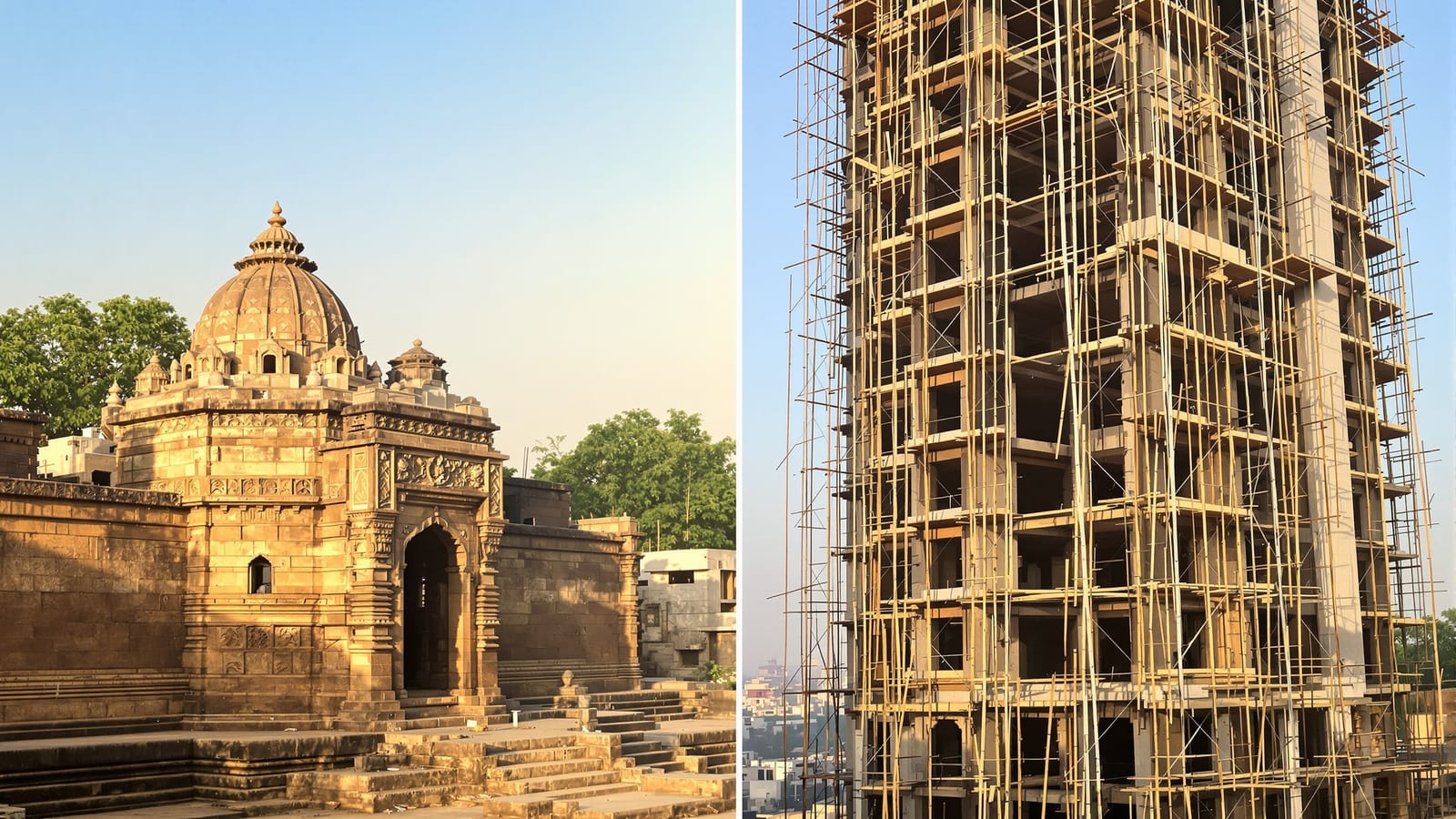
The Evolution of Building Regulations in India
From shilpa shastras and colonial plague laws to RERA and online approvals: how India's building rules grew, layer by layer
Every time you ask a builder how tall your house can be, how close it can sit to the road, or whether you need a fire escape, you are bumping into rules that took more than a century to take shape. Those rules did not arrive all at once. They grew, layer by layer, usually after something went wrong: a plague, a fire, a flood, a half-built tower that left buyers stranded. Understanding that story helps you make sense of why approvals feel the way they do today, and why two neighbouring plots can be governed by completely different paperwork.
This guide walks you through how building regulation in India evolved, from informal craft traditions to today's online single-window approvals. We will keep the jargon to a minimum and explain each term as it comes up. We are honest about dates and variation: building rules in India are mostly made and enforced at the state and city level, so the national story below is the spine, but your local bye-laws are what actually bind you. For the why behind all of it, see our companion guide on why building rules exist.
1. Before the rulebook: craft, custom and the shilpa shastras
Long before any government printed a code, India had detailed building knowledge. Ancient treatises known as the shilpa shastras (broadly, the "science of crafts") and the vastu shastras (the "science of dwelling and layout") set out proportions, orientation, room placement and town layout. Texts such as the Brihat Samhita, the Mayamata and the eleventh-century Samarangana Sutradhara described modular grids and proportion systems for temples, homes and settlements.
These were not laws in the modern sense. There was no municipal office to approve your plan. Instead, knowledge lived inside hereditary craft guilds, called shrenis, where skills passed from master to apprentice, often father to son. The guild enforced its own standards and codes of conduct, and rulers respected them. In practice, this meant quality control came from the craftsman's training and reputation, not from a permit. Vastu functioned as an informal "code" that everyone in a region understood: which direction a kitchen faced, how a courtyard was placed, how a street grid was laid. If you have ever wondered why vastu still influences Indian home design, this is the deep root.
The limitation is obvious in hindsight. Custom works when settlements are small and slow-growing. It does not scale to a crowded industrial city, and it has nothing to say about a fire spreading across a tightly packed neighbourhood or sewage contaminating a shared well.
2. The colonial trigger: epidemics, fire and the first town-planning acts
The first true building and planning laws in India came under British rule, and they were driven almost entirely by public-health disasters. Crowded port cities suffered repeated outbreaks of plague and cholera. The bubonic plague that struck Bombay in 1896 was a turning point. It exposed how dense, unventilated, poorly drained housing turned into a death trap.
The legislative response was the Bombay Town Planning Act, 1915, widely regarded as the first land-use planning law in India. Influenced by the ideas of the planner Patrick Geddes, it let local authorities prepare town planning schemes, regulate how land was developed, and recover a share of the increased land value from owners who benefited. Other presidency municipalities followed, and municipal acts across the country began carrying provisions about ventilation, drainage, setbacks and minimum standards.
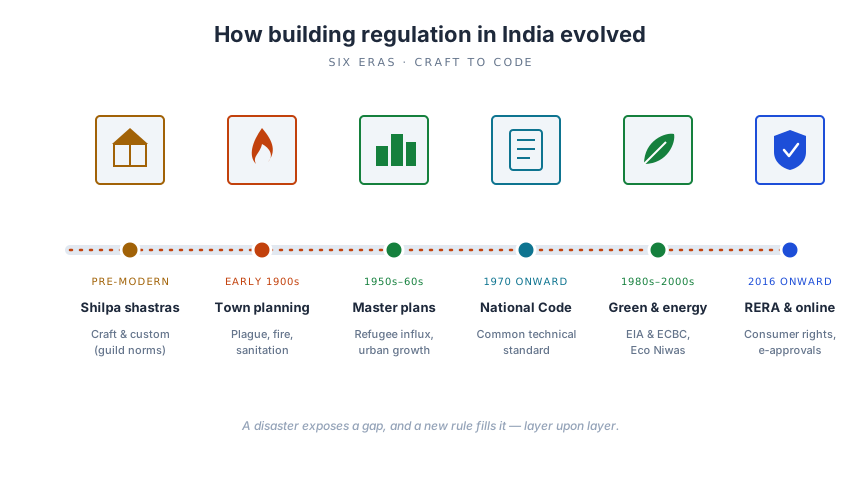
| Era | Main driver | Key instrument |
|---|---|---|
| Pre-modern | Craft tradition and custom | Shilpa and vastu shastras, guild norms |
| Colonial (early 1900s) | Plague, fire, sanitation | Bombay Town Planning Act, 1915; presidency municipal acts |
| Early independence (1950s-60s) | Refugee influx, rapid urban growth | Delhi Development Act, 1957; state town-planning acts |
| 1970s onward | Need for a common technical standard | National Building Code (SP 7), 1970 |
| 1980s-2000s | Environment and energy | EIA Notification 2006; ECBC 2007 |
| 2016 onward | Consumer protection and reform | RERA 2016; Model Building Bye-Laws 2016; online approvals |
The pattern that began here never really stopped: a disaster exposes a gap, and a rule fills it. Keep that lens as we move forward.
3. After 1947: refugees, growth and development authorities
Independence in 1947 brought a wave of urban pressure. The Partition sent enormous numbers of refugees into cities almost overnight; Delhi alone absorbed roughly half a million people in a single year. Existing municipal machinery could not cope with planning at that scale.
The signature response was the Delhi Development Act, 1957, which created the Delhi Development Authority (the DDA). The idea was a single, powerful agency that could plan, acquire land and develop the whole city in a coordinated way, rather than leaving growth to scattered local bodies. The DDA went on to prepare the first Master Plan for Delhi, which came into effect around 1962 and has been revised across the decades since.
This was the birth of the "master-plan-led" model that still dominates Indian urban planning. The principle is simple: a city draws up a long-range plan that zones land into uses (residential, commercial, industrial, green) and sets density and intensity limits, and all private building must fit within it. When your architect talks about land use, zoning or whether your plot is in a "residential zone," they are working inside this framework. The development authority for your city, whatever it is called, is the descendant of this 1950s idea.
4. States take the lead: town and country planning acts
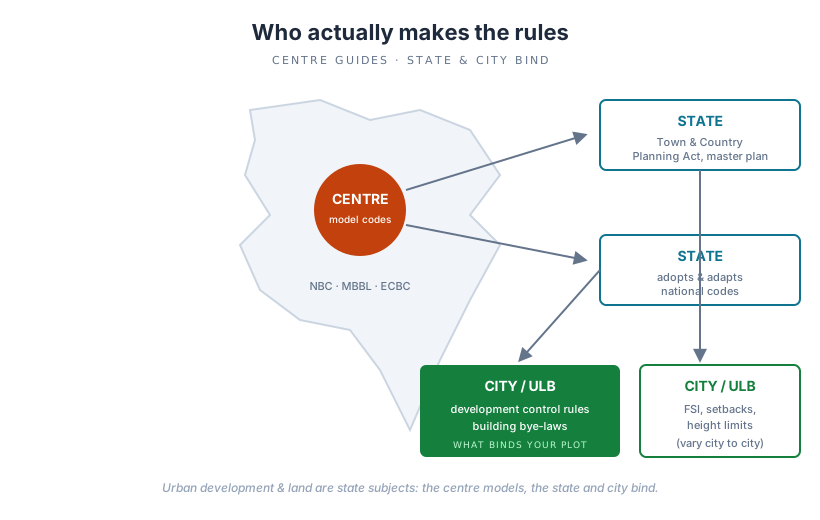
Here is the structural fact that explains a lot of confusion: in India's constitution, urban development, land and local government are largely state subjects. The central government can guide and model, but the binding rules are made by states and their cities.
So through the 1960s and 1970s, states passed their own Town and Country Planning Acts to give themselves the legal power to make master plans, set up planning authorities and control development. A widely copied template was the Maharashtra Regional and Town Planning Act, 1966, built on comprehensive-planning theory, which several states adapted for their own use. These acts are the legal parent of your local development plan and the development-control rules that flow from it.
The practical consequence for you, the homeowner, is variation. The maximum floor area you can build (often expressed as FSI or FAR), the setbacks you must leave, the height you are allowed, and the documents you must file all depend on your state and city. A guide written for Bengaluru will not match Mumbai detail-for-detail. This is also why you should always confirm the rules for your own jurisdiction; our India Regulatory Atlas is a starting point for finding the right authority.
5. A common technical standard: the National Building Code
With every state writing its own rules, the country needed a shared technical reference so that "safe construction" meant roughly the same thing everywhere. That role fell to the National Building Code of India, published by the Bureau of Indian Standards (BIS) as Special Publication 7, usually written SP 7.
The first National Building Code appeared in 1970, prepared at the instance of the Planning Commission. It was a comprehensive technical document covering structural design, fire and life safety, materials, plumbing, electrical work and more. It was revised in 1983, revised again in 2005, and most recently in 2016 as the National Building Code of India 2016. Each revision absorbed years of feedback and brought the standard closer to contemporary international practice, with the 2016 edition expanding coverage of areas like fire safety, accessibility, and sustainability.
An important nuance: the National Building Code is, by itself, a recommended technical standard, not automatically law everywhere. It becomes legally binding when a state or city adopts it into their bye-laws. Many states have built their building rules around it, which is exactly what was intended. So when a structural engineer cites "the NBC," they are pointing to this national benchmark that your local rules very likely incorporate.
6. The environmental layer: EIA and the coast
By the 1980s and 1990s a new driver entered the picture: the environment. Building was no longer judged only on whether it was safe and orderly, but on what it did to air, water, land and ecosystems.
Two instruments matter most for construction. The Environmental Impact Assessment (EIA) Notification, issued under environmental law and consolidated in its current form in 2006, requires larger building and construction projects above defined built-up-area thresholds to obtain environmental clearance before they proceed. The assessment looks at water use, sewage, solid waste, traffic and more. Separately, the Coastal Regulation Zone (CRZ) rules restrict and regulate construction along India's coastline; the CRZ regime has been revised several times, with a widely referenced version in 2019.
For most individual homeowners building a single house on a normal urban plot, full EIA clearance does not apply, since the thresholds target larger projects. But the environmental layer reshaped how big apartment complexes and townships get approved, and CRZ rules can directly affect you if your plot is near the sea. The lasting change is cultural: environmental scrutiny became a normal part of how India regulates the built environment.
7. The energy layer: ECBC and Eco Niwas Samhita
The newest technical driver is energy. As air-conditioning spread and electricity demand climbed, the government began regulating how much energy buildings are designed to consume.
The Energy Conservation Building Code (ECBC) was launched in 2007 by the Bureau of Energy Efficiency (BEE), a statutory body set up under the Energy Conservation Act, 2001. The ECBC set minimum energy-efficiency standards, initially aimed at commercial buildings, and an updated version was notified in 2017. For homes, the BEE introduced the Eco Niwas Samhita, a residential energy-conservation code: Part I, covering the building envelope (walls, windows, insulation, orientation), was released in 2018, with a later part covering electro-mechanical and renewable systems.
For you, this is the regulatory root of features that lower running costs: better wall and roof insulation, shading, window-to-wall ratios tuned to your climate, and efficient services. Like the National Building Code, how strongly these energy codes bind a private home depends on whether your state has adopted and is enforcing them, which is uneven across the country. But the direction of travel is clear, and a home designed to these ideas is cheaper to live in.
8. Consumer protection arrives: RERA and the reform wave
Through the 2000s, India's property boom produced a painful problem the old rules never addressed: buyers paying for flats that were delayed for years, changed without consent, or never delivered at all. Safety codes and zoning said nothing about protecting a purchaser's money.
The answer was the Real Estate (Regulation and Development) Act, 2016, universally known as RERA, which came into force in 2017. RERA is a consumer-protection law. It requires most projects above defined size thresholds to register with a state Real Estate Regulatory Authority before they can be advertised or sold, mandates that a large share of buyer money sits in a dedicated project account so it cannot be diverted, requires standard sale agreements and disclosure, and gives buyers a forum to complain. Each state and union territory runs its own RERA authority, so registration and rules differ by state.
Alongside RERA came a reform wave aimed at making the rules clearer and approvals faster. The Ministry of Housing and Urban Affairs (MoHUA), through its Town and Country Planning Organisation, issued the Model Building Bye-Laws, 2016, a template for states and urban local bodies, especially smaller towns that had no proper bye-laws at all. The other big shift was digital: spurred by ease-of-doing-business goals, states rolled out Online Building Permission / Plan Approval Systems (often called OBPAS) that allow electronic submission, automated drawing scrutiny against the rules, online fees, and even online occupancy certificates. For how all this comes together when you actually apply, see the building plan approval process and our explainer on understanding building bye-laws.
What this means for you
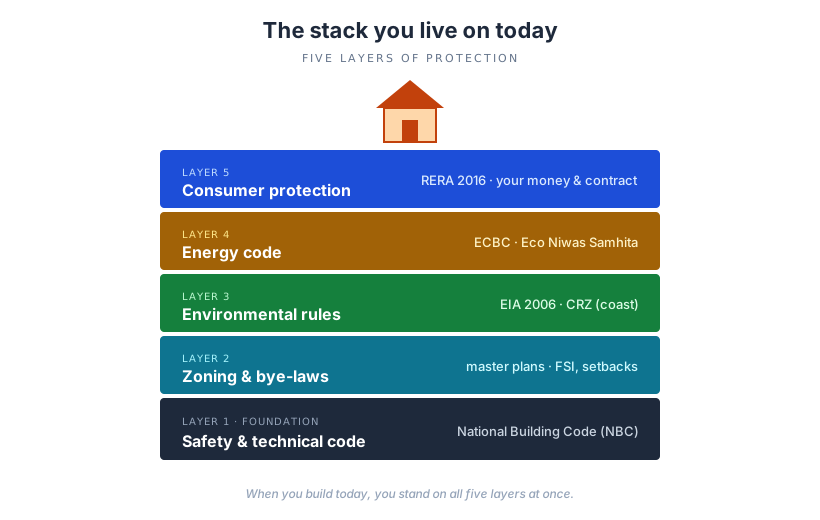
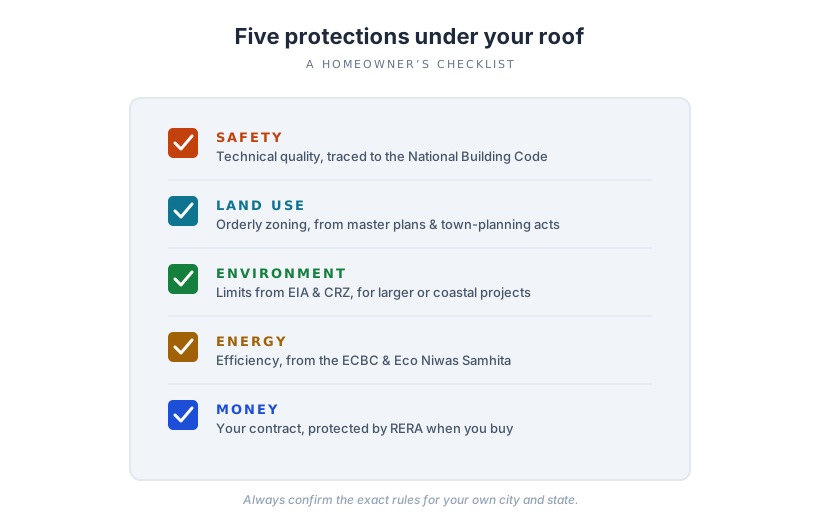
The history above is really the history of a stack of protections that pile up under your roof. When you build or buy today, you are standing on all of it at once:
- Safety and technical quality, traced back to the National Building Code and your local bye-laws.
- Orderly land use, traced back to master plans and your state's town-planning act.
- Environmental limits, from the EIA and CRZ regimes, mostly for larger or coastal projects.
- Energy efficiency, from the ECBC and Eco Niwas Samhita.
- Your money and your contract, protected by RERA when you buy from a developer.
Three practical takeaways follow from this story. First, your local bye-laws are king. The national codes are the spine, but what binds your specific plot is your city or state's rules, so always confirm them for your jurisdiction. Second, the rules will keep changing, because every layer above was added in response to a new problem, and that process is ongoing; for where it is heading, see the future of building regulations. Third, none of this is meant to trap you. Each layer exists because someone, somewhere, was harmed by its absence, whether by a fire, a flood, a collapse, or a builder who took their money and ran.
When you treat approvals not as bureaucratic friction but as a century of hard-won lessons, the whole process becomes easier to navigate, and easier to insist on when a builder tempts you to skip it.
Sources
- Town and Country Planning Department, Government of Gujarat, "The Bombay Town Planning Act, 1915" (full text). https://townplanning.gujarat.gov.in/Documents/The-Bombay-Town-planning-act-1915.pdf
- Bureau of Indian Standards, "National Building Code (NBC) of India - 2016" (history and revisions, SP 7). https://www.bis.gov.in/standards/technical-department/national-building-code/
- India Code / Government of India, "The Delhi Development Act, 1957." https://www.indiacode.nic.in/handle/123456789/1391
- Delhi Development Authority, "Master Plan for 1962." https://dda.gov.in/master-plan-1962
- Directorate of Town Planning and Valuation, Government of Maharashtra, "The Maharashtra Regional and Town Planning Act, 1966." https://dtp.maharashtra.gov.in/en/mrtp-act
- Town and Country Planning Organisation, Ministry of Housing and Urban Affairs, "Model Building Bye-Laws (MBBL) - 2016." http://tcpo.gov.in/model-building-bye-laws-mbbl-2016
- Real Estate (Regulation and Development) Act, 2016, overview. https://en.wikipedia.org/wiki/Real_Estate_(Regulation_and_Development)_Act,_2016
- Bureau of Energy Efficiency, "Eco Niwas Samhita 2018 (Energy Conservation Building Code for Residential Buildings)," summary. https://www.drishtiias.com/daily-updates/daily-news-analysis/eco-niwas-samhita-2018
- Wikipedia, "Shilpa Shastras" (traditional Indian building knowledge and guilds). https://en.wikipedia.org/wiki/Shilpa_Shastras
Export this guide
Related Guides — Deep-dive reading
The Future of Building Regulations in India
Where India's building rules are heading on energy, climate resilience, digital approvals and green construction, and what it means for the home you build next.
Building Regulations & ComplianceWhy Building Rules Exist in India: A Homeowner's Guide
What setbacks, FAR, height limits and certificates quietly protect — and why following them pays you back
Building Regulations & ComplianceSecurity and Fire Regulations Guide for India (2026): Know the Rules and How to Navigate Them
There is no single national rulebook you can read off. This is the map of the whole regulatory landscape for home, housing-society and commercial security and fire systems in India, and a calm way to navigate it: who sets the rules, who approves what, and how to stay on the right side of them.
SecurityRelated Tools — Try Free
Cross-Ventilation Analyzer
Estimate airflow and air changes per hour (ACH) from room size, window areas, layout, and local wind — with NBC 2016 Part 8 compliance check.
Ventilation CalculatorCCTV Placement Planner
Pick your property and zones to get a prioritised, zone-by-zone checklist of which camera goes where and how to mount it.
Placement PlannerApartment Video Door System Planner
Enter flats, entrances, floors and guard desk for a first-pass building intercom plan — door stations, indoor monitors, guard station, the right architecture and an indicative cost band.
Building Planner