
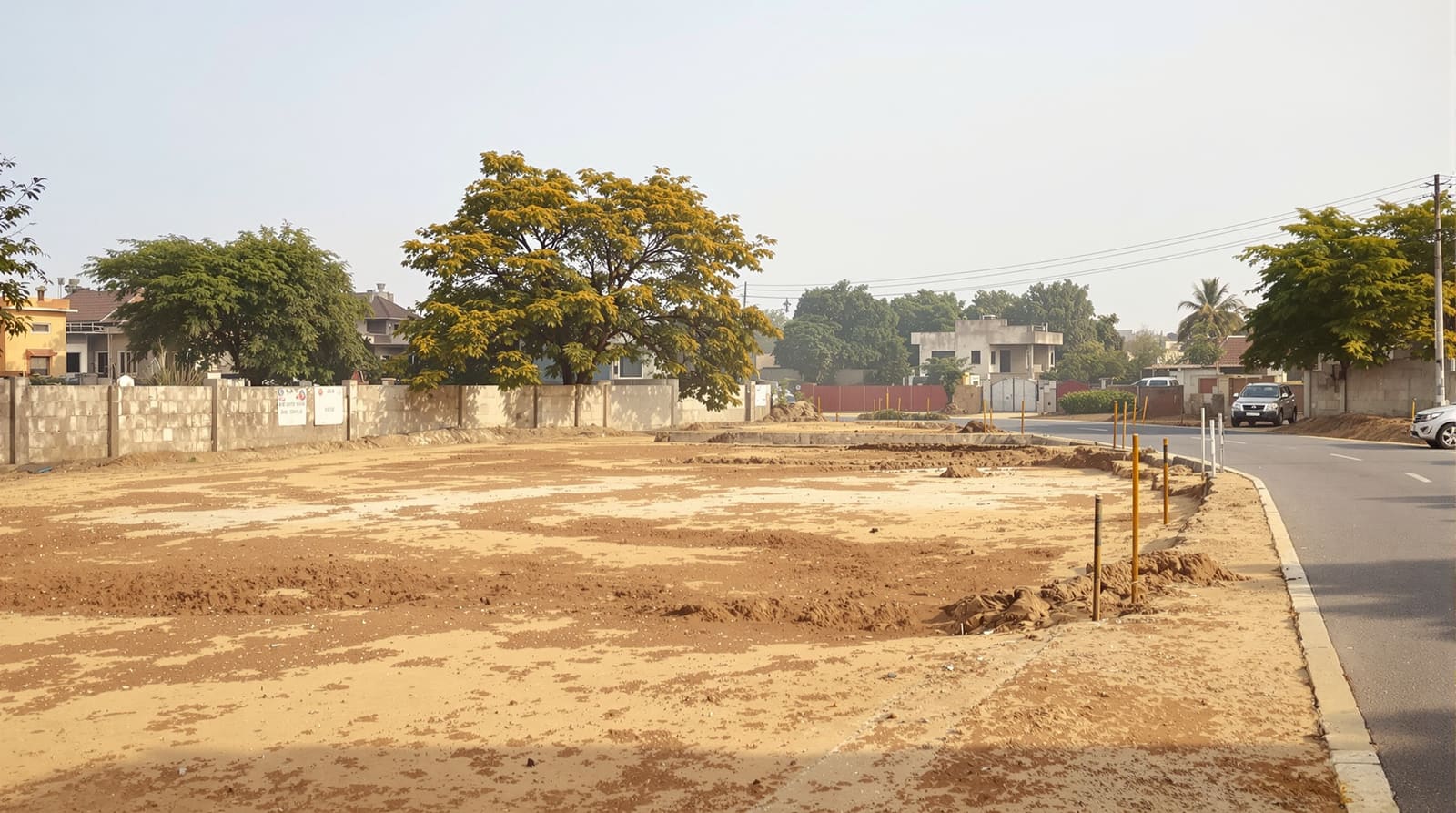
What Architects Look for During Site Visits
The pre-design site-reading visit — the kit, the stand-at-the-centre-then-the-edges method, and what a trained eye notices about sun, wind, levels, access, trees, services and neighbours
The broker is already halfway up the plot, gesturing at the road and rattling off numbers — corner site, clear title, ready for registration, sir, only two left. You stand near the gate, phone out, ready to nod. But the architect you brought along does something odd. She doesn't follow the broker. She walks slowly to the rough middle of the plot, turns a full circle, and just stands there for a minute, looking at nothing in particular. Then she takes out a small compass, checks it against the sun, scribbles in a notebook, and asks the watchman next door a question that has nothing to do with the price: "Where does the water come during the rains?"
In those few quiet minutes she has read more about this plot than the brochure will ever tell you — which corner cooks under the west sun, how the land tips towards the back, where the neighbour's wall will throw an evening shadow, and the fact that a stormwater drain runs invisibly along the rear boundary. None of it is on the survey plan. All of it will shape, and sometimes punish, whatever you build. A pre-design site visit is not a formality before buying — it is a structured act of reading the land, and a trained eye gathers in twenty minutes the facts that decide whether a plot is a gift or a thirty-year compromise.
Why the first visit decides so much
Most of what makes a house comfortable or miserable is set before a single line is drawn — by the plot itself. Orientation fixes which rooms will be bright and which will bake. Levels decide where water collects and how much you will spend on retaining and filling. Access governs where the gate can go and how the car turns in. None of these can be undone later by clever interior design; they are the hand the site deals you, and the site visit is where you actually see the cards.
This is the pre-design visit — reading a plot before you buy it, or before you commission a design on land you already own. It is a different exercise from supervising a build. Once construction starts, the architect's site supervision checklist takes over with its own concerns — pour quality, line and level, cover blocks. Keep the two firmly apart. The reading visit asks one question: what is this site, really, and what does it want a house to do? Everything you notice here feeds the deeper work of understanding site constraints and understanding site potential, and it sits under the broader discipline of site analysis for homeowners.
The good news is that the architect's eye is borrowable. The moves are learnable, the kit is cheap, and a homeowner who walks the plot the way a designer does will ask sharper questions and avoid the dearest mistakes.
What to carry, and why each thing earns its place
Turn up empty-handed and you will leave with impressions and no record. A few small items turn a stroll into a survey.
Carry the survey plan and any approved layout — the dimensions, the survey number, the road and drain alignments. You are going to test the paper against the ground, and the two often disagree. Carry a measuring tape, and a laser distance meter if you have one, to check the road width, the actual frontage, and the level difference at the gate; brokers' frontages have a way of shrinking under a tape. Carry a compass — the phone compass is fine, away from steel — because orientation is the single most important reading and you must know true directions, not guesses. Carry a camera (your phone) and shoot generously: each boundary, the road, the neighbours' overlooking windows, the trees, the sky in each direction. Carry a notebook for the things photos miss — smells, noise, the feel of the breeze, what the watchman tells you. And carry, or at least have read, the local building bye-laws — the city's Development Control Regulations — so you can sense-check setbacks, ground coverage and permissible FSI against the plot's actual size and road width, the detail worked through in FSI and FAR computation.

The walk-through method: centre first, then the edges
Amateurs work the boundary; professionals work the centre first. Here is the method, and it is genuinely how experienced architects move on a plot.
Stand at the rough centre and read the whole site. Turn a slow full circle. Where is the sun now, and where will it be at four in the afternoon? Which way does the land seem to fall? Where is the noise coming from — a main road, a temple, a workshop? Which direction carries the breeze? What can you see beyond the boundary that you would want to keep in view, and what you would rather never see again? This centre reading gives you the plot's character as a whole before details distract you.
Then work the edges, one boundary at a time. Walk each side slowly. At the front: the road, the access, the gate. At the sides and rear: the neighbours, their walls and windows, the drains, the trees. Note where each boundary is higher or lower than the plot, because that is where water will either pond against you or rush away. Photograph each edge as you go.
What the trained eye actually notices
Orientation and the sun
Orientation is everything in the Indian climate, and it costs nothing to get right at design stage and a fortune in air-conditioning to get wrong. Find true north with the compass and mark where the sun rises and sets relative to the plot. The reading that matters most is the harsh west: the late-afternoon sun that pours low and hot into any west-facing wall or window and turns those rooms into ovens by evening. Note which boundary takes the west, because that is where you will want service spaces, thick walls or screening rather than living rooms. Look, too, at the shadows neighbours cast — a tall building or wall to the south or south-west can steal your winter light or, helpfully, shade your west. The full logic of this is worth studying in sun path analysis and the broader site orientation explained.
Wind and the breeze
Stand still and feel where the air comes from — across most of India the cooling breeze arrives from a fairly consistent prevailing direction through the warm months. A plot whose long side faces the breeze can be cross-ventilated almost for free; one boxed in by neighbours on the windward side cannot. Note also the unwelcome carriers on the wind: dust off an unpaved road, smoke, kitchen smells from a neighbour, effluent from a nearby drain.
Levels and drainage
Walk the slope and ask the architect's favourite question: where would the water go? Water always wins, and in the monsoon it will find the low point of your plot whether you planned for it or not. A site that falls gently towards the road drains itself; one that dips towards the rear or sits below road level will collect water and demand filling, raised plinths or proper stormwater design. Look for signs of past flooding — silt lines on the boundary wall, a high water table, soggy ground. This is the seed of why topography matters.
Access and the road
Measure the road width — it governs both how you arrive and, in many cities, how much FSI you are allowed. Check the level difference between road and plot: a steep step up or down decides where the gate and the driveway can sensibly go. Note traffic, whether the road floods, and whether it is a recognised, regularised road at all, since access is a frequent source of disputes.
Trees, rock, structures and services
A mature tree is an asset worth designing around, not a nuisance to fell on day one; note its species, health and shade. Look for rock outcrops (expensive to excavate but excellent foundation), existing structures, and the services that ambush the unwary: overhead power lines crossing the plot (which impose clearance setbacks), a transformer humming on the boundary, manholes and sewer lines running through, and the position of the nearest water and electricity connection.
Neighbours, overlooking, noise and smells
Look up at the neighbours' windows and balconies — where will they overlook your courtyard or terrace, and where will you overlook theirs? Privacy is cheap to protect in plan and impossible to retrofit. Register the noise and the smells honestly, at the time of day you would actually be home.
Soil clues and the views
You cannot do a geotechnical test on a casual visit, but you can read clues — black cotton soil that cracks in summer and swells in the rains, loose fill, marshy patches, exposed rock. These hint at what the formal soil bearing test (IS 1904 / IS 6403) will later confirm and what your foundation will cost. Finally, decide which views to keep — a hill, a green, an open sky — and which eyesores to screen — a blank wall, a tank, a transformer — because the design will be built around exactly these decisions, as explored in designing for views and privacy.

Talking to the people who know the ground
The most valuable instrument on a site visit is a conversation. The neighbours and the watchman carry years of ground truth that no document holds: how high the water rose in the worst monsoon, whether the road floods, which drain backs up, how loud the street gets at night, who actually owns the strip along the boundary, and whether the land has a history of disputes. Ask them gently and listen. Cross-check the paper trail separately — title, khata, encumbrance, RERA registration where it applies, and sanction status with the planning authority — but treat the watchman's monsoon story as primary data.
The site-visit checklist
| What to check | What a good eye looks for | Why it matters |
|---|---|---|
| Orientation & sun | True north; the harsh west; neighbours' shadows | Fixes which rooms are bright, which bake |
| Wind & breeze | Prevailing breeze direction; dust, smoke, smells | Decides free cross-ventilation vs. sealed boxes |
| Levels & drainage | The fall of the land; where water collects; flood marks | Foundation, plinth & stormwater cost |
| Access & road | Road width; road-to-plot level difference; flooding | Gate position, FSI, arrival, disputes |
| Trees, rock & structures | Mature trees; outcrops; existing built work | Assets to keep, costs to excavate |
| Services | Overhead lines; transformer; manholes; sewers | Clearance setbacks & routing constraints |
| Neighbours & privacy | Overlooking windows; noise; smells | Privacy is cheap in plan, dear to retrofit |
| Soil clues | Black cotton, fill, marsh, rock | Hints at the geotechnical test & foundation |
| Views | Keep the good; screen the bad | The design is built around these |
| Records & talk | Title, khata, RERA, sanction; the watchman's monsoon story | Paper truth plus ground truth |
The time-of-day and time-of-year caveat
Here is the trap that catches even careful buyers: a plot seen once, on a bright dry winter morning, lies to you by omission. The west sun is gentle in December and brutal in May. The dry-season drain is a quiet ditch that becomes a torrent in July. The breeze shifts with the season. So an architect, given the chance, visits more than once and at different times — late afternoon to feel the west sun, evening to judge the noise and the overlooking, and above all during the monsoon if at all possible, because the rains reveal in an hour what a dry visit hides for a year. If you cannot wait for the rains, make the watchman's flood story do the work for you.
References
- National Building Code of India 2016 (Bureau of Indian Standards), Part 3 — Development Control Rules and General Building Requirements.
- The relevant State Town and Country Planning Act and the local Development Control Regulations / municipal building bye-laws (setbacks, ground coverage, permissible FSI by road width — varies by city).
- IS 1904: Code of practice for design and construction of foundations in soils, and IS 6403: Determination of bearing capacity of shallow foundations.
- Real Estate (Regulation and Development) Act, 2016 (RERA) — project and plot registration.
- Kevin Lynch & Gary Hack, Site Planning (MIT Press).
- Joseph De Chiara & Lee Koppelman, Site Planning Standards.
Read this alongside understanding site constraints and understanding site potential — then let DesignAI turn what you noticed on the plot into a first plan that respects the sun, the slope and the breeze you read with your own eyes.

Export this guide
Related Guides — Deep-dive reading
Site Analysis for Homeowners: How to Read a Plot Before You Build
The master guide to reading your land — its legal envelope, sun, wind, slope, soil, access, neighbours, views, services and microclimate — before you buy a plot or draw a plan.
Site PlanningUnderstanding Sun Path Analysis for Your Home
How the sun actually moves over an Indian site through the day and the year — and why that single fact quietly decides where your kitchen, bedroom and living room should sit.
Site PlanningUnderstanding Site Planning for Residential Projects
A homeowner's landscape guide to reading your plot's sun, wind, water, soil and trees before zoning and building the grounds.
LandscapeRelated Tools — Try Free
Cross-Ventilation Analyzer
Estimate airflow and air changes per hour (ACH) from room size, window areas, layout, and local wind — with NBC 2016 Part 8 compliance check.
Ventilation CalculatorWindow Orientation Planner
Pick the best window type, glass and shading by wall direction — north, east, south and west.
Window ToolHome Building & Interior Cost Calculator — 20 Cities
Construction + interior costs for 20 Indian cities across kitchen, wardrobes, flooring, painting, ceiling.
Cost Calculator