
Water Supply Systems in India: How Water Reaches Every Tap in Your Home
The complete map of how water gets into an Indian home and out to every fixture — the sources it comes from, the sump-pump-overhead-tank storage model that buffers intermittent supply, how gravity and pressurised distribution differ, and the demand figures that size the whole thing.
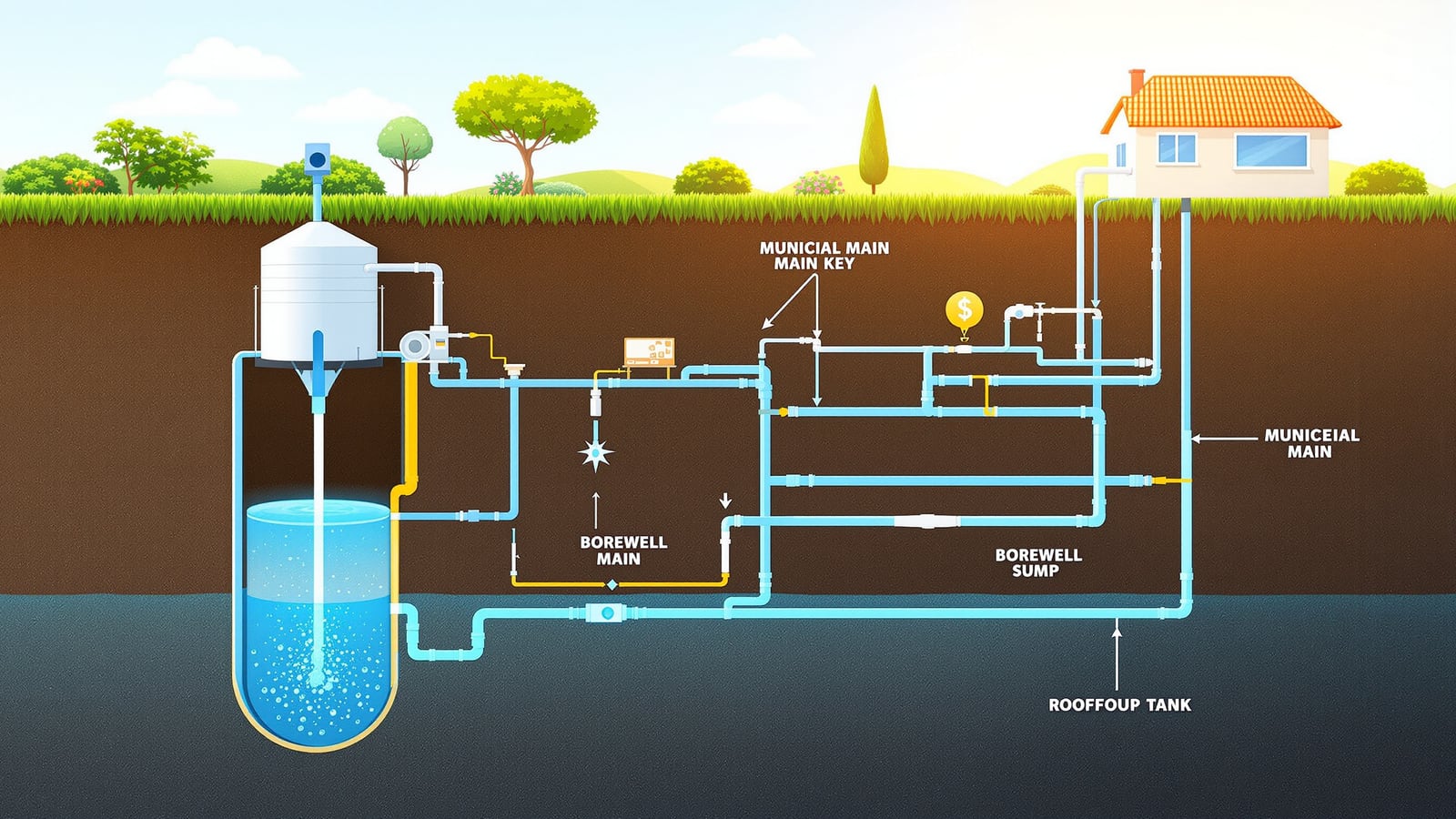
Every tap, shower, cistern and washing-machine inlet in your home sits at the end of a chain that starts far outside your walls — at a municipal main, a borewell, a well or a tanker. In between lies a storage tank, a pump and a web of pipes. Understanding that chain end-to-end is what turns "the water is weak upstairs" or "the tank ran dry again" from a mystery into a solvable problem.
This is the water supply systems section pillar of the Studio Matrx Plumbing Knowledge Hub. It gives you the whole map at a glance and then hands off to the detailed guides for each part — the sources, the storage-and-lift model, and the two ways water is finally distributed to your fixtures. For how plumbing fits into the wider building, start with the plumbing systems guide.
A water supply system has three jobs: get water (source), hold and lift it (storage and pumping), and deliver it under useful pressure (distribution). Almost every Indian home problem — dry taps, weak showers, dirty water — traces back to a weak link in one of these three.
The three stages of any water supply system
Whether you live in a village bungalow or a 30-storey tower, water follows the same three stages. What changes is only the equipment at each stage.
- Source — where the water comes from: municipal supply, borewell, open well, tanker, or a recycled/dual line for non-potable uses.
- Storage and lift — how the water is buffered and raised: an underground sump, a pump, and an overhead tank sitting on the roof.
- Distribution — how it travels to fixtures under pressure: by gravity from the overhead tank, or pushed by a pressurised system.
Stage 1 — Where the water comes from
Most Indian homes do not rely on a single source. A resilient supply blends two or three, because no one source is reliable on its own.
| Source | Typical role | Reliability | Watch-outs |
|---|---|---|---|
| Municipal supply | Primary, potable | Intermittent — often 1–4 hrs/day | Low or no pressure; timing varies; needs storage |
| Borewell | Primary or backup | Good where the aquifer holds | Depth/yield varies; may be hard or saline; needs treatment |
| Open well | Backup, garden | Seasonal | Contamination risk; needs safe covering |
| Tanker | Emergency top-up | On demand, at a cost | Quality unknown; verify before drinking |
| Dual / recycled line | Flushing, gardening | Cuts fresh-water use | Non-potable only; must be a separate plumbed line |
The reason to blend sources is resilience: a single source is a single point of failure. Municipal supply stops during repairs; a borewell can dry through a bad summer; a tanker may not arrive when you need it. A home that draws on two or three sources into a common sump rides through any one of them faltering. This is why even homes on a good municipal line commonly keep a borewell and a tanker inlet as backup.
Two sources dominate. Municipal water is treated and usually the safest to drink, but it arrives for only a few hours a day at low pressure — which is exactly why the storage stage exists. Full details, connection, metering and safe use are in the municipal water supply guide.
A borewell gives you your own on-plot source, invaluable where the municipal line is thin or absent, but its yield, depth and water quality vary enormously across India and the water often needs treatment before it is drinkable. The borewell water system guide covers depths, yields, pumps and quality.
A growing number of homes also run a dual supply: fresh water for drinking and washing, plus a separate non-potable line of treated or recycled water for toilet flushing and gardening. Because that water must never cross into the drinking lines, it is always plumbed separately — see treated water for toilet flushing and home greywater recycling systems.
Stage 2 — Storage and lift: the sump, pump and overhead tank
This is the stage that defines Indian plumbing. Because municipal water is intermittent, a home cannot draw straight from the main on demand. Instead it stores a full day's water and lifts it once, high enough to feed every tap by gravity. The classic arrangement — called an indirect supply system — has three parts:
- The underground sump. A large low-level tank (often below the driveway) fills whenever the municipal main flows, or from the borewell. It is the bulk buffer: it captures water during the short supply window so nothing is wasted.
- The pump. Once or twice a day, a pump lifts water from the sump up to the roof. Crucially, it runs only briefly — the daily distribution costs no electricity at all.
- The overhead tank (OHT). Sitting on the roof, it holds the day's water and, by its height, gives every fixture below it pressure for free. This is why tanks live on the roof: height is stored pressure.
Why store water twice? The sump can be large and cheap at ground level and fill directly from a low-pressure main; the overhead tank need only be big enough for a comfortable buffer while providing head. Splitting the job keeps both tanks a sensible size — an overhead tank holding a full day's water for a large family would be too heavy to sit safely on most roofs, while a ground-level sump can be as large as the plot allows.
The pump that links the two is sized to the lift and the flow, not to household demand — it only needs to refill the overhead tank within the supply window. A standard monoblock or submersible pump handles a typical home; taller buildings step up to multi-stage or booster pumps. Keep the pump protected from dry running, and fit a float or level controller so it stops automatically when the overhead tank is full rather than overflowing across the roof.
Sizing the storage
Storage is sized off demand. The standard planning figure in India, per CPHEEO guidance, is around 135 litres per person per day (lpcd) for a home with full indoor plumbing. From that you can size both tanks.
| Household | Daily demand (135 lpcd) | Typical sump | Typical overhead tank |
|---|---|---|---|
| 2 people | ~270 litres | 500–1,000 L | 500 L |
| 4 people | ~540 litres | 1,000–2,000 L | 1,000 L |
| 6 people | ~810 litres | 2,000–3,000 L | 1,500 L |
| Small building (16 people) | ~2,160 litres | 5,000–10,000 L | 3,000–5,000 L |
These are indicative starting points. Most designers keep a full day's reserve in storage so taps run through a missed supply cycle, and often more where supply is unreliable. To size your own tanks to household, floors and supply frequency, use the Studio Matrx bathroom water tank calculator.
Stage 3 — Distribution: getting water to the fixtures
Once water sits in the overhead tank, it has to travel to every basin, shower, WC cistern and kitchen tap. There are two ways to do that, and Indian homes use both — often in the same building.
Gravity distribution lets the water fall from the overhead tank to the fixtures. The height difference (the head) creates the pressure — roughly 0.1 bar for every metre the tank's water surface sits above the outlet. It is silent, costs nothing to run and never fails, which is why it supplies most homes up to about G+3. It is explained in full in the gravity-fed plumbing system guide.
Pressurised distribution uses a pump or a pressure vessel to push water at a set pressure regardless of height. It is what taller buildings, pressure-hungry rain showers and instant geysers need, and it delivers even, strong flow on every floor. The full treatment — pumps, hydro-pneumatic sets, pressure zones — is in the pressurised plumbing system guide.
| Aspect | Gravity distribution | Pressurised distribution |
|---|---|---|
| Driving force | Head from the overhead tank | Pump / pressure vessel |
| Typical pressure | ~0.1–0.8 bar (varies by floor) | ~1.5–3 bar, even across floors |
| Running cost | Effectively nil | Ongoing electricity |
| Best for | Homes up to ~G+3 | Tall buildings, rain showers, instant geysers |
| Weak spot | Low pressure on the top floor | Cost, noise, dependence on power |
You do not have to pick one for the whole house. A common, sensible hybrid runs the building on gravity and adds a small booster only where gravity falls short — the top-floor bathroom, a rain shower, an instant geyser. The mechanics of how water then routes through the internal pipe network, valves and manifolds is the job of the domestic water distribution guide.
Cold and hot water: two lines, one system
The distribution stage actually runs two parallel lines. The cold line carries water straight from the overhead tank or pressurised main to every fixture. The hot line first passes through a water heater (a geyser), then runs its own set of pipes to the shower, wash basin and kitchen.
A few things worth knowing about hot-water distribution:
- Keep the geyser close to the point of use. The further the hot line runs, the more water you waste waiting for it to run warm, and the more heat is lost in the pipe. Bathroom geysers sit near the shower for exactly this reason.
- Insulate long hot runs. On any hot pipe over a couple of metres, insulation saves both heat and the wait.
- Match the geyser's pressure needs. Instant/tankless geysers need a minimum flow pressure to fire — a real issue on a low-head top floor. Storage geysers are far more pressure-tolerant.
- Recirculation (a loop that keeps hot water moving) gives instant hot water in large homes, at the cost of extra pipe and energy.
This guide covers how hot water is distributed; sizing and running the heater itself is a bathroom topic. Size the unit with the geyser size calculator and check its running cost with the geyser running cost calculator.
Putting it together
A well-planned home water supply system is really just three good decisions in a row: a blend of sources so you are never fully dry, enough storage lifted high enough to buffer intermittent supply and give free pressure, and a distribution scheme — gravity, pressurised, or a hybrid — matched to the building's height and the fixtures it feeds.
Read each stage's dedicated guide for the numbers that apply to your home, and before you commit pipe sizes, tank capacities or a pump to the wall, have the design checked by a licensed plumber against NBC 2016 Part 9 and your local municipal bye-laws. Water supply is one system where a small planning error becomes a daily annoyance for years.
References
- National Building Code of India (NBC) 2016, Part 9 — Plumbing Services — water supply sources, storage, distribution and pressure requirements.
- CPHEEO Manual on Water Supply and Treatment, Ministry of Housing and Urban Affairs — per-capita demand (lpcd), source planning and storage design.
- IS 1172 — Code of basic requirements for water supply, drainage and sanitation.
- IS 2065 — Code of practice for water supply in buildings.
Figures here are indicative for planning. Verify demand, storage volumes, pipe sizes and source water quality locally with a licensed plumber and your local water authority before building.
Export this guide
Related Guides — Deep-dive reading
Plumbing Systems: The Ultimate Guide for Indian Homes & Buildings
The wide-angle pillar for the Studio Matrx Plumbing Knowledge Hub — what plumbing is, the two halves of every system (water supply and drainage/DWV), the whole-house water journey from source to fixture to drain, the main system types, and where conservation, building services and maintenance fit — with links down to every deeper guide.
PlumbingGravity-Fed Plumbing System in India: How Overhead Tanks Push Water to Every Tap
The overhead-tank-to-fixture model that most Indian homes run on — how head height creates pressure, why the tank sits on the roof, how much pressure each floor really gets, how to size pipes for gravity flow, and exactly where gravity struggles and how to fix it.
PlumbingWater Pressure Booster Pump India: Fix Weak Shower Flow Before You Buy a Rain Head (2026)
Gravity from an overhead tank cannot run a rain shower or body jets — especially on the top floor. This is the honest India-first guide to pressure booster pumps: pressure-switch vs flow-switch, single-fixture vs whole-house sizing by head and LPM, dry-run protection, noise, mounting, electricals and real rupee ranges.
BathroomsRelated Tools — Try Free
Rainwater Tank Sizer
How big should your rainwater tank be? Computes annual harvest, recommended tank capacity in litres, water-bill savings, and payback — for 10 Indian cities.
RWH CalculatorGeyser Size Calculator
Find the right water-heater capacity (litres) or instant kW for your bathroom and household, with an indicative running-cost note.
Bathroom CalculatorShower Pump Calculator
Check whether your shower needs a pressure-boost pump and what size — available vs required pressure from your tank height or supply.
Bathroom Calculator