
Municipal Water Supply in India: How Corporation Water Reaches Your Home
The full journey of city water — from the street main through your ferrule connection, meter and stopcock into the underground sump — why supply arrives for only a few hours a day, how a new water connection and bye-laws work, what metering and tariffs cost, and how safe the water in the line really is.
Turn on a tap fed by the city and you are drawing on a network that starts kilometres away at a treatment plant, travels through trunk mains, and finally squeezes through a small brass fitting into your boundary wall. For most urban Indian homes, this municipal water supply — corporation water, water-board water, whatever your city calls it — is the primary source. Yet it almost never runs straight to your taps. It fills a tank first, and understanding why is the key to a home that always has water.
This guide sits inside the Studio Matrx Plumbing Knowledge Hub. It covers how city water arrives and is stored, not how it is then pushed to your fixtures — for that architecture see the companion guides linked below. Here we follow the water from the street to your sump.
The single most important fact about Indian municipal supply: it is intermittent. Water comes for a few hours, then the line goes dead. Everything about the way homes are plumbed — the sump, the pump, the overhead tank — exists to bridge the hours when nothing is coming.
The journey: main to ferrule to meter to sump
City water reaches your plot through a chain of components, each with a job. Follow it in order:
- Distribution main — the utility's pipe running under the street, typically 100–300 mm, kept pressurised (when supply is on) by service reservoirs and pumping stations.
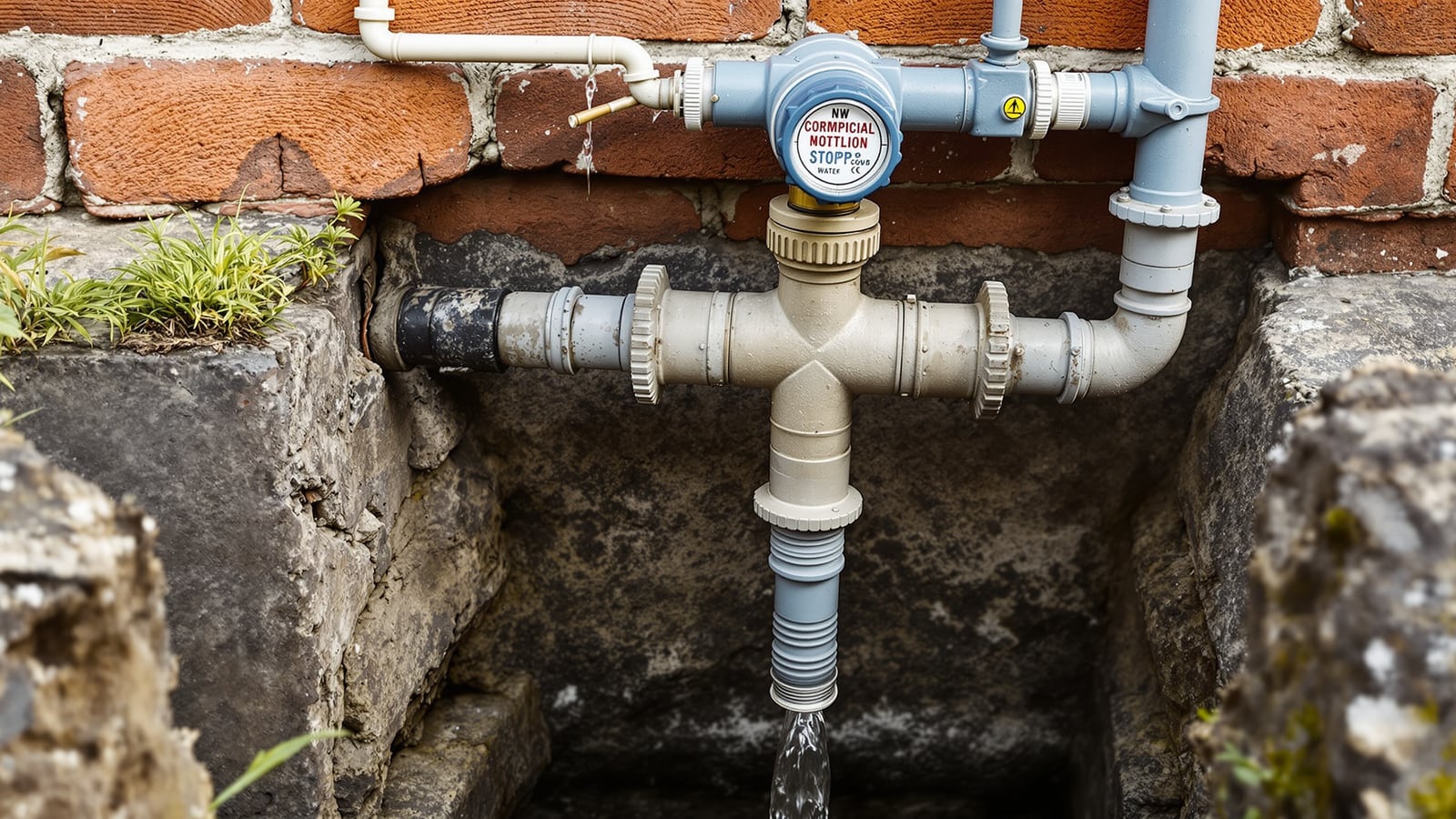
- Ferrule / service connection — a small tapping (commonly 15–25 mm) drilled and threaded into the main. The ferrule is the legal boundary: everything upstream belongs to the utility, everything downstream to you.
- Service pipe — carries water from the ferrule across to your boundary. Usually 15–25 mm for a single home, sized up for larger plots.
- Water meter — installed near the property line to record consumption for billing.
- Stopcock / stop tap — your master shut-off just inside the boundary. Close it before any plumbing work; it isolates the whole house from the mains.
- Underground sump — a masonry or plastic storage tank, usually below or at ground level, that the mains fills during supply hours.
- Pump and overhead tank — a pump lifts water from the sump to a roof tank, from where gravity feeds the house.
The order matters. Water does not flow main → taps. It flows main → sump → pump → overhead tank → taps. The mains only ever talks to your sump.
Getting a new water connection and bye-law basics
A new municipal connection is granted by your local water utility — the corporation, water board, jal board, or municipality, depending on the city. The process is broadly similar countrywide:
1. Apply to the utility (increasingly online) with proof of ownership, an approved building plan, and identity documents.
2. Pay charges — a one-time connection or deposit fee that scales with connection size and plot use, plus a security deposit.
3. Site inspection — a utility engineer verifies the tapping point, meter position and pipe route.
4. Tapping and metering — the utility (or its approved contractor) makes the ferrule tap, lays the service pipe to your boundary and fits the meter.
A few bye-law realities worth knowing before you apply:
- The utility owns everything up to the meter. You cannot legally tap the main yourself; unauthorised tapping is an offence and a common cause of contamination.
- Direct suction from the main is usually prohibited. Bye-laws in most cities forbid connecting a pump directly to the service pipe, because it robs pressure from neighbours and can suck contaminants into the network. This is why the sump exists — you draw from your own stored water, never from the live main.
- Connection size is regulated. A standard home gets a 15–20 mm connection; larger sizes need justification and higher fees.
- Storage is often mandated. Many municipal and building bye-laws require adequate underground and overhead storage sized to daily demand.
Because rules and figures vary by city and change over time, treat every number here as indicative and confirm the current schedule with your local water authority.
Why supply is intermittent — and why the sump is not optional
Very few Indian cities run a 24×7 pressurised network. The norm is intermittent supply: water is released to each zone on a rota, often for just 2–4 hours a day, sometimes on alternate days. When your zone's window opens, the main pressurises; when it closes, the line drains and goes flat.
This single fact drives the entire storage model:
- During the supply window, water flows by mains pressure into your underground sump — the lowest, easiest point to reach.
- A pump then lifts it to the overhead tank on the roof.
- For the other 20-plus hours, your home lives off that stored water, gravity-fed down from the roof.
Sizing the storage matters. Domestic demand in India is planned at roughly 135 litres per capita per day (lpcd) in fully sewered towns, per the CPHEEO norm used by utilities. A family of four therefore needs around 540 litres a day, and storage is usually sized to hold one to two days of that so a missed supply day does not empty the house.
| Household size | Demand at 135 lpcd | One-day storage | Suggested sump + OHT split |
|---|---|---|---|
| 2 persons | ~270 litres/day | ~270 litres | 500 L sump + 300 L OHT (indicative) |
| 4 persons | ~540 litres/day | ~540 litres | 1,000 L sump + 500 L OHT (indicative) |
| 6 persons | ~810 litres/day | ~810 litres | 1,500 L sump + 1,000 L OHT (indicative) |
| Small apartment block | scales with occupancy | 1-2 days total | Sized by plumbing consultant to bye-law |
The sump is deliberately larger than the overhead tank: it catches the whole supply window, and the pump then tops up the roof tank as needed. For how storage tanks are chosen, sited and kept clean, see our forthcoming guide on water storage tanks; for how the stored water is then routed to fixtures, see domestic water distribution.
Metering and tariffs
Most utilities meter domestic connections and bill on telescopic (slab) tariffs — the rate per kilolitre rises as you use more, to reward conservation. A kilolitre (kL) is 1,000 litres. Typical structures look like the table below; the exact slabs and rates are set by each city and revised periodically, so these are indicative only.
| Monthly use | Typical domestic character | Indicative rate | Notes |
|---|---|---|---|
| First ~10 kL | Lifeline / basic slab | Lowest ₹ per kL | Sometimes a low fixed minimum |
| ~10–20 kL | Normal family use | Higher ₹ per kL | Bill rises with consumption |
| ~20–30 kL | Heavy use | Higher still | Telescopic penalty band |
| Above ~30 kL | Very heavy | Highest ₹ per kL | Plus sewerage cess in many cities |
Points that catch homeowners out:
- A sewerage cess is often added as a percentage of the water charge, whether or not you are on the STP or municipal sewer.
- Unmetered / flat-rate connections still exist in some towns, billed at a fixed monthly amount — usually a poor deal for small households.
- A faulty or stuck meter may be billed on assessed average; get it replaced promptly, as disputes are hard to reverse.
- Annual connection and meter-servicing charges of a few hundred to a couple of thousand rupees (say ₹1,200 a year, indicative) may apply on top of consumption.
Pressure at the main
Even when supply is on, do not assume strong pressure. Utility networks are designed to deliver a minimum residual pressure at the consumer point — commonly targeted around 7–12 metres of head (roughly 0.7–1.2 bar) in the distribution zone under the relevant design norms. In practice, tail-end streets, high floors and old undersized mains often see far less, which is exactly why direct-from-mains supply to upper floors is unreliable and the sump-and-pump model wins.
This is also why bye-laws ban direct pumping from the main: a booster pump drawing on the live service pipe can pull the residual pressure below the point where neighbours get anything at all, and can create suction that draws groundwater or contaminants in through joints.
Water quality from municipal lines
Municipal water is treated to a potable standard at the plant — filtered, clarified and disinfected (usually with chlorine) to meet the drinking-water specification. In principle it leaves the plant safe. In practice, quality at your tap depends on what happens in between:
- Intermittent supply is the main risk. When a main goes empty between windows, the pipe is at low or negative pressure, and cracked joints or nearby drains can let contaminants seep in. Water that was clean at the plant can pick up trouble on the last kilometre.
- Old or corroded pipes add sediment, iron and taste.
- Chlorine residual protects the water in transit but can leave an odour and taste at the tap.
- Your own storage is the second line of defence and the second risk: an uncovered or unclean sump or overhead tank can undo the utility's treatment. Keep tanks lidded, screened against mosquitoes, and cleaned periodically.
For drinking, most homes add a point-of-use step — an RO, UV or gravity filter — regardless of source. Municipal water is generally lower in dissolved solids than borewell water, so it often needs lighter treatment. This guide stays on the supply and safe-storage side; for choosing and running purification kit, see our smart water purifier guide, and to compare municipal against a private bore, see the borewell water system guide.
Treat the sump and overhead tank as part of the treatment chain, not just plumbing. The cleanest municipal water in the country is only as safe as the last tank it sits in.
Where this fits in your plumbing
Municipal supply is one source. Many Indian homes run a dual arrangement — corporation water for drinking and cooking, borewell water for flushing, gardening and washing — switched at the sump or through separate tanks. Some also plumb treated greywater or STP output to toilets to cut demand on the mains. However you combine sources, the storage-and-pump backbone stays the same; only what fills the sump changes.
To go deeper:
- The pillar overview: /guides/water-supply-systems-india
- Where supply fits in the whole house: /guides/plumbing-systems-guide-india
- The alternative / supplementary source: /guides/borewell-water-system-india
- How stored water reaches your fixtures: /guides/domestic-water-distribution-india
- Sizing and siting the tanks (forthcoming): /guides/water-storage-tanks-guide-india
- The two ways stored water is pushed to taps: /guides/gravity-fed-plumbing-system-india and /guides/pressurized-plumbing-system-india
- Cutting mains demand with recycled flush water: /guides/treated-water-toilet-flushing and /guides/home-greywater-recycling-systems
References
- National Building Code of India (NBC) 2016, Part 9 — Plumbing Services (water supply, storage and distribution)
- CPHEEO Manual on Water Supply and Treatment, Ministry of Housing and Urban Affairs (per-capita demand, design flows and residual pressure)
- IS 2065 — Code of practice for water supply in buildings
- IS 1172 — Code of basic requirements for water supply, drainage and sanitation
- IS 10500 — Drinking water specification (potable-water quality parameters)
- Your local water utility's bye-laws, connection schedule and tariff notification (vary by city and revised periodically — confirm locally)
Export this guide
Related Guides — Deep-dive reading
Water Supply Systems in India: How Water Reaches Every Tap in Your Home
The complete map of how water gets into an Indian home and out to every fixture — the sources it comes from, the sump-pump-overhead-tank storage model that buffers intermittent supply, how gravity and pressurised distribution differ, and the demand figures that size the whole thing.
PlumbingPlumbing Systems: The Ultimate Guide for Indian Homes & Buildings
The wide-angle pillar for the Studio Matrx Plumbing Knowledge Hub — what plumbing is, the two halves of every system (water supply and drainage/DWV), the whole-house water journey from source to fixture to drain, the main system types, and where conservation, building services and maintenance fit — with links down to every deeper guide.
PlumbingLow-Rise Plumbing Systems in India: Houses, Villas & Buildings up to 4 Storeys
How plumbing is organised for independent houses, villas and low-rise buildings up to about four storeys — the simple overhead-tank gravity model, when a small booster is still worth adding, single- versus multi-floor distribution, and the simpler stack and venting a low building can get away with.
PlumbingRelated Tools — Try Free
Rainwater Tank Sizer
How big should your rainwater tank be? Computes annual harvest, recommended tank capacity in litres, water-bill savings, and payback — for 10 Indian cities.
RWH CalculatorCross-Ventilation Analyzer
Estimate airflow and air changes per hour (ACH) from room size, window areas, layout, and local wind — with NBC 2016 Part 8 compliance check.
Ventilation CalculatorContract Studio
AI generates professional architecture service agreements with milestones and scope.
ArchitectAI