
Water Pressure Booster Pump India: Fix Weak Shower Flow Before You Buy a Rain Head (2026)
Gravity from an overhead tank cannot run a rain shower or body jets — especially on the top floor. This is the honest India-first guide to pressure booster pumps: pressure-switch vs flow-switch, single-fixture vs whole-house sizing by head and LPM, dry-run protection, noise, mounting, electricals and real rupee ranges.
You have picked the tiles, chosen a beautiful rain head, maybe even a set of body jets — and then, on the first shower, the water dribbles. This is the single most common, most avoidable disappointment in Indian bathroom upgrades, and it almost never means a faulty fitting. It means the water pressure booster pump you needed was never in the budget. In most Indian homes the shower is fed by gravity from an overhead tank a floor or two up, and gravity alone simply cannot push enough water through a modern head. This guide is the honest, technical companion to fix that — read it before you buy a rain shower, not after.
Read it up to the bathroom plumbing guide for India for the whole supply-and-drainage picture, and alongside the fittings that most need a pump: the rain shower guide for India and body jets shower systems for India. If you are laying out a new supply, pair it with the bathroom water supply guide for India.
A booster pump does not create water — it creates pressure. If your problem is an empty tank or a choked half-inch pipe, no pump will save you. Diagnose flow and pressure first; then size the pump to the head and litres-per-minute your fittings actually demand.
Why gravity from an overhead tank gives weak flow
Pressure from a tank is pure height. Every 10 metres of vertical drop from the water surface to the outlet gives roughly 1 bar of pressure. Do the arithmetic for a real Indian home and the problem is obvious.
- A tank sitting 3 metres above a first-floor shower gives about 0.3 bar.
- The top-floor bathroom — the one closest to the tank on the terrace — may have the tank only 1–2 metres above the shower head, giving a miserable 0.1–0.2 bar. This is why the top floor is always the worst for pressure, the opposite of what people expect.
- Add friction losses in long horizontal runs, elbows, a half-open stopcock or a 15 mm (half-inch) pipe feeding a hungry head, and even that thin pressure collapses further.
Now compare what modern fittings want. A conventional hand shower is happy at 0.5 bar. But a rain head expects 1.0–1.5 bar and 12–20 LPM; a bank of body jets can demand 2.5–3 bar and 20–30 LPM all at once. A gravity top-floor tap offering 0.15 bar is delivering a tenth of what body jets need. No amount of "premium" fitting fixes a supply that is short by a factor of ten — only a pump does.
What a booster pump actually is
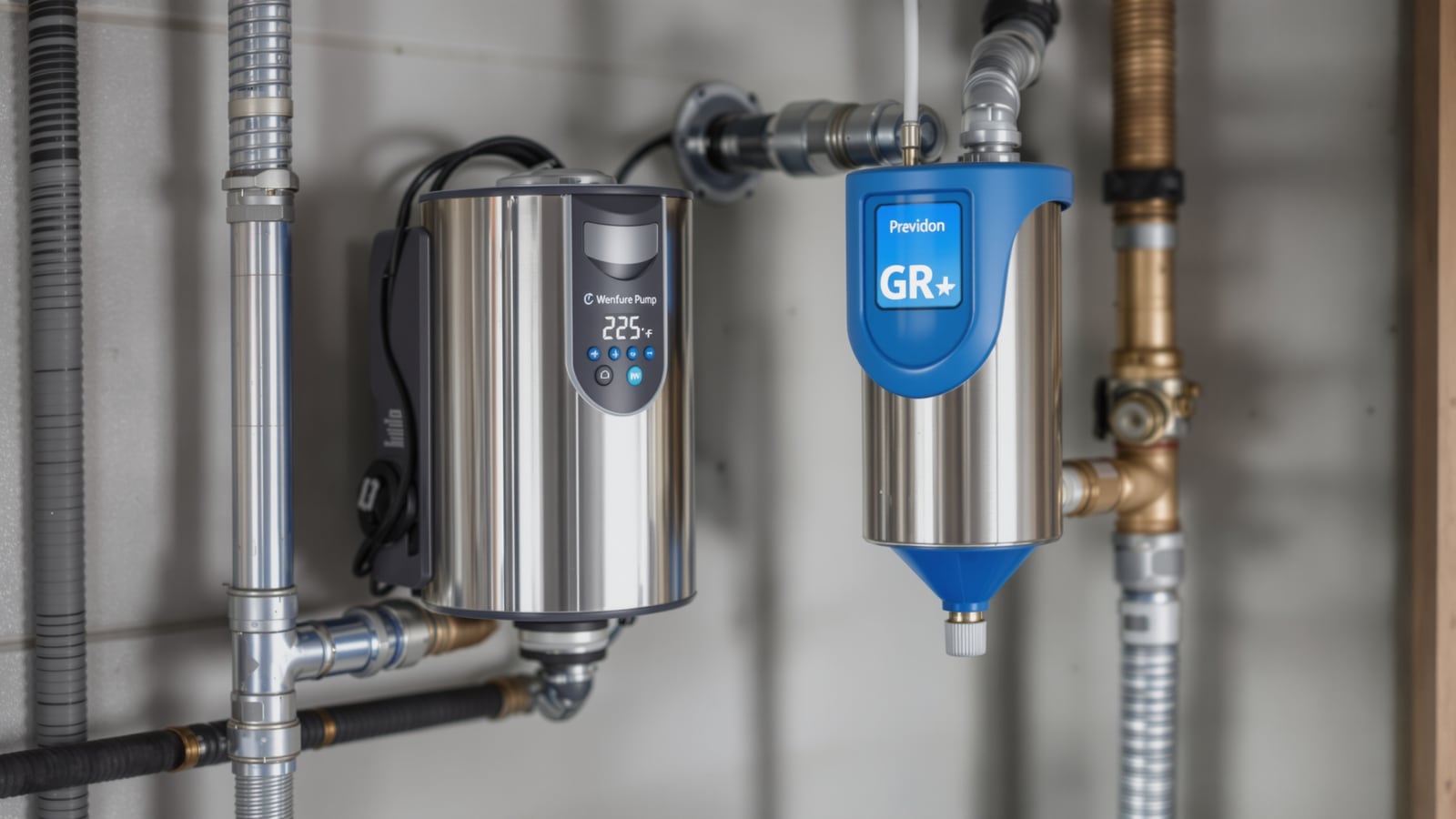
A domestic pressure booster pump is a small centrifugal pump that sits on the supply line after the tank, senses when you open a tap, switches on automatically and raises pressure to a set level. The good ones do three jobs: boost pressure, start and stop by themselves, and protect against running dry. The two families you will be offered differ mainly in how they decide to switch on.
| Control type | How it switches on | Pros | Watch out for |
|---|---|---|---|
| Flow-switch (automatic pump controller) | Detects water movement when a tap opens | Simple, cheap, self-priming units common; instant response | Needs a minimum flow to trigger; can "hunt" (rapid on/off) at a trickle |
| Pressure-switch | Cuts in below a set pressure, cuts out above | Steady pressure, holds a set band | Cycles more without a tank; switch can wear |
| Pressure-switch + small pressure vessel | Vessel stores pressurised water; pump runs less | Fewest starts, quiet, long pump life | Larger footprint, higher cost |
| Constant-pressure (VFD / inverter) | Varies motor speed to hold exact pressure | Silent, rock-steady even with several taps open | Most expensive; overkill for one bathroom |
For a single bathroom, a flow-switch self-priming pump is the usual, sensible pick. For a whole floor or house with several outlets that may open together, a pressure-switch pump with a pressure vessel (a small hydro-pneumatic set) stops the pump machine-gunning on and off.
Where to boost: one fixture, one bathroom, or the whole house
Deciding the scope first prevents both under- and over-spending.
- Single fixture / single bathroom. A compact 0.5 HP self-priming pump on the bathroom's feed line. Cheapest, easiest, and enough for a rain head plus hand shower. This is the right answer for one problem shower on the top floor.
- Whole bathroom with body jets. A 0.5–1 HP pump, ideally with a small pressure vessel, because jets + overhead running together pull a lot of LPM at once.
- Whole house. A hydro-pneumatic pressure system — pump(s) plus a pressure vessel and controller — fitted at the tank outlet so every outlet in the home is pressurised evenly. This is the proper answer for a villa or a serious luxury bathroom design in India, and it removes the "someone flushed while I showered" pressure drop for good.
A house-wide system costs far more but is fitted once and serves everything; a per-bathroom pump is cheap but multiplies if you have three weak bathrooms.
Sizing: head and litres per minute
Pumps are rated by two numbers, and both must be met — not just the headline horsepower.
- Head (metres): how high, in equivalent vertical metres, the pump can push water. 10 m of head ≈ 1 bar. To reach 2 bar at the shower you need roughly 20 m of head plus enough to overcome pipe friction — aim for a pump rated 25–30 m for a comfortable 2 bar at the outlet.
- Flow (LPM): the volume it can move. Add up the fittings that run together. A rain head (15 LPM) plus a hand shower (8 LPM) wants a pump comfortable at ~25 LPM; add four body jets and you are looking for 30–40 LPM.
| Use case | Suggested rating | Approx. motor | Delivers |
|---|---|---|---|
| One hand/overhead shower, top floor | 20–25 m head, 20 LPM | 0.5 HP | ~1.5–2 bar |
| Rain head + hand shower | 25–30 m head, 25 LPM | 0.5–1 HP | ~2 bar |
| Body jets + overhead together | 30 m head, 30–40 LPM | 1 HP + vessel | ~2.5–3 bar |
| Whole house (3–4 bathrooms) | Hydro-pneumatic set | 1–2 HP | 2.5–3 bar, all outlets |
A pump that is oversized short-cycles and wears; one that is undersized never reaches pressure. Match the rating to the simultaneous demand, not the biggest single fitting.
Dry-run protection — the feature that saves the pump
Indian tanks run empty — water arrives on a schedule, or the tank drains during a long shower. A centrifugal pump run dry burns out its seals and motor within minutes. So dry-run protection is not optional:
- Look for a built-in automatic pump controller that cuts power on loss of flow/pressure and will not restart until water returns.
- Or fit a separate dry-run preventer / low-level cut-off wired to a tank sensor.
- Never plumb a booster pump on the suction (lift) side from an underground sump unless it is explicitly self-priming and rated for it — most domestic booster pumps want a flooded (positive) suction from the overhead tank feeding down into them.
Noise, vibration and mounting
A booster pump lives with you, so how it is mounted decides whether it hums quietly or hammers through the wall.
- Mount on a rubber/anti-vibration pad or bush, never bolted hard to a resonant slab or a hollow drywall.
- Use flexible connectors (braided hose unions) on inlet and outlet so pipe-borne vibration does not travel into the plumbing.
- Site it in a utility balcony, shaft or duct — not sharing a wall with a bedroom headboard. A pressure-vessel set is quietest because the pump starts far less often; a bare pressure-switch pump is the noisiest because it cycles.
- Keep the unit dry and ventilated; monsoon damp and a sealed cupboard shorten motor life.
Electricals and safety
- Give the pump its own switch and a dedicated point with correct earthing per IS 732 (electrical wiring). A small 0.5 HP pump runs on a normal single-phase 230 V point; verify the load.
- Fit an RCD/ELCB on the circuit — this is a wet area with a motor.
- Keep it on the inverter/UPS-friendly side of thinking: during load-shedding your gravity supply still trickles, but the pump is dead, so a top-floor bathroom may have no usable flow until power returns. A small pressure vessel buys you a few litres of pressurised water through a short cut.
- All wiring, earthing and switching should follow NBC 2016 electrical and plumbing provisions and be done by a licensed electrician.
What it costs in India
| Item | Budget (₹) | Mid (₹) | Premium (₹) |
|---|---|---|---|
| Single-bathroom booster pump (0.5 HP, flow-switch) | 4,500–7,000 | 8,000–13,000 | 14,000–20,000 |
| Pressure pump + small pressure vessel (1 bathroom/floor) | 12,000–18,000 | 18,000–30,000 | 30,000–45,000 |
| Whole-house hydro-pneumatic system | 40,000–70,000 | 70,000–1,20,000 | 1,20,000–2,50,000+ |
| Dry-run controller (if not built in) | 800–1,500 | 1,500–3,000 | — |
| Plumbing + electrical fitting labour | 1,500–3,000 | 3,000–6,000 | 6,000+ |
Brand-neutral guidance: entry pumps from the usual pump houses are fine for one bathroom; spend up for a pressure vessel or constant-pressure (VFD) unit only when several outlets run together or noise matters. Whatever you spend on the rain head, the pump budget comes first — a ₹40,000 head on 0.15 bar performs worse than a ₹4,000 head on 2 bar.
Quick selection checklist
- Confirm the problem is pressure, not an empty tank or a choked 15 mm pipe.
- Top floor near the tank? You almost certainly need a pump — that floor has the least height.
- Size by head (25–30 m for ~2 bar) and LPM for the fittings that run together.
- Insist on dry-run protection — built in or a separate cut-off.
- One shower: 0.5 HP flow-switch pump. Body jets or several outlets: add a pressure vessel. Whole villa: hydro-pneumatic set.
- Mount on anti-vibration pads with braided flexible unions, in a utility duct — not beside a bedroom.
- Dedicated earthed point with an ELCB, wired per IS 732 / NBC 2016.
References
- National Building Code of India (NBC) 2016, Part 9 (Plumbing Services) — water supply, minimum service pressures and fixture demand; Part 8 for electrical installation of pumps.
- IS 1172 — code of basic requirements for water supply, drainage and sanitation (per-capita demand and fixture flow).
- IS 1520 / IS 8034 — horizontal centrifugal and domestic monoblock pump sets (ratings, head and discharge).
- IS 732 — code of practice for electrical wiring installations (earthing, protection for wet-area motor circuits).
- CPHEEO Manual on Water Supply and Treatment, Ministry of Housing and Urban Affairs — service pressure and demand guidance.
- BIS product standards for pumps and IGBC/GRIHA water-efficiency guidance for pressurised, low-flow fittings.
Export this guide
Related Guides — Deep-dive reading
Bathroom Water Supply India: Cold & Hot Feed, Pipe Sizing, Pressure & Booster Pumps (2026)
How water actually reaches your fixtures in an Indian home — gravity-fed cold from the overhead tank, hot from the geyser, the pipe sizes that decide whether your shower gushes or dribbles, isolation valves at every fixture, booster pumps and hard-water protection, all mapped to IS 1172.
BathroomsWater Pumps Guide for India: Types, How to Choose & Size (Head, Flow, Phase)
The master overview of domestic and building water pumps — what a pump actually does (lift plus pressure), the two numbers that decide everything (HEAD in metres and FLOW in LPM), a pump-type-to-use table, single vs three phase, priming, foot valve and NRV needs, dry-run protection, and BEE star rating with running cost at a glance for an Indian home.
PlumbingBooster & Pressure Pumps in India: How to Get Strong, Even Water Pressure at Every Outlet
The pump that fixes weak, trickling taps and limp rain showers — how pressure boosting works, constant-pressure vs pressure-switch-and-tank vs hydro-pneumatic vs VFD boosters, where each is needed, target pressures in bar, correct install position, dry-run and auto cut-off, noise, and indicative cost for an Indian home.
PlumbingRelated Tools — Try Free
Shower Pump Calculator
Check whether your shower needs a pressure-boost pump and what size — available vs required pressure from your tank height or supply.
Bathroom CalculatorElectrical Safety & Load Audit
Home electrical audit — 10 categories, 65+ checkpoints across earthing, RCCB, MCB, wiring, switchboards, appliance circuits, DG/inverter backup.
Safety AuditMonsoon-Readiness Checklist
Pre-rain home audit across 9 categories — terrace, drains, waterproofing, electrical, HVAC, pest, vehicles, documents.
Seasonal Audit