
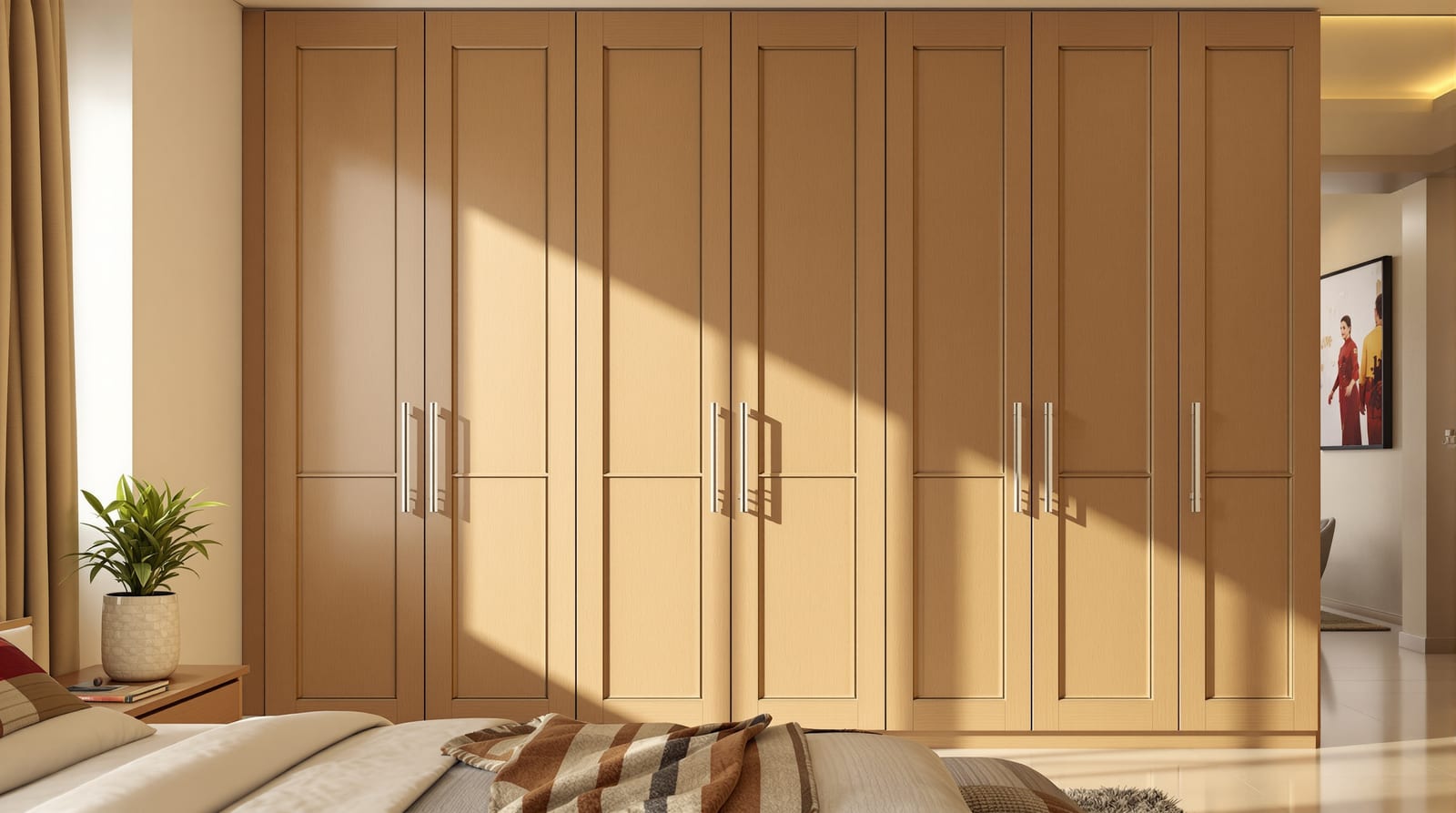
Wardrobe Doors in India: Hinged vs Sliding vs Bi-fold, Finishes & Cost
How to pick the right wardrobe door for your room — hinged for full access, sliding to save floor space, bi-fold for tight corners — and which shutter finish survives Indian humidity.
The wardrobe is usually the single biggest piece of joinery in an Indian bedroom, and its doors decide three things at once: how much of the room you lose to a swing, how much of the wardrobe you can actually see when it is open, and how the whole wall looks. Get the door type wrong and you live with it every day — a hinged shutter that bangs the bed, or a sliding door that hides half your shelves behind the other half. This guide walks through the four real choices for Indian homes — hinged (openable), sliding, bi-fold and walk-in (no door or a curtain) — with honest pros and cons, the shutter finishes that survive monsoon humidity and coastal salt, the hardware that makes a wardrobe feel premium (soft-close, handleless profiles), and what each costs per square foot of shutter.
This is a deep dive on wardrobe doors specifically. If you have already decided on a sliding system and want the mechanism, track and stopper detail, read our companion on sliding wardrobe doors in India. For the magnets that hold hinged shutters quietly shut, see magnetic door catches in India.
The core trade-off: floor space versus access
Every wardrobe door decision comes back to one tension. A hinged door swings out into the room, so it needs clearance — but when open it gives you the entire wardrobe at a glance. A sliding door uses no floor space at all — but two or three panels share one opening, so you can only ever see half (or two-thirds) of the inside at once. There is no door type that gives both. You choose which problem you would rather have.
That single picture explains most of what follows. A 6-foot two-shutter hinged wardrobe needs roughly 500-650 mm of clear floor in front of each shutter; in a compact 10x10 ft bedroom with a bed and a side table, that clearance is exactly what you do not have, which is why sliding wardrobes dominate small Indian flats while hinged wardrobes are the default in larger rooms and villas.
The four wardrobe door types
1. Hinged (openable) wardrobes
The traditional, most common choice. Shutters swing outward on butt hinges or concealed (European/auto-close) hinges. Each shutter is typically 450-600 mm wide; go wider and the shutter sags and fouls on the carcass over time, especially once monsoon humidity swells the ply slightly.
Strengths: full access — open both shutters and the whole interior is in front of you, so deep shelves, drawers and pull-outs all work. Cheaper than sliding because the hardware is just hinges, handles and a magnetic catch rather than a track system. Easier to repair by any local carpenter. You can also fit a full-height mirror or a loft (over-head storage) shutter without a track penalty.
Weaknesses: needs swing clearance, so it eats floor space and can collide with the bed, a side table or the room door. Tall shutters can warp or droop if the ply or hinges are weak. Best for: rooms with space to spare, walk-in dressing areas, and anyone who hates losing visibility of their clothes.
2. Sliding wardrobes
Two or three panels run on a top or bottom track and slide past each other. The single biggest advantage in an Indian flat: zero floor clearance — the doors never enter the room, so you can stand a bed right up against the wardrobe.
Strengths: space-saving, clean flush-wall look, large uninterrupted panels suit mirror and lacquered-glass finishes beautifully, and a good top-hung soft-close track feels genuinely premium. Weaknesses: you only ever access half (2-panel) or two-thirds (3-panel) of the interior at once — there is always a "dead" overlap zone you must slide a panel to reach. Internal pull-out trays and corner shelves are harder to use because a panel always blocks part of the opening. Tracks collect dust and hair (a real maintenance point in Indian homes) and a cheap bottom track can derail; quality top-hung systems (Hettich, Hafele, Ozone, Slido) cost more but slide for years. Best for: small and medium bedrooms, any wall against which furniture sits, and clean minimalist elevations.
3. Bi-fold wardrobes
Each "door" is two narrow leaves hinged together that fold flat like a concertina against the side of the opening. A halfway house between hinged and sliding.
Strengths: needs far less swing clearance than a full hinged shutter (the leaves fold back on themselves), yet when open they clear most of the opening, so access is better than sliding. Good for awkward narrow rooms and utility/store wardrobes. Weaknesses: the folding hardware (pivots and a guide track) is more complex, can rack or jam if alignment drifts, and the fold lines interrupt large mirror or glass finishes. Less common in mass Indian carpentry, so fewer fitters do it well. Best for: tight rooms where you still want most of the wardrobe visible, and narrow utility cupboards.
4. Walk-in (no door, or a curtain)
In a dedicated dressing room or a wardrobe niche, you can skip shutters entirely — open shelving with a curtain, a sliding fabric panel, or a barn-style sliding door across the whole opening.
Strengths: cheapest (no shutter hardware), full visibility, easy to restyle, and excellent ventilation, which matters in humid coastal cities where closed shutters can trap damp and breed mildew. A curtain or barn door gives a soft, characterful look. Weaknesses: clothes collect dust, there is no security, and it only looks good if the wardrobe is kept genuinely tidy. Best for: walk-in dressing rooms, master suites with a separate closet, and people who like an open-shelf aesthetic.
Wardrobe door type comparison
| Door type | Floor space needed | Access | Best room size | Shutter cost (indicative, ₹/sq ft) |
|---|---|---|---|---|
| Hinged (openable) | ~500-650 mm swing per shutter | Full (whole interior) | Medium to large; villas | 450-1,100 |
| Sliding (2-3 panel) | None | Half / two-thirds at a time | Compact to medium flats | 500-1,200 |
| Bi-fold | ~150-250 mm (leaves fold flat) | Most of opening | Narrow / awkward rooms | 600-1,300 |
| Walk-in / curtain | None (open) | Full | Dressing room / niche | 150-400 (curtain/track only) |
Costs are for the shutter finish per square foot of shutter area, fitted, indicative and varying by city, vendor and finish; the carcass (the box, shelves and drawers) is priced separately, usually per running foot, and +18% GST applies. Sliding adds a track premium of roughly ₹1,500-6,000 per running foot for a good soft-close system.
Shutter finishes — what survives Indian conditions
The door type sets the mechanism; the finish sets the look, the price and how well it ages in heat, humidity and handling. From budget to premium:
| Finish | Look | Durability / care | Indicative ₹/sq ft |
|---|---|---|---|
| Laminate | Matt or textured, huge range of woodgrains/solids | Toughest everyday surface; scratch and moisture resistant; wipe clean | 450-700 |
| Membrane (PVC foil) | Seamless moulded shapes, soft matt | No edge banding; can peel at edges in heat over years | 500-800 |
| Veneer (PU/melamine top coat) | Real wood grain, warm | Premium natural look; needs polishing, can fade in sun | 800-1,500 |
| PU (paint) lacquer | Smooth solid-colour, satin or matt | Rich and seamless; site spray needs skill; chips can show | 900-1,500 |
| Acrylic / high-gloss | Mirror-like glossy colour, very modern | Stunning but shows fingerprints, dust and fine scratches | 900-1,600 |
| Lacquered glass | Deep glossy colour-backed glass, easy to wipe | Fingerprint-resistant, premium, but heavy and can chip at edges | 1,000-1,800 |
| Mirror | Full-length dressing mirror | Doubles as mirror, brightens small rooms; needs safety backing | 700-1,400 |
A practical note for Indian climates: in humid coastal cities (Mumbai, Chennai, Kochi, Goa), prefer moisture-stable cores — boiling-water-proof (BWP) ply or WPC over cheap MDF — and choose laminate or lacquered glass over membrane, because membrane foil is the finish most likely to lift at the edges in sustained heat and damp. Acrylic and high-gloss look spectacular in a showroom but reward only tidy households; on a daily-use shutter touched with oily hands, fingerprints are relentless. For the deeper material trade-offs see our guides on laminate doors in India and membrane doors in India.
Hardware that makes a wardrobe feel premium
The shutter is only as good as what holds and moves it.
Hinges. Hinged shutters today almost always use concealed European clip-on hinges with built-in soft-close — the shutter glides shut for the last few centimetres instead of banging. Specify hinges rated for the shutter weight and add an extra hinge for tall (over 1800 mm) shutters to stop droop. A simple magnetic catch holds light shutters closed; see magnetic door catches in India.
Soft-close. On sliding wardrobes, a soft-close damper on the track stops the panel slamming the carcass and is the single upgrade people notice most. On hinged, it lives in the hinge. Worth paying for; it also protects the shutter edge from chipping over years.
Handles — and going handleless. Three routes:
- Conventional knobs and pulls (cheapest, easy to replace) — knob and handle styles are covered in our door knobs and door handles guides.
- Profile (G or J) handles — an aluminium channel routed into the shutter edge that you hook your fingers behind. Clean, no protruding hardware, very common on modern Indian wardrobes.
- Push-to-open / handleless — a magnetic or mechanical push-latch opens the shutter with a tap, for a perfectly flush, knob-free elevation. Beautiful, but needs accurate fitting and is harder to repair.
Choosing by room size — a quick decision path
- Compact bedroom (under ~110 sq ft) or any wall the bed sits against: go sliding. The lost-access half is a fair price for the floor you keep.
- Medium bedroom with a metre of clear floor in front of the wardrobe wall: hinged gives you full access and costs less; this is the sweet spot for most Indian homes.
- Narrow or awkward room where a full swing would hit something but you still want to see everything: consider bi-fold.
- Separate dressing room or a deep niche: go walk-in with open shelving and a curtain or a single barn-style sliding panel — cheapest and best ventilated.
When you are budgeting the whole wardrobe (carcass plus shutters plus hardware), our door cost calculator and door material comparison tools help you sanity-check a quotation before you sign.
Frequently asked questions
Are sliding or hinged wardrobe doors better for a small bedroom?
Sliding, almost always. Sliding doors use zero floor space, so you can place a bed or table right against the wardrobe — impossible with hinged shutters that need 500-650 mm of swing clearance. The trade-off is access: you only ever see half (2-panel) or two-thirds (3-panel) of the interior at once. In a compact Indian flat the floor you save matters more than the access you lose. See sliding wardrobe doors in India for the mechanism detail.
Which wardrobe shutter finish is best for humid coastal cities?
Laminate or lacquered glass on a moisture-stable BWP-ply or WPC core. Both wipe clean, resist humidity and do not lift like membrane (PVC foil), which is the finish most prone to peeling at the edges in sustained heat and damp. Avoid cheap MDF cores in coastal homes; they swell. High-gloss acrylic looks great but shows fingerprints on daily-use shutters.
How much do wardrobe shutters cost per square foot in India?
Indicatively (fitted, finish only, +18% GST, varies by city and vendor): laminate ₹450-700, membrane ₹500-800, veneer ₹800-1,500, PU lacquer ₹900-1,500, acrylic/high-gloss ₹900-1,600, lacquered glass ₹1,000-1,800, mirror ₹700-1,400. Sliding adds a track premium of roughly ₹1,500-6,000 per running foot. The carcass is priced separately, usually per running foot.
Do wardrobe doors need soft-close hardware?
Not strictly, but it is the upgrade most people notice. Soft-close stops shutters and sliding panels slamming, which also protects the shutter edge from chipping and the hinge/track from wear over years. On a daily-use bedroom wardrobe it is worth the small extra cost; on a rarely opened store-room cupboard you can skip it.
Can I fit a full-length mirror on a wardrobe door?
Yes, and it is one of the best small-room tricks — a mirror shutter doubles as a dressing mirror and visually enlarges the room. It works on both hinged and sliding doors; on sliding it suits the large uninterrupted panels especially well. Insist on a safety backing film so that if the glass ever breaks, it holds together rather than shattering.
Export this guide
Related Guides — Deep-dive reading
Sliding Wardrobe Doors in India: Tracks, Profiles, Soft-Close and Shutter Infills (2026)
How bottom-roller and top-hung track systems, aluminium profiles and shutter infills decide what a sliding wardrobe really costs and how long it stays smooth.
Home Doors & EntrancesComplete Guide to Interior Hardware
The 8–12% of the interior budget that decides whether everything else works
Materials & FinishesDining Room Door in India: Best Partition & Opening Choices (2026)
How to choose the right door for the dining area of an Indian home - kitchen-dining partitions that trap cooking smells and smoke while keeping flow, plus open dining-to-living and dining-to-garden options - ranked picks, drivers and indicative costs.
Home Doors & EntrancesRelated Tools — Try Free
Window Hardware Cost Calculator
Estimate window hardware cost — hinges, handles, locks, rollers and multipoint gears.
Window CalculatorWardrobe Door Planner
Plan wardrobe doors for an opening — hinged vs sliding vs bi-fold, panel count, finish and an indicative cost.
Door PlannerDoor Material Comparison Tool
Compare 2–4 door materials on cost, durability, maintenance, security and moisture resistance.
Comparison Tool