
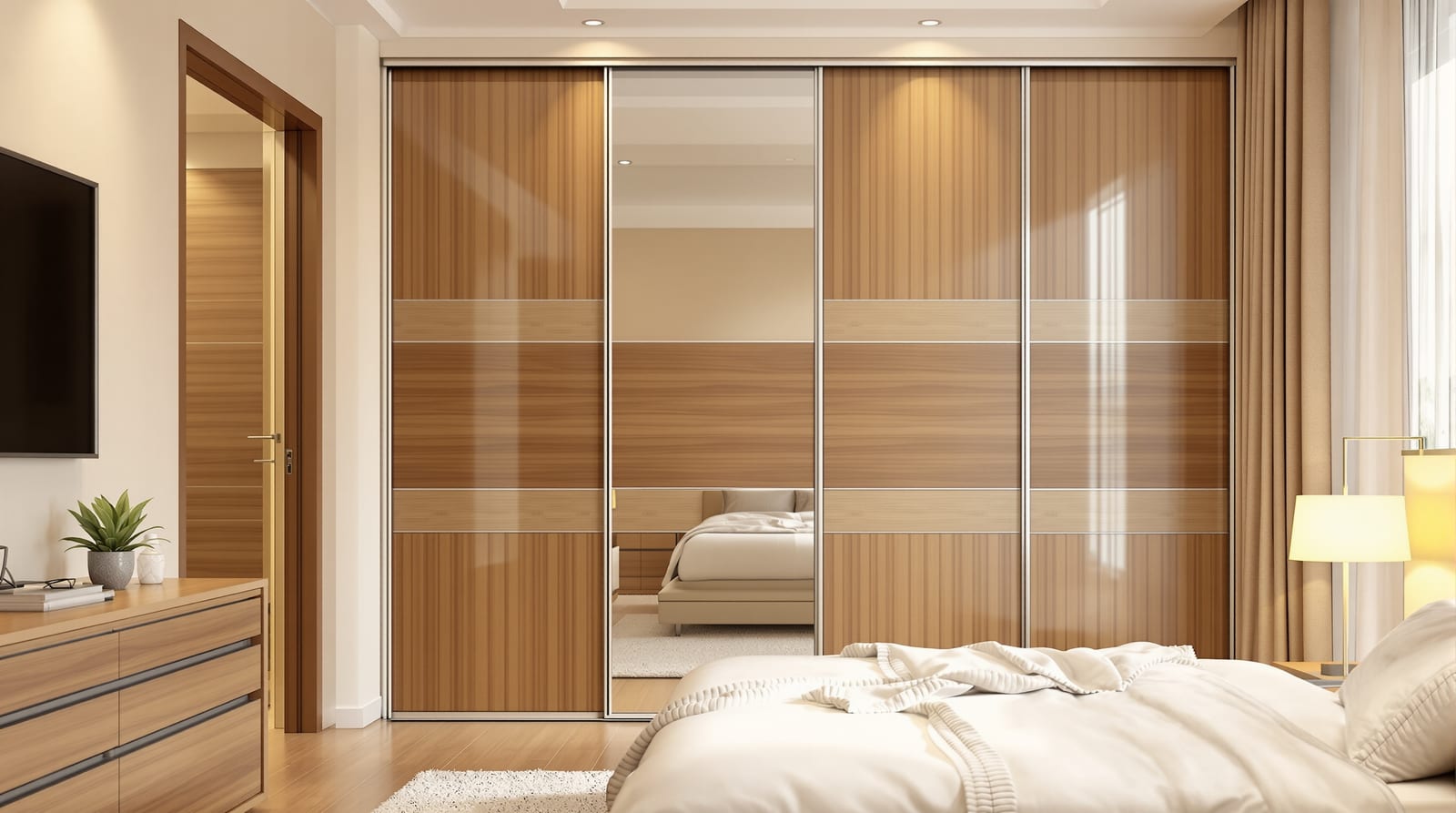
Sliding Wardrobe Doors in India: Tracks, Profiles, Soft-Close and Shutter Infills (2026)
How bottom-roller and top-hung track systems, aluminium profiles and shutter infills decide what a sliding wardrobe really costs and how long it stays smooth.
A sliding wardrobe door looks like one decision: pick a finish, slide it shut. In practice the finish is the part that ages best and the track is the part that decides whether the wardrobe still glides in year five or grinds and jumps off its rail. The shutter you see is carried by hardware you don't, and in Indian homes — where humidity, dust and a carpenter's "adjust it later" all conspire against alignment — the track and roller system is where the money and the regret both live. This guide goes deep on that hardware so you can complement what our wardrobe doors guide covers, and choose a system that stays smooth.
Why people choose sliding over hinged wardrobe doors
A hinged (openable) shutter needs swing clearance in front of the wardrobe — typically 500-600 mm of dead floor that you cannot put a bed or chair into. In compact 2BHK bedrooms across Mumbai, Bengaluru and Pune, that clearance is a luxury. Sliding wardrobe doors move within the wardrobe's own footprint, so you can park the bed right up to the shutter. They also give you a flush, gap-free wall of laminate, glass or mirror that reads as architecture rather than furniture.
The catch is structural to the format and worth saying plainly: with sliding doors you can only ever open one panel's worth of the wardrobe at a time. With two panels, you reach half the wardrobe; with three panels, two-thirds. The "half-access trade-off" is the single most important thing to understand before you commit — we return to it below.
The track system is the real product
Everything begins with how the shutter is carried. There are two families.
Bottom-roller (bottom-running) systems. The shutter's weight sits on rollers that run in a bottom track fixed to the wardrobe base; a top track only guides the shutter and stops it tipping. This is by far the most common system in Indian wardrobes — it is cheaper, tolerant of slightly out-of-true cabinets, and easy for a local carpenter to fit. The downside: the bottom track collects dust, hair and the fine grit that Indian homes generate endlessly, and that grit is what eventually makes a shutter stutter. A bottom track also creates a small lip at the wardrobe floor.
Top-hung (top-running) systems. The shutter hangs from rollers on a top track bolted into the wardrobe top; the bottom has only a shallow guide channel (or a floor guide pin), so there is no dust-catching bottom rail and the floor stays flush. Top-hung glides feel noticeably lighter and quieter, and they are the premium standard for tall, full-height shutters. The trade-off: the wardrobe top and its fixing must be genuinely strong and level, because the entire shutter weight hangs from it — a flimsy ply top or a poorly anchored carcass is the usual reason a top-hung system sags. Top-hung kits also cost more.
| Track / profile system | What carries the weight | Best for | Feel & upkeep | Indicative ₹ (system, per running/sq ft, fitting extra) |
|---|---|---|---|---|
| Bottom-roller, basic single-track | Bottom rollers | Budget builds, short shutters | Functional; bottom track needs regular vacuuming | Hardware ₹1,500-3,500 / wardrobe; shutter ₹450-700/sq ft |
| Bottom-roller, branded with soft-close & anti-jump | Bottom rollers | Most homes wanting reliability | Smooth, self-closing last few cm | Hardware ₹3,500-9,000; shutter ₹650-1,000/sq ft |
| Top-hung, slim profile | Top rollers | Tall/full-height premium shutters | Lightest glide, flush floor; needs strong top | Hardware ₹8,000-20,000+; shutter ₹800-1,200/sq ft |
| Synchronised / telescopic (panels move together) | Top or bottom | Wide 3+ panel runs, showrooms | Plush; costliest, more to misalign | Hardware ₹15,000-35,000+ |
Costs are indicative and vary by city, vendor and GST (most fittings carry +18% GST); confirm with a local quote. Use our door cost calculator to sanity-check a fitter's estimate.
Inline diagram: how a bottom-roller sliding shutter sits in its track
The shutter's edges are gripped by an aluminium profile — a slim or wide frame that both stiffens the panel and holds the infill (glass, laminate board, mirror). Slim profiles (handle-integrated edge, ~18-20 mm sightline) look contemporary and let the infill dominate; wide profiles (with a separate vertical handle channel) are sturdier, hide more board edge and cost less. The roller bracket bolts into the bottom of this profile.
Soft-close and anti-jump: the two features worth paying for
Two upgrades separate a wardrobe that ages gracefully from one that annoys you daily.
Soft-close (cushioning). A damper catches the shutter in the last few centimetres and draws it shut slowly, so panels never slam, mirror infills never get shock-cracked, and a child can't trap fingers in a hard bang. Branded systems from Hettich, Hafele and Ebco offer soft-close on one or both ends of travel. On a mirror or lacquered-glass shutter, treat soft-close as essential, not optional.
Anti-jump (anti-tilt). Sliding shutters can lift and skip out of the track if knocked, or simply work loose over years of pulling. Anti-jump devices clip the shutter to the top guide so it cannot lift off — important for tall, heavy panels and for homes with kids. Cheaper bottom-roller kits often omit it; ask specifically.
Other quality tells: adjustable rollers (a hex screw that raises or lowers each corner to level the shutter after the cabinet settles), brush or anti-dust seals along profile edges that also damp rattle, and a buffer/stopper at travel ends.
Panel layouts and the half-access trade-off
How many panels you run changes both how the wardrobe looks and how much of it you can reach at once.
- 2-panel (most common for a ~1.8-2.4 m wide wardrobe): the simplest, sturdiest layout. Each panel is wide, so each opening is generous — but you only ever access one half at a time, and the centre meeting stile permanently hides a vertical strip where the panels overlap.
- 3-panel (for ~2.4-3.6 m runs): panels are narrower and lighter to slide, the look is more refined, and you reach two-thirds of the interior. Three tracks (or a synchronised system) cost more and there is more to misalign.
- Synchronised / telescopic: panels are linked so pushing one slides the others, opening a wider clear span. Plush and showroom-grade, but the priciest and most service-dependent.
Plan the interior to match the gaps you can never fully open. Put the long-hanging section and everyday shelves behind panels you slide most; push rarely-used deep storage to the always-half-covered ends. If you genuinely need to see the entire wardrobe at once — a tailoring household, a large shared family wardrobe — hinged or bi-fold wardrobe shutters may serve better despite the floor clearance they demand.
Shutter infills: what slides in the frame
The aluminium profile is agnostic; what it holds defines the room.
| Infill | Look | Strengths | Watch-outs | Indicative ₹/sq ft (shutter) |
|---|---|---|---|---|
| Laminate on board (HDHMR/MDF/ply) | Matte, woodgrain, solids | Cheapest, vast designs, scratch-tough | Edges can chip; humidity can swell low-grade board | ₹450-750 |
| Lacquered (back-painted) glass | Glossy, seamless colour | Premium sheen, wipe-clean, no fingerprints like gloss laminate | Heavier; needs soft-close; visible if it cracks | ₹700-1,100 |
| Mirror | Doubles as dressing mirror, expands small rooms | Free full-length mirror, brightens room | Heaviest; shows dust/smudges; anti-jump a must | ₹650-1,000 |
| Acrylic / high-gloss | Mirror-like gloss, lighter than glass | Lighter than glass, vivid colours | Scratches more easily than glass | ₹600-950 |
| Fabric / cane / fluted | Soft, textured, "quiet" | Hides handprints, adds warmth | Harder to clean; not for damp rooms | ₹700-1,200 |
Costs include profile and basic hardware in many quotes but exclude soft-close, premium tracks and fitting labour — always confirm what is bundled. Glass and mirror infills should be toughened/safety-backed; a fall risk is real with a child in the room.
Climate, dust and the Indian reality
Three local forces shape how a sliding wardrobe ages. Dust and grit are the chief enemy of bottom-roller tracks — vacuum the bottom channel monthly and the system stays smooth; ignore it and the rollers grind. Monsoon humidity swells low-grade MDF infill and can rust a cheap unplated roller; insist on stainless or quality nylon rollers and a moisture-resistant board (BWR ply or HDHMR) for the shutter and carcass. In coastal homes (Chennai, Kochi, Goa, Mumbai) salt air corrodes plain steel hardware — specify stainless or properly powder-coated/anodised aluminium profiles. Termites attack the board, not the aluminium, so pair good hardware with a termite-resistant carcass; our termite-proofing doors guide applies to wardrobe boxes too.
Brands and what to ask for
The hardware brand matters more here than the shutter, because the shutter you can refinish but the track you live with.
- Hettich — wide range from value to premium; "TopLine"-class top-hung and soft-close systems are a popular reliable spec.
- Hafele — the Slido line is a benchmark for top-hung and synchronised sliding; strong soft-close and anti-jump.
- Ebco — well-priced Indian-made sliding fittings; good value bottom-roller and mid systems widely available with carpenters.
- Slido (Hafele's sliding-hardware brand) — premium glides and concealed running gear.
Also look at Ozone and Godrej-adjacent kits at the value end. Whatever the brand, the questions that protect you are concrete: Is this top-hung or bottom-roller? Does it include soft-close and anti-jump? Are the rollers stainless or quality nylon? Are they adjustable? What is the panel weight rating, and does my shutter (glass/mirror is heavy) stay within it? Get the system named on the quote, not just "branded sliding fitting." For locks and pulls, see our door hardware brands guide and, for keeping panels gently held shut, magnetic door catches.
Alignment and maintenance
A sliding wardrobe goes wrong in predictable ways, all fixable.
- Stutters or grinds: vacuum and wipe the bottom track; a dry silicone spray (never oil, which traps dust) on the track keeps it gliding.
- Shutter not level / rubbing the frame: turn the adjustable roller screw at the affected corner up or down a turn at a time until the gap is even.
- Jumps off track: the anti-jump device is missing or loosened — refit or add one; check the top guide is engaged.
- Mirror/glass loose in profile: the rubber gasket has perished; re-glaze before it rattles or cracks.
- Sagging top-hung shutter: the wardrobe top fixing has loosened — re-anchor; this is why a strong, level top matters for top-hung.
Twice a year is enough for most homes: clean both tracks, check and tighten roller brackets, and confirm the soft-close still catches.
Frequently asked questions
Sliding or hinged wardrobe doors — which is better for a small Indian bedroom?
Sliding, almost always, because it needs no swing clearance and lets you push the bed against the wardrobe. Accept the half-access trade-off (you reach one panel's width at a time) and plan the interior so everyday items sit behind the panels you slide most. If you must see the whole wardrobe at once, hinged shutters suit better despite the floor space they eat.
Bottom-roller or top-hung — which should I choose?
Bottom-roller is cheaper, forgiving of an imperfect cabinet and fine for most homes — just vacuum the bottom track monthly. Top-hung glides lighter and quieter, keeps the floor flush (no dust-catching rail) and suits tall full-height shutters, but costs more and demands a genuinely strong, level wardrobe top to hang from.
How much does a sliding wardrobe shutter cost per square foot in India?
As a 2026 guide, laminate shutters run roughly ₹450-750/sq ft, lacquered glass and mirror ₹650-1,100/sq ft, with premium top-hung or synchronised hardware adding several thousand rupees per wardrobe. Figures are indicative, exclude fitting labour, and vary by city, brand and GST — get a local quote.
Are soft-close and anti-jump worth the extra cost?
Yes. Soft-close stops slamming that can crack a mirror or glass infill and protects little fingers; anti-jump keeps heavy panels from lifting off the track. On any glass or mirror shutter, treat both as essential rather than upgrades.
Can a sliding wardrobe have a built-in mirror?
Yes — a mirror infill is one of the most popular shutters because it doubles as a full-length dressing mirror and visually enlarges a small room. Because mirror glass is heavy, insist on a branded track rated for the weight, with anti-jump and soft-close, and use safety-backed toughened glass.
Export this guide
Related Guides — Deep-dive reading
Wardrobe Doors in India: Hinged vs Sliding vs Bi-fold, Finishes & Cost
How to pick the right wardrobe door for your room — hinged for full access, sliding to save floor space, bi-fold for tight corners — and which shutter finish survives Indian humidity.
Home Doors & EntrancesComplete Guide to Interior Hardware
The 8–12% of the interior budget that decides whether everything else works
Materials & FinishesAluminium Door Cost in India 2026: ₹/Sq Ft by Profile Grade, Finish, Glazing & Hardware
A focused 2026 cost guide for aluminium doors in India — ₹ per sq ft of opening by profile grade (economy domal vs branded system sections vs thermal-break), powder-coat vs anodised vs wood-finish surcharge, glazing, rollers/locks/handles, sliding vs openable, fitting and GST, with a worked balcony/utility example.
Home Doors & EntrancesRelated Tools — Try Free
Wardrobe Door Planner
Plan wardrobe doors for an opening — hinged vs sliding vs bi-fold, panel count, finish and an indicative cost.
Door PlannerWindow Maintenance Cost Calculator
Estimate annual window upkeep by frame material — yearly, per-window and 5-year cost.
Window CalculatorAluminium Door Cost Calculator
Estimate an aluminium door cost by opening size, profile grade, finish, glazing and type, with fitting and GST.
Door Calculator